
As a researcher in the field of advanced materials for renewable energy applications, I have closely observed the evolution of ductile iron as a critical material for wind power casting parts. The global shift toward green energy has propelled wind power to the forefront, and the reliability of wind turbine components hinges on the performance of materials like ductile iron. In this article, I will delve into the current state, influencing factors, and future directions of ductile iron used in wind power casting parts, drawing from extensive industry insights and technical analyses. The term “casting part” is central to this discussion, as these components form the backbone of wind energy systems, demanding exceptional strength, toughness, and durability. Throughout this exploration, I will emphasize how advancements in metallurgy and processing are shaping the future of these casting parts, ensuring they meet the rigorous demands of modern wind turbines.
The wind energy industry relies heavily on robust casting parts, such as hubs, gearboxes, bases, and planetary carriers, which are predominantly manufactured from ductile iron. This material, known for its high strength, ductility, and corrosion resistance, has become a cornerstone for wind power casting parts due to its excellent castability, machinability, and cost-effectiveness. In recent years, the global capacity for producing these casting parts has expanded, particularly in emerging markets like India and Brazil, while mature regions like Europe and the U.S. maintain stable production. According to industry forecasts, the installation of wind turbines is set to grow significantly, driving continuous demand for high-quality casting parts. My analysis will cover the microstructure, alloying effects, and processing techniques that define the performance of these casting parts, highlighting the challenges and innovations in this domain. The integration of tables and formulas will help summarize key data, providing a comprehensive overview for professionals engaged in developing and optimizing wind power casting parts.
To begin, the microstructure of ductile iron for wind power casting parts is primarily composed of ferritic or pearlitic matrices, each tailored to specific application requirements. Ferritic ductile iron, with over 90% ferrite content, is favored for casting parts like bearing covers and hubs, where high toughness and impact resistance are essential, especially in low-temperature environments. In contrast, pearlitic ductile iron, used for casting parts such as planetary carriers, offers superior strength and wear resistance. The table below summarizes the typical material grades and properties for various wind power casting parts, illustrating how microstructure dictates mechanical performance.
| Material Grade | Wall Thickness (mm) | Tensile Strength (MPa) | Yield Strength (MPa) | Elongation (%) | Ferrite Content (%) | Pearlite Content (%) | Typical Casting Part |
|---|---|---|---|---|---|---|---|
| QT350-22AL | ≤30 | 350 | 220 | 22 | ≥90 | – | Bearing cover |
| QT350-22AL | >30-60 | 330 | 210 | 18 | ≥90 | – | Gearbox |
| QT350-22AL | >60-200 | 320 | 200 | 15 | ≥90 | – | Hub, base |
| QT400-18AL | ≤60 | 400 | 240 | 18 | ≥90 | – | Bearing cover |
| QT700-2A | >60-200 | 660 | 380 | 1 | – | ≥90 | Planetary carrier |
The mechanical properties of these casting parts can be described by formulas that relate microstructure to performance. For instance, the tensile strength ($\sigma_t$) of ductile iron often correlates with graphite nodule count ($N_g$) and matrix hardness ($H$), expressed as:
$$\sigma_t = k_1 \cdot N_g^{0.5} + k_2 \cdot H$$
where $k_1$ and $k_2$ are material constants. This highlights how optimizing microstructure is crucial for enhancing the reliability of wind power casting parts.
Moving to alloying elements, their impact on ductile iron for wind power casting parts is profound. Silicon (Si) is a key element that promotes graphite spheroidization and influences matrix formation. However, excessive Si can lead to graphite distortion and reduced toughness, particularly in thick-section casting parts where cooling rates are slow. My research indicates that an optimal Si range of 2.0-2.5% balances strength and ductility in ferritic casting parts. The effect of Si on impact toughness can be modeled using an empirical equation:
$$IT = \alpha – \beta \cdot [Si]^2$$
where $IT$ is impact toughness, $[Si]$ is silicon concentration, and $\alpha$ and $\beta$ are coefficients derived from experimental data. This underscores the need for precise control in producing high-integrity casting parts.
Beyond silicon, modified nano-powders, such as vanadium carbide (VC), have emerged as enhancers for wind power casting parts. Adding 0.1% modified nano-VC powder refines grains and increases graphite nodule count, improving both strength and low-temperature impact resistance. The refinement mechanism involves dispersion strengthening, where nano-particles act as heterogeneous nucleation sites. The Hall-Petch relationship can be adapted to describe the grain size ($d$) effect on yield strength ($\sigma_y$) in these casting parts:
$$\sigma_y = \sigma_0 + \frac{k_y}{\sqrt{d}}$$
Here, $\sigma_0$ is the friction stress, and $k_y$ is a constant. This demonstrates how nano-technology is revolutionizing the performance of ductile iron casting parts.
Lanthanum (La)-containing nodulizers are another area of focus for wind power casting parts. La promotes ferrite formation and refines graphite, enhancing the ductility of casting parts like hubs and bases. However, in thick-section casting parts, its efficacy may diminish due to prolonged solidification times. The relationship between La content and graphite nodule density ($\rho_g$) can be approximated as:
$$\rho_g = \gamma \cdot [La]^{0.3}$$
where $\gamma$ is a factor dependent on cooling conditions. This highlights the tailored approaches required for different casting parts.
Trace elements like bismuth (Bi) and antimony (Sb) play critical roles in mitigating defects in wind power casting parts. Bi, when combined with rare earth elements, counters graphite degeneration in thick-section casting parts, increasing nodule count and roundness. For example, adding 0.01% Bi can suppress chunk graphite formation in casting parts with wall thicknesses up to 100 mm. The synergistic effect of Bi and rare earths can be quantified by a parameter $R_{Bi/RE}$, where optimal performance occurs at $R_{Bi/RE} \approx 1.5-2.5$. This is vital for ensuring consistency in large-scale casting parts production.
Sb, on the other hand, stabilizes pearlite in casting parts requiring high strength, such as planetary carriers. However, excessive Sb can degrade graphite morphology, necessitating careful dosage. The effect of Sb on pearlite content ($P_c$) can be expressed as:
$$P_c = \delta \cdot [Sb] + \epsilon$$
where $\delta$ and $\epsilon$ are constants. This emphasizes the precision needed in alloy design for specialized casting parts.
Niobium (Nb) is used to form carbides that refine pearlite in high-strength casting parts. While it enhances strength, excessive Nb can reduce graphite spheroidization, impacting the toughness of casting parts. The trade-off between strength and ductility in Nb-alloyed casting parts can be modeled using a composite equation:
$$\sigma_u = \eta \cdot [Nb]^{0.5}, \quad \varepsilon_f = \theta – \iota \cdot [Nb]$$
where $\sigma_u$ is ultimate tensile strength, $\varepsilon_f$ is fracture strain, and $\eta$, $\theta$, $\iota$ are material parameters. This illustrates the balanced approach required for advanced casting parts.
The production of wind power casting parts also heavily depends on spheroidization and inoculation processes. Nodulizers, typically Mg-based with rare earth additions, are essential for achieving spherical graphite in casting parts. For thick-section casting parts, heavy rare earth nodulizers like Y-Mg-Si offer better anti-fade properties, ensuring consistent quality in large casting parts. The magnesium recovery rate ($R_{Mg}$) in treatment methods, such as the pour-over process, affects the cost and performance of casting parts, and can be estimated as:
$$R_{Mg} = \frac{Mg_{absorbed}}{Mg_{added}} \times 100\%$$
Inoculants, such as Ba-bearing alloys, prolong inoculation effects, crucial for preventing graphite degeneration in slow-cooling casting parts. The inoculation efficiency ($IE$) relates to the addition level ($A_{inoc}$) and solidification time ($t_s$):
$$IE = \kappa \cdot \frac{A_{inoc}}{t_s^{0.5}}$$
where $\kappa$ is a constant. Optimizing these processes is key to defect-free casting parts.
In discussing the manufacturing of these critical components, it is essential to visualize the scale and complexity involved. The following image provides a glimpse into the production environment for wind power casting parts, highlighting the intricate processes that ensure quality and reliability.
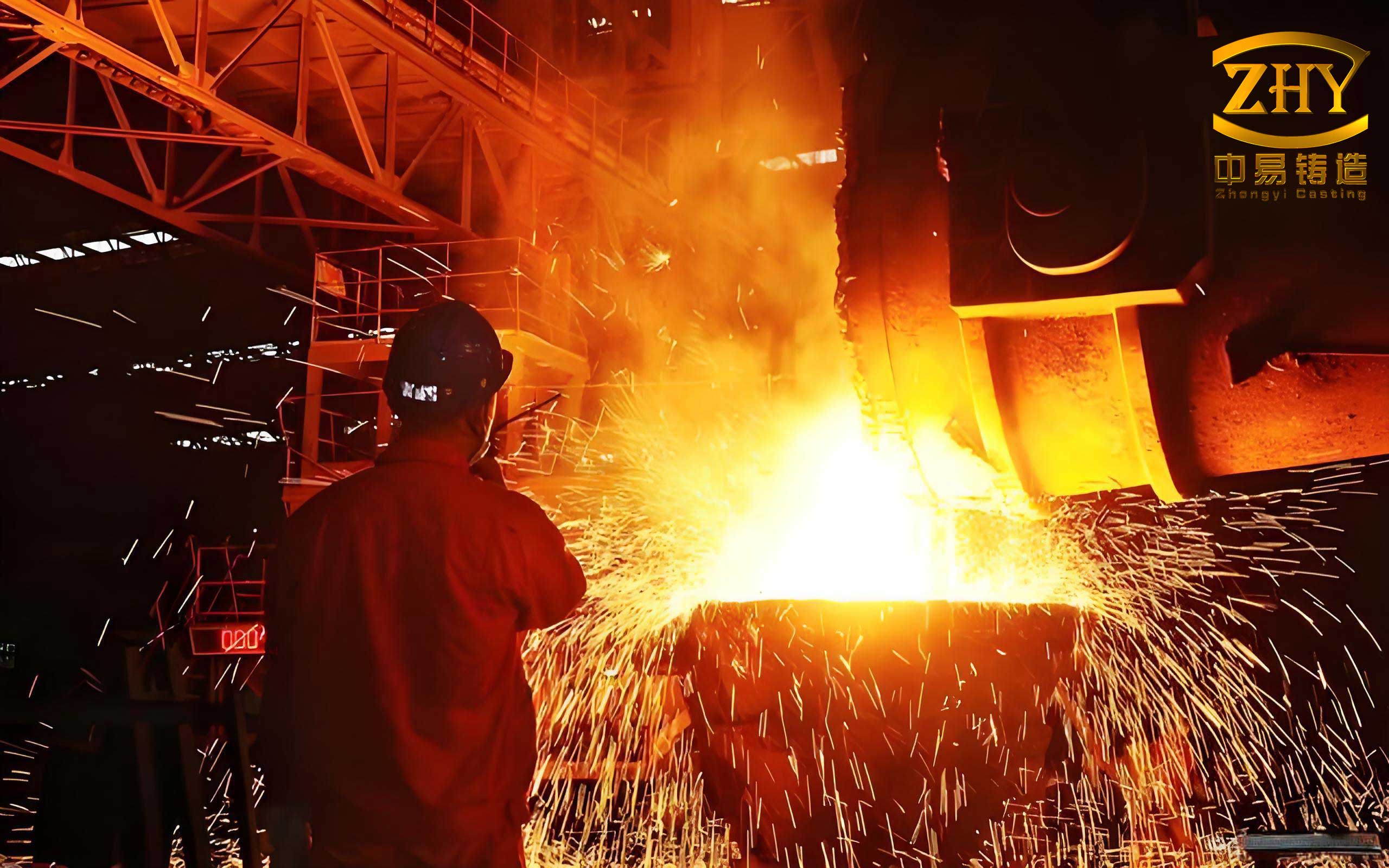
Looking ahead, wind power casting parts face several challenges and opportunities. Enhancing material performance is paramount; for instance, reducing harmful elements like phosphorus and sulfur in molten iron can improve the purity and toughness of casting parts. Research into the mechanisms of chunk graphite formation in thick-section casting parts is ongoing, aiming to develop long-lasting inoculants tailored for these applications. Process innovation, including optimized melting and heat treatment, can minimize defects and residual stresses in casting parts, ensuring uniformity. The table below outlines future development directions for ductile iron in wind power casting parts, summarizing key focus areas.
| Challenge | Development Direction | Impact on Casting Parts |
|---|---|---|
| Material Performance | Increase strength and toughness through microalloying and nano-additives | Extended lifespan and reliability of casting parts in harsh environments |
| Process Optimization | Implement advanced cooling techniques and real-time monitoring | Reduced defects and improved consistency in casting parts production |
| Green Manufacturing | Lower energy consumption and promote recycling in foundries | Sustainable production of casting parts with reduced environmental footprint |
| Large-Scale Production | Automate processes for thick-section casting parts manufacturing | Cost-effective and high-volume output of critical casting parts |
Green manufacturing and sustainability are increasingly important for wind power casting parts. Reducing energy use and emissions during production aligns with global environmental goals, making casting parts more eco-friendly. The life-cycle assessment (LCA) of casting parts can be modeled to evaluate their environmental impact, with formulas like:
$$LCA = \sum_{i} (E_i \cdot CF_i)$$
where $E_i$ is energy input at stage $i$, and $CF_i$ is the carbon footprint factor. This drives innovation toward greener casting parts.
In conclusion, the future of ductile iron for wind power casting parts hinges on interdisciplinary advancements in metallurgy, processing, and sustainability. As wind turbines grow larger and more efficient, the demand for high-performance casting parts will only intensify. By leveraging alloy design, trace element control, and innovative treatment methods, we can overcome current limitations and produce casting parts that meet the rigorous standards of the wind energy industry. My perspective, rooted in years of study, affirms that continuous research and collaboration are essential to advancing these critical casting parts, ensuring they contribute reliably to our renewable energy future. The journey of optimizing wind power casting parts is ongoing, and I am confident that with focused efforts, we will achieve new milestones in material science and engineering for casting parts.