
In the shipbuilding industry, casting parts are critical components that directly influence structural integrity, hydrodynamic performance, and overall construction precision. Traditionally, the design of complex linear casting parts—such as stern shaft hubs and anchor mouths—has relied on manual lofting in CAD software, which is labor-intensive, error-prone, and lacks three-dimensional visualization. This approach often leads to significant inaccuracies, requiring excessive allowances and rework during production. In my experience, these limitations have hindered efficiency and increased costs. To address this, I have explored the use of Rhino, a powerful 3D modeling software, for the production design of casting parts. This article discusses a novel methodology that leverages Rhino for fine modeling, integrated design with hull structures, and the generation of fabrication drawings and inspection templates. Through practical applications on bulk carriers, I have demonstrated how this approach enhances accuracy, reduces material waste, and streamlines the manufacturing process for casting parts.
The core challenge lies in the intricate geometries of casting parts, which must conform to the ship’s hull lines. Domestic ship design software often lacks advanced surface modeling capabilities, making it difficult to create accurate 3D models of casting parts. Rhino, with its robust NURBS-based surface tools, offers a solution. My workflow begins by importing hull lines—such as waterlines, frame lines, and buttock lines—from the ship’s lines plan into Rhino. This ensures that the casting part’s external shape aligns perfectly with the hull’s curvature. For instance, when designing a stern shaft hub casting part, I extract the aft section lines to establish a reference framework. The imported lines form a 3D wireframe that serves as the basis for surface generation, as visualized below:
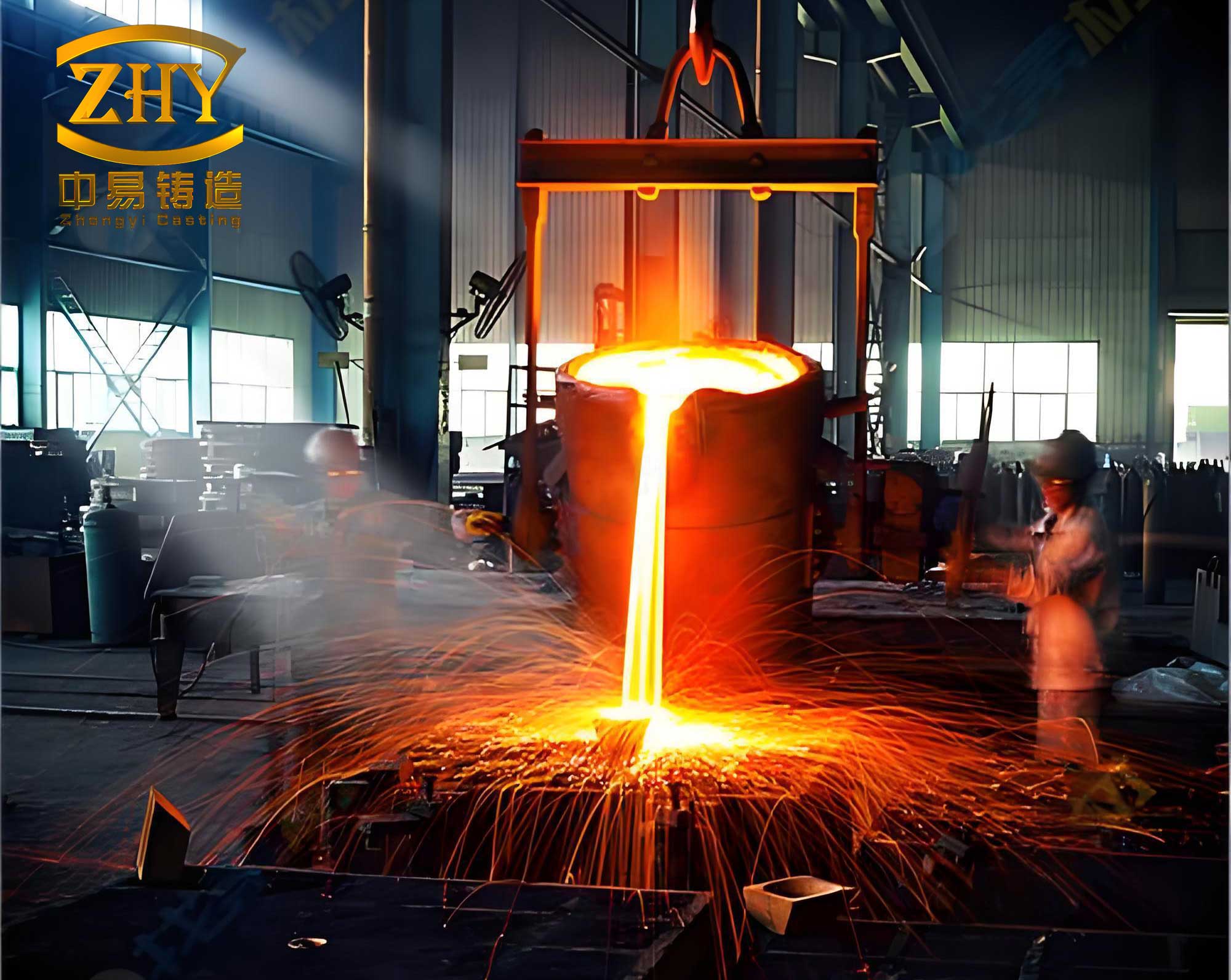
This image illustrates the complexity of steel casting parts, highlighting the need for precise modeling. Using Rhino, I then construct surfaces through commands like Loft, Sweep, and NetworkSrf. The key is to ensure surface continuity and smoothness, which are vital for hydrodynamic efficiency. For example, the external shell of a casting part can be represented as a parametric surface: $$ \mathbf{S}(u,v) = \left[ x(u,v), y(u,v), z(u,v) \right] $$ where \( u \) and \( v \) are parameters defining the surface. By adjusting control points and knots, I achieve a G2 continuity (curvature continuous) surface, reducing stress concentrations. Internal structures, such as ribs and openings, are modeled using Boolean operations and surface trimming. To validate the model, I perform multiple sectional cuts at arbitrary angles, comparing them with detailed design drawings. This process eliminates guesswork and ensures the casting part meets all specifications.
Fine modeling of casting parts involves refining local details to prevent stress risers and improve manufacturability. Rhino’s tools allow for precise corrections. For instance, when two surfaces intersect at an awkward angle, I use the BlendSrf command to create a smooth transition. The blend surface can be mathematically described as a weighted combination: $$ \mathbf{B}(t) = (1-t)^3 \mathbf{P}_0 + 3(1-t)^2 t \mathbf{P}_1 + 3(1-t) t^2 \mathbf{P}_2 + t^3 \mathbf{P}_3 $$ where \( \mathbf{P}_i \) are control points derived from the original surfaces. Additionally, fillets and chamfers are applied to edges, with radii calculated based on structural requirements. The table below summarizes key modeling techniques for casting parts:
| Modeling Technique | Rhino Command | Application in Casting Part Design | Mathematical Basis |
|---|---|---|---|
| Surface Lofting | Loft | Creating external hull from curves | NURBS interpolation: $$ \mathbf{C}(t) = \sum_{i=0}^n N_{i,p}(t) \mathbf{P}_i $$ |
| Surface Blending | BlendSrf | Smoothing intersections between surfaces | Bezier or B-spline blending |
| Fillet Creation | FilletSrf | Adding radii to edges for stress reduction | Circular arc approximation: $$ r = \frac{\|\mathbf{T}_1 \times \mathbf{T}_2\|}{\|\mathbf{T}_1 – \mathbf{T}_2\|} $$ |
| Surface Trimming | Trim | Cutting openings for internal structures | Parametric domain subdivision |
| Curvature Analysis | CurvatureGraph | Checking surface smoothness | Gaussian curvature: $$ K = \frac{LN – M^2}{EG – F^2} $$ |
Once the casting part model is complete, integrating it with the hull structure is crucial for seamless assembly. In my projects, I use SPD software for hull design and Rhino for casting parts. The integration involves exporting the Rhino model as an IGES or STEP file and importing it into SPD. This allows for a unified 3D environment where interferences and mismatches can be detected early. The integrated design process ensures that the casting part aligns with adjacent plates and stiffeners, minimizing on-site adjustments. For example, the connection between a stern shaft hub casting part and the hull plate requires precise allowance allocation. I calculate allowances based on thermal expansion and welding shrinkage using the formula: $$ A = \alpha L \Delta T + \beta W $$ where \( A \) is the total allowance, \( \alpha \) is the coefficient of thermal expansion, \( L \) is the length, \( \Delta T \) is the temperature change, \( \beta \) is the welding shrinkage factor, and \( W \) is the weld volume. The table below outlines the integrated design workflow:
| Step | Action | Tool Used | Outcome for Casting Part |
|---|---|---|---|
| 1 | Extract hull lines from ship database | SPD/Rhino | Reference curves for casting part surface |
| 2 | Model casting part in Rhino | Rhino | 3D NURBS model with fine details |
| 3 | Export casting part model | Rhino (IGES export) | Neutral file for integration |
| 4 | Import into hull structure model | SPD | Unified assembly check |
| 5 | Verify connections and allowances | SPD/Rhino | Optimized joint designs |
| 6 | Generate joint details (e.g., weld prep) | Rhino/SPD | Accurate坡口 (groove) specifications |
This holistic approach ensures that the casting part is not an isolated component but an integral part of the hull, reducing rework and improving fit-up accuracy. In one case, the integration revealed a misalignment in an anchor mouth casting part, which was corrected digitally before fabrication, saving weeks of potential delays.
Producing fabrication drawings and inspection templates for casting parts is streamlined with Rhino. Traditionally, 2D drawings were created manually, requiring numerous sectional views. With Rhino, I can generate any section plane instantly. For an anchor mouth casting part, I define key planes based on the anchor chain pipe’s centerline angles—horizontal and vertical relative to the ship’s baseline. Using the Section command, I obtain contour lines at each plane, which are then flattened into 2D profiles for the drawing. The sectional profiles can be represented as polyline approximations: $$ \mathbf{P}_i = \{ (x_1, y_1), (x_2, y_2), \dots, (x_n, y_n) \} $$ for the \( i \)-th section. These profiles are compiled into a composite view, showing all critical dimensions. Additionally, I add auxiliary sections at equal angular intervals to provide more data for quality control. The drawing includes tolerances, material specifications, and welding symbols, all derived from the 3D model. For inspection, I design templates that match the casting part’s profiles. These templates, often made from wood or plastic, are used to verify the as-cast geometry. The deviation \( \delta \) between the template and the casting part is measured: $$ \delta = \max \| \mathbf{P}_{\text{template}} – \mathbf{P}_{\text{casting}} \| $$ where \( \mathbf{P} \) denotes profile points. If \( \delta \) exceeds a threshold (e.g., 2 mm), the casting part is reworked. The table below compares traditional and Rhino-based methods for casting part documentation:
| Aspect | Traditional Manual Lofting | Rhino-Based 3D Modeling | Improvement for Casting Part |
|---|---|---|---|
| Time for drawing creation | 40-50 hours per complex part | 10-15 hours with automated sections | 70% reduction |
| Accuracy of profiles | ±5 mm due to manual interpolation | ±1 mm from precise surface cuts | Enhanced precision |
| Number of sections | Limited to key views (e.g., 3-5) | Unlimited sections at any angle | Comprehensive coverage |
| Inspection template design | Separate manual process | Direct export from model profiles | Faster and more accurate |
| Revision ease | Redraw entire sections | Update model and regenerate views | Minimized rework |
The practical application of this methodology has yielded significant benefits in real ship projects. For instance, on a 120,000 DWT bulk carrier, the stern shaft hub casting part was modeled in Rhino and integrated with the hull. Previously, allowances for the connecting hull plates were 80-100 mm due to uncertainties. With the precise 3D model, allowances were reduced to 30-50 mm, calculated using the formula: $$ A_{\text{new}} = k \cdot \sqrt{L^2 + W^2} $$ where \( k \) is a safety factor (typically 1.2), and \( L \) and \( W \) are the dimensions from the model. This reduction saved over 20% in steel weight for the affected areas. Moreover, welding preparations, such as groove angles, were designed directly from the integrated model. The groove angle \( \theta \) for a butt joint is determined by: $$ \theta = 2 \cdot \arctan\left( \frac{t}{2d} \right) $$ where \( t \) is the plate thickness and \( d \) is the root gap. By specifying these details in the drawing, onsite welding quality improved, with fewer defects. The table below quantifies the improvements observed in casting part installation:
| Performance Metric | Before Rhino Implementation | After Rhino Implementation | Change |
|---|---|---|---|
| Allowance for hull plates (mm) | 80-100 | 30-50 | 50-60% reduction |
| On-site cutting length (meters) | 40+ | 10-15 | 60-75% reduction |
| Fit-up time (hours) | 24-30 | 8-12 | 65% reduction |
| Weld rework rate | 15% | 5% | 67% improvement |
| Overall cost per casting part | High due to rework | Lower with optimized material | 20-30% savings |
These results underscore the value of using Rhino for casting part design, not only in accuracy but also in economic and time efficiencies. The software’s ability to output various formats (e.g., OBJ, STL) also facilitates collaboration with foundries, who can use the data for pattern making and CNC machining.
The software application effects are multifaceted. Firstly, 3D modeling of complex linear casting parts eliminates the inaccuracies of manual lofting. Secondly, drawing production becomes faster and more adaptable to changes. Thirdly, integrated design with hull structures ensures seamless assembly. Fourthly, arbitrary sectioning provides rich data for inspection and quality assurance. Lastly, Rhino’s compatibility with other systems enables a digital thread from design to manufacturing. To summarize, the advantages can be expressed in a holistic equation: $$ \text{Total Benefit} = \sum_{i=1}^n \left( \Delta \text{Accuracy}_i + \Delta \text{Efficiency}_i \right) $$ where \( n \) represents the various stages of casting part production. Each stage benefits from the digital model, reducing cumulative errors.
In conclusion, the adoption of Rhino software for the production design of complex linear casting parts represents a paradigm shift in shipbuilding. By enabling fine 3D modeling, integrated design, and precise documentation, it addresses longstanding challenges in casting part fabrication. My experience shows that this approach not only enhances geometric accuracy but also reduces material waste, shortens construction cycles, and improves overall quality. As the industry moves towards digitalization, tools like Rhino will become indispensable for optimizing casting part design and ensuring competitive advantage. Future work could explore automation scripts in Rhino to further streamline the process, but the current methodology already offers a robust framework for advanced casting part production.