
In the modern manufacturing industry, the precision of casting parts is critical for ensuring product quality, reducing machining costs, and enhancing efficiency. As a key component in diesel engines, the wet cylinder liner engine block is a complex casting part that requires high dimensional accuracy. In this study, we analyze the factors affecting the precision of such casting parts, including shrinkage rate, anti-deformation technology, and core assembly methods. Through optimization, we aim to improve the consistency and accuracy of casting parts, which is essential for mass production. The casting part, being a fundamental element in engine assembly, must meet stringent tolerances to avoid issues in downstream processes.
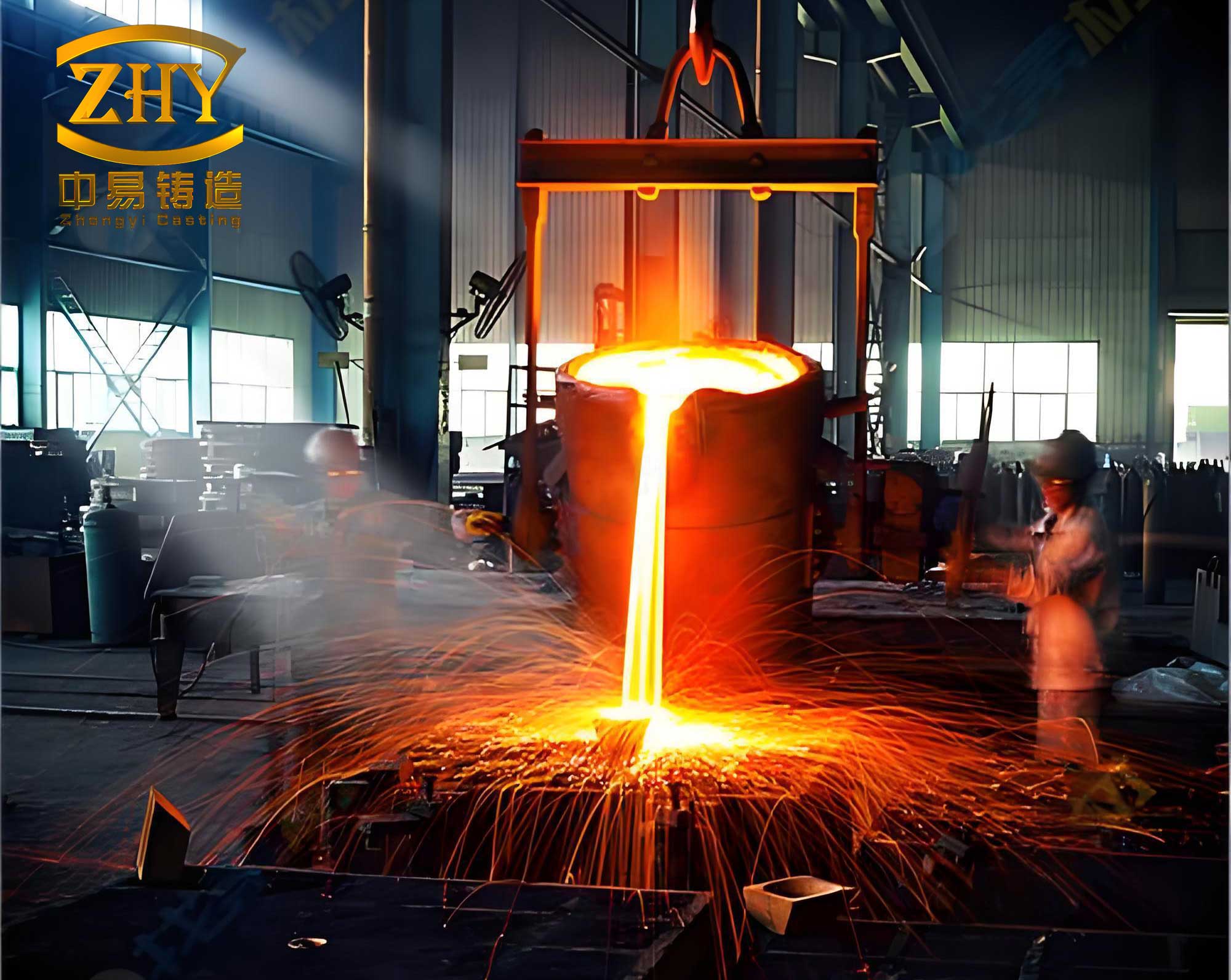
The casting part for a wet cylinder liner engine block typically involves intricate geometries, such as integrated gear chambers and oil passages, making precision control challenging. In our production line, we use a vertical core assembly and horizontal pouring process, with one casting part per mold. The core assembly includes multiple cores, such as cylinder cores, front and rear end cores, water jacket cores, tappet cores, oil passage cores, and cover plate cores. These are assembled as a whole, coated, and fastened with bolts. However, initial inspections revealed significant dimensional inconsistencies in the casting part, leading to excessive machining allowances and increased tool wear. This study delves into the root causes and proposes solutions to enhance the precision of this critical casting part.
The precision of a casting part is influenced by various factors during the casting process. Shrinkage rate is a primary factor, as it determines the dimensional relationship between the mold and the final casting part. The shrinkage rate depends on the material properties, casting geometry, and process conditions. For our casting part, we observed that different sections exhibited varying shrinkage behaviors, leading to deviations in key dimensions. For instance, the water jacket and tappet cores showed different shrinkage rates compared to the main core assembly. This inconsistency can be modeled using the shrinkage formula:
$$ S = \frac{L_m – L_c}{L_c} \times 100\% $$
where \( S \) is the shrinkage rate, \( L_m \) is the mold dimension, and \( L_c \) is the casting part dimension. In our case, the initial shrinkage rates were set at 1% for most cores and 1.1% for specific areas, but analysis indicated that a uniform adjustment could improve accuracy. The casting part’s dimensional stability is crucial, and optimizing shrinkage is a key step.
Another critical factor is anti-deformation technology. During pouring, the thermal expansion of molten iron causes core deformation, known as “swelling,” which affects the casting part’s dimensions. This deformation is non-uniform, with greater swelling in the central regions due to constraints. To compensate, we employ anti-deformation techniques by pre-distorting the core assembly in the opposite direction. The deformation can be approximated by a beam bending model:
$$ \delta = \frac{F L^3}{3 E I} $$
where \( \delta \) is the deflection, \( F \) is the thermal force, \( L \) is the length, \( E \) is the modulus of elasticity, and \( I \) is the moment of inertia. By applying a reverse deformation, we can offset the swelling and achieve a more accurate casting part. This approach requires precise calculation based on historical data and simulation.
The core assembly method also significantly impacts the precision of the casting part. Initially, the core assembly was fastened with a single bolt at the center, leading to inadequate rigidity and deformation during handling, coating, and pouring. This resulted in dimensional variations, especially in the skirt areas of the cylinders. To address this, we redesigned the assembly by adding fastening points, such as at the camshaft and between the cover plate and end cores. This enhanced the stiffness of the core assembly, reducing deformation and improving the consistency of the casting part. The improved assembly can be analyzed using structural mechanics principles, ensuring that the casting part meets design specifications.
To quantify the impact of these factors, we conducted measurements on multiple casting parts using 3D scanning and compared them with design models. The data revealed deviations in key dimensions, such as distances between cylinder bores and tappet holes. For example, the water jacket core spacing showed an average deviation of 1.39 mm from the theoretical value, while the tappet core spacing deviated by 1.29 mm. These inconsistencies highlighted the need for optimization. The following table summarizes the initial deviations observed in the casting part:
| Measurement Location | Average Measured Value (mm) | Theoretical Value (mm) | Deviation (mm) |
|---|---|---|---|
| Water Jacket Core Spacing (1-6) | 723.61 | 725.00 | -1.39 |
| Tappet Core Spacing (2-5) | 435.71 | 437.00 | -1.29 |
| Cylinder Bore Spacing (1-2) | 148.74 | 149.00 | -0.26 |
| Cylinder Bore Spacing (3-4) | 148.31 | 149.00 | -0.69 |
Based on this analysis, we implemented several optimizations to improve the precision of the casting part. First, we adjusted the shrinkage rate for auxiliary cores, such as water jacket and tappet cores, to a uniform 1.1% across all sections. This change was based on the observation that the upper and lower templates, with a 1.1% shrinkage rate, produced more accurate dimensions. The shrinkage adjustment can be expressed as:
$$ L_m = L_c \times (1 + S) $$
where \( L_m \) is the mold dimension, \( L_c \) is the desired casting part dimension, and \( S \) is the optimized shrinkage rate. For our casting part, this adjustment reduced deviations in critical features.
Second, we redesigned the core assembly method to enhance rigidity. Instead of a single central bolt, we added fastening at the camshaft location and between the cover plate and end cores. This multi-point fastening system distributes loads more evenly, minimizing deformation during processing. The improved assembly’s stiffness can be modeled as a series of springs in parallel, increasing the overall resistance to deformation. This ensures that the casting part maintains its shape throughout the casting cycle.
Third, we applied anti-deformation technology by incorporating a reverse deformation in the core design. Based on historical swelling data, we pre-distorted the core assembly opposite to the expected thermal expansion. This compensation technique is crucial for achieving net-shape casting parts. The anti-deformation amount \( \Delta \) can be calculated as:
$$ \Delta = k \cdot \delta_{max} $$
where \( k \) is a compensation factor derived from empirical data, and \( \delta_{max} \) is the maximum observed deformation. For our casting part, we used a factor of 0.8 to 1.2, depending on the section, to optimize the casting part’s final dimensions.
After implementing these optimizations, we validated the improvements through multiple batches of core production, assembly, and casting. The results showed significant enhancements in the precision of the casting part. For the water jacket cores, the sand core dimensions were measured using 3D scanning, and the data indicated closer alignment with theoretical values. The following table presents the sand core measurements after optimization:
| Core Type | Measurement Location | Average Measured Value (mm) | Theoretical Value (mm) | Deviation (mm) |
|---|---|---|---|---|
| Water Jacket Core | Cylinder Bore Spacing (1-2) | 150.50 | 150.58 | -0.08 |
| Water Jacket Core | Cylinder Bore Spacing (3-4) | 150.46 | 150.58 | -0.12 |
| Water Jacket Core | Overall Spacing (1-6) | 732.51 | 732.92 | -0.41 |
| Tappet Core | Spacing (2-5) | 441.89 | 441.75 |
For the final casting part, we scanned machined engine blocks to evaluate the dimensional accuracy. The water jacket core spacing in the casting part showed an average value of 724.76 mm, compared to the theoretical 724.00 mm, reducing the deviation from 1.39 mm to 0.76 mm. Similarly, the tappet core spacing averaged 436.76 mm versus 437.00 mm, cutting the deviation from 1.29 mm to 0.24 mm—an improvement of over 80%. These results demonstrate that the optimizations effectively enhanced the precision of the casting part. The casting part’s consistency across multiple units also improved, as shown in the table below for machined casting parts:
| Casting Part Feature | Average Measured Value (mm) | Theoretical Value (mm) | Deviation (mm) | Improvement (%) |
|---|---|---|---|---|
| Water Jacket Core Spacing | 724.76 | 724.00 | +0.76 | 45.3 |
| Tappet Core Spacing | 436.76 | 437.00 | 81.4 | |
| Cylinder Skirt Deviation (3-4) | 1.56 | 0.00 | 22.5 | |
| Cylinder Skirt Deviation (2-5) | 1.12 | 0.00 | 35.0 |
The improvement in the casting part’s precision can be attributed to the synergistic effects of shrinkage rate optimization, anti-deformation technology, and enhanced core assembly. Shrinkage rate adjustments ensure that the mold dimensions accurately account for material contraction, which is vital for producing a precise casting part. The anti-deformation technology compensates for thermal distortions, a common issue in casting parts with complex geometries. Meanwhile, the redesigned core assembly method provides greater stability, reducing handling-induced variations. Together, these measures address the root causes of dimensional inaccuracies in the casting part.
To further analyze the impact, we can model the overall precision gain using a composite error reduction formula. The total error \( E_{total} \) in a casting part can be expressed as the sum of individual error contributions from shrinkage, deformation, and assembly:
$$ E_{total} = E_s + E_d + E_a $$
where \( E_s \) is the shrinkage error, \( E_d \) is the deformation error, and \( E_a \) is the assembly error. After optimization, each component is reduced. For shrinkage, the error reduction \( \Delta E_s \) is given by:
$$ \Delta E_s = |S_{old} – S_{new}| \times L $$
where \( S_{old} \) and \( S_{new} \) are the old and new shrinkage rates, and \( L \) is the characteristic length. For our casting part, with \( L \approx 1000 \) mm, the reduction is significant. Deformation error reduction \( \Delta E_d \) is achieved through anti-deformation, modeled as:
$$ \Delta E_d = \delta_{max} \times (1 – C) $$
where \( C \) is the compensation efficiency, typically 0.7 to 0.9 for our process. Assembly error reduction \( \Delta E_a \) comes from increased stiffness, which can be quantified by the reduction in deflection under load. The cumulative effect leads to a more precise casting part.
In addition to dimensional accuracy, the optimization also benefits the overall quality of the casting part. Reduced deviations mean lower machining allowances, which decreases material waste and tool wear. This is economically advantageous for mass production of casting parts. Moreover, the improved consistency enhances the reliability of the casting part in engine assembly, reducing the risk of fit issues or performance degradation. The casting part, as a critical component, must meet high standards, and our improvements contribute to that goal.
The success of these optimizations has led to their application in other casting parts within our production line. For instance, similar wet cylinder liner engine blocks and other complex casting parts have benefited from adjusted shrinkage rates and enhanced assembly methods. This scalability underscores the importance of a systematic approach to precision improvement in casting parts. Future work could involve advanced simulations to predict shrinkage and deformation more accurately, further refining the casting part’s dimensions.
In conclusion, the precision of wet cylinder liner engine block casting parts is influenced by multiple factors, including shrinkage rate, anti-deformation technology, and core assembly methods. Through careful analysis and optimization, we have demonstrated significant improvements in dimensional accuracy and consistency. The casting part’s deviations were reduced by adjusting shrinkage to 1.1%, implementing anti-deformation compensation, and redesigning the core assembly for greater rigidity. These changes have not only enhanced the casting part’s quality but also reduced machining costs and improved production efficiency. As the demand for high-precision casting parts grows, such optimizations are essential for maintaining competitiveness in the manufacturing industry.
Our findings highlight that a holistic approach, combining empirical data with theoretical models, is key to advancing casting part precision. The casting part, as a fundamental element in many mechanical systems, deserves continuous improvement efforts. We recommend ongoing monitoring and adaptation of these techniques to other casting parts, ensuring that quality standards are consistently met. The journey toward perfecting the casting part is ongoing, but with these strategies, we are well-positioned to achieve higher levels of accuracy and reliability.