
In my years of specializing in metal mold casting, I have tackled numerous complex components, but few are as illustrative of the technique’s demands and potential as a particular oil-water separator housing. This component, a critical part for heavy-duty diesel engines, is a quintessential example of a precision shell casting. Manufactured from cast aluminum alloy with a net weight of approximately 2 kg, its successful production hinges on a meticulously designed metal mold process. The journey from blueprint to sound casting involves overcoming significant challenges related to geometry, thermal management, and dimensional accuracy, all hallmarks of high-quality shell castings.
The component’s geometry, as shown below, presents the primary challenges. It is fundamentally a truncated cone shape adorned with six concentric cooling fins. Each fin has a draft angle of 1.5° to facilitate extraction from the mold, with a maximum height of 30 mm. The main body wall is a thin 4 mm. Internally, eight evenly spaced ribs, 10 mm in height and 3 mm in width, run longitudinally. Only the two end faces are machined; all other surfaces, including the intricate fins and internal passages, are as-cast. This defines it as a true net-shape or near-net-shape shell casting.
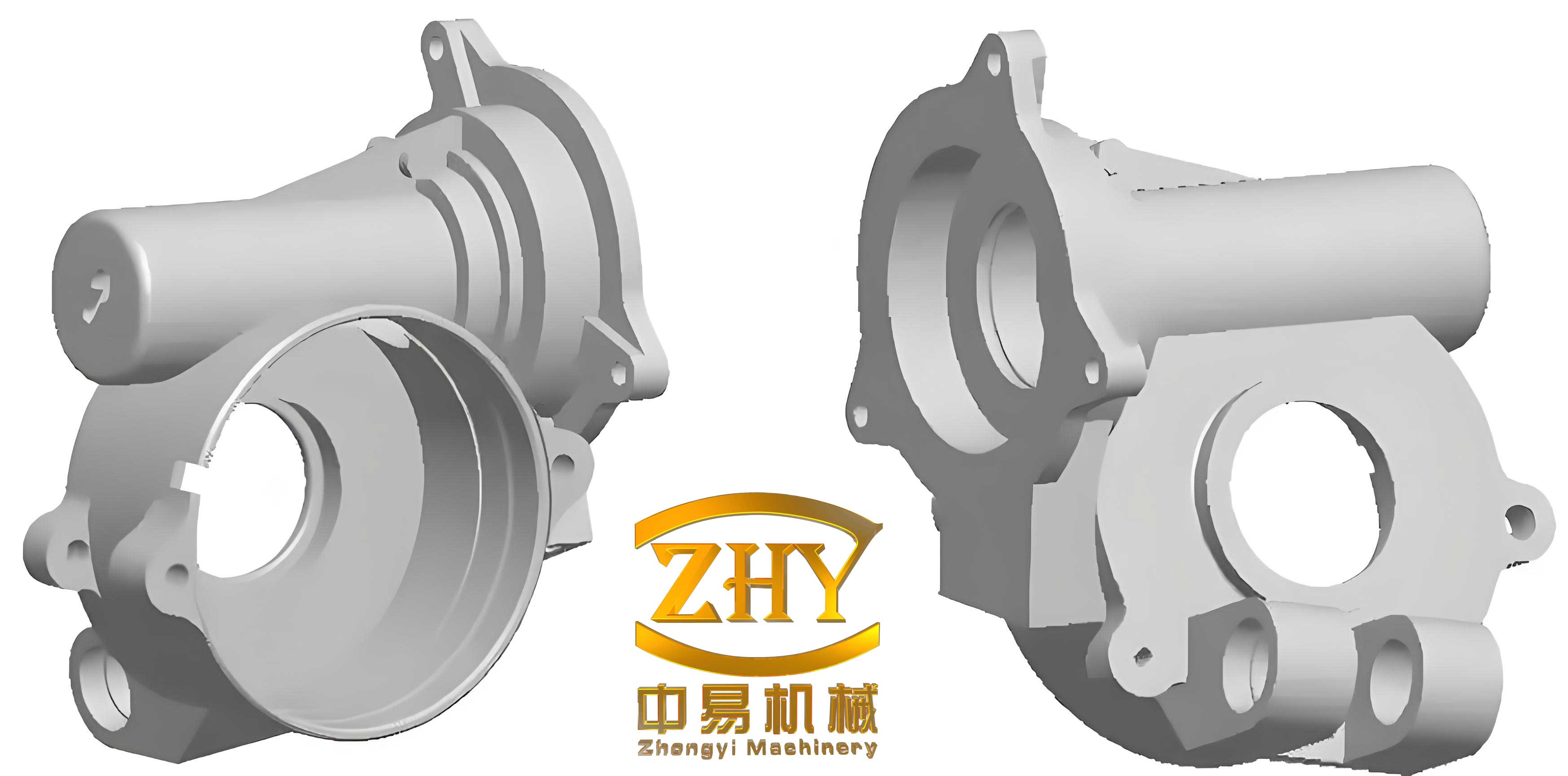
The technical requirements are stringent. The casting must be free from shrinkage cavities, slag inclusions, cracks, and porosity. The microstructure must be dense, without severe segregation or the presence of coarse, detrimental intermetallic phases like needle-shaped iron-aluminum or iron-aluminum-silicon compounds. Dimensional tolerance for the internal cavity is tight, not exceeding ±0.5 mm. Finally, it must pass a pressure test without leakage, a direct testament to the integrity achievable with well-executed metal mold shell castings.
Process Design: The Foundation of Quality Shell Castings
To achieve the necessary precision and facilitate mechanized core pulling, a vertical parting plane was selected for the metal mold. This decision is crucial for the consistent production of such shell castings. The key process parameters were derived from empirical knowledge and calculations specific to aluminum alloys in metal molds.
The machining allowance is not uniform; the bottom requires 2.5 mm, while the top is increased to 6 mm to account for potential shrinkage and to create a feed head. Determining the correct casting shrinkage is critical for dimensional accuracy. For metal molds, the alloy’s contraction is counteracted by the expansion of the hot mold itself. The effective shrinkage varies by direction. The linear contraction in the horizontal direction is approximately 0.6%, while in the vertical direction it is about 1.0% due to different constraints. A “parting negative” or crush allowance of 0.2 mm is applied to account for mold closure. Core design requires careful calculation of its final dimensions, factoring in both alloy shrinkage and the core’s own thermal expansion. The core head height totals 25 mm, with a cylindrical fit having a clearance of 0.4 mm (mold: +0.2 mm, core: -0.2 mm).
| Parameter | Value / Specification | Remarks |
|---|---|---|
| Parting Line | Vertical | Facilitates core pulling and mold opening. |
| Machining Allowance (Bottom/Top) | 2.5 mm / 6.0 mm | Top allowance acts as a riser. |
| Linear Shrinkage (Horizontal) | 0.6% | $$L_{mold, H} = L_{part} \times (1 + 0.006)$$ |
| Linear Shrinkage (Vertical) | 1.0% | $$L_{mold, V} = L_{part} \times (1 + 0.010)$$ |
| Parting Negative | 0.2 mm | Compensation for mold closure. |
| Core Head Clearance | 0.4 mm total | Mold: +0.2 mm, Core: -0.2 mm. |
The gating system is designed with principles similar to sand casting, but with a drastically reduced pouring time to match the rapid heat extraction of the metal mold. For a vertical parting, the molten metal meniscus rise speed in the cavity should not be less than 2 cm/s to prevent mist runs and cold shuts on the thin fins. A serpentine sprue with a diameter of φ1.6 cm was chosen. The total cross-sectional area of the ingates must exceed that of the downsprue to ensure proper filling. Strategic use of the serpentine channel provides directional solidification towards localized hot spots (bosses), with the upper section of the sprue near the flange acting as an annular riser 4 cm in height. This controlled feeding is essential for producing sound, dense shell castings.
Metal Mold and Core Design: Engineering the Tooling
The mold body is constructed from ordinary gray iron, a material with good thermal conductivity, castability, and resistance to thermal fatigue. The wall thickness is determined by an empirical rule of thumb for shell castings: the mold wall thickness should be 1.2 to 2 times the casting’s wall thickness. For our 4 mm casting wall, a mold thickness of 20 mm (2 cm) was selected.
$$ \delta_{mold} \approx (1.2 \text{ to } 2.0) \times \delta_{casting} = 2 \times 4 \text{ mm} = 8 \text{ mm minimum}$$
We selected a more robust 20 mm for durability and thermal mass control.
A critical feature for this finned shell casting is venting. To prevent air entrapment at the tips of the cooling fins—a common cause of misruns—multiple vent plugs are placed around the perimeter of each fin level in the mold halves. These tiny vents allow air to escape while preventing metal penetration.
The internal metal core is the key to forming the complex inner cavity. Its dimensions are not simply the inverse of the part; they must account for a compounded thermal effect. The final dimension of a hole in the casting is a function of the alloy’s solidification shrinkage and the core’s thermal expansion during the process. The required contraction allowance for the core ($$ \epsilon_{core}$$) is calculated as:
$$ \epsilon_{core} = \epsilon_{alloy} – \alpha_{steel} \cdot \Delta T $$
Where:
$$ \epsilon_{alloy}$$ is the free contraction of the aluminum alloy (~1.2%),
$$ \alpha_{steel}$$ is the linear thermal expansion coefficient of the steel core (~12 x 10⁻⁶ /°C),
$$ \Delta T$$ is the temperature rise of the core during casting (e.g., 300°C).
$$ \epsilon_{core} \approx 0.012 – (12 \times 10^{-6} \times 300) \approx 0.012 – 0.0036 = 0.0084 \text{ or } 0.84\% $$
Therefore, the core must be made smaller than the nominal hole size to compensate for its own expansion and the alloy’s shrinkage. Finally, a coating thickness (typically 0.1-0.2 mm) must be subtracted from the core’s working surfaces. The final core dimension formula is:
$$ D_{core} = [D_{part} \times (1 – \epsilon_{core}) – 2 \cdot t_{coating}] \pm \Delta $$
Where $$ D_{part}$$ is the part’s nominal internal diameter, $$ t_{coating}$$ is the coating thickness (e.g., 0.15 mm), and $$ \Delta$$ is the manufacturing tolerance (±0.1 mm). This precise calculation is fundamental for achieving the tight ±0.5 mm internal tolerance required for this shell casting.
Overcoming Defects in Shell Castings
The production of thin-walled, finned shell castings like this separator is prone to specific defects if the process is not perfectly tuned. Based on my experience, the primary challenges and solutions are:
| Defect | Root Cause | Corrective Action |
|---|---|---|
| Misruns on Fins | Insufficient metal velocity/feed; trapped air. | Optimize gating for >2 cm/s rise speed; install vent plugs at fin tips. |
| Shrinkage Porosity in Thick Sections | Inadequate directional solidification. | Use chills on mold adjacent to thick bosses; design gating to act as a thermal gradient. |
| Hot Tearing at Rib Junction | High thermal stress during contraction, constrained by the core. | Ensure core coating has excellent lubricity; slightly increase fillet radii; control mold temperature to reduce thermal shock. |
| Dimensional Inaccuracy | Incorrect shrinkage allowance or core expansion calculation. | Recalibrate $$ \epsilon_{core}$$ formula based on measured castings; maintain consistent coating thickness. |
Broader Principles and Applications
The methodology applied to this oil-water separator is broadly applicable to a wide range of metal mold shell castings. The core tenets remain: understanding the thermal interaction between the mold, the core, and the solidifying alloy. The mold acts as a powerful heat sink, promoting rapid solidification that yields finer microstructures and improved mechanical properties compared to many sand castings. This makes it ideal for high-integrity shell castings in automotive, aerospace, and hydraulic applications.
The design of the gating and feeding system is always a compromise between fast filling to avoid cold defects and controlled thermal gradients to promote soundness. For aluminum shell castings, the use of computerized solidification simulation has become an invaluable tool to visualize these gradients and optimize the placement of chills, vents, and risers before cutting metal for the mold.
Furthermore, the choice of mold and core materials extends beyond gray iron and steel. For higher volume production or more aggressive alloys, copper alloys or specially formulated cast irons with improved thermal fatigue resistance are used for mold inserts. The coatings applied to the mold and core surfaces are themselves a science, tailored to provide thermal insulation, lubricity for ejection, and a barrier against soldering between the aluminum and the iron mold.
Conclusion: The Art and Science of Shell Castings
Producing a high-quality, complex component like the oil-water separator housing is a testament to the precision and control offered by metal mold casting. It transcends mere copying of a shape; it is an engineered manipulation of solidification physics. Every parameter—from the calculated shrinkage allowance on the steel core to the placement of microscopic vent plugs—plays a critical role in determining the success of the shell casting.
The vertical parting, carefully calculated metal dimensions, and a gating system designed for both rapid filling and controlled feeding are all interlocking pieces of the puzzle. The result is a casting that meets stringent dimensional, microstructural, and pressure-tightness requirements directly from the mold, with minimal subsequent machining. This case study underscores that mastery in producing reliable shell castings lies in a deep understanding of materials science, heat transfer, and practical foundry engineering, blending empirical knowledge with calculated design to transform molten metal into precise, reliable components.