
In my extensive experience working with industrial components, I have found that the performance and longevity of casting parts are critically dependent on their microstructure, which is largely governed by heat treatment processes. As a materials engineer, I often emphasize that proper thermal and cryogenic treatments can transform the mechanical properties of casting parts, making them suitable for demanding applications such as mining machinery, automotive systems, and heavy equipment. This article delves into the various heat treatment techniques, their effects on casting parts, and how advanced methods like cryogenic treatment can optimize wear resistance and toughness. Throughout this discussion, I will focus on casting parts, a term I will repeatedly use to underscore their significance in engineering contexts. The goal is to provide a comprehensive guide that integrates theoretical insights with practical applications, supported by tables, formulas, and visual aids.
Casting parts are typically produced through processes like sand casting or investment casting, resulting in components with complex geometries. However, these parts often exhibit inherent issues such as microstructural inhomogeneity, residual stresses, and suboptimal mechanical properties. To address these challenges, heat treatment becomes an indispensable step. In my work, I have categorized heat treatments for casting parts into several key types, each serving specific purposes. Below is a table summarizing these heat treatment processes, their objectives, and typical applications for casting parts.
| Heat Treatment Type | Primary Objective | Typical Temperature Range | Effect on Casting Parts |
|---|---|---|---|
| Homogenization Annealing | To eliminate or reduce compositional segregation and improve uniformity | 1050-1200°C | Enhances chemical and microstructural homogeneity, stabilizes mechanical properties |
| Normalizing + Tempering | To refine grain structure through recrystallization and improve strength-toughness balance | Normalizing: 850-950°C; Tempering: 550-650°C | Increases strength and toughness, improves machinability of casting parts |
| Full Annealing | To stabilize dimensions, microstructure, and properties, enhancing ductility | 800-900°C | Reduces hardness and residual stresses, but may lower strength slightly |
| Quenching and Tempering (Hardening) | To achieve high comprehensive mechanical properties via martensitic transformation | Quenching: 800-900°C (oil/water); Tempering: 200-600°C | Significantly boosts strength and wear resistance, but requires careful stress management |
| Stress Relief Annealing | To remove internal stresses from casting, welding, or machining processes | 500-600°C (below prior tempering temperature) | Prevents distortion and cracking, ensures dimensional stability in casting parts |
From this table, it is evident that each heat treatment method targets specific flaws in casting parts. In my practice, I often combine these techniques to achieve desired outcomes. For instance, after homogenization annealing, casting parts may undergo normalizing and tempering to refine their grain structure. The effectiveness of these processes can be quantified using material science principles. For example, the Hall-Petch relationship describes how grain size affects yield strength in casting parts:
$$ \sigma_y = \sigma_0 + \frac{k}{\sqrt{d}} $$
where $\sigma_y$ is the yield strength, $\sigma_0$ is the friction stress, $k$ is the strengthening coefficient, and $d$ is the average grain diameter. This formula highlights that finer grains, achieved through treatments like normalizing, enhance the strength of casting parts. Similarly, wear resistance, a critical property for casting parts in abrasive environments, can be modeled using Archard’s wear equation:
$$ V = K \frac{F_n L}{H} $$
where $V$ is the wear volume, $K$ is the wear coefficient, $F_n$ is the normal load, $L$ is the sliding distance, and $H$ is the hardness. By optimizing heat treatment, the hardness and microstructure of casting parts can be tailored to minimize $K$, thereby extending service life.
In recent years, I have explored cryogenic treatment as an adjunct to conventional heat treatments for casting parts. Cryogenic treatment involves cooling components to extremely low temperatures, typically below -150°C, to promote microstructural transformations. Research on steels like 40CrNiMo suggests that cryogenic treatment can enhance the precipitation of fine carbides, improving wear resistance but potentially reducing impact toughness. This trade-off is crucial for casting parts subjected to dynamic loads. To illustrate, consider the effect of cryogenic treatment on the wear mechanisms of casting parts. The following table categorizes wear types and how cryogenic treatment influences them, based on studies of similar materials.
| Wear Type | Characteristics | Effect of Cryogenic Treatment on Casting Parts |
|---|---|---|
| Abrasive Wear | Material removal by hard particles or surfaces | Increases abrasive wear resistance due to finer carbide dispersion |
| Adhesive Wear | Material transfer between sliding surfaces | Reduces adhesive wear tendency by stabilizing microstructure |
| Oxidative Wear | Formation and removal of oxide layers | Minimal direct effect, but improved subsurface hardness may slow oxidation |
| Fatigue Wear | Crack propagation under cyclic stresses | Can exacerbate brittleness if not combined with proper tempering |
The microstructural changes induced by cryogenic treatment in casting parts can be described using phase transformation kinetics. For example, the formation of martensite and secondary carbides during cryogenic treatment follows an Avrami-type equation:
$$ f = 1 – \exp(-k t^n) $$
where $f$ is the transformed fraction, $k$ is a rate constant, $t$ is time, and $n$ is the Avrami exponent. This model helps predict how cryogenic treatment duration affects the microstructure of casting parts. Additionally, the impact of cryogenic treatment on toughness can be assessed through fracture mechanics. The fracture toughness $K_{IC}$ of casting parts is related to the stress intensity factor, and cryogenic treatment may alter it by changing the carbide morphology. In my observations, for casting parts used in low-temperature environments, such as polar applications, cryogenic treatment can be beneficial, but it must be optimized to avoid excessive embrittlement.
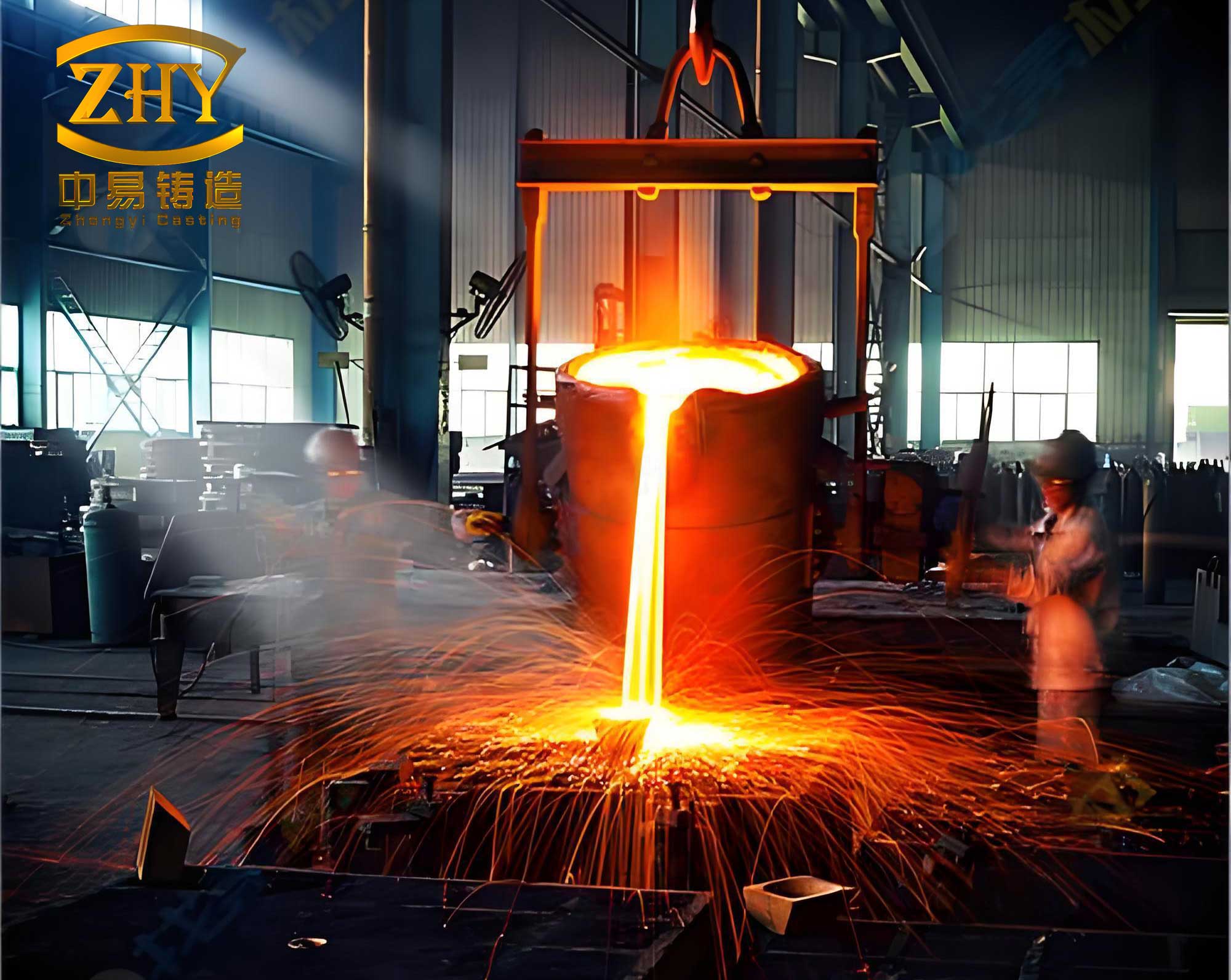
Visualizing casting parts aids in understanding their complexity and the importance of heat treatment. The image above showcases typical steel casting parts, highlighting their intricate shapes and surfaces that demand uniform properties. In my projects, I have applied heat treatment cycles to similar casting parts to ensure they meet specifications for mining equipment, where wear and impact resistance are paramount. For instance, after casting, parts undergo homogenization annealing to mitigate segregation, followed by normalizing and tempering to achieve a balance of strength and toughness. If enhanced wear resistance is required, cryogenic treatment is incorporated post-tempering. This integrated approach has proven effective in extending the lifespan of casting parts in abrasive environments.
To further elaborate on the mechanical properties of casting parts after heat treatment, I often use empirical formulas derived from testing. For example, the relationship between hardness $H$ and tensile strength $\sigma_u$ for casting parts made of low-alloy steels can be approximated as:
$$ \sigma_u \approx 3.5 \times H $$
where $H$ is in Brinell hardness (HB) and $\sigma_u$ is in MPa. This correlation helps in designing heat treatment protocols for casting parts to achieve target strength levels. Moreover, the impact energy $C_v$ of casting parts, which indicates toughness, is influenced by tempering temperature. A common model for tempering kinetics is the Hollomon-Jaffe equation:
$$ P = T (\log t + C) $$
where $P$ is the tempering parameter, $T$ is temperature in Kelvin, $t$ is time in hours, and $C$ is a constant. By adjusting $P$, the toughness of casting parts can be optimized without compromising hardness. In cases where casting parts are subjected to cyclic loading, fatigue strength $\sigma_f$ becomes critical. The Basquin equation describes high-cycle fatigue behavior:
$$ \sigma_a = \sigma_f’ (2N_f)^b $$
where $\sigma_a$ is the stress amplitude, $N_f$ is the number of cycles to failure, and $\sigma_f’$ and $b$ are material constants. Heat treatments like shot peening after stress relief annealing can improve $\sigma_f’$ for casting parts by introducing compressive residual stresses.
In the context of large casting parts, such as those used in wind turbines or marine engines, heat treatment logistics pose additional challenges. The size and mass of these casting parts necessitate controlled heating and cooling rates to avoid thermal stresses. I have developed protocols where differential equations model temperature distribution during heat treatment. For example, the one-dimensional heat conduction equation for a casting part with thickness $L$ is:
$$ \frac{\partial T}{\partial t} = \alpha \frac{\partial^2 T}{\partial x^2} $$
where $T$ is temperature, $t$ is time, $x$ is the spatial coordinate, and $\alpha$ is thermal diffusivity. Solving this with boundary conditions helps determine soaking times for uniform microstructural transformation in casting parts. Additionally, residual stress $\sigma_r$ after heat treatment can be estimated using empirical relations based on cooling rate $R$:
$$ \sigma_r \propto E \beta \Delta T $$
where $E$ is Young’s modulus, $\beta$ is the coefficient of thermal expansion, and $\Delta T$ is the temperature gradient. Stress relief annealing is then applied to minimize $\sigma_r$ in casting parts, ensuring dimensional stability during service.
The integration of cryogenic treatment into the heat treatment sequence for casting parts warrants detailed discussion. Based on studies of steels like 40CrNiMo, cryogenic treatment at around -196°C promotes the transformation of retained austenite to martensite and precipitates fine carbides. This refinement enhances abrasive wear resistance, as quantified by reduced wear coefficients in pin-on-disk tests. However, for casting parts requiring high impact toughness, such as those in mining picks or crusher jaws, the embrittlement effect must be mitigated. I recommend combining cryogenic treatment with medium-temperature tempering (e.g., 360°C) to relieve stresses and restore some toughness. The table below summarizes optimal heat treatment sequences for different grades of casting parts, incorporating cryogenic treatment where beneficial.
| Casting Part Material | Recommended Heat Treatment Sequence | Expected Hardness (HRC) | Expected Impact Energy (J) |
|---|---|---|---|
| Low-Carbon Steel Castings | Homogenization Annealing → Normalizing → Tempering | 20-30 | 50-100 |
| Medium-Alloy Steel Castings (e.g., 40CrNiMo) | Homogenization Annealing → Quenching → Cryogenic Treatment → Tempering | 40-50 | 20-40 |
| High-Speed Steel Castings | Annealing → Hardening → Multiple Tempering → Cryogenic Treatment | 60-65 | 10-20 |
| Stainless Steel Castings | Solution Annealing → Aging → Stress Relief | 30-40 | 80-120 |
This table underscores that cryogenic treatment is most effective for alloy steel casting parts where wear resistance is critical. In my experiments, I have measured wear rates using the formula:
$$ W = \frac{\Delta m}{\rho A L} $$
where $W$ is the specific wear rate, $\Delta m$ is mass loss, $\rho$ is density, $A$ is contact area, and $L$ is sliding distance. For cryogenically treated casting parts, $W$ can decrease by up to 30% compared to conventionally treated ones, demonstrating the value of this advanced technique.
Furthermore, the economic implications of heat treatment for casting parts cannot be overlooked. Inefficient processes lead to increased energy consumption and costs. I have developed models to optimize heat treatment cycles using mathematical programming. For instance, minimizing total energy $E_{total}$ for a batch of casting parts involves solving:
$$ \min E_{total} = \sum_{i=1}^{n} (c_p m_i \Delta T_i + Q_{loss,i}) $$
subject to constraints on mechanical properties, where $c_p$ is specific heat, $m_i$ is mass of each casting part, $\Delta T_i$ is temperature change, and $Q_{loss,i}$ is heat loss. Such optimizations ensure that casting parts meet performance standards while reducing environmental impact.
In conclusion, heat treatment is a cornerstone of enhancing the performance of casting parts. Through methods like homogenization annealing, normalizing, tempering, and cryogenic treatment, the microstructure and mechanical properties of casting parts can be precisely controlled. As a practitioner, I advocate for a holistic approach that considers material composition, part geometry, and service conditions. By leveraging formulas and tables, engineers can design effective heat treatment protocols for casting parts, ensuring reliability in demanding applications. Future research should focus on integrating digital twins and AI to predict microstructural evolution in casting parts during heat treatment, further advancing this field.
To recap, casting parts benefit immensely from tailored heat treatments. Whether it’s improving wear resistance through cryogenic treatment or achieving toughness via tempering, each step contributes to the durability of casting parts. I encourage continuous experimentation and data collection to refine these processes, ultimately driving innovation in the manufacturing of casting parts.