
In the field of advanced manufacturing, the development of critical casting parts for gas turbines presents significant challenges due to stringent quality requirements. As a casting engineer involved in this project, I will share the comprehensive process design and iterative improvements undertaken for a newly developed gas turbine bearing cover casting part. This casting part is a key component for international clients, with high technical specifications that prohibit defects such as slag inclusion, sand inclusion, cold shuts, and shrinkage porosity. The casting part features substantial variations in wall thickness, ranging from 22 mm to 85 mm, and is made of ductile iron (ASTM A395), which is prone to shrinkage defects. Achieving sound casting parts necessitates a holistic approach involving gating systems, chills, and risers to ensure directional solidification and defect elimination. This article delves into the casting process design, initial production outcomes, and subsequent enhancements, emphasizing the importance of simulation and practical adjustments in producing high-integrity casting parts.
The successful production of such casting parts relies on meticulous attention to material properties, dimensional accuracy, and non-destructive testing standards. The casting part has a mass of 116 kg and overall dimensions of 556 mm × 436 mm × 196 mm. Key requirements include a ferritic matrix, mechanical properties like tensile strength of 415 N/mm², yield strength of 275 N/mm², elongation of 18%, and a Brinell hardness of 143–187 HBS. Non-destructive testing mandates magnetic particle inspection per EN1369 Grade 2 and 100% ultrasonic testing per EN12680-3 Grade 2, with no welding repairs allowed. These constraints underscore the need for a robust casting process to deliver flawless casting parts. Below, I summarize the technical specifications in a table to highlight the critical aspects of these casting parts.
| Parameter | Specification |
|---|---|
| Material Standard | ASTM A395 (Ductile Iron) |
| Mass | 116 kg |
| Dimensions | 556 mm × 436 mm × 196 mm |
| Wall Thickness Range | 22 mm (min) to 85 mm (max) |
| Tensile Strength | ≥ 415 N/mm² |
| Yield Strength (0.2%) | ≥ 275 N/mm² |
| Elongation | ≥ 18% |
| Brinell Hardness | 143–187 HBS |
| Dimensional Tolerance | ISO 8062 CT11 (general), CT12 (wall thickness) |
| Surface Roughness | Ra 25–50 μm |
| Magnetic Particle Inspection | EN1369 Grade 2, no slag/sand defects |
| Ultrasonic Testing | EN12680-3 Grade 2, 100% coverage |
| Repair Allowance | No welding permitted |
The complexity of these casting parts arises from their geometry and material behavior. Ductile iron casting parts are susceptible to shrinkage porosity due to graphite expansion during solidification, which can counteract feeding demands. To address this, the casting process must promote directional solidification from the extremities toward the risers. The initial design involved placing the casting part in the upper mold to ensure dimensional accuracy and cleanliness of machined surfaces, particularly the bearing areas. Key casting parameters were selected, including machining allowances, padding, gating system design, riser and chill placement, and pouring conditions. For instance, machining allowances were set at +12 mm for the top, +8 mm for bearing areas, and +8 mm for sides, with a +1 mm padding on the top surface for slag removal during finishing. The gating system employed a bottom-gating approach with two ingates and a filter screen to reduce slag inclusion, using an open system with a cross-sectional ratio of sprue:runner:ingate = 1:2.0:2.1. Two exothermic risers were placed on top, and shaped chills were used in bearing regions to enhance cooling and temperature gradients. Pouring parameters included a temperature range of 1340–1360°C, and chemical composition was controlled to achieve a carbon equivalent (CE) of 4.4–4.5, with specific ranges for carbon, silicon, manganese, phosphorus, sulfur, and magnesium. The relationship for carbon equivalent in ductile iron casting parts is given by:
$$ CE = \%C + \frac{\%Si + \%P}{3} $$
For these casting parts, the target composition was w(C) = 3.6–3.7%, w(Si) = 2.6–2.7%, w(Mn) < 0.2%, w(P) < 0.035%, w(S) < 0.015%, and w(Mg) = 0.040–0.060%. This composition supports a ferritic matrix while minimizing shrinkage risk. To illustrate the feeding requirements for such casting parts, the modulus method can be applied to size risers. The modulus (M) of a casting part section is defined as volume divided by surface area (V/A), and risers are designed with a modulus about 1.2 times that of the casting part to ensure adequate feeding. For example, for a thick section of 85 mm in these casting parts, the modulus can be approximated for a plate as M = thickness/2, so M ≈ 42.5 mm. Thus, riser modulus should be ≥ 51 mm. However, practical adjustments are needed based on simulation.
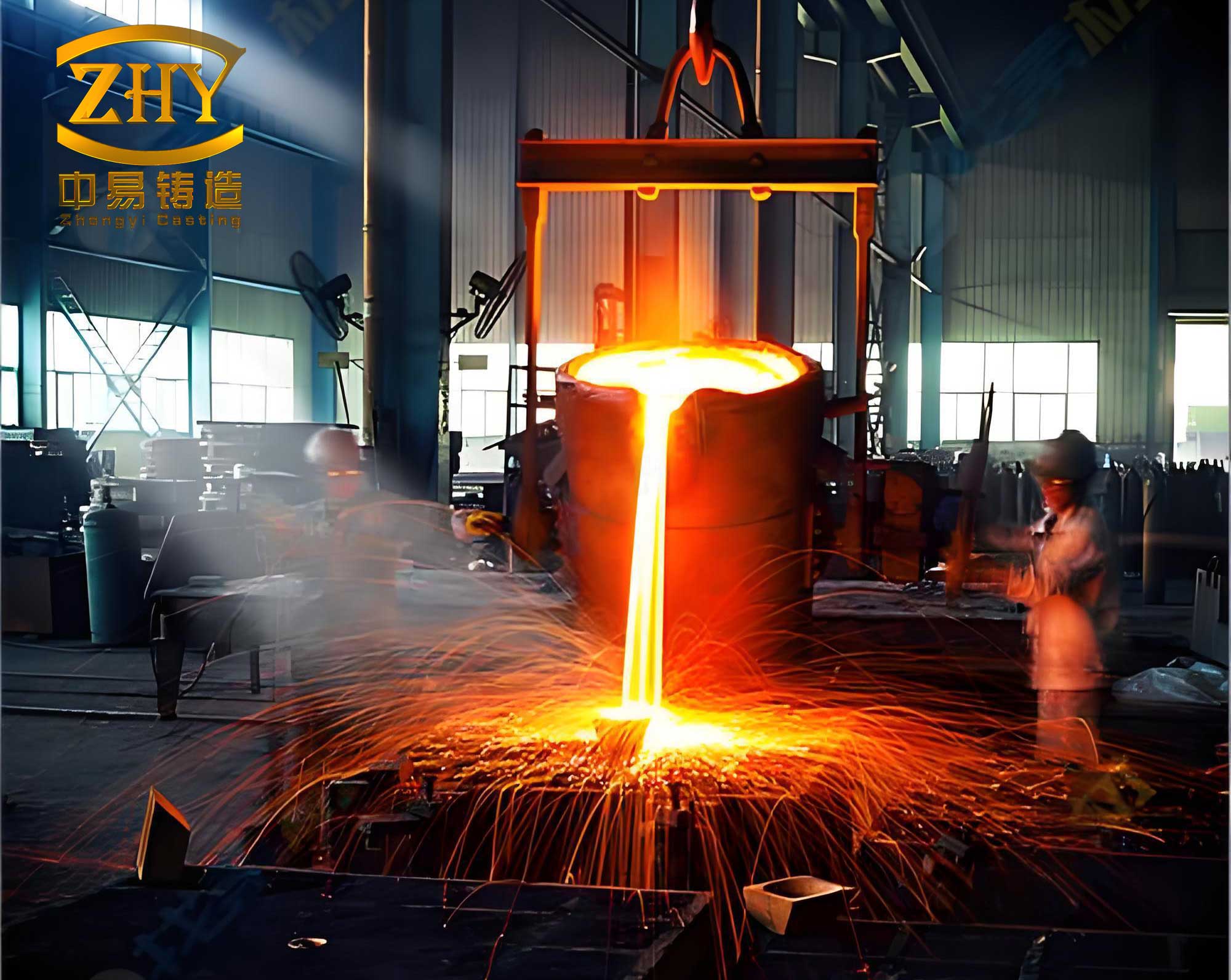
The image above illustrates typical steel casting parts, highlighting the complexity and precision required in such components. Similarly, our bearing cover casting parts demand meticulous process control to achieve defect-free outcomes. In the initial design phase, computer simulation was employed to predict solidification and shrinkage behavior. The simulation indicated minimal shrinkage porosity, with isolated liquidus areas that seemed acceptable. However, upon producing the first casting part, ultrasonic testing revealed shrinkage defects in the bearing regions, which posed a risk of exposure during machining. This discrepancy between simulation and reality prompted a detailed analysis. The simulation showed that the last solidifying areas, represented as isolated liquid pockets, were prone to shrinkage, but their severity was underestimated. This experience underscores that for ductile iron casting parts, simulation must be complemented with empirical validation, especially for critical sections.
To address the shrinkage issue, we modified the riser placement and chill design. Originally, two exothermic risers were positioned on the top, but one was relocated directly over the problematic bearing area to enhance feeding. Additionally, the shaped chills in the bearing zones were optimized to improve heat extraction and temperature gradients. The revised layout aimed to establish a more effective directional solidification pattern, ensuring that risers feed the thick sections sequentially. The gating system was retained, as it effectively minimized slag inclusion in these casting parts. The modifications were guided by re-simulation, which confirmed the elimination of isolated liquidus areas. Below, I summarize the key changes in a table to contrast the initial and improved process parameters for these casting parts.
| Parameter | Initial Design | Improved Design |
|---|---|---|
| Riser Placement | Two risers on top, away from bearing areas | One riser relocated over critical bearing area |
| Chill Configuration | Shaped chills in bearing regions | Optimized chill geometry and placement |
| Simulation Prediction | Minor shrinkage, isolated liquidus present | No shrinkage, liquidus eliminated |
| Ultrasonic Test Result | Shrinkage defects in bearing areas | No defects detected |
| Directional Solidification | Partially achieved | Fully achieved through enhanced gradients |
The improvement process involved iterative simulations to optimize the thermal gradients. The temperature gradient (G) and solidification rate (R) are critical parameters in predicting shrinkage in casting parts. The condition for avoiding shrinkage porosity is often expressed as G/√R ≥ constant, where higher gradients promote better feeding. For ductile iron casting parts, this relationship is nuanced due to graphite expansion, but generally, a steep gradient aids in directional solidification. In our case, by adjusting risers and chills, we increased G in the bearing areas, thereby reducing the risk of shrinkage. The pouring temperature was maintained at 1350±10°C to balance fluidity and solidification characteristics. The chemical composition played a vital role; for instance, the magnesium content influences nodule count, which affects shrinkage behavior. The nodule count (N) can be related to cooling rate and composition, but for simplicity, we focused on maintaining CE within 4.4–4.5 to ensure adequate graphitization expansion to counteract shrinkage.
After implementing the improvements, the first revised casting part was produced and subjected to non-destructive testing. Ultrasonic inspection showed no shrinkage defects, confirming the effectiveness of the changes. Subsequently, batch production was initiated, and all casting parts met the stringent quality standards, enabling successful delivery to the customer. This outcome highlights the importance of adaptive process design in manufacturing high-integrity casting parts. The experience also reinforced that simulation tools, while valuable, require careful interpretation, particularly for complex geometries like these bearing cover casting parts. The final simulation results demonstrated a uniform temperature distribution and absence of porosity, aligning with practical outcomes.
To generalize the learnings, I propose a framework for designing such casting parts. The key steps include: (1) analyzing geometry to identify hot spots, (2) using simulation to predict solidification patterns, (3) designing gating and risering systems based on modulus calculations, (4) incorporating chills to control gradients, and (5) validating through pilot casting parts. For ductile iron casting parts, the riser design must account for graphite expansion, which can be quantified using the feeding demand equation: Feeding Demand = Volume Shrinkage – Graphite Expansion. Typically, volume shrinkage in ductile iron is around 4–6%, but graphite expansion can offset 2–3%, reducing the net feeding requirement. This can be expressed as:
$$ F_d = V_s – V_g $$
where \( F_d \) is the feeding demand, \( V_s \) is the volumetric shrinkage (e.g., 5% of casting volume), and \( V_g \) is the volumetric expansion from graphite precipitation. For our casting parts, with a volume of approximately 0.015 m³ (based on mass and density), assuming density of 7100 kg/m³, the shrinkage volume is about 0.00075 m³. The riser volume must compensate for this, considering efficiency. Exothermic risers with an efficiency of 15–20% were used, so riser volume \( V_r \) is sized as \( V_r = F_d / \eta \), where \( \eta \) is riser efficiency. For instance, if \( F_d = 0.0005 \, \text{m}^3 \) and \( \eta = 0.18 \), then \( V_r ≈ 0.0028 \, \text{m}^3 \).
In conclusion, the development of these gas turbine bearing cover casting parts underscores the critical role of integrated process design in achieving defect-free components. By combining simulation insights with practical adjustments to risers and chills, we established effective directional solidification, eliminating shrinkage porosity. The experience emphasizes that for ductile iron casting parts, particular attention must be paid to last-solidifying areas in simulations, as they indicate potential defect sites. Furthermore, the use of filtering systems and controlled pouring parameters helped mitigate slag inclusion, ensuring high surface quality. The successful batch production validates the robustness of the improved process, contributing to the reliable manufacturing of such high-demand casting parts. Future work could explore advanced simulation models that better account for graphite expansion in ductile iron casting parts, further enhancing predictive accuracy. Overall, this project demonstrates that with systematic design and iterative refinement, even the most challenging casting parts can be produced to meet exacting standards.
To encapsulate the technical aspects, here is a summary table of the key formulas and parameters used in the process design for these casting parts.
| Concept | Formula/Parameter | Application in Casting Parts |
|---|---|---|
| Carbon Equivalent | $$ CE = \%C + \frac{\%Si + \%P}{3} $$ | Controls matrix structure and shrinkage tendency |
| Modulus for Riser Sizing | $$ M = \frac{V}{A} $$; Riser M ≥ 1.2 × Casting M | Ensures adequate feeding capacity |
| Feeding Demand | $$ F_d = V_s – V_g $$ | Accounts for graphite expansion in ductile iron |
| Temperature Gradient | G = ΔT/Δx | Higher gradients promote directional solidification |
| Solidification Rate | R = dx/dt | Influences microstructure and defect formation |
| Riser Efficiency | η = Feeding Volume / Riser Volume | Typically 15–20% for exothermic risers |
| Pouring Temperature | 1340–1360°C | Optimized for fluidity and shrinkage control |
This comprehensive approach ensures that casting parts like the bearing cover are produced with high reliability, meeting the rigorous demands of gas turbine applications. The iterative design process, supported by simulation and empirical testing, is essential for advancing the quality of complex casting parts in the industry.