
In the field of advanced manufacturing, the demand for high-quality aluminum alloy casting parts has increased significantly, particularly in aerospace, defense, and electronics industries. These casting parts are required to exhibit superior mechanical properties, precise dimensional accuracy, and excellent internal integrity. As a researcher focused on casting technology, I embarked on a study to address the challenges associated with producing large ZL205A aluminum alloy cabin casting parts. The goal was to develop a robust casting process that ensures defect-free casting parts with enhanced performance. This article details my first-person perspective on the research, including process design, numerical simulation, and experimental validation, with an emphasis on optimizing casting parts for critical applications.
The ZL205A alloy is a high-strength casting aluminum alloy known for its complex composition and wide solidification range, which poses significant challenges in achieving directional solidification. In my study, the target casting parts were cylindrical cabin structures with dimensions of approximately Φ1,200 mm × 1,500 mm, an average wall thickness of 5–8 mm, and a net weight of 520 kg. These casting parts serve as key load-bearing components in missile systems, necessitating stringent requirements: no internal defects such as cracks, porosity, or shrinkage, high mechanical properties (e.g., tensile strength σb ≥ 400 MPa, yield strength σ0.2 ≥ 300 MPa, elongation δ5 ≥ 5%), and adherence to tight dimensional tolerances. My initial assessment revealed that conventional casting processes, particularly using slot gating systems, led to hot spots and micro-porosity defects in the casting parts, compromising their quality.
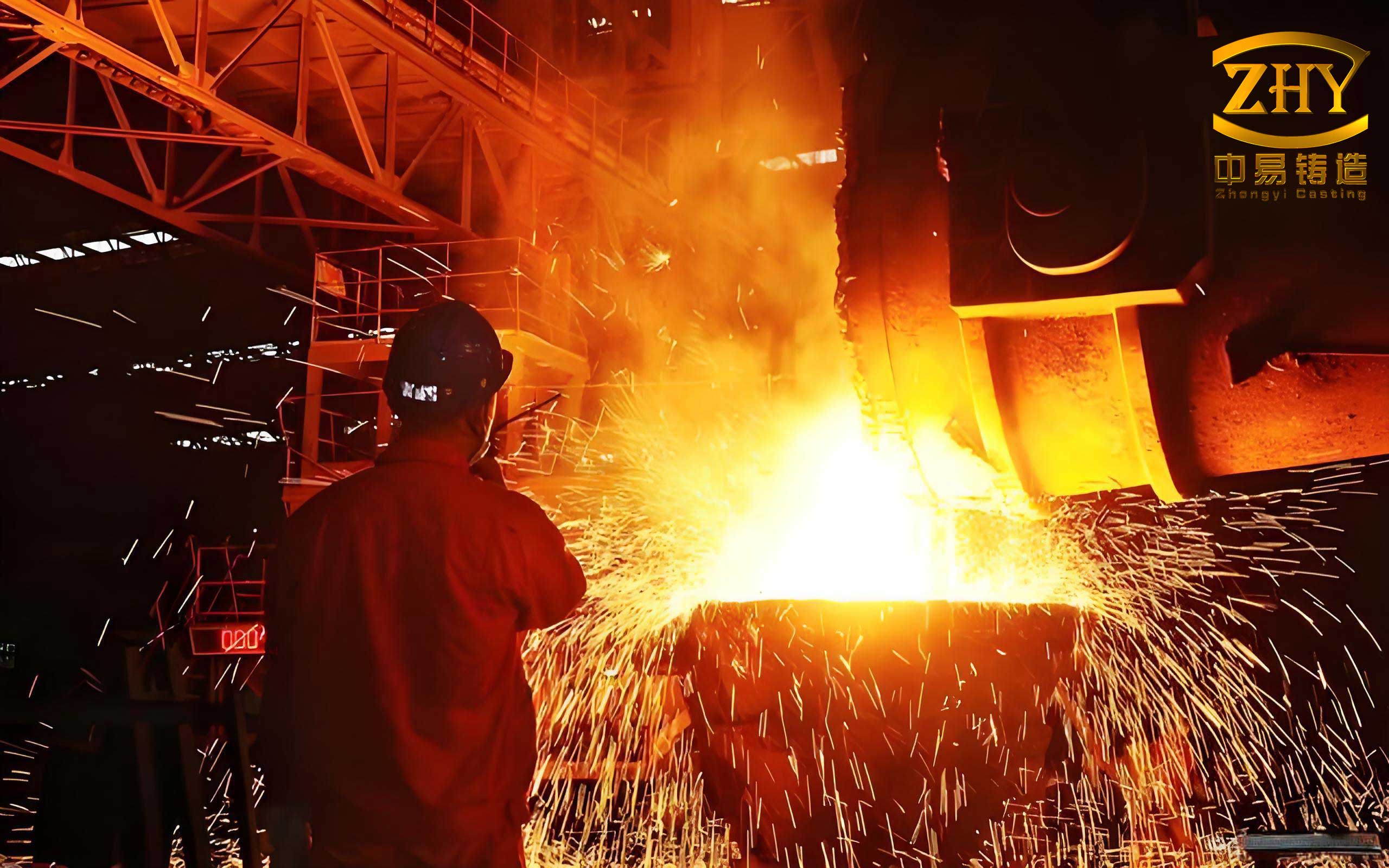
To overcome these issues, I focused on redesigning the casting process. The core approach involved employing counter-pressure casting (also known as differential pressure casting), a method where molten metal is forced into a pre-pressurized mold under a pressure differential. This technique enhances feeding and reduces gas entrapment, making it ideal for producing dense casting parts. The pressure parameters were set with a working pressure of 0.6 MPa and a differential pressure range of around 50 kPa. The governing equation for the pressure-driven flow can be expressed as:
$$ \Delta P = P_{\text{bottom}} – P_{\text{top}} $$
where ΔP is the pressure differential, Pbottom is the pressure in the lower chamber containing the molten metal, and Ptop is the pressure in the upper chamber housing the mold. This pressure differential facilitates upward filling and promotes solidification under high pressure, thereby improving the integrity of casting parts.
In conjunction with counter-pressure casting, I developed a low-heat pouring system to minimize thermal gradients and hot spots. Traditional slot gating systems, while effective for some alloys, created heat accumulation at the junction between the gating and the casting parts, leading to micro-porosity in ZL205A alloy casting parts. My optimized design incorporated a modified slot gate with a feeder补贴 (a supplemental metal reservoir) and strategically placed chills. The key dimensions of the gating system were defined as follows: let n be the number of slots, S the perimeter of the casting part, δ the thickness of the slot gate, δcasting the wall thickness at the gate junction, b the width of the slot gate, and d the diameter of the vertical slot riser. The modification included adding a feeder补贴 to the riser, which redistributes heat and shifts the hot spot away from the casting parts. The chill design involved using iron chills with a width smaller than that of the feeder补贴 to enhance cooling without blocking feeding channels. This can be summarized in the table below:
| Parameter | Symbol | Value/Range | Purpose |
|---|---|---|---|
| Number of Slots | n | 4–6 (based on circumference) | Ensure uniform filling |
| Slot Gate Thickness | δ | 8–10 mm | Control metal flow rate |
| Casting Wall Thickness | δcasting | 5–8 mm | Maintain structural integrity |
| Slot Gate Width | b | 20–30 mm | Optimize heat distribution |
| Riser Diameter | d | 40–50 mm | Provide feeding capacity |
| Feeder补贴 Width | wfeeder | 15–25 mm | Shift hot spot externally |
| Chill Width | wchill | 10–15 mm | Enhance cooling gradient |
Numerical simulation played a crucial role in validating this design. I used finite element method (FEM) software to model the temperature fields and solidification behavior of the casting parts. The simulation results indicated that the modified gating system effectively reduced overheating at the gate-casting junction. The temperature distribution T(x,y,z,t) and solid fraction fs(t) were analyzed to ensure directional solidification. The heat transfer during solidification can be described by the Fourier equation:
$$ \rho C_p \frac{\partial T}{\partial t} = \nabla \cdot (k \nabla T) + L \frac{\partial f_s}{\partial t} $$
where ρ is density, Cp is specific heat, k is thermal conductivity, L is latent heat, and fs is solid fraction. The simulation showed that with the optimized process, the solid fraction near the casting parts increased gradually from the gate outward, confirming that hot spots were relocated to the feeder补贴 area, away from the critical zones of the casting parts. This minimized defects in the final casting parts.
Experimental trials were conducted to verify the simulation findings. The casting parts were produced using the counter-pressure casting setup with the low-heat pouring system and chills. After solidification, the casting parts underwent non-destructive testing, including X-ray inspection and fluorescent penetrant testing. The results demonstrated that the casting parts were free from significant defects such as porosity, shrinkage, or cracks. For instance, X-ray images of the critical hot spot regions showed no indications of micro-porosity, confirming the effectiveness of the process for these casting parts. The internal quality met the highest standards for aerospace casting parts.
Mechanical properties were evaluated by extracting test samples from the thickest sections of the casting parts, specifically from an area labeled A (with higher wall thickness). A total of 12 samples were taken from this region, and their tensile properties were measured. The data are summarized in the table below, highlighting the superior performance of the casting parts:
| Sample No. | Tensile Strength σb (MPa) | Yield Strength σ0.2 (MPa) | Elongation δ5 (%) |
|---|---|---|---|
| 1 | 433 | 350 | 8.3 |
| 2 | 414 | 345 | 9.7 |
| 3 | 452 | 360 | 8.8 |
| 4 | 426 | 338 | 10.8 |
| 5 | 470 | 375 | 9.7 |
| 6 | 420 | 332 | 10.9 |
| 7 | 479 | 380 | 12.1 |
| 8 | 483 | 385 | 12.7 |
| 9 | 447 | 355 | 17.1 |
| 10 | 451 | 358 | 16.1 |
| 11 | 444 | 350 | 17.7 |
| 12 | 450 | 352 | 19.2 |
| Requirements | ≥400 | ≥300 | ≥5 |
As shown, all samples exceeded the specified mechanical property thresholds, with tensile strengths ranging from 414 to 483 MPa and elongations from 8.3% to 19.2%. This indicates that the casting parts achieved high strength and ductility, essential for demanding applications. The success can be attributed to the optimized process that ensured directional solidification and reduced defects in the casting parts.
Further analysis involved examining the microstructure of the casting parts. I observed that the modified gating system and chills promoted finer grain structures and reduced micro-porosity. The solidification time ts for different sections of the casting parts was calculated using the Chvorinov’s rule approximation:
$$ t_s = B \left( \frac{V}{A} \right)^2 $$
where V is volume, A is surface area, and B is a mold constant. For the thick sections of the casting parts, the cooling rate was optimized to prevent coarse microstructures. The integration of chills increased the cooling rate locally, which can be expressed as:
$$ \frac{dT}{dt} = \frac{h (T – T_{\text{mold}})}{\rho C_p} $$
where h is the heat transfer coefficient, T is the metal temperature, and Tmold is the mold temperature. By controlling these parameters, I achieved a uniform temperature gradient across the casting parts, enhancing their mechanical properties.
In discussion, I reflected on the implications of this research. The optimized casting process not only resolved the hot spot issue but also provided a scalable framework for producing large, complex casting parts from ZL205A alloy. The use of counter-pressure casting, combined with a low-heat pouring system and strategic chilling, proved effective in achieving directional solidification and high integrity in casting parts. This approach can be adapted for other high-performance casting parts in aerospace and defense sectors. Moreover, the numerical simulation tools validated the design, reducing trial-and-error costs and improving efficiency in developing casting parts.
To summarize the key process parameters and their effects on casting parts, I developed a comprehensive table below:
| Aspect | Conventional Process | Optimized Process | Impact on Casting Parts |
|---|---|---|---|
| Pouring Method | Gravity pouring | Counter-pressure casting | Enhances density, reduces porosity in casting parts |
| Gating System | Standard slot gate | Low-heat slot gate with feeder补贴 | Shifts hot spots, minimizes defects in casting parts |
| Cooling Approach | Natural cooling | Iron chills at strategic locations | Improves temperature gradient, refines microstructure of casting parts |
| Solidification Control | Random | Directional via simulation-guided design | Ensures uniform properties in casting parts |
| Defect Rate | High micro-porosity | Negligible defects | Produces high-integrity casting parts |
| Mechanical Performance | Variable, often below spec | Consistently exceeds requirements | Yields reliable casting parts for critical uses |
In conclusion, my study demonstrates that through innovative process design—integrating counter-pressure casting, a low-heat pouring system, and targeted cooling—it is possible to produce large ZL205A aluminum alloy cabin casting parts with exceptional quality. The casting parts exhibited superior internal integrity and mechanical performance, meeting all technical specifications. This research underscores the importance of holistic process optimization for advancing the manufacturing of high-stakes casting parts. Future work could explore further refinements, such as adaptive control of pressure parameters or advanced alloy modifications, to push the boundaries of what is achievable with casting parts. The insights gained here provide a valuable reference for engineers and researchers focused on enhancing the reliability and performance of casting parts across industries.