
In my extensive experience within precision foundry operations, the production of high-integrity, complex geometry casting parts presents a persistent and multifaceted challenge. One particularly demanding component that encapsulates these challenges is a guide vane or flow diverting support plate, a critical element for gas turbine engines. This specific casting part is characterized by its hollow, flattened form with substantial planar surfaces and highly variable wall thickness. Typical dimensions include a height of approximately 350 mm, a chord width of 240 mm, with a maximum airfoil thickness of 35 mm transitioning to nominal walls as thin as 8 mm. The internal cavity, a defining feature, can be as narrow as 20 mm at its widest point. Fabricated from a 1Cr18Ni9Ti (AISI 321 equivalent) stainless steel via the investment casting process, this geometry imposes significant difficulties across the entire production chain—from slurry coating and stuccoing to dewaxing, sintering, pouring, and final fettling. Furthermore, stringent non-destructive testing requirements, including fluorescence penetrant and radiographic inspection, demand exceptional internal soundness and dimensional accuracy, pushing the limits of conventional casting process design and execution.
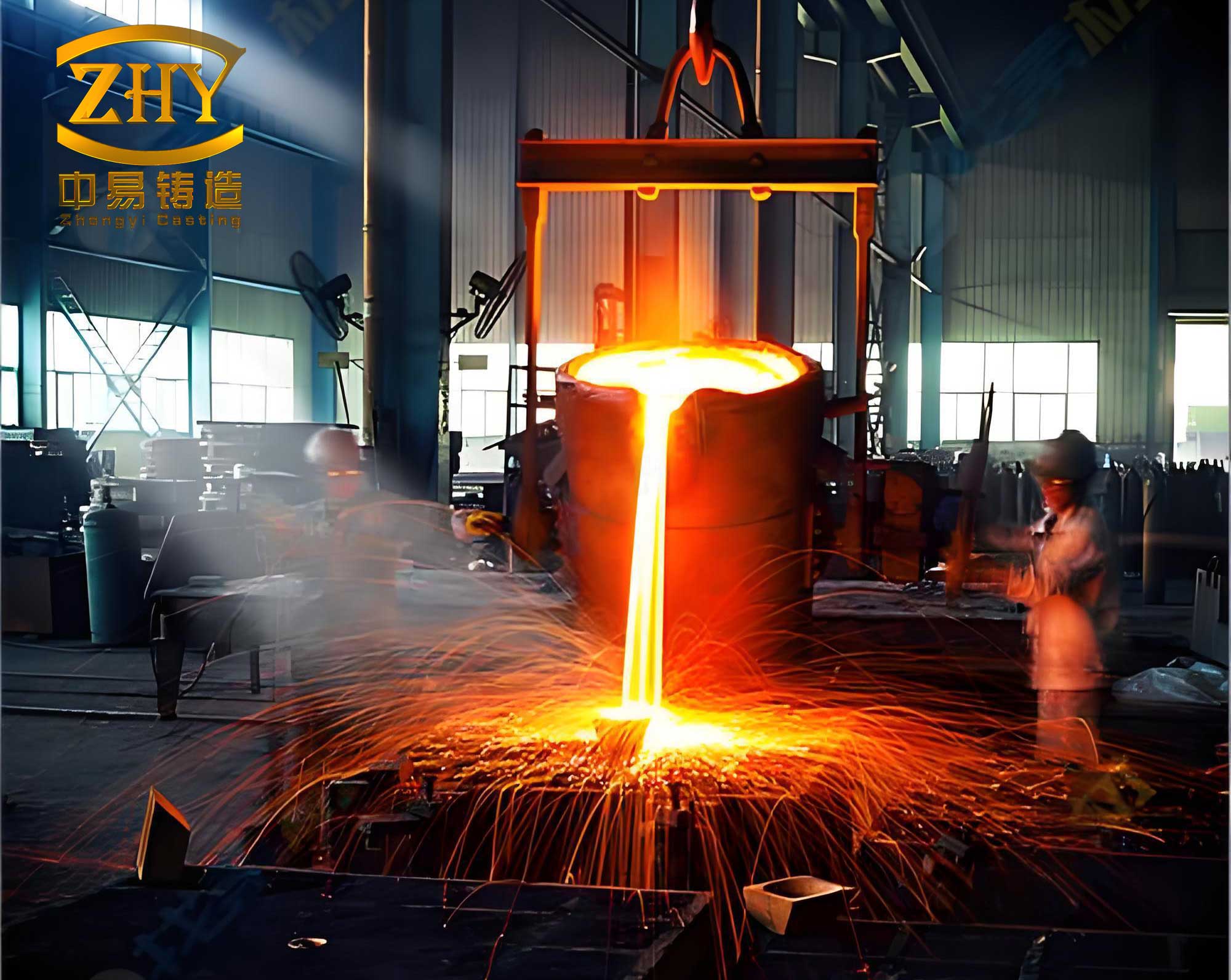
The initial production runs of these casting parts were plagued by a high rejection rate, primarily due to three interrelated families of defects: shell bulging, shrinkage porosity/cavities, and non-metallic inclusions. Achieving a viable yield required a systematic, root-cause analysis followed by the implementation of targeted countermeasures spanning pattern, shell, gating, and melting disciplines.
1. Comprehensive Analysis of Prevalent Casting Defects
The pursuit of quality in such intricate casting parts begins with a precise understanding of failure modes. The defects observed were not random but stemmed from specific process limitations.
1.1 Shell Bulging and Fracture
Post-pouring inspection frequently revealed localized swelling or complete rupture of the ceramic shell, particularly on the large, flat surfaces of the casting part. This defect, termed “bulging,” directly compromises the dimensional fidelity and surface finish of the final component. The primary root cause was identified as insufficient localized strength of the shell’s primary layers. During the turbulent filling stage, the dynamic pressure and thermal shock exerted by the incoming molten metal can exceed the tensile strength of the shell wall. This is exacerbated on large, flat areas where the shell’s adhesion to the wax pattern is mechanically less robust, and the shell curvature—which inherently adds stiffness—is minimal. The fundamental stress ($\sigma$) on the shell wall can be related to the metal static head ($\rho g h$) and dynamic pressure, approximated for simplification during initial filling as:
$$\sigma_{shell} \propto \rho_{metal} \cdot g \cdot h + \frac{1}{2} \rho_{metal} v^2$$
Where $\rho_{metal}$ is the metal density, $g$ is gravity, $h$ is the instantaneous metal height above the point of interest, and $v$ is the pour velocity. If $\sigma_{shell}$ exceeds the shell’s green or fired strength, deformation or fracture occurs.
1.2 Shrinkage Porosity and Macro-Shrinkage Cavities
Shrinkage manifestations were twofold: diffuse micro-porosity within the airfoil sections and gross shrinkage pipes or cavities, up to 20 mm deep, at the junction of the thick mounting lugs (chordal ends) and the feeding gates/risers. This defect is the most critical for structural casting parts as it severely undermines fatigue life and mechanical integrity. The cause was traced to an inadequate feeding system design. The original gating employed a bottom-filling approach which, while minimizing turbulence, created unfavorable thermal gradients. The gates themselves, acting as thermal masses, remained hot and became the last points to solidify, starving the adjacent thick sections of the casting part of feed metal during the critical solidification phase. This violates the fundamental principle of directional solidification towards a functional riser. The solidification time ($t_f$) for a simple shape is often estimated by Chvorinov’s rule:
$$t_f = B \left( \frac{V}{A} \right)^n$$
where $V$ is volume, $A$ is surface area, $n$ is a constant (often ~2), and $B$ is the mold constant. In our case, the gate ($V/A$ large) solidified after the lug section it was meant to feed, making it a “hot spot” and the origin of shrinkage.
1.3 Non-Metallic Inclusions (“Starry-Sky” Defects)
The surface of the castings exhibited a high density of finely dispersed, non-metallic inclusions, described as a “starry-sky” pattern. This led to extensive and costly rework during fluorescent penetrant inspection, with initial first-pass yields plummeting to around 20%. The inclusions originated from three primary sources contaminating the molten alloy destined for the casting parts:
- Charge Material Inclusions: Oxide films, slag particles, or refractory fragments inherent in the master alloy ingots or revert material.
- In-Melt Oxidation: Reaction of active alloying elements (e.g., Cr, Ti, Al) with oxygen or water vapor present in the furnace atmosphere during air melting.
- Flux-Derived Inclusions: Entrapment of undeveloped or reacted slag/flux used for refining and covering the melt in non-vacuum conditions.
The probability of an inclusion being trapped on the surface of a thin-walled casting part is high due to the rapid solidification front and the difficulty for buoyant particles to float to a top surface in a complex, constrained cavity.
2. Implemented Countermeasures and Validated Results
The improvement strategy was holistic, addressing each defect family through modifications in pattern engineering, shell building, process simulation, and melting practice.
2.1 Eradication of Shell Bulging
To combat the shell strength issue, a multi-pronged reinforcement strategy was deployed specifically for these large-planar-area casting parts.
Pattern Modification: Temporary wax reinforcement ribs were applied to the large flat faces of the wax assembly. These ribs, typically 3-5 mm in width and height, served a dual purpose: they drastically increased the surface area and curvature for the primary slurry layers, improving adhesion, and they acted as structural stiffeners for the fragile green shell during handling and the early stages of dewaxing. These ribs are later removed during the standard cut-off and grinding operations after casting.
Shell Reinforcement Protocol: A procedural enhancement was mandated for building shells for these critical casting parts. After the application of the second or third ceramic layer (once sufficient mechanical key had been established), the entire shell cluster was externally and internally girdled with a network of nickel-chromium alloy wire. This wire, resistant to oxidation at high temperatures, was woven around the shell in a cross-hatch pattern and tied securely. This mesh becomes embedded within subsequent slurry layers, creating a composite ceramic-metal shell with significantly enhanced tensile strength and resistance to thermal distortion.
Cavity Support: For the narrow, internal cavities of the casting part, an innovative support method was used. After the shell was complete and dried, the internal cavities were carefully filled with fine, chemically bonded silica sand. The ends were sealed with refractory cement. This internal sand core provided massive mechanical support against metal static pressure during pouring, effectively turning the hollow shell into a solid, reinforced structure during the casting event. The sand is easily removed after shakeout.
The efficacy of these measures is summarized below:
| Countermeasure | Function | Outcome |
|---|---|---|
| Wax Reinforcement Ribs | Increase shell adhesion area & green strength | Eliminated primary layer peeling and cracking. |
| Nickel-Chrome Wire Mesh | Provide structural reinforcement within shell wall | Increased high-temperature shell strength by >50%; prevented distortion. |
| Internal Cavity Sand Support | Resist internal pressure from molten metal | Completely prevented bulging of internal walls. |
The combined implementation resulted in the complete elimination of bulging defects, ensuring dimensional consistency for these casting parts.
2.2 Optimization for Soundness: Shrinkage Elimination
Addressing shrinkage required a fundamental redesign of the thermal and feeding dynamics. This was achieved through computational simulation-guided design.
Leveraging ProCAST Numerical Simulation: The original gating was modeled using finite element analysis software (ProCAST). The initial simulation clearly predicted the “hot spot” and shrinkage cavity at the gate-lug junction, correlating perfectly with the observed defect. An iterative optimization process was then undertaken virtually.
Scheme 1 (Increased Riser Volume): The first modification involved increasing the cross-sectional area of the feeders and the height of both top and bottom risers to 50 mm. The simulation, however, indicated that while improved, the thermal center remained at the top riser’s neck, predicting a residual shrinkage cavity. Physical trials confirmed this, with shrinkage cavities approximately $\phi$30 mm x 30 mm present.
Scheme 2 (Optimized Thermal Gradient): The key insight was to enforce a steeper, unidirectional thermal gradient. The total height of the gating system was a constraint. Therefore, the height of the bottom feeder was reduced to allocate more height to the top riser, increasing it to 70 mm. This enhanced the metallostatic pressure and the thermal capacity of the top riser. The ProCAST simulation for Scheme 2 showed a clear progression of solidification isotherms from the center of the casting part towards both the top riser and the bottom gate, indicating open feeding channels. The predicted shrinkage was confined to the risers themselves. The governing energy equation solved during such simulation is the transient heat conduction equation with latent heat release:
$$\rho c_p \frac{\partial T}{\partial t} = \nabla \cdot (k \nabla T) + \rho L \frac{\partial f_s}{\partial t}$$
where $T$ is temperature, $t$ is time, $\rho$ is density, $c_p$ is specific heat, $k$ is thermal conductivity, $L$ is latent heat, and $f_s$ is solid fraction. The simulation ensures the thermal gradient ($\nabla T$) points toward the riser.
Physical Validation: Casting trials using Scheme 2 produced casting parts completely free of macro-shrinkage cavities in the critical lug areas. Some minor, acceptable levels of micro-porosity remained, which were repairable via weld repair. A batch of 20 casting parts was subsequently cast with consistent, defect-free results.
| Scheme | Riser Configuration | ProCAST Prediction | Physical Result | Conclusion |
|---|---|---|---|---|
| Original | Small top/bottom risers | Shrinkage at lug-gate junction | Major shrinkage cavity | Unacceptable |
| Scheme 1 | Taller risers (50mm/50mm) | Shrinkage in top riser neck | $\phi$30mm cavity present | Unacceptable |
| Scheme 2 | Tall top riser (70mm), shorter bottom gate | Sound casting, shrinkage in riser only | No macro-shrinkage | **Acceptable** |
2.3 Mitigation of Inclusion Defects
The solution to the pervasive “starry-sky” inclusions necessitated a paradigm shift in melting and pouring practice for these high-quality casting parts.
Transition to Vacuum Induction Melting and Pouring (VIM/VIC): The most impactful change was abandoning air melting. The entire process—charging, melting, refining, and pouring—was conducted inside a vacuum furnace. This single step addressed all three inclusion sources:
- Pre-alloyed vacuum-grade master ingots were used, minimizing inherent oxides.
- The low-pressure environment (typically below 0.1 mbar) virtually eliminated in-melt oxidation. The activity of reactive elements is controlled, preventing the formation of fresh oxide/slag films.
- The need for protective or refining fluxes was entirely eliminated, removing that potential source of contamination.
Enhanced Fluid Dynamics: Vacuum pouring also improves metal fluidity by removing dissolved gases that can nucleate porosity, which indirectly aids in the floating out of any rare, remaining inclusions. The cleanliness of the melt can be quantified by reduced total oxygen and nitrogen content, often expressed as:
$$[O]_{total}, [N]_{total} \ll \text{(specification limit for air melt)}$$
Post-implementation, fluorescent penetrant inspection rejection rates for inclusions dropped from ~80% to less than 5%, representing a monumental improvement in the quality and yield of these casting parts.
| Inclusion Source | Mechanism | Air Melting Risk | Vacuum Melting Solution | Effectiveness |
|---|---|---|---|---|
| Charge Material | Oxides in master alloy | High | Use of certified vacuum-grade ingots | High |
| In-Melt Oxidation | Reaction with air (Cr, Ti) | Very High | Melting under inert vacuum atmosphere | Very High |
| Flux/Slag | Entrapment of refining agent | Moderate | No flux required | Complete |
3. The Critical Role of Process Simulation in Casting Development
The successful resolution of the shrinkage issue underscores the indispensable value of solidification and flow simulation in modern foundry practice, especially for mission-critical casting parts. The use of ProCAST was not merely diagnostic but prescriptive. It allowed for the rapid, cost-effective evaluation of multiple gating scenarios without consuming physical resources. The software solves the coupled equations of fluid dynamics, heat transfer, and stress, providing a comprehensive view of the casting process. For the feeding system optimization, the key simulated parameters included:
- Fraction Solid Plot: To visualize feeding paths and last-to-freeze zones.
- Niyama Criterion: A local predictive criterion for microporosity based on thermal gradient $G$ and solidification rate $R$: $N_Y = \frac{G}{\sqrt{R}}$. Areas with $N_Y$ below a critical threshold indicate high risk of porosity.
- Temperature Gradient: Direct assessment of directional solidification.
By correlating simulation predictions with actual casting results, the fidelity of the digital model is continuously improved, creating a powerful digital twin for future development of even more complex casting parts.
4. Conclusion and Future Perspectives
The systematic campaign to improve the quality of the complex guide vane casting parts demonstrates that persistent casting defects are solvable through a disciplined, engineering-based approach that integrates materials science, mechanical engineering, and computational tools. The shell bulging was conquered by innovative mechanical reinforcement techniques applied directly to the shell mold. The insidious shrinkage defects were definitively eliminated by leveraging numerical simulation to design a gating system that enforces proper directional solidification, a principle governed by fundamental heat transfer physics. The pervasive inclusion problem was solved at its root by transitioning to a clean, vacuum melting and casting process, which controls the thermodynamic environment of the molten metal.
The successful outcome for these specific casting parts has broader implications. It validates a methodology: 1) Rigorous defect root-cause analysis, 2) Strategic application of mechanical and thermal process enhancements, and 3) The integration of simulation as a core design tool. This methodology is directly transferable to other challenging investment cast components across aerospace, power generation, and medical industries. Future work will focus on further digitizing the process chain, potentially employing machine learning algorithms to correlate historical process data from shell building and melting with final quality metrics, moving towards predictive quality control for every single casting part produced.