
In the production of heavy truck brake drum castings, which are critical components in automotive braking systems, ensuring reliability and safety is paramount. These casting parts are characterized by large outer dimensions, high axial heights, and substantial wall thicknesses. During manufacturing, a recurring issue is the appearance of scab defects at the inner filleted corners of the flange, leading to high scrap rates and increased production costs. From my perspective, as part of a technical team involved in addressing this problem, I have conducted comprehensive investigations across all production stages, including sand mixing, melting, molding, and pouring. Through longitudinal and horizontal analysis, I have deduced the mechanisms behind these defects in wet clay sand machine molding processes. This article details the practical measures implemented to control sand quality, adjust process parameters, shorten pouring times, and enhance venting. By integrating these strategies, we successfully eliminated scab defects, improving the quality and efficiency of producing these essential casting parts.
Scab defects manifest as localized, protruding scars on the surface of casting parts, often with edges separated from the main body and underlying layers of sand or coating. Upon removal, irregular pits with protruding remnants are revealed, typically occurring at corners or transitions in geometry. For heavy truck brake drums made of HT250 gray iron, with outer diameters ranging from 480 to 520 mm, heights up to 300 mm, wall thicknesses of 38–45 mm, and weights of 80–90 kg, these defects are consistently found at the inner filleted corners where the flange meets the drum body. The defects measure 10–50 mm in length and 1–6 mm in height, positioned about 8 mm from the inner wall, with corresponding missing material on the inner surface. This consistency in location and morphology indicates a systematic issue tied to process conditions, affecting the integrity of these high-stress casting parts.
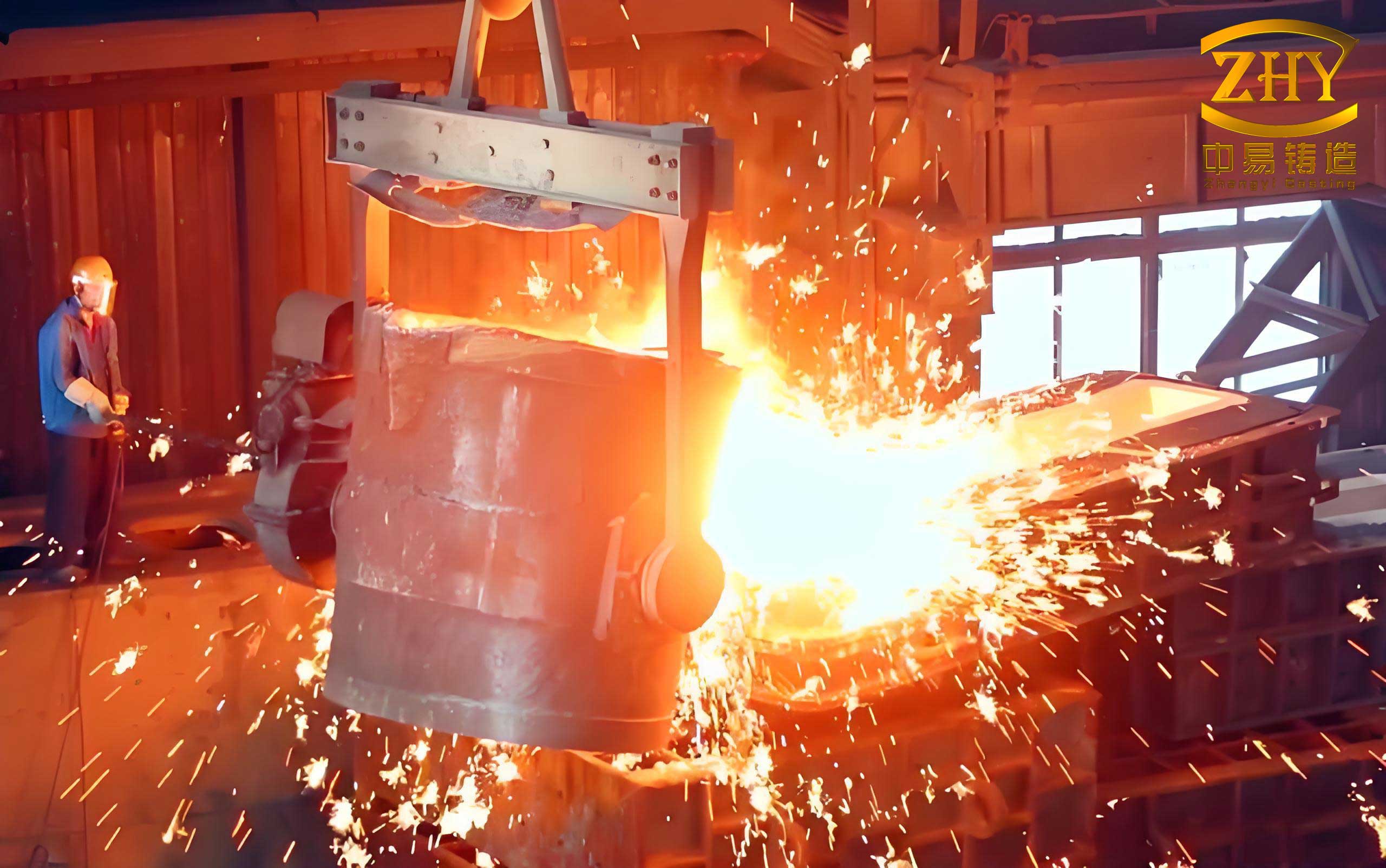
The formation of scab defects is primarily attributed to thermal and mechanical interactions during pouring. When high-temperature iron enters the mold cavity, the sand surface experiences rapid heating. Above 600°C, bentonite loses its structural water, and beyond 800°C, it transforms into dead clay with no bonding capacity. Simultaneously, silica sand undergoes a phase transformation at 573°C from β-quartz to α-quartz, accompanied by volumetric expansion. This expansion, constrained by cooler inner sand layers, generates stress leading to delamination. Additionally, as the metal rises, prolonged heating causes moisture migration, forming a high-moisture, low-strength condensed layer 2–5 mm beneath the surface. The reduced hot-wet strength fails to resist shear forces from expanding sand layers, causing cracking or detachment. Molten metal then infiltrates these gaps, resulting in scabs on the final casting parts. This mechanism can be modeled using thermal expansion equations. For instance, the volumetric expansion of silica sand due to phase change can be expressed as:
$$ \Delta V = V_0 \cdot \alpha \cdot \Delta T $$
where $$ \Delta V $$ is the volume change, $$ V_0 $$ is the initial volume, $$ \alpha $$ is the coefficient of thermal expansion (approximately 1.5 × 10^{-5} °C^{-1} for quartz), and $$ \Delta T $$ is the temperature change. In practice, the stress $$ \sigma $$ developed in the sand layer due to constrained expansion is given by:
$$ \sigma = E \cdot \epsilon $$
with $$ E $$ as the modulus of elasticity and $$ \epsilon $$ as the strain. When $$ \sigma $$ exceeds the hot-wet tensile strength of the sand, delamination occurs, directly impacting the quality of casting parts.
To address these defects, I focused on two main areas: casting process optimization and sand quality control. Initially, statistical analysis of defective casting parts showed that scabs occurred consistently regardless of pouring stage, ruling out temperature variations as a primary cause. Therefore, the first improvement involved modifying the gating system. The original process used a single-side gating with a pouring time of 22–25 seconds per mold. By switching to a double-side dispersed gating with multiple ingates, pouring time was reduced to 17–20 seconds, minimizing localized heating of the sand mold. Additionally, top venting was increased by adding four vent pins near the defect-prone areas to enhance gas escape and reduce moisture condensation. Numerical simulation of fluid flow and temperature fields confirmed more uniform filling and reduced thermal gradients, though the direct impact on scab reduction was limited to about 3%. This underscores that process tweaks alone are insufficient for these complex casting parts.
The core solution lay in enhancing sand quality. In wet sand molding, the properties of molding sand are critical for defect prevention. I implemented stricter control over mixing parameters and adjusted sand composition. Key adjustments included increasing old sand inventory to ensure consistency, modifying new sand grain size for better permeability, and optimizing moisture and ash content. The table below summarizes the changes in mixing parameters:
| Parameter | Before Adjustment | After Adjustment |
|---|---|---|
| Old Sand Inventory (t) | ≥200 | ≥260 |
| New Sand Grain Size (mesh) | 70–140 | 50–100 |
| Old Sand Moisture Content (%) | 1.2–1.5 | 1.5–2.0 |
| Old Sand Ash Content (%) | ≤13.5 | ≤12.5 |
| Old Sand Temperature (°C) | ≤48 | ≤45 |
| Mixing Time (s) | 90 | 100 |
These adjustments aimed to reduce free water content and improve sand uniformity, crucial for maintaining mold integrity during the production of casting parts. Furthermore, the selection of high-quality sodium bentonite as a binder was emphasized. Its properties, such as blue absorption value, swelling capacity, and reusability, directly influence hot-wet strength. The technical standards for optimal bentonite are shown below:
| Property | Specification |
|---|---|
| Blue Absorption (g/100 g) | ≥37 |
| Wet Compression Strength (kPa) | ≥120 |
| Swelling Value (mL) | ≥90 |
| Reusability (%) | ≥70 |
| Moisture Content (%) | Summer ≤12, Winter ≤15 |
| Hot-Wet Tensile Strength (kPa) | ≥3.5 |
| Grain Fineness (200 mesh passing rate) | ≥90% |
To enhance sand toughness, α-starch was added at 2.5% of the bentonite weight. This additive burns during pouring, creating voids that accommodate thermal expansion, thereby reducing stress on the mold surface. The overall sand performance metrics were also refined, as detailed in this comparison:
| Property | Before Adjustment | After Adjustment |
|---|---|---|
| Compactability (%) | 41–44 | 39–42 |
| Wet Compression Strength (kPa) | 190–210 | 200–220 |
| Moisture Content (%) | 4.1–4.4 | 3.9–4.2 |
| Hot-Wet Tensile Strength (kPa) | ≥3.0 | ≥3.5 |
| Effective Bentonite Content (%) | 8–9 | 9–10 |
| Loss on Ignition (%) | 5–6 | 5.5–6.5 |
| Clay Content (%) | 11.5–14.5 | 10.5–13.5 |
| Breakage Index | ≥72 | ≥75 |
The improvement in hot-wet tensile strength is particularly significant, as it resists sand layer detachment. The relationship between sand strength and defect prevention can be expressed through a simplified model:
$$ S_{req} = \frac{F_{thermal}}{A} $$
where $$ S_{req} $$ is the required sand strength, $$ F_{thermal} $$ is the thermal stress force from expansion, and $$ A $$ is the area of the sand layer. By increasing hot-wet tensile strength to above 3.5 kPa, we ensured that $$ S_{req} $$ was exceeded, mitigating scabs in casting parts. Additionally, reducing the average fineness of the sand through grain size control and dust removal enhanced permeability, facilitating gas escape and minimizing moisture accumulation. These measures collectively stabilized the sand system over three months of testing, leading to the virtual elimination of scab defects.
From my experience, the casting process modifications, while beneficial, were secondary to sand quality control. The primary driver of scab defects in these heavy truck brake drum casting parts is inadequate sand properties, particularly insufficient hot-wet strength and improper moisture management. By optimizing mixing parameters, selecting superior binders, and incorporating additives like α-starch, we achieved a robust sand system capable of withstanding thermal shocks. This approach not only resolved the immediate issue but also provided a framework for preventing similar defects in other casting parts. Future work could involve predictive modeling using finite element analysis to simulate sand behavior under varying conditions, further refining process windows. Ultimately, the success underscores the importance of a holistic view in foundry operations, where material science and process engineering converge to produce high-quality casting parts reliably and efficiently.