
In the context of promoting high-quality economic development, enhancing industrial technological innovation capability stands as a pivotal feature of scientific and technological advancement empowering economic growth. Energy conservation, environmental protection, and product lightweighting are among the most effective measures to reduce energy consumption and emissions. The development of lightweighting technology holds significant importance in the transformation and upgrading of China’s manufacturing sector. Innovation in lightweight materials is key to lightweight design. Among metallic materials, Austempered Ductile Iron (ADI), through the integration and implementation of improved manufacturing methods, has the potential to reduce the wall thickness of ductile iron casting parts by up to 50%, leading to weight reductions of 30% to 50%. For existing components redesigned based on the superior mechanical properties of ADI materials, weight savings can reach 20% to 35%. ADI casting parts are widely used in mechanical engineering vehicles, demanding high mechanical performance and internal quality of the casting parts.
This article delves into the process development for a critical load-bearing front axle casting part used in large agricultural machinery, made from ADI 1050-6 grade material. The casting parts feature complex geometries with significant wall thickness variations, requiring meticulous process design to avoid defects and achieve the desired microstructure and properties.
The front axle casting parts possess an outline dimension of approximately 1300 mm × 400 mm × 220 mm. The wall thickness varies considerably: the arm sections are around 18 mm thick, while the main body at the axle journal is about 45 mm, with the thickest sections reaching up to 172 mm. Such disparity poses significant challenges during solidification, making the casting parts prone to issues like graphite degeneration, shrinkage porosity, and segregation. Therefore, the process must ensure uniform cooling and adequate feeding to produce sound casting parts.
The specified material is ADI 1050-6, requiring high mechanical properties after a salt bath austempering heat treatment to obtain a fully ausferritic microstructure. To guarantee these properties, excellent graphite morphology and high casting density are essential. The substrate of the casting parts must have a graphite nodule count ≥ 100 nodules/mm², a minimum nodularity of 85%, and graphite nodule size no coarser than Grade 6. Defects such as graphite flotation and shrinkage porosity are strictly prohibited in the final casting parts.
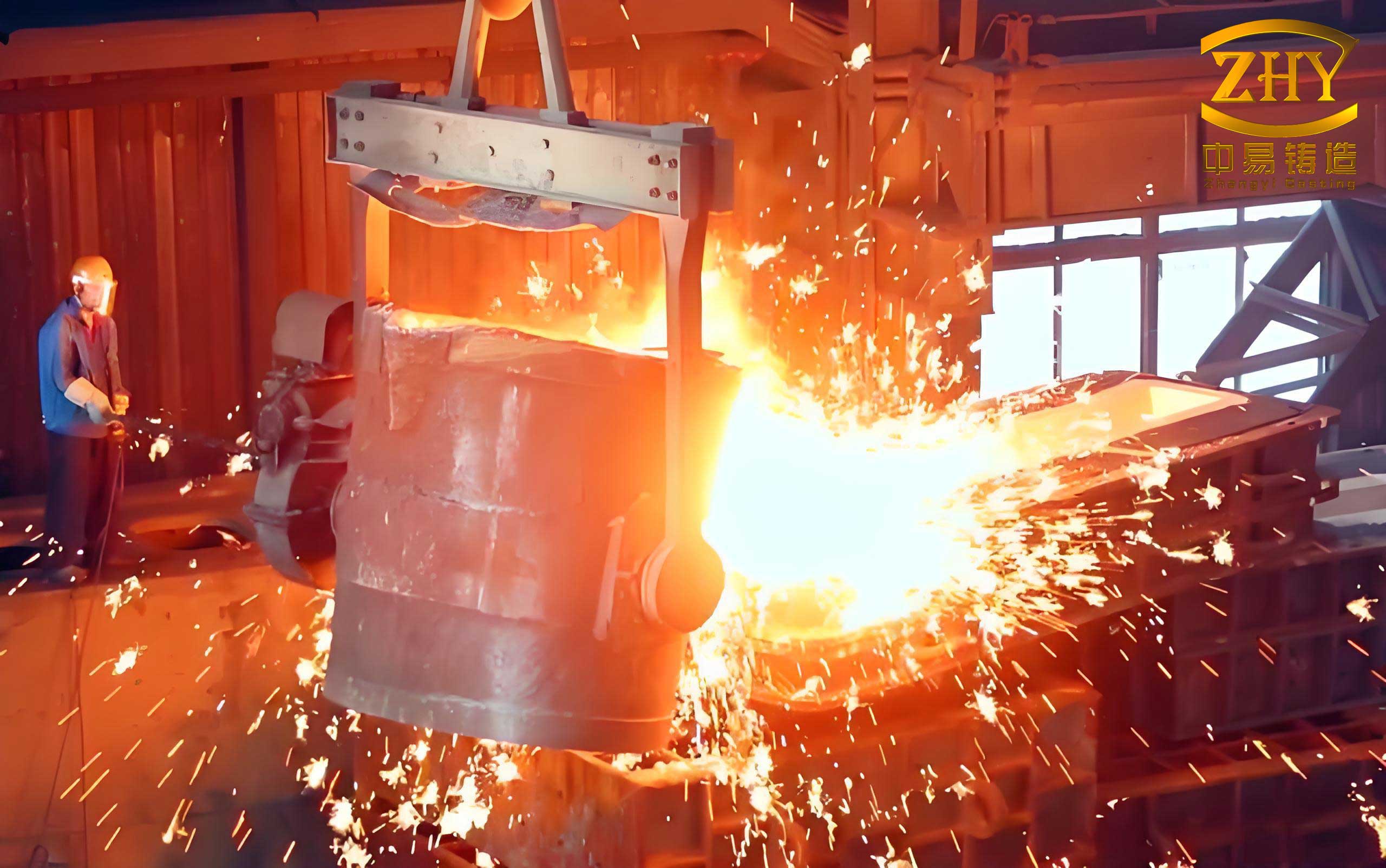
The casting process employs resin sand molding with a two-part flask, producing two casting parts per mold. Melting is conducted using a medium-frequency induction furnace. To achieve dense casting parts, a combined feeding system using chills and risers is adopted. Numerical simulation with MAGMA software is performed to optimize the gating and feeding system. The pouring temperature is set at 1380°C. Solidification simulation analysis confirms that the feeding is sufficient, with no apparent shrinkage defects predicted. The progressive solidification sequence shows a directional solidification pattern toward the risers, ensuring the integrity of the casting parts.
The success of high-integrity casting parts heavily relies on precise chemical composition design. Each element plays a critical role in the solidification behavior, graphite formation, and the subsequent austempering response.
- Carbon (C): Carbon is a graphitizing element. A higher carbon content in ductile iron helps inhibit the precipitation of cementite, increases the liquid expansion during solidification, thereby reducing the tendency for shrinkage cavities and porosity, and improves the casting soundness of the casting parts. Carbon also stabilizes austenite, retards the bainitic transformation, and influences the lower temperature limit of upper bainite. It decisively affects the stability of retained austenite. The general range is ω(C) = 3.6%–3.8%.
- Silicon (Si): Silicon increases the eutectoid temperature and broadens the eutectoid transformation temperature range. It shortens the incubation period for pearlitic and bainitic transformations, thus reducing hardenability, but delays the transformation completion time. Silicon promotes the bainitic transformation, forming fine acicular bainite, which enhances the mechanical properties of the casting parts. Higher silicon content in ADI improves toughness and provides a wider heat treatment window. A key advantage of silicon is its inhibition of carbide precipitation during the bainitic transformation, allowing the nucleation and growth of acicular ferrite without accompanying carbide formation. Typically, ω(Si) = 2.3%–2.7% for ADI casting parts.
- Manganese (Mn): Manganese expands the austenite region, decreases the decomposition rate of undercooled austenite, increases austenite stability, shifts the C-curve to the right, and significantly improves hardenability. It also separates the high-temperature and medium-temperature transformation regions and distinctly divides the upper and lower bainite transformation zones. Manganese notably lowers the Ms (martensite start) temperature and inhibits the formation of lower bainite. The detrimental effect of manganese on the mechanical properties of ADI casting parts stems from its uneven distribution. Manganese exhibits positive segregation during eutectic solidification, leading to martensite-austenite mixtures at the cell boundaries after austempering, which severely impairs the plasticity and toughness of the casting parts. Therefore, manganese should be controlled to ω(Mn) ≤ 0.3%.
- Phosphorus (P): Excessive phosphorus leads to the formation of phosphide eutectic, severely deteriorating toughness and ductility. Each 0.01% increase in phosphorus raises the brittle transition temperature by approximately 4–4.5°C. Thus, phosphorus must be tightly controlled at ω(P) ≤ 0.03% for high-quality casting parts.
- Sulfur (S): Sulfur is an anti-nodularizing element. High sulfur content severely deteriorates graphite morphology. For ductile iron casting parts, ω(S) ≤ 0.015% is standard.
- Magnesium (Mg): Magnesium is crucial for nodularization. Excessive residual magnesium can impair casting fluidity and increase shrinkage tendency, while insufficient levels lead to poor nodularity. The residual magnesium in the molten iron is typically controlled within ω(Mg) 0.035%–0.05% for these casting parts.
- Alloying Elements (Cu, Ni): Copper and nickel exhibit negative segregation during eutectic solidification, helping to counteract the microstructural inhomogeneity caused by the positive segregation of elements like molybdenum or manganese. Both elements shift the C-curve to the right, enhancing the hardenability of the casting parts. They retard austenite decomposition, reduce the sensitivity of the bainitic transformation product to time, expand the austenite region, form solid solutions without forming carbides, and lower the cold brittleness transition temperature. A combination of Cu and Ni is often most effective. For this thick-section casting part, the recommended ranges are ω(Cu) 0.8%–0.9% and ω(Ni) 1.6%–1.8%.
The designed chemical composition for the front axle casting parts is summarized in Table 1.
| C | Si | Mn | P | S | Mg | RE | Cu | Ni |
|---|---|---|---|---|---|---|---|---|
| 3.7-3.8 | 2.4-2.6 | 0.2-0.3 | ≤ 0.03 | ≤ 0.015 | 0.035-0.05 | 0.01-0.03 | 0.8-0.9 | 1.6-1.8 |
The melting and treatment processes are critical for achieving the target composition and microstructure in the final casting parts.
Charge Materials: To minimize trace interference elements and low-melting-point elements that cause grain boundary segregation, raw material quality is strictly controlled. High-purity pig iron (e.g., Q10 or high-purity pig iron) and high-quality carbon steel scrap are used to restrict the contents of Mn, P, S, and trace elements.
High-Temperature Holding: Molten iron is superheated to a temperature between 1520°C and 1540°C and held for 5-10 minutes. This high-temperature holding purifies the melt by allowing inclusions to float out. Research indicates that superheating to 1528°C significantly reduces oxide inclusions compared to 1483°C. This practice is essential for producing clean molten iron for high-integrity casting parts.
Molten Iron Pretreatment: Pretreatment with high-purity silicon carbide (SiC, >95% purity) is performed to refine the austenite dendrites and significantly increase the graphite nodule count in the final casting parts. The mechanism involves SiC promoting the nucleation of austenite dendrites. During solidification in the interdendritic regions, carbon atoms diffuse from the austenite/liquid interface into the liquid, creating carbon-enriched zones that facilitate graphite nucleation. Thus, dendrite refinement promotes graphite nucleation. Approximately 0.2% SiC (1-5 mm granules) is added to the molten iron 5-10 minutes before tapping.
Inoculation Practice: A four-stage inoculation strategy is employed to ensure a robust and fading-resistant inoculation effect, crucial for achieving fine and uniform graphite in the thick sections of the casting parts.
- Pretreatment: As described, using 0.2% SiC.
- Ladle Inoculation: During tapping for spheroidization, 0.4%-0.6% of a Si-Ca-Ba inoculant (3-8 mm granules) is added.
- Stream Inoculation: During pouring, 0.05%-0.1% of a fine-grained Si-Bi inoculant (0.2-0.7 mm) is added via a feeder.
- In-Mold Inoculation: Special inoculation blocks are placed in the gating system, upstream of the filter, to provide late-stage nucleation within the mold cavity, ensuring excellent graphite morphology throughout the casting parts.
The effectiveness of inoculation can be related to the undercooling and nucleation rate. A simplified model for nodule count (N) considers the effect of inoculant particles:
$$ N = k_I \cdot C_I \cdot \exp\left(-\frac{\Delta G^*}{k_B T}\right) $$
where \( k_I \) is a constant related to inoculant efficiency, \( C_I \) is the effective inoculant concentration, \( \Delta G^* \) is the critical nucleation energy barrier, \( k_B \) is Boltzmann’s constant, and \( T \) is temperature. The multi-stage approach maximizes \( C_I \) at different solidification stages.
Spheroidization Treatment: The nodularization process uses a tundish cover method. Pure lanthanum-based nodulizer (1-5, 5-25 mm granules) is added at 1.3%-1.4%. Lanthanum-based nodulizers help reduce shrinkage porosity and the tendency for chunky graphite formation in thick-section casting parts. The treatment temperature is carefully controlled between 1450°C and 1480°C. The nodulizer is placed in a pocket at the bottom of the treatment ladle and covered with inoculant. Tapping is performed avoiding direct impact on the nodulizer, with a fast initial rate followed by a slower rate to ensure smooth reaction and high magnesium recovery.
The residual magnesium content is vital and can be estimated based on the initial sulfur content and nodulizer addition. An approximate mass balance is:
$$ [Mg]_{res} \approx [Mg]_{added} – \alpha [S]_{initial} – \beta $$
where \( \alpha \) and \( \beta \) account for Mg consumed in desulfurization and other losses.
The heat treatment cycle is designed to transform the as-cast ferritic-pearlitic matrix of the ductile iron casting parts into the desired ausferritic structure. The process involves three main steps:
- Austenitization: The casting parts are heated to 900°C ± 10°C and held for 2 hours to achieve a homogeneous, carbon-saturated austenitic microstructure. The time is sufficient for the thick sections of the casting parts.
- Rapid Quenching: The casting parts are swiftly transferred and quenched into a salt bath maintained at 300°C ± 5°C to rapidly cool them to the isothermal transformation temperature.
- Isothermal Holding: The casting parts are held at this temperature for 2 hours. During this period, the austenite transforms into acicular ferrite (bainitic ferrite) and high-carbon stabilized austenite, forming the ausferrite microstructure. Finally, the casting parts are air-cooled to room temperature.
The transformation kinetics can be described by the Johnson-Mehl-Avrami-Kolmogorov (JMAK) equation for the fraction transformed (X):
$$ X(t) = 1 – \exp\left(-(k t)^n\right) $$
where \( k \) is a rate constant dependent on temperature and composition, \( t \) is time, and \( n \) is the Avrami exponent. For the bainitic transformation in ADI, \( n \) typically ranges from 1 to 2.
To verify the process, samples are taken from the critical thick section (45 mm wall) of the heat-treated casting parts. Metallographic examination and mechanical testing are conducted.
Metallographic Structure: The microstructure reveals well-dispersed, spherical graphite nodules with a nodularity exceeding 90% and a nodule count greater than 100 nodules/mm². The matrix consists of a typical ausferritic structure – dark etching acicular ferrite laths interspersed with interlath retained austenite. No significant carbide precipitation or martensite is observed, indicating a successful austempering process for these casting parts.
Mechanical Properties: The tensile, impact, and hardness properties of the casting parts are summarized in Table 2. All values meet and exceed the stringent requirements for ADI 1050-6 grade.
| Property | Requirement | Actual Value |
|---|---|---|
| Tensile Strength (Rm) | ≥ 970 MPa | 1098 MPa |
| Yield Strength (Rp0.2) | ≥ 700 MPa | 758 MPa |
| Elongation (A) | ≥ 3 % | 10.0 % |
| Impact Energy (Unnotched) | ≥ 80 J | 122 J |
| Hardness (HBW) | 302 – 380 | 309 – 310 |
The remarkable combination of strength and ductility in these casting parts can be attributed to the ausferritic microstructure. The strength is derived from the fine acicular ferrite, while the high toughness and elongation benefit from the presence of stable, film-like retained austenite between the ferrite laths. The relationship between microstructure and properties can be explored using composite models. For instance, the yield strength (\( \sigma_y \)) of the ADI casting parts can be approximated by a rule of mixtures considering the ferrite (\( \sigma_f \)) and austenite (\( \sigma_\gamma \)) phases:
$$ \sigma_y \approx V_f \sigma_f + V_\gamma \sigma_\gamma $$
where \( V_f \) and \( V_\gamma \) are the volume fractions of ferrite and retained austenite, respectively. The high silicon content suppresses carbide formation, allowing the austenite to remain stable and contribute to ductility via the TRIP (Transformation Induced Plasticity) effect under strain.
The successful development and mass production of these high-performance front axle casting parts demonstrate the effectiveness of the integrated approach. The use of chills and risers in the casting design effectively eliminated shrinkage defects, ensuring the soundness of the casting parts. The carefully balanced chemical composition, coupled with rigorous molten iron pretreatment, multi-stage inoculation, and controlled spheroidization, provided the foundation for excellent as-cast graphite morphology and composition uniformity. Finally, the precisely controlled salt bath austempering heat treatment transformed the matrix into the optimal ausferritic structure, unlocking the full potential of the ADI 1050-6 grade for these demanding casting parts.
This case underscores the importance of a holistic view in manufacturing advanced casting parts. Every step—from alloy design and melting practice to mold design and heat treatment—must be meticulously planned and controlled. The synergy between robust casting processes and tailored heat treatment is essential for producing lightweight, high-strength, and high-toughness ADI casting parts that meet the evolving demands of modern machinery and automotive industries. The methodologies developed here can be adapted and scaled for producing other complex, high-integrity ADI casting parts, contributing significantly to product lightweighting and performance enhancement initiatives. Future work may focus on further optimizing the process windows, exploring alternative alloying systems for even thicker casting parts, and implementing real-time process monitoring to ensure consistent quality across all production batches of these critical casting parts.