
The pursuit of high-integrity, near-net-shape castings has driven the widespread adoption of Lost Foam Casting (LFC) technology. This process is particularly advantageous for complex geometries, offering significant benefits such as the elimination of cores and parting lines, excellent dimensional accuracy, and a reduced environmental footprint due to sand reclamation. Ductile iron casting, renowned for its combination of strength and ductility, is a prime candidate for this process. However, the inherent complexity of LFC, where a foam pattern vaporizes upon contact with molten metal, introduces unique challenges in process control. A critical parameter governing the final quality of a ductile iron casting produced via LFC is the internal mold cavity pressure during filling. Unstable or improperly controlled filling pressure can lead to a host of defects, including surface turbulence, gas porosity, folds, and cold shuts, ultimately compromising the mechanical properties and surface finish of the casting.
Traditional control methodologies, such as Proportional-Integral (PI) control, have been applied to regulate process variables in foundries. However, their performance in managing the highly dynamic and non-linear pressure transients within an LFC mold can be suboptimal, leading to significant tracking errors. This work delves into the formulation of a mathematical model for cavity pressure evolution and investigates the implementation of a Programmable Logic Controller (PLC)-based control system to precisely regulate the filling pressure for ductile iron castings. Through simulation and comparative analysis, we demonstrate the superior capability of a PLC system in maintaining stable pressure conditions, thereby ensuring a laminar metal front and minimizing defect formation in the final ductile iron casting.
The Lost Foam Casting Process for Ductile Iron
The production of a ductile iron casting via the Lost Foam process is a sequence of meticulously controlled steps. The entire workflow can be summarized in the following stages, which are crucial for understanding the context in which pressure control is applied:
- Pattern Production: Expandable polystyrene (EPS) or similar foam beads are expanded and fused within an aluminum die to create a precise replica of the desired ductile iron casting, including the gating and feeding systems.
- Cluster Assembly: Multiple foam patterns (e.g., the part and its gates/risers) are assembled using hot-melt adhesives to form a complete cluster or tree ready for coating.
- Coating Application: The assembled foam cluster is dipped or sprayed with a refractory ceramic coating. This coating serves multiple purposes: it provides a smooth surface finish for the ductile iron casting, enhances the pattern’s strength for handling, and creates a permeable barrier that allows decomposed gases to escape while containing the liquid metal.
- Coating Drying: The coated cluster is placed in a controlled drying oven to remove all moisture from the ceramic slurry, ensuring coating integrity.
- Molding: The dried cluster is positioned in a flask, which is then filled with unbonded, dry sand. The flask is subjected to vibration to achieve high and uniform compaction around the intricate geometry of the pattern. A plastic film is placed over the flask, and a vacuum is applied to the sand mass, rigidizing it and creating the negative-pressure environment critical for the process.
- Pouring: Molten ductile iron is poured into the sprue cup. As the metal advances, the foam pattern thermally decomposes into gaseous and liquid products. The applied vacuum extracts these products through the coating and the permeable sand, allowing the metal to faithfully replicate the foam’s shape, resulting in the ductile iron casting.
- Cooling & Shakeout: After the ductile iron casting solidifies, the vacuum is released. The sand is dumped out, and the casting cluster is removed for cleaning, which includes the removal of the gating system and any residual coating.
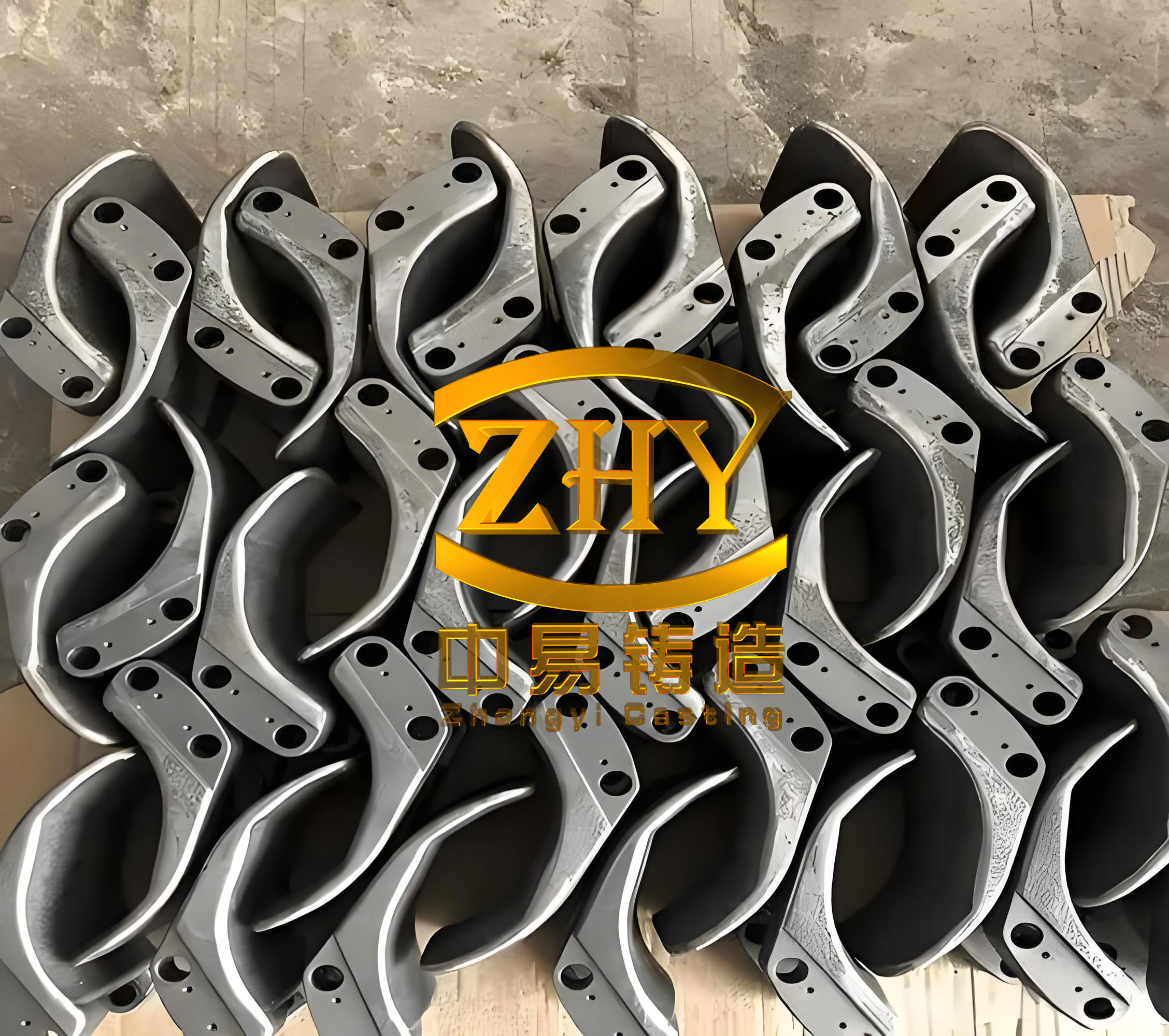
The success of this entire operation, especially during the pouring stage (Step 6), hinges on maintaining an optimal pressure differential. This brings us to the core challenge: modeling and controlling the transient gas pressure within the cavity during the filling of a ductile iron casting.
Mathematical Modeling of Cavity Pressure in Lost Foam Casting
To design an effective control system, a fundamental understanding of the physics governing pressure generation and release is essential. We develop a mathematical model for the gas pressure in the narrow gap (δ) between the advancing molten ductile iron and the receding foam pattern. The analysis is based on the following reasonable assumptions:
- The mold assembly (sand, coating) is a homogeneous, porous medium with isotropic permeability.
- Gas flow through the coating is one-dimensional, laminar, and follows Darcy’s law.
- The gases generated behave as ideal gases.
- The permeability of the sand and coating remains constant, and the gas temperature in the gap is constant (at an elevated decomposition temperature).
Consider a time increment dτ. The net change in gas mass within the gap, dG1, is the difference between the mass generated from foam decomposition, dGn, and the mass vented out through the coating, dGτ:
$$ dG_1 = (dG_n – dG_{\tau}) d\tau $$
Expressing this in terms of volumetric flow at standard conditions (density ρ0):
$$ \frac{dG_1}{\rho_0} = \left( \frac{dG_n}{\rho_0} – \frac{dG_{\tau}}{\rho_0} \right) d\tau $$
The mass of gas vented in time dτ is given by:
$$ dG_{\tau} = \rho_{\tau} v_{\tau} \delta S d\tau $$
where ρτ is the gas density in the gap, vτ is the gas velocity, δ is the gap thickness, and S is the perimeter of the metal-foam interface. Applying Darcy’s Law for flow through a porous medium (the coating):
$$ v_{\tau} = -C \frac{dP_{\phi}}{dy} $$
Here, C is the permeability of the coating, μ is the gas viscosity, and dPφ/dy is the pressure gradient across the coating thickness. Using the ideal gas law, ρτ = (MmolPφ)/(R Tφ), where Mmol is the molar mass, R is the universal gas constant, and Tφ is the gas temperature in the gap. Substituting into the equation for dGτ yields:
$$ dG_{\tau} = \frac{M_{mol} C \delta S}{2 \mu T_{\phi} R} \cdot \frac{d(P_{\phi}^2)}{dy} d\tau $$
The pressure gradient can be approximated linearly across the coating thickness l, from the gap pressure Pφ to the cavity pressure Ps:
$$ \frac{d(P_{\phi}^2)}{dy} = \frac{P_{\phi}^2 – P_s^2}{l} $$
Thus, the volumetric flow rate of vented gas at standard conditions becomes:
$$ \frac{dG_{\tau}}{\rho_0} = dV = \frac{273 C \delta S (P_{\phi}^2 – P_s^2)}{2 \mu T_{\phi} P_0 l} d\tau $$
The volumetric rate of gas generation from foam decomposition is often empirically modeled as a power function of time:
$$ \frac{dG_n}{\rho_0} = dV_n = \phi \alpha F \tau^{\phi-1} d\tau $$
where φ and α are decomposition constants, and F is the current area of the metal-foam interface. Substituting the expressions for dV and dVn into the net change equation gives:
$$ dV_1 = \left[ \phi \alpha F \tau^{\phi-1} – \frac{273 C \delta S (P_{\phi}^2 – P_s^2)}{2 \mu T_{\phi} P_0 l} \right] d\tau $$
This net change must equal the increase in gas volume stored in the gap itself over time dτ. The stored volume change, dV2, considering the ideal gas law, is:
$$ dV_2 = \frac{273 \delta F}{P_0 T_{\phi}} dP_{\phi} $$
Setting dV1 = dV2 and rearranging, we obtain the differential equation governing the gap pressure Pφ:
$$ \frac{dP_{\phi}}{d\tau} = \frac{P_0 T_{\phi}}{273 \delta F} \left[ \phi \alpha F \tau^{\phi-1} – \frac{273 C \delta S (P_{\phi}^2 – P_s^2)}{2 \mu T_{\phi} P_0 l} \right] $$
For a stable filling process in ductile iron casting, the gap pressure should reach a quasi-steady state (dPφ/dτ ≈ 0). Solving for Pφ under this condition provides a key relationship between the controlled cavity pressure Ps and the process parameters:
$$ P_{\phi} = \sqrt{ P_s^2 + \frac{2 \mu T_{\phi} P_0 l \phi \alpha F \tau^{\phi-1}}{273 C \delta S} } $$
This model highlights that the pressure experienced at the metal front (Pφ) is a function of the cavity vacuum level (Ps), foam decomposition kinetics, and the venting characteristics of the coating/sand system. Precise control of Ps is therefore paramount to managing the entire filling dynamics for a high-quality ductile iron casting.
The Imperative for Precise Filling Pressure Control in Ductile Iron Casting
The consequences of poor pressure control during the LFC of ductile iron are severe. The following table summarizes the primary defects associated with incorrect cavity pressure levels:
| Cavity Pressure Condition | Effect on Metal Flow | Resulting Defects in Ductile Iron Casting |
|---|---|---|
| Excessively Low Pressure (High Vacuum) | Very rapid, turbulent filling. Increased “wall attachment” or “inverse waterfall” effect. | Cold shuts, folds, erosion of coating leading to sand inclusions, excessive porosity from entrapped pyrolysis liquids. |
| Excessively High Pressure (Low Vacuum) | Sluggish, uneven filling. Incomplete foam degradation. | Gas porosity (from trapped decomposition gases), misruns, poor surface finish (carbonaceous residue). |
| Unstable, Fluctuating Pressure | Erratic metal velocity, stops and starts. | Laps, cold shuts, non-uniform microstructure, variable mechanical properties. |
The goal is to maintain a cavity pressure profile that promotes a steady, laminar advance of the molten ductile iron, allowing for complete foam decomposition and efficient gas evacuation. This requires a control system that can dynamically adjust the vacuum level in response to the changing conditions during the pour. Traditional PI controllers, while simple, often struggle with the set-point tracking required for this nonlinear, time-varying process, leading to the error patterns previously discussed. This necessitates a more robust and programmable approach.
PLC-Based Control System for Filling Pressure Regulation
A Programmable Logic Controller (PLC) offers a superior framework for managing the complex task of pressure control in ductile iron lost foam casting. Its advantages include high reliability in industrial environments, flexibility in programming complex control logic (beyond simple PID), seamless integration with various sensors and actuators, and the capability for data logging and supervisory communication.
The proposed PLC control system for regulating the mold cavity pressure during the pouring of a ductile iron casting involves the following core components and logic flow:
- Sensing: A high-response pressure transducer is installed in the mold cavity or the vacuum line to provide real-time feedback of the actual cavity pressure Ps, actual.
- Control Algorithm: The PLC’s CPU executes a user-defined program. This program compares the measured Ps, actual with a pre-programmed optimal pressure setpoint trajectory Ps, set(τ). The error e(τ) = Ps, set(τ) – Ps, actual(τ) is computed.
- Output Processing: Based on the error, the control algorithm (which can be an advanced PID with tuning, a fuzzy logic module, or a model-predictive routine) calculates a corrective output signal.
- Actuation: This output signal is sent from the PLC’s output module to the final control element, typically a high-speed proportional vacuum control valve or a variable-frequency drive (VFD) controlling the vacuum pump. The valve or pump speed modulates to precisely adjust the suction applied to the mold, thereby controlling Ps.
- Ancillary Control: The same PLC can integrate control over other critical pouring sequence events, such as starting/stopping the pouring conveyor, activating the vacuum pump, and managing safety interlocks, creating a fully automated pouring cell for ductile iron casting production.
The heart of the system’s effectiveness is the pre-programmed optimal pressure setpoint trajectory Ps, set(τ). This trajectory is not a constant value but a curve designed based on the gating design, pattern geometry, and the mathematical model described earlier. It might start at a moderate vacuum to initiate filling, increase (lower pressure) to maintain velocity as metal rises in the sprue, and then potentially modulate to account for changing foam interface area F during the fill. The PLC’s programmability allows for the implementation of such a dynamic setpoint with ease, a task that is cumbersome for a standard PI controller.
Simulation Analysis: PLC vs. PI Control Performance
To quantitatively evaluate the benefits of a PLC-based control strategy for ductile iron lost foam casting, we conducted a simulation study using MATLAB/Simulink. The simulation incorporated the derived pressure dynamics model and represented both a conventional PI controller and a PLC implementing a more sophisticated control algorithm (e.g., a gain-scheduled PI or a simple model-based compensator). The key parameters for the simulated ductile iron casting scenario are listed below:
| Parameter | Symbol | Value | Unit |
|---|---|---|---|
| Pouring Temperature | Tpour | 1390 | °C |
| Metal Volume | Vm | 4.5 × 10⁻³ | m³ |
| Cast Density (Ductile Iron) | ρiron | 7.1 × 10³ | kg/m³ |
| Pattern Surface Area | Spattern | 0.52 | m² |
| Target Fill Time | τfill | 20 | s |
| Coating Thickness | l | 0.25 | mm |
| Coating Permeability | C | 1.5 × 10⁻¹² | m&sup4/(Pa·s) |
| Gas Viscosity | μ | 1.2 × 10⁻⁵ | Pa·s |
The simulation tracked the pressure tracking error, defined as Error(τ) = Ps, set(τ) – Ps, actual(τ), over the 20-second filling period for the ductile iron casting.
Results for PI Control: The simulation of the PI-controlled system showed significant limitations. The controller exhibited notable overshoot at the start of the pour as it reacted to the initial pressure drop. Throughout the fill, it struggled to perfectly track the dynamic setpoint, resulting in a persistent, oscillating error. The root-mean-square (RMS) error was relatively high. This oscillatory pressure would translate into an unsteady metal flow front, increasing the risk of turbulence-related defects in the final ductile iron casting.
Results for PLC-based Advanced Control: In contrast, the PLC-based system demonstrated markedly superior performance. The pressure error was significantly reduced in magnitude. The response was faster and more damped, eliminating the large overshoot. The actual cavity pressure Ps, actual adhered closely to the desired setpoint trajectory Ps, set throughout the entire pouring cycle. The RMS error was calculated to be less than half that of the PI control system. This level of precision ensures a stable, predictable pressure differential driving the fill, which is critical for achieving laminar flow and high-quality ductile iron casting surfaces.
The comparative summary of key performance indicators is presented below:
| Performance Metric | PI Control System | PLC-based Control System |
|---|---|---|
| Maximum Overshoot | High (>15% of setpoint) | Low (<5% of setpoint) |
| Steady-State Error Oscillation | Significant (± 8-10 Pa) | Minimal (± 2-3 Pa) |
| Settling Time | Long | Short |
| RMS Tracking Error | High | Low (Reduction > 50%) |
| Implied Metal Flow | Unsteady, Turbulent-prone | Stable, Laminar-promoting |
Conclusion and Industrial Implications
The production of high-integrity ductile iron castings via the Lost Foam process demands exceptional control over the filling stage. This work has established a foundational mathematical model linking cavity pressure to foam decomposition and gas venting physics. More importantly, it has demonstrated, through rigorous simulation, the compelling advantages of implementing a Programmable Logic Controller (PLC)-based system for pressure regulation over traditional PI control.
The PLC’s architecture provides the necessary flexibility, robustness, and computational capability to execute advanced control strategies that can dynamically track an optimal pressure setpoint trajectory. As shown, this results in significantly lower pressure tracking errors, which directly translates to a more stable and laminar advance of molten ductile iron. For the foundry engineer, this means a direct reduction in defect rates associated with erratic filling—such as gas porosity, cold shuts, folds, and poor surface finish. The consistency afforded by precise PLC control also contributes to more uniform microstructures and mechanical properties across production runs of ductile iron castings.
Future work in this domain will focus on the real-time integration of additional sensory data (e.g., metal temperature, sand compaction) into the PLC’s decision-making algorithm, potentially employing adaptive or model-predictive control schemes for even greater precision. The ultimate goal is a fully autonomous, self-optimizing pouring system that guarantees the highest quality for every single ductile iron casting produced, solidifying LFC’s position as a leading advanced manufacturing technology.