
As a researcher focused on advanced materials for heavy-duty applications, I have been deeply involved in the development of low temperature high strength ductile iron casting. This material is crucial for components in high-power locomotives, electric multiple units, wind turbines, subway systems, nuclear power plants, and machinery operating in frigid environments such as petroleum and mining equipment. The market potential for this high-tech, high-value-added material is vast. However, compared to conventional ductile iron casting, its production is more challenging and technologically demanding. Since 2008, our team has conducted a series of studies on the YJ105A traction motor frame made from low temperature high strength ductile iron casting, achieving significant progress. After mastering key technologies for producing low temperature high strength ductile iron casting (published separately) and using domestic raw materials for the YJ105A frame (also published separately), we successfully developed a nickel-free variant of this ductile iron casting.
Nickel (Ni) is a critical element in traditional low temperature high strength ductile iron casting, as it enhances the low-temperature toughness of ferrite and lowers the ductile-to-brittle transition temperature. Consequently, conventional methods often incorporate Ni to improve low-temperature properties, especially impact toughness. However, Ni’s high cost increases production expenses. To reduce costs and improve economic efficiency, we embarked on a study to produce a Ni-free low temperature high strength ductile iron casting for the YJ105A traction motor frame. Our findings indicate that by strictly controlling the metallurgical quality of molten iron, optimizing the contents of elements such as C, Si, Mn, Ca, Ba, Re, and S—particularly limiting manganese content below 0.15%—and employing high-quality nodulizers and inoculants alongside stringent casting processes and enhanced parameter detection methods, the production of Ni-free low temperature high strength ductile iron casting for the YJ105A frame is feasible.
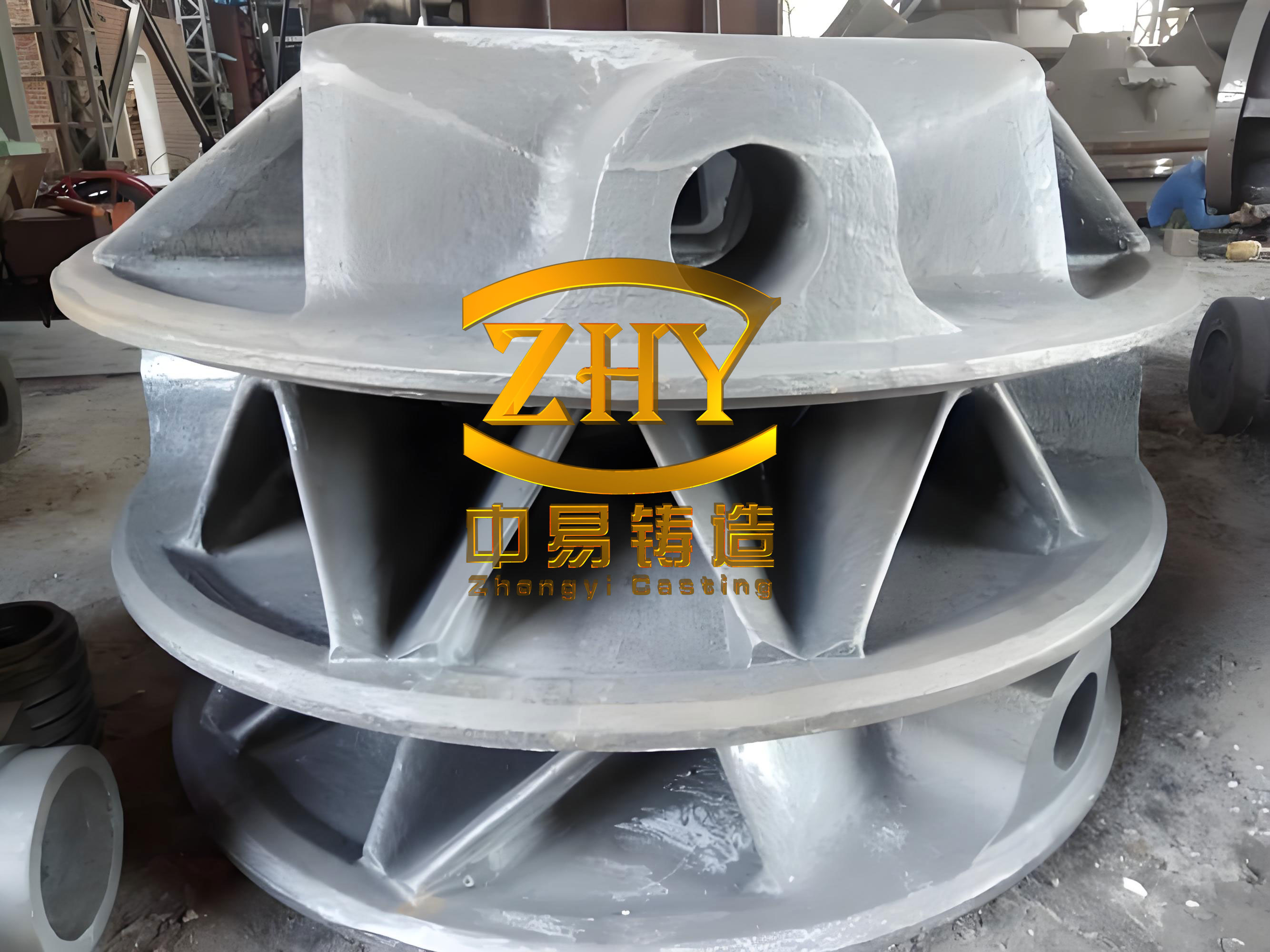
The success of this ductile iron casting project hinges on meticulous material selection and compositional design. We prioritized raw materials that ensure high purity and consistency, as detailed in Table 1. For instance, we used Linzhou low-titanium pig iron, whose chemical composition is shown in Table 2. The optimized composition for the Ni-free low temperature high strength ductile iron casting YJ105A traction motor frame is presented in Table 3. This formulation is designed to achieve the desired mechanical properties without relying on Ni, making the ductile iron casting more cost-effective.
| Raw Material Name | Specification/Type |
|---|---|
| Pig Iron | Linzhou Low-Ti Pig Iron |
| Return Material | Low Temperature Ductile Iron Return Material |
| Scrap Steel | High-Quality A3 Steel |
| Carburizer | Imported High-Quality Low-S Carburizer from the USA |
| Nodulizer | Domestic BS-6 Type High-Quality Nodulizer |
| Inoculant | Domestic BS-1A Type High-Quality Inoculant |
| Pig Iron Grade | C | Si | Mn | P | S |
|---|---|---|---|---|---|
| Ball 12 (Q12) | 3.8–4.6 | 1.00–1.40 | >0.20–0.50 | ≤0.05 | ≤0.02 |
| Element | Range |
|---|---|
| C | 3.6–3.9 |
| Si | 1.6–2.0 |
| Mn | 0.1–0.3 |
| Cu | 0.3–0.6 |
| P | ≤0.03 |
| S | ≤0.02 |
In our approach to ductile iron casting, the experimental methodology was rigorously defined to ensure reproducibility and quality. The process began with metal melting and demanganization. We used a medium-frequency induction furnace, with a charge consisting of 50% to 60% scrap steel and low temperature ductile iron return material. High-quality low-sulfur carburizer and silicon carbide were added to adjust carbon and silicon levels. After complete melting at 1380–1420°C, we sampled the melt to determine manganese content, as shown in Table 4. To reduce manganese, we inserted a steel pipe (wall thickness 1.5–2 mm, sealed at both ends) filled with chromium trioxide powder (Cr₂O₃) into the molten metal. The Cr₂O₃ addition was 0.5% to 0.8% of the total melt weight. The temperature was then raised to 1600–1620°C and held for 3–5 minutes. Subsequently, carburizer equivalent to 1% of the melt weight was evenly sprinkled on the surface to compensate for carbon loss. After 3–5 minutes, the power was reduced, and upon cooling to 1500–1530°C, we resampled for manganese content, with results in Table 5. Once manganese levels met specifications, desulfurization proceeded.
| Sample | Manganese Content (%) |
|---|---|
| Test Value 1 | 0.41 |
| Test Value 2 | 0.38 |
| Test Value 3 | 0.39 |
| Average | 0.39 |
| Sample | Manganese Content (%) |
|---|---|
| Test Value 1 | 0.13 |
| Test Value 2 | 0.12 |
| Test Value 3 | 0.12 |
| Average | 0.12 |
Desulfurization was critical for this ductile iron casting. At 1500–1530°C, we added 0.4% to 0.6% dried soda ash (sodium carbonate) desulfurizer to the ladle bottom. The iron was poured slowly and uniformly into the ladle, followed by covering agent addition and thorough stirring. After reaction, slag was promptly removed, and the desulfurized iron was returned to the furnace for further refining. Sampling data for sulfur content after desulfurization are listed in Table 6. Upon chemical analysis and adjustment, the iron was tapped at 1490–1510°C.
| Heat Number | Sulfur Content (%) | Average (%) |
|---|---|---|
| 1 | 0.018; 0.017; 0.017 | 0.017 |
| 2 | 0.016; 0.015; 0.019 | 0.017 |
| 3 | 0.017; 0.015; 0.016 | 0.016 |
| 4 | 0.015; 0.016; 0.015 | 0.015 |
| 5 | 0.017; 0.016; 0.016 | 0.016 |
Nodulization treatment followed, essential for achieving the spherical graphite structure in ductile iron casting. The BS-6 nodulizer was crushed to 15–30 mm particles and placed in a recess on one side of the ladle bottom. The addition was 1.3% to 1.4% of the iron weight. It was covered with BS-1A inoculant, then with a mixture of charcoal and plant ash, and finally pressed with a 2–3 mm thick steel plate. During tapping, initially 1/2 to 2/3 of the iron was poured to initiate reaction; after boiling ceased, the remaining iron was added. Post-nodulization, slag removal agents were used to clear slag, and the temperature was maintained at 1450–1500°C.
Inoculation was performed in three stages to enhance graphite nucleation in this ductile iron casting. First, 0.7% BS-1A inoculant (by iron weight) covered the nodulizer. During tapping, 0.3% to 0.5% BS-1A inoculant was added via stream inoculation using a quantitative funnel until about 4/5 of the iron was in the ladle. Finally, during pouring, 0.2% to 0.3% BS-1A inoculant was added for instantaneous stream inoculation.
The casting process for this ductile iron casting was designed to optimize microstructure and minimize defects. We used furan resin sand molds with 1.0% to 1.2% resin addition to enhance mold rigidity. A bottom-gated, open gating system reduced oxidation during pouring. To slow cooling and promote ferrite formation, we increased mold wall thickness, avoided chills, and extended mold opening time. To improve metallurgical quality, we raised melting temperatures, extended holding times, and ensured at least 2 minutes of stillness after nodulization for slag flotation. Multiple covers and frequent slag removal were employed. A filter-equipped slag trap separated iron from slag, purifying the metal before mold entry. Additionally, we minimized elements that cause grain boundary segregation, oxide, and sulfide formation.
Heat treatment was applied to eliminate carbides and phosphide eutectics, which harm low-temperature toughness in ductile iron casting. The thermal cycle, illustrated in Figure 1, involved heating to 890–920°C for 3–5 hours, cooling to 720–750°C for 3–5 hours, then slow cooling at less than 100°C/h to 580°C before air cooling. This process increased ferrite content and improved toughness.
The results from our ductile iron casting trials were promising. Microstructural examination data are summarized in Table 7, showing excellent nodularity and high ferrite content. Mechanical properties at -50°C, presented in Table 8, meet the required standards for low temperature high strength ductile iron casting. The microstructure, as observed, consists of fine graphite nodules in a ferritic matrix, confirming the efficacy of our approach.
| Sample ID | Nodularity Grade (Level) | Graphite Size (Level) | Ferrite Content (%) |
|---|---|---|---|
| 1# | 2 | 6 | 95 |
| 2# | 2 | 6 | 97 |
| 3# | 2 | 6 | 96 |
| Sample ID | Tensile Strength (MPa) | Elongation (%) | Yield Strength (MPa) | Low-Temperature Impact Value (J) |
|---|---|---|---|---|
| 1# | 404 | 23 | 263 | 12.4 |
| 412 | 22 | 256 | 13.7 | |
| 403 | 25 | 268 | 12.8 | |
| Average: 406.3 | Average: 23.3 | Average: 262.3 | Average: 13.0 | |
| 2# | 412 | 26 | 228 | 13.1 |
| 415 | 25 | 260 | 12.6 | |
| 407 | 26 | 252 | 13.8 | |
| Average: 411.3 | Average: 25.7 | Average: 246.7 | Average: 13.2 | |
| 3# | 413 | 22 | 238 | 13.7 |
| 411 | 26 | 242 | 13.5 | |
| 410 | 24 | 258 | 14.1 | |
| Average: 411.3 | Average: 24.0 | Average: 246.0 | Average: 13.8 | |
Analysis of these ductile iron casting results underscores the importance of controlling sulfur and manganese contents. The desulfurization process reduced sulfur to 0.015–0.017%, allowing lower nodulizer usage and minimizing Mg or Re ion segregation at grain boundaries, which benefits low-temperature toughness. Manganese control was even more critical; our demanganization method consistently lowered manganese below 0.15%. Research indicates that manganese raises the ductile-to-brittle transition temperature; for every 0.1% increase in manganese, the transition temperature rises by 10–12°C. We can express this relationship mathematically for ductile iron casting:
$$ T_{b} = T_{0} + k \cdot [\text{Mn}] $$
where \( T_{b} \) is the ductile-to-brittle transition temperature, \( T_{0} \) is the base transition temperature, \( [\text{Mn}] \) is the manganese content in weight percent, and \( k \) is a constant ranging from 10 to 12°C per 0.1% Mn. By keeping manganese low, we significantly improved impact toughness. Additionally, process modifications like slower cooling, higher melting temperatures, extended holding times, and iron filtration contributed to the success of this ductile iron casting. Thus, despite omitting Ni, our Ni-free low temperature high strength ductile iron casting achieved target performance.
Further insights into ductile iron casting can be gained by considering the role of carbon equivalent (CE) in microstructure formation. The carbon equivalent for ductile iron casting is often calculated as:
$$ \text{CE} = \%\text{C} + \frac{1}{3}\%\text{Si} $$
For our composition, CE ranges from approximately 4.13 to 4.57, which favors graphite formation and reduces chilling tendencies. The high ferrite content, as seen in Table 7, aligns with this, enhancing low-temperature ductility in our ductile iron casting.
In conclusion, the production of Ni-free low temperature high strength ductile iron casting for the YJ105A traction motor frame is achievable through stringent control of metallurgical quality, precise element management—especially manganese below 0.15%—and the use of premium nodulizers and inoculants coupled with rigorous casting protocols and enhanced detection methods. This advance in ductile iron casting technology offers a cost-effective solution for demanding low-temperature applications, broadening the scope of ductile iron casting in industries such as transportation and energy. Future work may explore further optimization of alloying elements and processing parameters to push the boundaries of ductile iron casting performance.
Reflecting on this journey in ductile iron casting, I emphasize that continuous innovation in material science is key to overcoming challenges like cost and performance. The ductile iron casting field benefits greatly from such studies, as they pave the way for more sustainable and economical manufacturing. By sharing these findings, I hope to contribute to the global knowledge base on ductile iron casting, inspiring further research and development in this vital area of metallurgy.