
In the realm of advanced engineering materials, the demand for high-performance ductile iron casting has escalated, driven by applications requiring superior mechanical properties such as elevated tensile strength, yield strength, and elongation. Traditional production methods often struggle to achieve this balance, particularly for grades like EN-GJS-500-14 and EN-GJS-600-10 specified in the EN1563:2012 standard. This study delves into a novel approach leveraging silicon solution strengthening to produce ferritic ductile iron casting with enhanced characteristics. By optimizing chemical composition, melt treatment, and inoculation processes, we aim to meet stringent standards while improving cost-efficiency through increased scrap utilization. The integration of tables and formulas will elucidate key parameters, and the discussion will emphasize the repeated importance of ductile iron casting in modern manufacturing.
The EN1563:2012 standard outlines mechanical property requirements for ductile iron casting, as summarized in Table 1. For EN-GJS-500-14, a minimum tensile strength (Rm) of 500 MPa, yield strength (Rp0.2) of 400 MPa, and elongation (A) of 14% are mandated for sections up to 30 mm. Similarly, EN-GJS-600-10 requires Rm ≥ 600 MPa, Rp0.2 ≥ 470 MPa, and A ≥ 10%. These specifications necessitate a microstructure predominantly of ferrite, achieved via solution strengthening—a process where solute atoms like silicon induce lattice strain, impeding dislocation movement and thereby enhancing strength without compromising ductility. This principle is fundamental to advancing ductile iron casting technology.
| Material Grade | Section Thickness t (mm) | Rm (MPa) | Rp0.2 (MPa) | A (%) |
|---|---|---|---|---|
| EN-GJS-500-14 | t ≤ 30 | 500 | 400 | 14 |
| 30 ≤ t ≤ 60 | 480 | 390 | 12 | |
| t > 60 | Negotiated between supplier and customer | |||
| EN-GJS-600-10 | t ≤ 30 | 600 | 470 | 10 |
| 30 ≤ t ≤ 60 | 580 | 450 | 8 | |
| t > 60 | Negotiated between supplier and customer | |||
Solution strengthening in ductile iron casting can be modeled using the following relationship, where the increase in yield strength due to silicon addition is approximated by:
$$\Delta \sigma_{y} = k \cdot C_{Si}^{n}$$
Here, $\Delta \sigma_{y}$ represents the yield strength increment, $C_{Si}$ is the silicon concentration in weight percent, $k$ is a material constant, and $n$ is an exponent typically around 0.5 for interstitial solutes. For ferritic ductile iron casting, silicon atoms dissolve in the iron matrix, causing lattice distortion that hinders dislocation glide. The effectiveness of this mechanism depends on precise control of alloying elements, as explored in subsequent sections.
Chemical composition is pivotal in producing high-quality ductile iron casting. Based on extensive trials, we established optimal ranges for key elements, considering their effects on graphite nodularity, matrix structure, and mechanical properties. Carbon equivalent (CE) significantly influences fluidity and shrinkage compensation; we targeted CE between 4.4% and 4.5%, calculated as:
$$CE = C + \frac{1}{3}(Si + P)$$
where C, Si, and P are weight percentages. This range ensures excellent castability for ductile iron casting components. Carbon content, critical for graphite formation, was maintained at 3.0–3.4% to avoid graphite floating and ensure adequate magnesium absorption. Silicon, the primary strengthening agent, was elevated to 3.5–4.4% for EN-GJS-600-10 and 2.6–3.0% for EN-GJS-500-14, leveraging its solid solution effects. However, excessive silicon beyond 5% can degrade properties, necessitating careful balance. Manganese, a pearlite promoter, was minimized below 0.2% to retain a ferritic matrix. Phosphorus and sulfur, detrimental impurities, were restricted to ≤0.04% and ≤0.02%, respectively, to prevent embrittlement and interference with nodularization. Residual magnesium (0.04–0.06%) and rare earth (0.01–0.02%) were controlled to secure spheroidal graphite formation. Table 2 consolidates these compositional guidelines for ductile iron casting production.
| Element | EN-GJS-600-10 | EN-GJS-500-14 |
|---|---|---|
| C | 3.00–3.20 | 3.20–3.40 |
| Si | 3.20–4.40 | 2.60–3.00 |
| Mn | < 0.20 | < 0.20 |
| P | ≤ 0.05 | ≤ 0.05 |
| S | ≤ 0.02 | ≤ 0.02 |
| Mgres | 0.04–0.06 | 0.04–0.06 |
| Reres | 0.01–0.02 | 0.01–0.02 |
The melting process for ductile iron casting employed high-purity raw materials: low-titanium pig iron, quality steel scrap, and increased returns (up to 40%) to reduce costs. Charging sequence prioritized pig iron, returns, and scrap to ensure dense packing and efficient melting. Table 3 details the charge composition, highlighting the economic advantage of this approach for ductile iron casting.
| Material | Percentage (%) |
|---|---|
| Pig Iron | 50 |
| Steel Scrap | 10 |
| Returns | 40 |
Spheroidization was conducted using a SiMgRe alloy (composition: 44–47% Si, 5.5–6.5% Mg, 1.8–2.4% Re) added at 1.2–1.4% via the sandwich method. The alloy was placed in the ladle, covered with ductile iron chips and steel plates, and treated with molten iron at temperatures below 1500°C to minimize magnesium loss. This step is crucial for achieving spherical graphite in ductile iron casting. Inoculation followed with BaSi alloy (70–75% Si, 2.0–3.0% Ba) at 0.8% addition through stream inoculation, enhancing graphite nucleation and matrix uniformity. The synergy between spheroidization and inoculation ensures consistent properties in ductile iron casting.
To validate the process, we cast Y25, Y50, and Y75 samples according to standard practices, allowing natural cooling in sand molds below 100°C before extraction. Tensile and metallographic tests were performed, with results for EN-GJS-500-14 and EN-GJS-600-10 shown in Tables 4 and 5. The data confirm that silicon levels between 3.5% and 4.4% effectively strengthen the ferritic matrix, meeting EN1563:2012 requirements. For instance, EN-GJS-600-10 exhibited tensile strengths up to 650 MPa and elongations exceeding 10%, while EN-GJS-500-14 achieved over 500 MPa tensile strength with elongations above 14%. Nodularity exceeded 90%, and ferrite content was >95%, underscoring the success of this ductile iron casting methodology.
| Trial | Sample | C (%) | Si (%) | Rm (MPa) | Rp0.2 (MPa) | A (%) | Nodularity (%) | Ferrite (%) |
|---|---|---|---|---|---|---|---|---|
| 1 | Y25 | 3.21 | 3.51 | 543 | 426 | 14.5 | 91 | >95 |
| Y50 | 3.13 | 3.56 | 523 | 412 | 16.2 | 90 | >95 | |
| Y75 | 3.22 | 3.54 | 510 | 399 | 17.0 | 90 | >95 | |
| 2 | Y25 | 3.22 | 3.66 | 550 | 434 | 16.3 | 93 | >95 |
| Y50 | 3.23 | 3.56 | 524 | 412 | 18.2 | 91 | >95 | |
| Y75 | 3.14 | 3.58 | 510 | 404 | 18.5 | 92 | >95 | |
| 3 | Y25 | 3.24 | 3.62 | 545 | 422 | 18.1 | 92 | >95 |
| Y50 | 3.10 | 3.58 | 538 | 411 | 17.9 | 90 | >95 | |
| Y75 | 3.19 | 3.57 | 515 | 392 | 20.1 | 91 | >95 |
| Trial | Sample | C (%) | Si (%) | Rm (MPa) | Rp0.2 (MPa) | A (%) | Nodularity (%) | Ferrite (%) |
|---|---|---|---|---|---|---|---|---|
| 1 | Y25 | 3.08 | 4.25 | 650 | 546 | 16.2 | 93 | >95 |
| Y50 | 3.11 | 4.32 | 624 | 531 | 15.0 | 91 | >95 | |
| Y75 | 3.06 | 4.27 | 611 | 509 | 13.3 | 91 | >95 | |
| 2 | Y25 | 3.03 | 4.33 | 638 | 532 | 18.0 | 92 | >95 |
| Y50 | 3.06 | 4.35 | 620 | 512 | 13.5 | 93 | >95 | |
| Y75 | 3.04 | 4.38 | 618 | 504 | 12.5 | 91 | >95 | |
| 3 | Y25 | 2.97 | 4.42 | 642 | 523 | 16.1 | 90 | >95 |
| Y50 | 3.00 | 4.39 | 636 | 511 | 14.9 | 90 | >95 | |
| Y75 | 3.09 | 4.43 | 615 | 510 | 12.5 | 91 | >95 |
Analysis of the results reveals a direct correlation between silicon content and mechanical performance in ductile iron casting. The strengthening effect can be quantified using a modified Hall-Petch-type relation adapted for solution strengthening:
$$\sigma_{y} = \sigma_{0} + K_{Si} \cdot C_{Si}^{1/2} + K_{d} \cdot d^{-1/2}$$
where $\sigma_{y}$ is the yield strength, $\sigma_{0}$ is the lattice friction stress, $K_{Si}$ is the silicon strengthening coefficient, $C_{Si}$ is silicon concentration, $K_{d}$ is the grain boundary strengthening coefficient, and $d$ is the grain size. In ferritic ductile iron casting, silicon elevates $\sigma_{0}$ by impeding dislocation motion, while fine graphite nodules (controlled by inoculation) contribute to $d$ effects. The data from Tables 4 and 5 align with this model, showing higher strengths at elevated silicon levels without sacrificing elongation, thanks to the ferritic matrix. This balance is essential for applications like automotive components or machinery parts where ductile iron casting is preferred for its durability and castability.
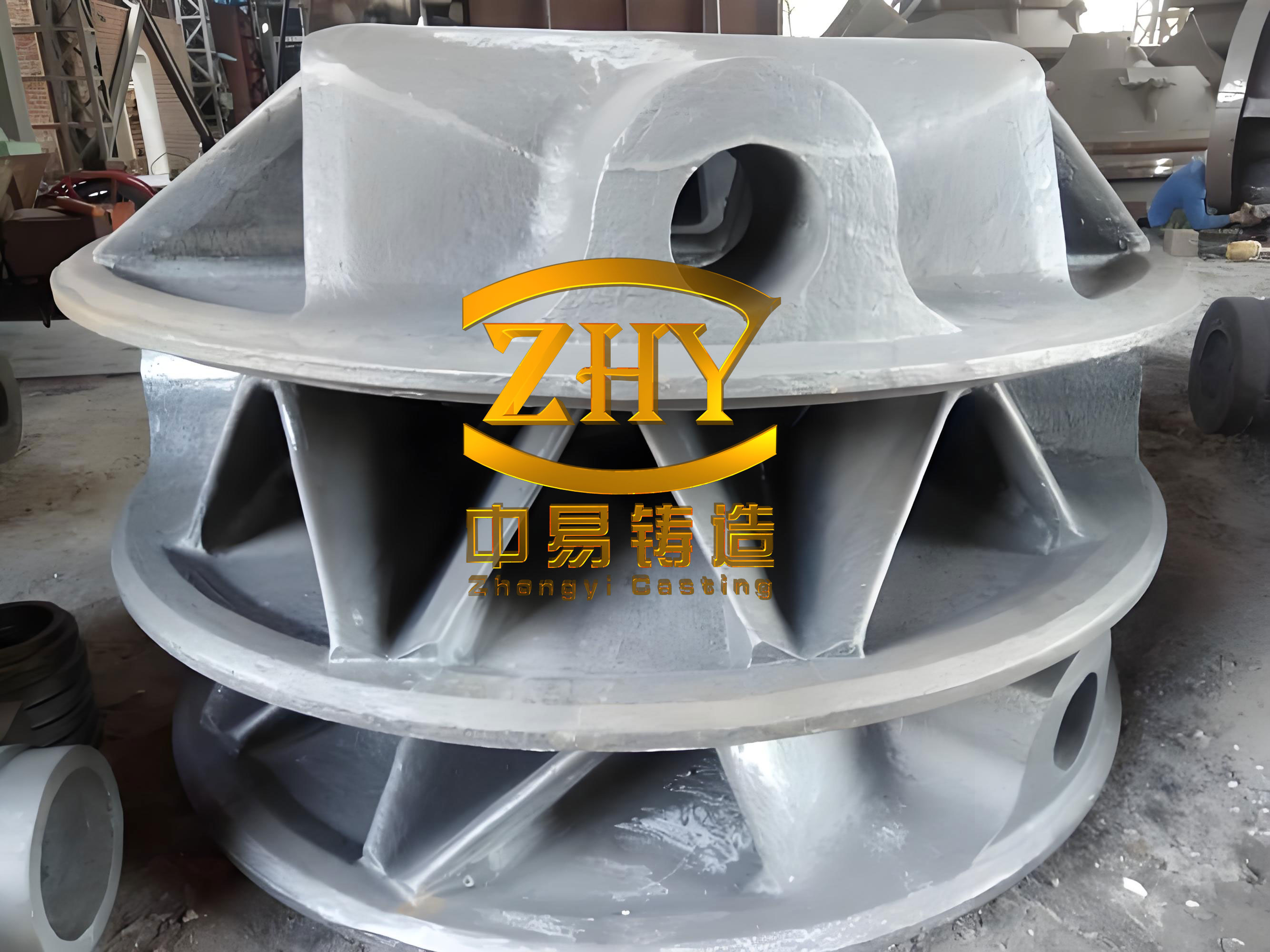
The economic benefits of this process are noteworthy. By incorporating up to 40% returns, material costs are reduced, enhancing the sustainability of ductile iron casting production. The high silicon content allows for greater flexibility in charge composition, as returns often contain residual elements that can be offset by silicon’s strengthening effect. This approach not only meets performance standards but also promotes resource efficiency, a key consideration in modern foundries specializing in ductile iron casting.
Further optimization can be explored through computational modeling. For instance, the solidification behavior of ductile iron casting can be simulated using thermodynamic software to predict phase formation and silicon distribution. The Gulliver-Scheil equation approximates microsegregation during solidification:
$$C_{s} = k \cdot C_{0} \cdot (1 – f_{s})^{k-1}$$
where $C_{s}$ is the solute concentration in the solid, $k$ is the partition coefficient, $C_{0}$ is the initial concentration, and $f_{s}$ is the solid fraction. For silicon in ductile iron casting, $k > 1$, leading to enrichment in the residual liquid and potential segregation. Controlling cooling rates and inoculation mitigates this, ensuring uniform properties. Such models aid in scaling up the process for industrial ductile iron casting applications.
In conclusion, the high silicon solution strengthened ferritic ductile iron casting process successfully achieves the mechanical properties outlined in EN1563:2012. By maintaining silicon between 3.5% and 4.4%, employing precise spheroidization and inoculation, and optimizing charge composition, we produce ductile iron casting with tensile strengths exceeding 600 MPa and elongations over 10%. The method leverages solid solution strengthening to enhance both strength and ductility, a rare combination in traditional ductile iron casting. Moreover, the increased use of returns lowers production costs, making this approach economically viable. Future work could focus on refining alloy designs for even higher performance grades of ductile iron casting, potentially incorporating other solutes like copper or nickel for synergistic effects. This research underscores the versatility and potential of ductile iron casting as a advanced engineering material, driven by innovative processing techniques.
Throughout this study, the term “ductile iron casting” has been emphasized to highlight its central role in achieving high-performance outcomes. The integration of tables and formulas provides a comprehensive framework for understanding the interplay between composition, processing, and properties in ductile iron casting. As industries demand materials with superior mechanical characteristics, processes like high silicon solution strengthening will become increasingly vital for ductile iron casting manufacturers, enabling them to meet evolving standards while maintaining cost-effectiveness and sustainability.