
In the pursuit of advancing wind energy technology, the demand for larger and more efficient wind turbines has necessitated the development of robust and reliable materials for critical components. As a materials engineer specializing in cast metals, I have focused on enhancing the properties of ductile iron casting, which is widely recognized as an ideal material for wind power castings due to its excellent wear resistance, damping capacity, notch insensitivity, superior castability, and cost-effectiveness. However, with the trend toward larger wind turbine components—where section thicknesses often exceed 200 mm—conventional ductile iron casting grades, such as QT400-18AL, face significant challenges. These include poor graphite spheroidization, reduced graphite nodule count, the formation of chunky graphite, severe compositional segregation, persistent carbides, coarse grain structures, and defects like black spots and shrinkage porosity. While process optimizations like controlled cooling and heat treatments offer some mitigation, they often fall short of achieving the required balance of strength and toughness without escalating costs. This has driven my research toward alloying strategies to develop a high-strength, high-toughness ductile iron casting material suitable for low-temperature applications in wind power, aiming to reduce section sizes and mitigate quality issues inherent in thick-walled castings.
The core of my approach lies in the strategic alloying of a base ductile iron casting composition similar to QT400-18AL. The selection of alloying elements was guided by the need to enhance tensile strength, yield strength, and elongation while preserving or improving low-temperature impact toughness—a critical requirement for wind turbine components operating in harsh environments. I incorporated nickel (Ni), niobium (Nb), and a trace amount of zirconium (Zr) based on their metallurgical benefits. Nickel is known to lower the ductile-to-brittle transition temperature, thereby improving low-temperature toughness. Niobium is a potent grain refiner and solid-solution strengthener that boosts mechanical properties without adversely affecting impact resistance. Zirconium, added in minimal quantities, acts as a deoxidizer and grain refiner, further promoting a clean and fine microstructure conducive to toughness. The precise composition I developed is summarized in the table below, which formed the foundation for all subsequent trials and evaluations.
| Element | C | Si | Mn | P | S | Mg | RE | Ni | Nb | Zr |
|---|---|---|---|---|---|---|---|---|---|---|
| Content | 3.5–3.7 | 2.0–2.3 | < 0.2 | < 0.02 | < 0.015 | < 0.04 | < 0.03 | 0.3–0.5 | 0.1–0.3 | 0.01–0.03 |
The material preparation followed a standardized melting and treatment process. First, a charge consisting of pig iron, returns, and steel scrap was melted in a furnace to produce the base iron. Carbon content was then adjusted through recarburization to meet the target range. Subsequently, the molten iron underwent spheroidization, inoculation, and alloying treatments. Niobium was added in the form of crushed ferroniobium to ensure dissolution, given its high melting point relative to iron, while nickel was introduced as pure metal or master alloy. Zirconium was incorporated via a silicon-zirconium inoculant. The treated iron was poured into molds to produce test blocks, specifically 300 mm x 300 mm x 300 mm cubes with attached 70 mm thick coupons for property evaluation, simulating the thermal conditions of thick-section ductile iron casting components. The successful pouring and shakeout of these blocks confirmed the viability of the alloying approach in a foundry setting.
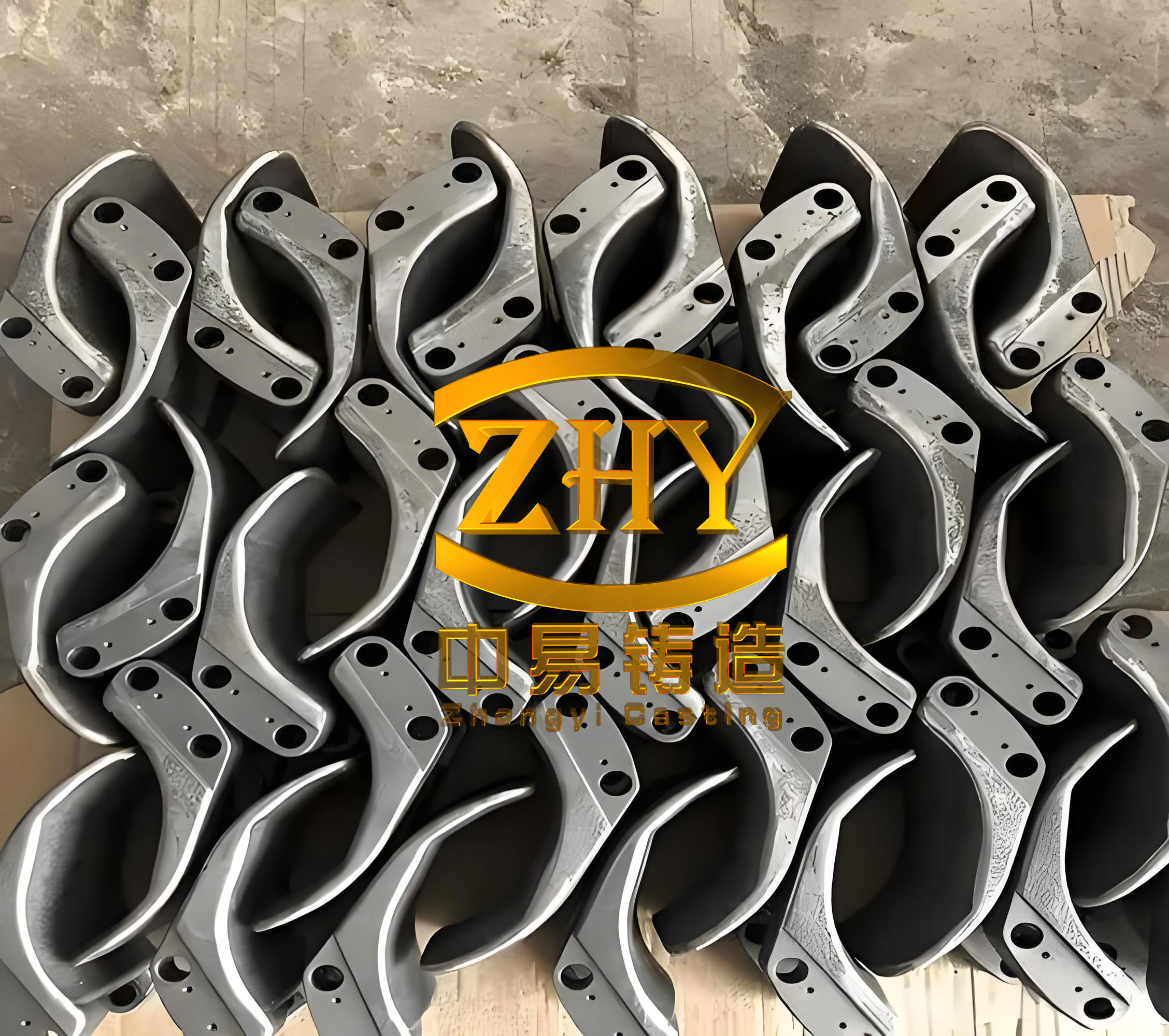
Comprehensive testing was conducted on specimens extracted from the coupons to evaluate the enhanced ductile iron casting material. The room-temperature tensile properties, assessed according to standard test methods, revealed a significant improvement over conventional grades. The results from three representative samples are tabulated below, demonstrating consistent performance.
| Sample No. | Tensile Strength (MPa) | Yield Strength (MPa) | Elongation (%) |
|---|---|---|---|
| 1 | 402.9 | 276.9 | 21.3 |
| 2 | 401.5 | 272.2 | 21.7 |
| 3 | 408.1 | 271.0 | 21.6 |
The microstructure, a critical determinant of properties in any ductile iron casting, was examined metallographically. The graphite morphology showed a well-defined spheroidal form with a high nodule count, rated as Grade 2 with a spheroidization rate exceeding 90% and a graphite size of Grade 6. The matrix was predominantly ferritic (≥90%), with minimal carbides (≤1%) and phosphide eutectic (≤0.5%), indicating an excellent response to the alloying and inoculation treatments. This fine, ferritic matrix is instrumental in achieving the combination of strength and ductility. The relationship between microstructure and yield strength can be conceptualized through a Hall-Petch type equation for ductile iron casting, where grain refinement contributes to strength:
$$\sigma_y = \sigma_0 + k_y \cdot d^{-1/2}$$
Here, $\sigma_y$ is the yield strength, $\sigma_0$ is the friction stress, $k_y$ is the strengthening coefficient, and $d$ is the average grain diameter. The addition of Nb and Zr promotes grain refinement, effectively reducing $d$ and increasing $\sigma_y$, while Ni enhances matrix toughness.
Low-temperature impact toughness is paramount for wind power ductile iron casting exposed to sub-zero temperatures. Charpy V-notch tests were performed at -20°C and -30°C. The results, presented in the following table, confirm that the material meets stringent impact energy requirements, surpassing typical benchmarks for such applications.
| Test Temperature (°C) | Impact Absorbed Energy Values (J) | Average Impact Absorbed Energy (J) |
|---|---|---|
| -20 | 12.9, 13.2, 13.1 | 13.1 |
| -30 | 10.7, 11.3, 10.4 | 10.8 |
Fatigue performance, critical for components subjected to cyclic wind loads, was evaluated under fully reversed axial loading (stress ratio R = -1) with a run-out limit set at 107 cycles. The fatigue limit was determined using the staircase (up-and-down) method. A stress increment of 10 MPa was used over 15 specimens. The data and resulting staircase plot led to the estimation of the fatigue endurance limit at 50% probability of failure. The test data and results are consolidated below.
| Specimen No. | Maximum Stress (MPa) | Cycles to Failure or Run-out | Result |
|---|---|---|---|
| 001 | 200 | 1.30×10⁶ | Failure |
| 002 | 190 | 1.00×10⁷ | Run-out |
| 003 | 200 | 1.00×10⁷ | Run-out |
| 004 | 210 | 6.59×10⁵ | Failure |
| 005 | 200 | 7.73×10⁵ | Failure |
| 006 | 190 | 1.00×10⁷ | Run-out |
| 007 | 200 | 1.81×10⁶ | Failure |
| 008 | 190 | 3.66×10⁶ | Failure |
| 009 | 180 | 1.00×10⁷ | Run-out |
| 010 | 190 | 1.00×10⁷ | Run-out |
| 011 | 200 | 1.00×10⁷ | Run-out |
| 012 | 210 | 5.21×10⁶ | Failure |
| 013 | 200 | 1.36×10⁶ | Failure |
| 014 | 190 | 1.00×10⁷ | Run-out |
| 015 | 200 | 1.00×10⁷ | Run-out |
From the staircase data, the fatigue limit (σFL) at 50% failure probability was calculated to be 196 MPa. To construct the S-N curve, additional fatigue tests were conducted at various stress levels. The combined dataset, including the endurance limit, allows for the modeling of fatigue life. The S-N relationship for this ductile iron casting can be expressed by the Basquin equation:
$$\sigma_a = \sigma_f’ (2N_f)^b$$
where $\sigma_a$ is the stress amplitude, $\sigma_f’$ is the fatigue strength coefficient, $N_f$ is the number of cycles to failure, and $b$ is the fatigue strength exponent. Fitting the experimental data yields the S-N curve presented in the table and subsequent plot below.
| Specimen No. | Maximum Stress (MPa) | Cycles to Failure (Nf) |
|---|---|---|
| 016 | 200 | 5.31×10⁶ |
| 017 | 200 | 1.50×10⁶ |
| 018 | 200 | 6.84×10⁵ |
| 019 | 220 | 6.43×10⁵ |
| 020 | 220 | 8.04×10⁵ |
| 021 | 220 | 9.35×10⁵ |
| 022 | 260 | 3.46×10⁵ |
| 023 | 260 | 4.63×10⁵ |
| 024 | 260 | 3.66×10⁵ |
| 025 | 290 | 6.31×10⁴ |
| 026 | 290 | 1.68×10⁵ |
| 027 | 290 | 1.14×10⁵ |
| 028 | 320 | 6.57×10⁴ |
| 029 | 320 | 5.20×10⁴ |
| 030 | 320 | 1.89×10⁴ |
The fitted S-N curve for this ductile iron casting material, representing median fatigue life, is characterized by parameters derived from regression analysis. The enhanced fatigue strength is a direct benefit of the fine microstructure and solid solution strengthening provided by Ni and Nb, which impede crack initiation and propagation in the ductile iron casting matrix.
The practical application of this advanced ductile iron casting material in wind power components, such as hubs, bedplates, and frames, offers transformative benefits. First, the superior mechanical properties allow for downsizing and lightweight design. By leveraging the higher strength and toughness, wall thicknesses can be reduced by approximately 15% compared to components made from conventional QT400-18AL ductile iron casting. This weight reduction alleviates issues related to slow cooling in thick sections, thereby minimizing microstructural defects like carbide formation and graphite degradation. Consequently, the inherent quality of the ductile iron casting is improved, leading to more reliable performance. Furthermore, lightweight components reduce raw material consumption, lower transportation and handling costs, and positively impact the overall structural loads and dynamics of the wind turbine assembly. The alloying approach, while adding modest cost for Ni and Nb, is offset by these savings and performance gains, making it a economically viable strategy for high-integrity ductile iron casting production.
In implementing this material, specific foundry practices must be considered. For instance, ferroniobium must be finely crushed to ensure complete dissolution in the iron melt. The overall melting and treatment process remains consistent with standard ductile iron casting production, ensuring easy adoption in existing foundries. The material’s compliance with international standards for low-temperature impact toughness positions it as a reliable replacement for QT400-18AL in demanding wind power applications, bridging the performance gap between standard ferritic grades and higher-strength but less tough alternatives.
In conclusion, the alloying of ductile iron casting with nickel and niobium, complemented by trace zirconium inoculation, has proven highly effective in developing a high-strength, high-toughness material suitable for wind power components. The experimental results demonstrate a substantial enhancement in tensile properties (over 400 MPa tensile strength, over 270 MPa yield strength, and over 21% elongation) while maintaining excellent low-temperature impact energy (exceeding 10 J at -30°C) and a fatigue endurance limit of 196 MPa under fully reversed loading. The microstructure is characterized by superior graphite spheroidization and a fine ferritic matrix, which are fundamental to this performance synergy. This advanced ductile iron casting material enables the design of lighter, more reliable wind turbine castings, directly addressing the challenges posed by large section sizes. It offers a pragmatic solution that enhances component quality, reduces weight, and contributes to the overall efficiency and durability of wind energy systems, marking a significant step forward in the metallurgy of ductile iron casting for renewable energy applications.