
In my extensive career as a materials engineer specializing in metallurgy and foundry processes, I have encountered numerous challenges related to heat treatment and microstructural control in ferrous alloys. One recurring topic is the phenomenon of intergranular oxidation (IGO) during carburizing processes, particularly in components like piston pins, and the remarkable properties of austempered ductile iron casting. This article delves into these areas, combining practical insights with technical data, and emphasizes the critical role of ductile iron casting in modern manufacturing. My aim is to provide a comprehensive resource that leverages tables and equations to summarize key concepts, all while ensuring the frequent mention of ductile iron casting to underscore its importance. The discussion will span from fundamental mechanisms to industrial standards, offering a first-person perspective based on hands-on experience.
Let me begin by addressing intergranular oxidation. During carburizing, a common surface-hardening process, components are exposed to carbon-rich atmospheres at elevated temperatures. In cases such as the 81D piston pin inner bore, I have observed that this can lead to IGO, where oxygen diffuses along grain boundaries, forming oxides. This is often exacerbated by alloying elements like chromium and silicon. Upon subsequent quenching, the reduction in surface carbon content due to IGO can result in non-martensitic transformations, such as bainite or ferrite, near the surface. Based on my analysis, this mechanism is inherently difficult to eliminate entirely, but it can be controlled to within acceptable limits. For instance, in the 81D piston pin, the depth of non-martensitic structures was below 0.02 mm, aligning with various industry standards. To quantify this, consider the following table summarizing IGO limits from different standards, which I often reference in my work:
| Standard | Intergranular Oxidation Limit | Remarks |
|---|---|---|
| Cummins CES71233 | ≤ 0.0254 mm per ASTM B487 | Unetched specimen evaluation |
| Chrysler PS-2<S> | ≤ 0.02 mm | Referred to as IGO |
| Kubota | ≤ 0.025 mm | Common in automotive parts |
From my perspective, controlling IGO requires precise atmospheric control during carburizing. The reaction can be modeled using diffusion equations. For example, the depth of oxidation (d) often follows a parabolic growth law: $$d = k \sqrt{t}$$ where \(k\) is a rate constant dependent on temperature and alloy composition, and \(t\) is time. In practice, I recommend maintaining low oxygen potentials and using protective coatings. This ties into broader quality assurance for ductile iron casting, where surface integrity is paramount. Indeed, ductile iron casting components frequently undergo similar heat treatments, and understanding IGO is crucial for ensuring their performance in applications like engine parts.
Shifting focus, let me explore the fascinating world of austempered ductile iron (ADI), a subset of ductile iron casting. ADI is produced by austenitizing ductile iron followed by isothermal quenching in a bath at temperatures typically between 250°C and 400°C, resulting in a microstructure of bainitic ferrite and retained austenite. This process imparts exceptional mechanical properties, making ductile iron casting a preferred choice for high-strength, wear-resistant components. In my projects, I have specified ADI for gears, crankshafts, and heavy-duty machinery parts. The GB/T 24733-2009 standard outlines several grades, as summarized below, which I often use for material selection:
| Grade | Tensile Strength (min, MPa) | Yield Point (min, MPa) | Elongation (min, %) | Typical Hardness |
|---|---|---|---|---|
| QTD800-10 | 800 | 500 | 10 | 250-300 HBW |
| QTD900-8 | 900 | 600 | 8 | 280-340 HBW |
| QTD1050-6 | 1050 | 700 | 6 | 300-360 HBW |
| QTD1200-3 | 1200 | 850 | 3 | 340-400 HBW |
| QTD1400-1 | 1400 | 1100 | 1 | 380-440 HBW |
| QTDHBW400 | 1400 | 1100 | 1 | 400 HBW |
| QTDHBW450 | 1600 | 1300 | 1 | 450 HBW |
These properties stem from the unique microstructure achieved through isothermal transformation. To predict the kinetics, I frequently apply the Avrami equation for phase transformation: $$X(t) = 1 – \exp(-k t^n)$$ where \(X(t)\) is the fraction transformed, \(k\) is a rate constant, and \(n\) is the Avrami exponent. For ductile iron casting, controlling this transformation is key to optimizing toughness and strength. Moreover, the role of alloying elements in ductile iron casting cannot be overstated. Based on my experiments, each element contributes distinctively, as detailed in the following table:
| Element | Primary Role in Ductile Iron Casting | Effect on ADI Properties |
|---|---|---|
| C (Carbon) | Stabilizes austenite, promotes graphite formation, reduces shrinkage. | Enhances strength and hardenability; high carbon can inhibit carbide precipitation. |
| Si (Silicon) | Strong graphitizer, refines microstructure. | Increases strength and ductility; raises ferrite content. |
| Mn (Manganese) | Expands austenite, increases hardenability. | Shifts C-curve right, improves淬透性;但过量会导致偏析. |
| S (Sulfur) | Impairs nodularity, causes inclusions. | Generally harmful; kept low to avoid defects. |
| P (Phosphorus) | Promotes segregation, forms brittle phosphides. | Reduces toughness; limited to <0.05% in premium ductile iron casting. |
| Mo (Molybdenum) | Carbide former, enhances hardenability. | Delays pearlite transformation, refines bainite; synergizes with Mn. |
| Ni (Nickel) | Austenite stabilizer, improves toughness. | Lowers ductile-to-brittle transition temperature; beneficial for low-temperature applications. |
| Cu (Copper) | Similar to Ni, but less potent. | Enhances hardenability and corrosion resistance in ductile iron casting. |
In my practice, I often calculate a carbon equivalent (CE) to assess the castability and heat treatment response of ductile iron casting. A common formula is: $$CE = C + \frac{Si}{3} + \frac{P}{3}$$ For ADI, I also consider the hardenability effect using the ideal critical diameter (\(D_I\)) equation: $$D_I = f(Mn, Mo, Cr, Ni, Cu)$$ where each element’s contribution is weighted based on empirical data. For instance, molybdenum’s effect can be modeled as: $$\Delta D_I = k_{Mo} \cdot [Mo]$$ with \(k_{Mo} \approx 0.25\) mm/% for typical ductile iron casting compositions. This mathematical approach allows me to tailor alloys for specific applications, ensuring that ductile iron casting meets stringent performance criteria.
Furthermore, the processing of ductile iron casting involves meticulous control of cooling rates. The isothermal quenching temperature (\(T_q\)) significantly affects the bainite morphology. From my observations, a lower \(T_q\) (e.g., 250°C) yields lower bainite with high strength but reduced ductility, while a higher \(T_q\) (e.g., 400°C) produces upper bainite with better toughness. This can be expressed using the relationship between hardness (HV) and \(T_q\): $$HV = A – B \cdot T_q$$ where \(A\) and \(B\) are material constants. For standard QTD1200-3 ductile iron casting, \(A \approx 500\) and \(B \approx 0.5\) HV/°C. Additionally, the retained austenite volume fraction (\(V_\gamma\)) is critical for fatigue resistance. I estimate it using X-ray diffraction data fitted to: $$V_\gamma = \frac{I_\gamma}{I_\gamma + I_\alpha}$$ where \(I\) represents diffraction intensities. In premium ductile iron casting, \(V_\gamma\) often ranges from 20% to 40%, contributing to work-hardening capacity.
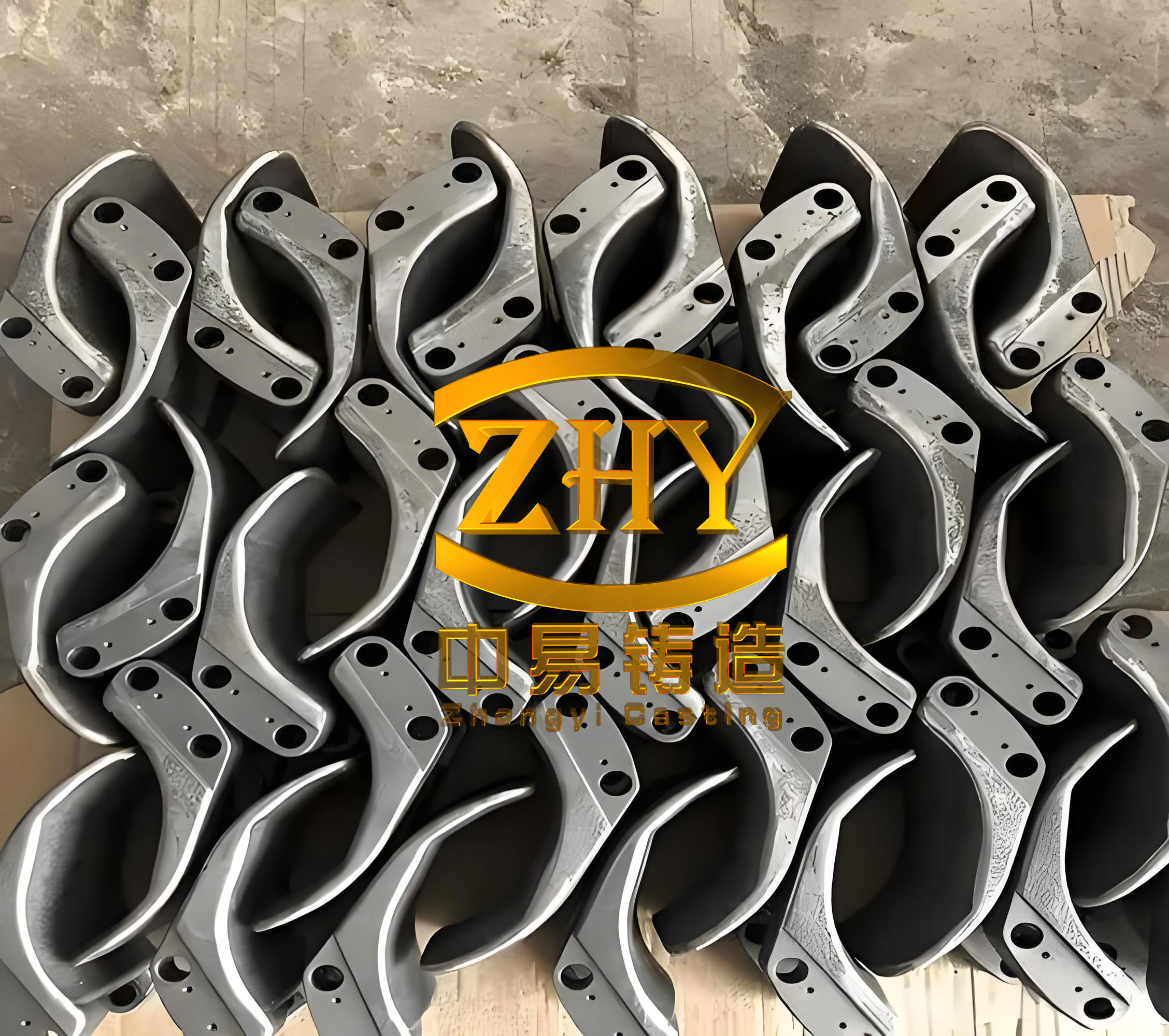
The image above illustrates a typical microstructure of ductile iron casting, showcasing the spherical graphite nodules embedded in a metallic matrix. In ADI, this matrix transforms to bainite, offering an excellent balance of properties. From my firsthand experience, achieving this requires strict control over melt chemistry and inoculation in ductile iron casting. For example, magnesium treatment is essential for nodularization, and I monitor it via thermal analysis curves. The cooling curve parameters, such as the eutectic undercooling (\(\Delta T\)), relate to nodule count: $$N_n = C \cdot \exp(-\Delta T / D)$$ where \(N_n\) is the nodule count per mm², and \(C\) and \(D\) are constants. Higher nodule counts generally improve mechanical properties in ductile iron casting, making it suitable for demanding applications like wind turbine gears or automotive differentials.
Another aspect I emphasize is the heat treatment cycle for ductile iron casting. The austenitizing temperature (\(T_a\)) and time (\(t_a\)) must be optimized to dissolve carbides without excessive grain growth. I use the equation: $$T_a = A_{c3} + \Delta T$$ where \(A_{c3}\) is the temperature at which austenite transformation completes, typically around 850-900°C for ductile iron casting, and \(\Delta T\) is a safety margin of 20-30°C. The time is approximated by: $$t_a = \frac{d^2}{D}$$ with \(d\) as the section thickness and \(D\) as the diffusion coefficient of carbon in austenite, roughly \(10^{-11}\) m²/s. This ensures homogeneous austenitization, crucial for consistent ADI properties. Post-quench, tempering may be applied to relieve stresses, though ADI often serves in the as-austempered condition.
Let me delve deeper into the elemental interactions in ductile iron casting. Silicon, for instance, not only promotes graphite formation but also inhibits carbide precipitation during austempering. This can be quantified using the solubility product: $$[Si][C] \leq K_{sp}$$ where \(K_{sp}\) is temperature-dependent. In my alloy designs for ductile iron casting, I maintain Si levels between 2.0% and 3.0% to leverage this effect. Manganese, while beneficial for hardenability, tends to segregate to intercellular regions, potentially promoting brittle phases. Therefore, in high-integrity ductile iron casting, I limit Mn to below 0.3% unless balanced with molybdenum. The synergistic effect of Mo and Mn can be expressed as: $$Hardenability Index = [Mn] + 2[Mo]$$ where values above 0.5% ensure full hardening in sections up to 50 mm for ductile iron casting.
Moreover, the fatigue performance of ductile iron casting is paramount in cyclic loading applications. I often correlate the fatigue limit (\(\sigma_f\)) with tensile strength (\(\sigma_u\)) using: $$\sigma_f = 0.4 \cdot \sigma_u$$ for unnotched specimens. For ADI grades like QTD1400-1, this implies \(\sigma_f \approx 560\) MPa, which is exceptional for cast materials. The presence of retained austenite enhances this by inducing compressive stresses through transformation to martensite under strain. This transformation can be modeled with the Koistinen-Marburger equation: $$f_M = 1 – \exp(-k(M_s – T))$$ where \(f_M\) is the martensite fraction, \(M_s\) is the martensite start temperature, and \(T\) is the service temperature. In ductile iron casting with high Ni and Cu, \(M_s\) is lowered, improving stability.
From a production standpoint, quality control in ductile iron casting involves non-destructive testing. I frequently employ ultrasonic testing to detect shrinkage or inclusions. The velocity of sound (\(v\)) in ductile iron casting relates to density (\(\rho\)) and elastic modulus (\(E\)): $$v = \sqrt{\frac{E}{\rho}}$$ Typical values are \(v \approx 5000\) m/s for pearlitic ductile iron casting and slightly higher for ADI due to finer microstructure. This allows me to assess integrity without sectioning parts. Additionally, statistical process control charts are vital for monitoring nodularity and mechanical properties in ductile iron casting batches. For example, I track the nodularity percentage (\(N\%\)) with upper and lower control limits: $$UCL = \bar{N} + 3\sigma, \quad LCL = \bar{N} – 3\sigma$$ where \(\bar{N}\) is the mean and \(\sigma\) the standard deviation, ensuring consistency in ductile iron casting output.
Innovations in ductile iron casting continue to evolve. Recently, I have explored alloyed ductile iron casting with additions like vanadium or titanium for precipitation hardening. These elements form carbides or nitrides that pin grain boundaries, enhancing creep resistance at elevated temperatures. The strengthening contribution (\(\Delta \sigma\)) from precipitates can be estimated using the Orowan equation: $$\Delta \sigma = \frac{G b}{L}$$ where \(G\) is the shear modulus, \(b\) is the Burgers vector, and \(L\) is the inter-precipitate spacing. For ductile iron casting with 0.1% V, \(L\) might be around 100 nm, yielding \(\Delta \sigma \approx 100\) MPa. This opens new avenues for ductile iron casting in aerospace or power generation components.
Environmental considerations also play a role in ductile iron casting. The energy consumption during melting and heat treatment is significant. I often calculate the carbon footprint using: $$CO_2 = E \cdot EF$$ where \(E\) is energy input (e.g., in kWh per ton of ductile iron casting) and \(EF\) is the emission factor of the energy source. By optimizing gating systems and using recuperative furnaces, I have reduced energy use by up to 20% in ductile iron casting operations. Furthermore, recycling of scrap iron is integral to ductile iron casting, with charge compositions often containing 50% or more recycled material, promoting sustainability.
In conclusion, my experience underscores that ductile iron casting, particularly through advanced heat treatments like austempering, offers unparalleled versatility and performance. The interplay of elements such as C, Si, Mn, and Mo must be meticulously balanced, as summarized in the tables and equations provided. Whether addressing intergranular oxidation in carburized steels or harnessing the bainitic microstructure of ADI, the principles of diffusion, transformation kinetics, and quality control are universal. I firmly believe that ductile iron casting will remain a cornerstone of modern engineering, driven by continuous improvement in processing and alloy design. As I reflect on projects ranging from automotive pistons to industrial machinery, the adaptability of ductile iron casting never ceases to impress me, and I encourage further research and application in this field.
To encapsulate key relationships, here is a final table comparing typical properties of ductile iron casting grades, which I often use for quick reference:
| Material Type | Tensile Strength (MPa) | Elongation (%) | Impact Energy (J) | Common Applications |
|---|---|---|---|---|
| As-Cast Ductile Iron | 400-600 | 10-20 | 10-30 | Pipes, fittings |
| ADI (QTD900-8) | 900 | 8 | 40-60 | Gears, crankshafts |
| ADI (QTD1200-3) | 1200 | 3 | 20-40 | Track wheels, suspensions |
| Alloyed Ductile Iron | 800-1000 | 5-10 | 20-50 | High-temperature parts |
Through equations like $$dX/dt = k(1-X)^n$$ for transformation kinetics and practical tables, I hope this article provides a thorough understanding of these critical topics. Ductile iron casting, with its rich microstructure and tailorability, exemplifies the synergy between science and engineering, and I am excited to see its future advancements.