
Lost foam casting, often hailed as a groundbreaking technology for the 21st century, has revolutionized the production of complex shell castings by enabling the creation of parts with superior surface finish, dimensional accuracy, and dense microstructure. In this study, I explore the application of numerical simulation using ProCAST software to optimize the lost foam casting process for reducer housings, a critical component in automotive systems. These shell castings are integral to vehicle chassis, requiring high precision and mechanical performance, yet their intricate geometry—featuring thin walls, multiple ribs, and hollow cavities—poses significant challenges in traditional sand casting. By simulating the filling and solidification stages, I aim to visualize fluid flow patterns, predict defect formation, and refine process parameters, thereby reducing reliance on costly trial-and-error methods and ensuring the quality of shell castings.
The reducer housing, as a quintessential example of shell castings, demands stringent technical specifications: it is made of QT450-10 ductile iron with tensile strength Rm ≥ 450 MPa, elongation A ≥ 10%, and Brinell hardness between 160 HBW and 210 HBW. Post-machining, the shell castings must be free from defects such as shrinkage porosity, gas holes, and cold shuts, with no cracks or welding repairs allowed. Structurally, these shell castings consist of a conical shell-like upper section with internal and external ribs, spherical bosses, and a hollow cavity, alongside four lower pillars for assembly connections. The minimal wall thickness of 7 mm classifies it as thin-walled shell castings, necessitating careful control during casting to avoid imperfections.
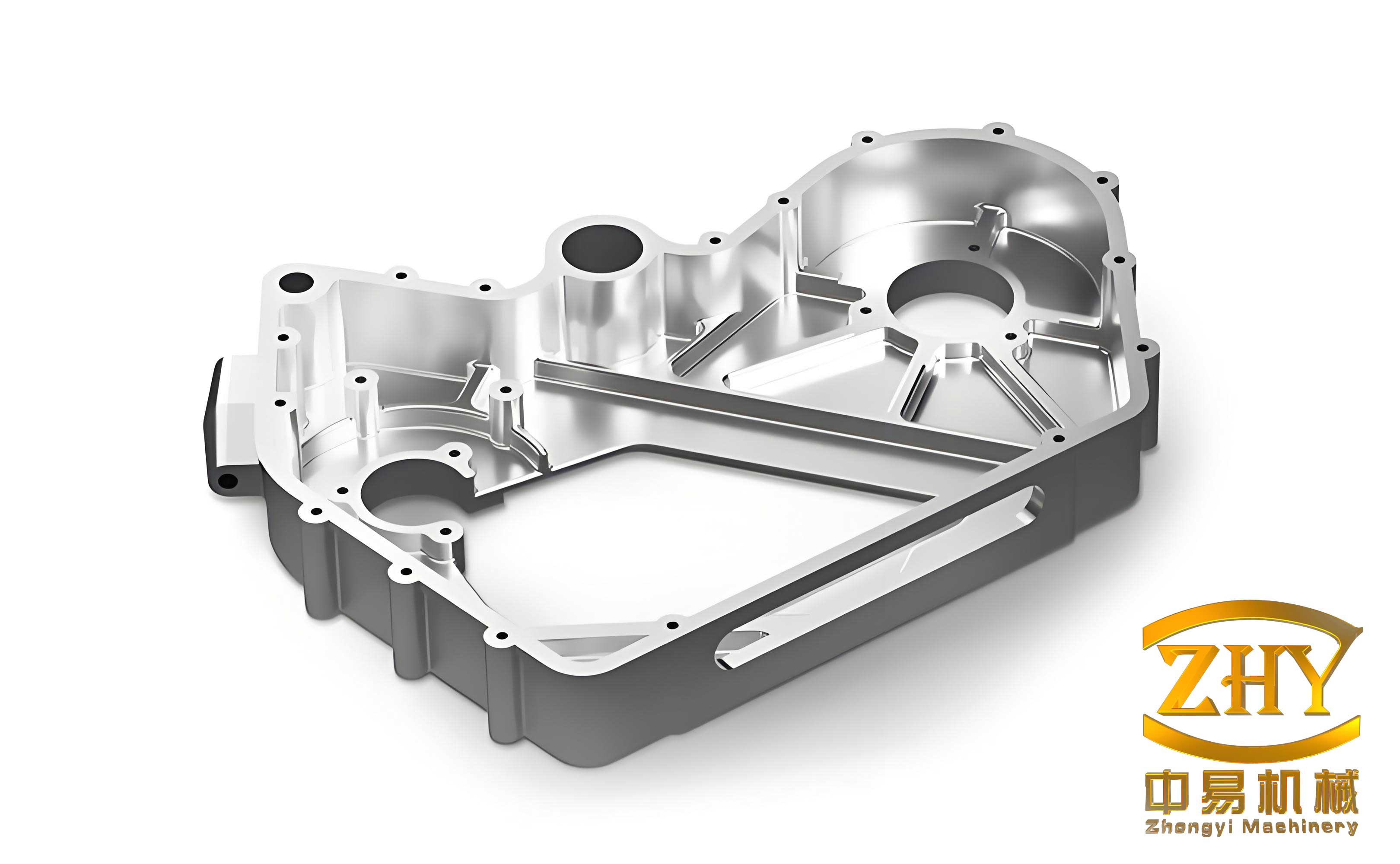
To simulate the lost foam casting process for these shell castings, I developed two gating system designs: a top-gating scheme and a side-gating scheme. The three-dimensional models of the reducer housing and gating systems were created in Pro/E, then imported into ProCAST for meshing. The finite element mesh parameters are summarized in Table 1, ensuring adequate resolution for accurate thermal and fluid dynamics analysis. For the shell castings, a finer mesh size of 5 mm was applied to capture detailed features, while the sand mold used a coarser 10 mm mesh to balance computational efficiency.
| Scheme | Number of Nodes | Total Mesh Elements | Sand Mold Mesh Size (mm) | Shell Castings Mesh Size (mm) |
|---|---|---|---|---|
| Top-Gating | 397,261 | 20,417 | 10 | 5 |
| Side-Gating | 610,366 | 3,478,376 | 10 | 5 |
The material properties assigned in the simulation are crucial for predicting the behavior of shell castings. The QT450-10 ductile iron has a liquidus temperature of approximately 1,150°C and a solidus temperature of 1,100°C, with thermal conductivity and specific heat varying with temperature. The foam pattern is made of expanded polystyrene (EPS) with a density of 25 kg/m³, thermal conductivity of 0.15 W/(m·K), specific heat capacity of 3.7 kJ/(kg·K), latent heat of 100 kJ/kg, melting temperature of 350°C, and glass transition temperature of 330°C. The dry quartz sand mold has high permeability, extracted from the ProCAST database. Boundary conditions include heat transfer coefficients: 100 W/(m²·K) between foam and sand, 500 W/(m²·K) between shell castings and sand, and 500 W/(m²·K) at the sand-environment interface. The process parameters set for the shell castings are a pouring temperature of 1,480°C, vacuum degree of -0.06 MPa, coating thickness of 1.5 mm, and coating permeability of 5 × 10⁻⁷ cm²/(kPa·min).
The filling process simulation reveals distinct flow characteristics for the two gating schemes in producing shell castings. For the top-gating scheme, metal initially flows rapidly through the hollow ceramic sprue, but upon contacting the EPS pattern, the front velocity decreases due to heat absorption from foam decomposition. The filling time is 5.8 seconds, with turbulent flow observed in the upper shell region. In contrast, the side-gating scheme results in a more stable filling pattern, taking 6.2 seconds, as metal enters laterally and rises gradually, minimizing temperature gradients. The flow behavior can be described using the Navier-Stokes equations for incompressible fluid flow:
$$ \rho \left( \frac{\partial \mathbf{v}}{\partial t} + \mathbf{v} \cdot \nabla \mathbf{v} \right) = -\nabla p + \mu \nabla^2 \mathbf{v} + \mathbf{f} $$
where $\rho$ is density, $\mathbf{v}$ is velocity vector, $p$ is pressure, $\mu$ is dynamic viscosity, and $\mathbf{f}$ represents body forces such as gravity. For shell castings, the reduced pressure from vacuum assistance is incorporated into $\mathbf{f}$ to enhance filling.
Solidification analysis focuses on the solid fraction distribution over time. The critical solid fraction, $f_s$, defined as the ratio of solid to total volume, is calculated using the lever rule approximation:
$$ f_s = \frac{T_l – T}{T_l – T_s} $$
where $T_l$ is the liquidus temperature, $T_s$ is the solidus temperature, and $T$ is the local temperature. For shell castings, solidification initiates at the thin-walled shell areas due to rapid heat dissipation, progressing toward thicker sections like the pillars. In both schemes, isolated liquid pools form at the junctions between the shell and pillars, posing risks for shrinkage defects. The solidification time, $t_s$, can be estimated using Chvorinov’s rule:
$$ t_s = k \left( \frac{V}{A} \right)^n $$
where $V$ is volume, $A$ is surface area, $k$ is a mold constant, and $n$ is an exponent typically around 2. For the shell castings, the high surface-area-to-volume ratio of the thin walls leads to faster solidification, whereas the pillars act as hot spots.
Shrinkage porosity prediction employs the Niyama criterion, which correlates defect formation with thermal gradients $G$ and cooling rates $R$:
$$ N_y = \frac{G}{\sqrt{R}} $$
Regions with $N_y$ below a critical threshold (e.g., 1 °C⁰·⁵·s⁰·⁵/mm) are prone to microporosity in shell castings. The simulation outputs for the two schemes are compared in Table 2, highlighting defect-prone zones.
| Gating Scheme | Filling Time (s) | Solidification Time (s) | Defect-Prone Areas | Maximum Shrinkage Porosity Volume (mm³) |
|---|---|---|---|---|
| Top-Gating | 5.8 | 995.1 | Spherical bosses, shell-pillar junctions, rib bases | 12.5 |
| Side-Gating | 6.2 | 1,598.2 | Spherical bosses, shell-pillar junctions | 8.3 |
The results indicate that while both schemes yield shell castings with potential defects, the side-gating scheme produces smaller shrinkage volumes and eliminates defects at the rib bases. This is attributed to more uniform temperature distribution and better feeding from the gating system. The thermal history at critical locations, such as the shell-pillar junctions, can be modeled using Fourier’s law of heat conduction:
$$ q = -k \nabla T $$
where $q$ is heat flux and $k$ is thermal conductivity. By integrating this over time, the cumulative heat loss determines the solidification pattern in shell castings.
Based on the simulation, I implemented process improvements for the side-gating scheme to enhance the quality of shell castings. Chills were added inside the four pillars—dimensioned slightly smaller than the recesses—to accelerate cooling and suppress isolated liquid zones. The modified process parameters, as validated through trial production, are summarized in Table 3. The resulting shell castings exhibited no visible surface defects like sand adhesion or folds, and sectioning confirmed the absence of shrinkage porosity in predicted areas, meeting all technical requirements for shell castings.
| Parameter | Value | Role in Shell Castings Production |
|---|---|---|
| Pouring Temperature | 1,480°C | Ensures adequate fluidity for filling thin-walled shell castings |
| Vacuum Degree | -0.06 MPa | Reduces gas entrapment and improves mold filling in shell castings |
| Coating Thickness | 1.5 mm | Controls heat transfer and prevents metal penetration in shell castings |
| Coating Permeability | 5 × 10⁻⁷ cm²/(kPa·min) | Allows degassing during foam decomposition for shell castings |
| Gating System | Side-Gating with Chills | Promotes directional solidification and reduces defects in shell castings |
Mechanical testing of Y-block samples from the trial production confirmed that the shell castings achieved tensile strength above 450 MPa, elongation over 10%, and an average hardness of 188.3 HBW, aligning with QT450-10 standards. The success underscores the value of numerical simulation in optimizing lost foam casting for complex shell castings, enabling precise control over microstructural integrity.
In conclusion, ProCAST simulation provides a powerful tool for analyzing the lost foam casting process of shell castings, offering insights into fluid dynamics, thermal gradients, and defect formation. By comparing top-gating and side-gating schemes, I identified the latter as superior for producing high-quality shell castings, with reduced shrinkage porosity and enhanced mechanical properties. The integration of chills and optimized parameters further mitigates defects, demonstrating the potential of simulation-driven design in industrial applications. Future work could explore advanced foam materials or multi-scale modeling to refine predictions for shell castings, pushing the boundaries of casting technology. Ultimately, this approach not only streamlines production but also ensures the reliability and performance of shell castings in critical automotive components.