
In the pursuit of advanced materials for demanding engineering applications, I embarked on a comprehensive study to develop a ductile iron casting that simultaneously exhibits high tensile strength and high elongation. This need arose specifically from the requirements for planetary carriers used in wind turbine gearboxes, where components must withstand complex dynamic loads while operating in harsh environments. The challenge was to produce a stable material grade, specifically equivalent to QT600-10 (or GJS-600-10 according to European standards), with a tensile strength exceeding 600 MPa, elongation consistently above 10%, and hardness controlled within 200-240 HBW. Traditional alloyed ductile iron castings often struggled to balance these properties cost-effectively, prompting an investigation into silicon solid-solution strengthened, fully ferritic grades.
The core objective was to optimize the entire manufacturing chain—from alloy design and charge calculation to melting practice and casting process design—to reliably achieve these target properties. This document details my experimental approach, findings, and the systematic methodology established for producing this high-performance ductile iron casting.
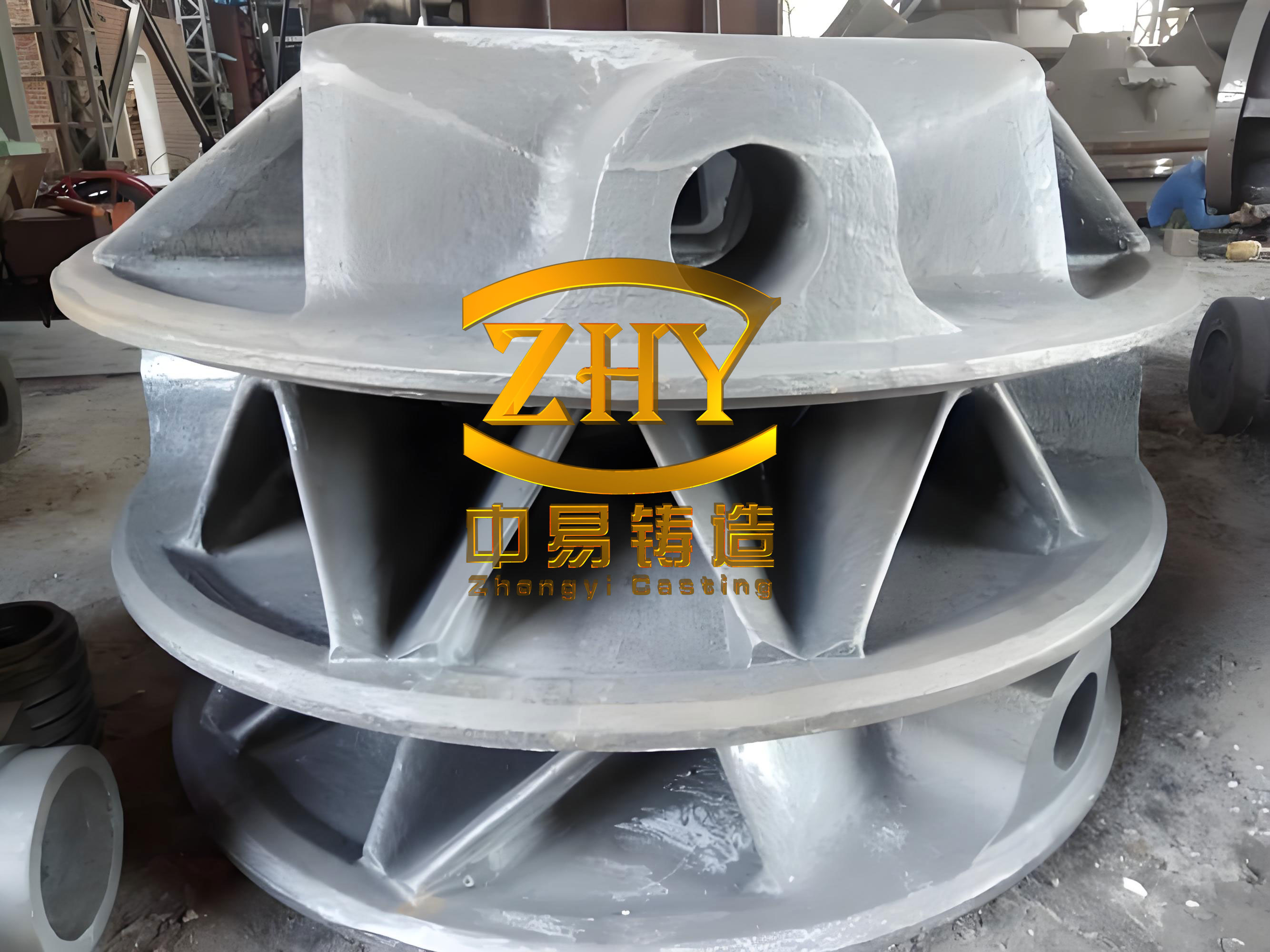
The performance of a ductile iron casting is fundamentally governed by its matrix structure and graphite morphology. The matrix can be ferritic, pearlitic, or a mixture, each imparting different mechanical characteristics. For high ductility, a ferritic matrix is desirable, but it typically comes at the expense of strength. Solid-solution strengthening, primarily through silicon, offers a pathway to enhance the strength of the ferrite phase without significantly compromising ductility, provided the silicon content is optimally controlled. The relationship between silicon content and the yield strength of ferrite can be approximated by:
$$ \sigma_{y(Si)} = \sigma_{y0} + K_{Si} \cdot C_{Si}^{n} $$
where $\sigma_{y(Si)}$ is the yield strength contribution from silicon, $\sigma_{y0}$ is the base yield strength of pure ferrite, $K_{Si}$ is a strengthening coefficient, $C_{Si}$ is the silicon concentration in weight percent, and $n$ is an exponent often near 1. This principle forms the foundation for developing high-silicon ductile iron casting.
Material Selection and Comparative Analysis
My initial phase involved a thorough comparison of standard ductile iron casting grades to identify a suitable baseline. The target specification demanded properties surpassing those of common pearlitic-ferritic grades like QT600-3.
| Standard | Grade Designation | Minimum Tensile Strength (MPa) | Minimum Yield Strength (MPa) | Minimum Elongation (%) | Typical Hardness (HBW) | Primary Matrix Structure | Typical Si Content (wt.%) |
|---|---|---|---|---|---|---|---|
| ISO 1083 / EN 1563 | EN-GJS-600-3 | 600 | 370 | 3 | 190-270 | Pearlite-Ferrite | 2.3-2.6 |
| ISO 1083 / EN 1563 | EN-GJS-600-10 | 600 | 470 | 10 | 200-230 | Ferritic (Solid-Solution) | 3.8-4.2 |
| Internal Target | QT600-10 (Developed) | 600 | 380 | 10 | 200-240 | Ferritic (Solid-Solution) | 3.8-4.2 |
The table clearly shows the advantage of the high-silicon, ferritic EN-GJS-600-10 grade. It offers a significantly higher minimum yield strength and elongation compared to the pearlitic EN-GJS-600-3 at the same tensile strength level. This makes it an ideal candidate for the planetary carrier ductile iron casting. Furthermore, its hardness range is more confined and favorable for machining.
To quantify the hardness stability, I conducted a series of tests comparing castings from both grades. The results, measured at the core section of the castings, demonstrated that the high-silicon ductile iron casting exhibited less hardness scatter. The standard deviation for the high-silicon grade was calculated to be approximately 5 HBW, compared to 8-10 HBW for the lower-silicon alloyed grade. This consistency is critical for predictable machining performance in high-volume production.
Another crucial consideration was impact toughness, especially for components subjected to dynamic loads. I evaluated Charpy V-notch impact energy for different grades across a temperature range. The high-silicon ductile iron casting (Si ~4.2%) showed superior room-temperature toughness compared to the low-silicon QT600-3. However, its toughness decreased more sharply at sub-zero temperatures, indicating a higher ductile-to-brittle transition temperature (DBTT). This can be modeled by the relationship:
$$ KV = A – B \cdot \exp\left(-\frac{T – T_{0}}{C}\right) $$
where $KV$ is the impact energy, $T$ is the test temperature, and $A$, $B$, $C$, and $T_{0}$ are material constants. This confirms that the developed high-silicon ductile iron casting is best suited for applications above 0°C.
Casting Process Design and Simulation
Producing a sound planetary carrier ductile iron casting requires meticulous process design to prevent defects like shrinkage porosity and slag inclusions, which could severely compromise fatigue life. The component features complex geometry with varying section thicknesses, creating natural hot spots.
I designed the casting process for production on a high-pressure molding line. The gating system was engineered as semi-open/semi-closed to ensure smooth, non-turbulent filling. For feeding and solidification control, a central riser supplemented with insulating and exothermic feeder sleeves was employed. To validate this design, I performed a comprehensive mold-filling and solidification simulation using MAGMAsoft. The criterion for internal soundness was set at a maximum shrinkage porosity area of less than 1% in any critical cross-section, as per relevant ASTM standards. The simulation predicted an area of approximately 0.8%, confirming the adequacy of the feeding system. The governing equations for fluid flow and heat transfer during solidification are based on Navier-Stokes and Fourier’s law, considering the latent heat release:
$$ \rho \left( \frac{\partial \mathbf{u}}{\partial t} + \mathbf{u} \cdot \nabla \mathbf{u} \right) = -\nabla p + \mu \nabla^2 \mathbf{u} + \rho \mathbf{g} $$
$$ \rho c_p \frac{\partial T}{\partial t} + \rho c_p \mathbf{u} \cdot \nabla T = \nabla \cdot (k \nabla T) – \rho L \frac{\partial f_s}{\partial t} $$
where $\rho$ is density, $\mathbf{u}$ is velocity, $p$ is pressure, $\mu$ is viscosity, $\mathbf{g}$ is gravity, $c_p$ is specific heat, $T$ is temperature, $k$ is thermal conductivity, $L$ is latent heat, and $f_s$ is solid fraction. The successful simulation outcome was a prerequisite for moving to experimental trials.
Metallurgical Control and Melting Practice
The heart of achieving the target properties in this ductile iron casting lies in strict metallurgical control. Trace elements like Ti, Sb, Pb, and Zn can promote carbide formation or intergranular segregation, destabilizing mechanical properties. Therefore, my strategy focused on purity and precise treatment.
Charge Composition and Melting
I opted for high-purity raw materials: low-manganese, low-sulfur steel scrap and high-purity pig iron. The charge makeup was meticulously planned:
| Material | Percentage (%) | Purpose & Notes |
|---|---|---|
| High-Purity Pig Iron | 20 | Primary source of carbon and silicon; low trace elements. |
| Low-Mn Steel Scrap | 50 | Base iron; provides dilution and controls chemistry. |
| Returns (Gates, Risers) | 30 | Economic and environmental sustainability. |
The charging sequence was optimized to promote nucleation: 10% pig iron was charged first, followed by 50% steel scrap, 30% returns, and the final 10% pig iron on top.
Silicon carbide (SiC) was used as a carburizer and silicon additive during melting. SiC acts as an excellent deoxidizer and preconditioner, enhancing iron cleanliness and promoting graphite nucleation. The reaction can be simplified as:
$$ \text{SiC} (s) \rightarrow \text{Si} (in\, Fe) + \text{C} (in\, Fe) $$
An essential step was a superheating and holding treatment. Once the melt reached the target composition, it was superheated to 1510-1530°C and held for 8-12 minutes. This practice homogenizes the bath, allows for slag formation and removal, and further purifies the melt, which is vital for the quality of the final ductile iron casting.
Inoculation and Spheroidization Treatment
A multi-stage inoculation practice was crucial for achieving a high nodule count and roundness, which directly influences strength and ductility. The process involved three steps:
- Pre-conditioning/In-mold Inoculation: During tapping from the furnace, the melt was treated with high-purity (≥98%) granular SiC (0.5-2.5 mm). This provides a slow-release source of nucleation sites, combating inoculation fade.
- Spheroidization: The treatment was conducted using a wire-feeding method in a dedicated station. This ensures consistent and reproducible magnesium recovery. The target residual magnesium content was tightly controlled between 0.03% and 0.045% to ensure a high nodularity (≥85%).
- Post-inoculation: A dual post-inoculation was performed. First, a stream inoculation using a FeSiBaCa alloy was done in the pouring basin. Second, a late stream inoculation using a sulfur-oxygen containing inoculant (like “Inoculin 63”) was performed directly in the pouring cup. The effectiveness of inoculation can be related to the nodule count $N$, which influences properties:
$$ \sigma_{uts} \propto \frac{1}{\sqrt{d}} \propto N^{1/3} $$
where $\sigma_{uts}$ is the ultimate tensile strength and $d$ is the average graphite nodule diameter. A high $N$ refines the matrix structure and improves properties.
The target chemical composition range established for the high-silicon ductile iron casting is summarized below:
| Element | Target Range (wt.%) | Rationale and Effect |
|---|---|---|
| Carbon (C) | 3.3 – 3.5 | Ensures graphitization potential, feeds shrinkage. |
| Silicon (Si) | 3.8 – 4.2 | Key element: Solid-solution strengthens ferrite. Below 3.8%, strength falls; above 4.2%, ductility drops sharply. |
| Manganese (Mn) | < 0.3 | Minimized to prevent pearlite stabilization and segregation. |
| Phosphorus (P) | < 0.03 | Minimized to avoid phosphide eutectic at grain boundaries. |
| Sulfur (S) | < 0.01 | Low base sulfur is essential for efficient Mg treatment. |
| Copper (Cu) | < 0.1 | Intentional addition avoided to prevent pearlite formation. |
| Magnesium (Mg)res | 0.03 – 0.045 | Ensures spheroidal graphite morphology. |
Experimental Verification and Results
I conducted a series of experiments to systematically verify the effects of chemistry and process on the ductile iron casting properties.
Experiment 1: Influence of Copper in Lower-Silicon Grades
To establish a baseline, I first attempted to achieve the target properties using a traditional alloying approach with copper in a lower-silicon melt (Si < 2.7%). The results confirmed the difficulty of reaching 10% elongation while maintaining strength.
| Heat/Ladle | Si (wt.%) | Cu (wt.%) | Tensile Strength (MPa) | Yield Strength (MPa) | Elongation (%) | Hardness (HBW) |
|---|---|---|---|---|---|---|
| A | 2.56 | 0.40 | 589 | 389 | 9.6 | 213 |
| B | 2.58 | 0.46 | 612 | 412 | 7.0 | 221 |
| C | 2.50 | 0.52 | 653 | 442 | 5.6 | 228 |
As copper increased, strength and hardness rose, but elongation consistently fell below 10%, failing the requirement. The microstructure became increasingly pearlitic.
Experiment 2: Defining the Silicon Window for QT600-10
Next, I focused on the high-silicon approach, melting several heats with varying silicon contents while keeping other elements low.
| Heat/Ladle | Si (wt.%) | Tensile Strength (MPa) | Yield Strength (MPa) | Elongation (%) | Hardness (HBW) | Matrix Estimate |
|---|---|---|---|---|---|---|
| A | 3.45 | 586 | 485 | 13.0 | 218 | ~8% Pearlite |
| B | 3.80 | 608 | 496 | 14.5 | 223 | ~6% Pearlite |
| C | 4.20 | 645 | 523 | 11.3 | 221 | ~5% Pearlite |
| D | 4.40 | 635 | 512 | 6.0 | 201 | ~5% Pearlite* |
*Note: At 4.4% Si, while the matrix remained largely ferritic, a sharp drop in elongation was observed, likely due to silicon-induced embrittlement and possible precipitation of silico-carbides. This defined the upper limit. The data clearly shows that the optimal silicon window for this high-performance ductile iron casting is 3.8% to 4.2%. Within this range, the yield strength shows a strong linear correlation with silicon content, which can be expressed as:
$$ \sigma_{y} (MPa) \approx 280 + 55 \cdot C_{Si} (wt.\%) \quad \text{for } 3.8 < C_{Si} < 4.2 $$
Experiment 3: Batch Stability Trial
Finally, I conducted a small batch production run using the optimized parameters: target Si of 4.0-4.1%, strict trace element control, and the multi-stage inoculation practice. Tensile specimens were taken from the castings themselves (separately cast test blocks could differ).
| Ladle Identifier | Si (wt.%) | Tensile Strength (MPa) | Yield Strength (MPa) | Elongation (%) | Hardness (HBW) | Nodularity (%) |
|---|---|---|---|---|---|---|
| 2-E335-A | 4.05 | 635 | 485 | 12.4 | 218 | 92 |
| 2-E335-C | 4.08 | 648 | 512 | 11.8 | 219 | 90 |
| 2-E335-E | 4.11 | 636 | 521 | 13.2 | 221 | 91 |
| 3-B286-A | 4.11 | 635 | 512 | 12.8 | 216 | 93 |
| 3-B286-C | 4.06 | 628 | 498 | 13.6 | 218 | 90 |
| 3-B286-E | 4.06 | 619 | 486 | 13.8 | 215 | 91 |
Statistical Summary:
– Average Tensile Strength: $633 \pm 10$ MPa
– Average Yield Strength: $502 \pm 15$ MPa
– Average Elongation: $12.9 \pm 0.8$ %
– Average Hardness: $218 \pm 2$ HBW
The results demonstrate exceptional consistency. All properties comfortably meet the QT600-10/GJS-600-10 specification. The high nodularity ensures good thermal and electrical conductivity properties as well. The relationship between elongation and the ratio of yield to tensile strength can be observed. A lower yield ratio (Yield Strength/Tensile Strength) generally correlates with higher elongation and better energy absorption. For this ductile iron casting, the yield ratio averaged 0.79, which is favorable for ductile behavior.
Discussion and Application Guidelines
The successful development of this high-silicon solid-solution strengthened ductile iron casting provides a robust material solution for components requiring an exceptional combination of strength and ductility. Key insights from this work include:
1. Critical Process Parameters: The ductile iron casting’s quality is highly sensitive to raw material purity, silicon content control, and inoculation efficacy. The use of high-purity charge materials cannot be overstated. The three-stage inoculation process is vital to achieve a high and stable nodule count, which directly translates to property consistency. The optimal mechanical properties are achieved when the graphite nodule count exceeds 120 nodules/mm² and the nodularity is above 90%.
2. Property Relationships: The mechanical properties of this ferritic ductile iron casting can be interrelated. An empirical model linking hardness (HB) to tensile strength (TS in MPa) and elongation (El% ) for this specific composition range was observed:
$$ TS \approx 3.0 \times HB \quad \text{and} \quad El \approx 55 – 0.2 \times HB $$
These approximations hold within the narrow hardness band of 200-230 HBW for this ductile iron casting.
3. Design and Manufacturing Implications: The availability of a ductile iron casting with 600 MPa tensile strength and over 10% elongation enables more aggressive lightweight design. Safety factors can be potentially reduced due to the higher yield strength and improved toughness, leading to material savings. Furthermore, the consistent hardness and fully ferritic matrix result in excellent machinability, reducing tool wear and improving surface finish. This ductile iron casting is ideally suited for static and moderately dynamic load applications at ambient or elevated temperatures (up to ~400°C, where silicon also improves oxidation resistance).
4. Limitations and Considerations: As confirmed by impact tests, this material’s toughness decreases in sub-zero environments. Therefore, for low-temperature service, alternative grades with lower silicon and nickel or copper additions should be considered. Additionally, the high silicon content slightly reduces thermal conductivity, which should be factored in for applications involving significant heat flux.
Conclusion
Through systematic research and process optimization, I have established a reliable methodology for producing a high-performance, solid-solution strengthened ferritic ductile iron casting, grade QT600-10. By targeting a controlled high silicon content (3.8-4.2 wt.%), employing high-purity charge materials, implementing a rigorous superheating practice, and utilizing a multi-stage inoculation and consistent spheroidization treatment, it is possible to consistently achieve tensile strengths above 600 MPa, yield strengths near 500 MPa, and elongations consistently above 12%, with stable hardness around 220 HBW. This ductile iron casting offers a superior property profile compared to traditional alloyed pearlitic-ferritic grades, enabling enhanced performance, weight reduction, and cost-effectiveness for critical components like planetary carriers. The principles and controls detailed here provide a framework for expanding the application of high-silicon ductile iron casting across various demanding engineering fields.