
Our journey in developing advanced ductile iron castings for commercial vehicles stems from a long-standing commitment to lightweighting and performance enhancement. This document details our first-person experience in the research, design, optimization, and successful implementation of three critical chassis bracket components, transitioning them from conventional QT450-10 ductile iron to high-performance Austempered Ductile Iron (ADI). The primary objectives were significant weight reduction, maintained or improved structural integrity, and validation for high-stress commercial vehicle applications.
Project Genesis and Material Selection Rationale
The project was initiated to support the development of a new generation of lightweight commercial vehicles. Three key suspension brackets—the Rear Bracket for the Second Axle Leaf Spring, the Rear Bracket Assembly for the Front Leaf Spring, and the Front Bracket for the Second Front Leaf Spring—were initially designed in QT450-10 grade ductile iron. While serviceable, they presented a clear opportunity for optimization. ADI, with its superior strength-to-weight ratio, emerged as the ideal candidate. The fundamental advantage of ADI over standard grades lies in its unique ausferritic microstructure, offering a remarkable combination of high strength, ductility, and wear resistance. The driving equation for lightweighting can be simplified as seeking a lower density-to-strength ratio:
$$ \text{Lightweighting Potential} \propto \frac{1}{\rho / R_m} = \frac{R_m}{\rho} $$
where \( R_m \) is the tensile strength and \( \rho \) is the material density. For ADI grades like QTD 800-10, the \( R_m/\rho \) value is significantly higher than for QT450-10, enabling thinner sections and direct weight savings without compromising safety factors.
Design Optimization and Structural Analysis
The redesign process was iterative, involving Computer-Aided Design (CAD) and Finite Element Analysis (FEA). The original geometries were analyzed under simulated service loads to identify stress concentrations and low-utilization areas. The core philosophy was to transition to a more uniform wall thickness design, mitigating the section sensitivity inherent in ductile iron and allowing the full potential of the ADI material to be realized.
The mechanical constraints and loads applied during the FEA simulation for one of the brackets are summarized below. These were derived from extreme vehicle operating conditions, including braking, cornering, and vertical impacts.
| Constraint/Load Type | Description | Magnitude |
|---|---|---|
| Fixed Constraints | Four mounting bolt holes on the side face | Fully constrained |
| Vertical Load (Fz) | Applied at both ends of the leaf spring seat | -50,000 N |
| Lateral Load (Fy) | Applied at both ends of the leaf spring seat | -30,000 N |
| Braking Load (Fx) | Applied at both ends of the leaf spring seat | -60,000 N |
Comparative FEA runs were conducted between the original QT450-10 design and the optimized ADI design. The results were decisive. Not only did the redesigned components achieve substantial mass reduction, but the stress levels were also generally lower, and the comprehensive safety factor increased. The quantitative outcomes for the three redesigned ductile iron castings are presented in the following table.
| Part Description | Original Weight (kg) | Optimized ADI Weight (kg) | Weight Reduction | Peak Stress (Original) | Peak Stress (Optimized) |
|---|---|---|---|---|---|
| Rear Bracket – 2nd Axle Spring | 5.95 | 4.86 | 18.32% | 917 MPa | 753 MPa |
| Rear Bracket Assy. – Front Spring | 7.95 | 6.70 | 15.72% | 833 MPa | 765 MPa |
| Front Bracket – 2nd Front Spring | 6.87 | 5.50 | 19.94% | 703 MPa | 691 MPa |
The success of this phase confirmed that strategic design, coupled with the advanced properties of ADI, could yield lighter, stiffer, and potentially more reliable components. The average weight saving across the three brackets was approximately 18%, a significant achievement for heavy vehicle components.
Material and Process Development for ADI Castings
With the geometry finalized, the focus shifted to the manufacturing process to reliably achieve the target material properties: QTD 800-10 according to relevant standards. The production of high-integrity ductile iron castings is the critical first step.
Melting and Treatment
We employed a 500 kg medium-frequency induction furnace. The charge composition was carefully controlled:
- Pig Iron (Q12 grade): 20%
- Steel Scrap (Bundled): 50%
- Returns (Gating systems and certified scrap castings): 30%
Carbon was adjusted using high-purity recarburizer blocks. The melting sequence involved charging recarburizer first, followed by pig iron, steel scrap, and returns. Once the bath temperature reached 1500–1520°C, the melt was held for homogenization and sampled for spectroscopic analysis.
The nodularizing treatment was performed using the sandwich method in a preheated ladle. 1.5 wt% FeSiMg nodularizer was placed in the well, covered with inoculant and thin ductile iron chips. Approximately two-thirds of the iron was poured rapidly to initiate a vigorous reaction. After reaction completion, the remaining iron was added for temperature adjustment, accompanied by stream inoculation.
Two-stage inoculation was crucial for achieving a high nodule count and preventing chill:
1. Primary Inoculation: 0.2 wt% 75FeSi placed atop the nodularizer in the ladle.
2. Post-Inoculation: 0.5 wt% fine 75FeSi added during the final ladle fill.
Given the relatively thin and uniform sections of the brackets (<12 mm average wall thickness), the chemical composition was tailored to ensure hardenability for the subsequent austempering process while maintaining excellent castability. The target range is shown below.
| Element | Target Range (wt%) |
|---|---|
| C | 3.7 – 3.9 |
| Si | 2.6 – 2.8 |
| Mn | ≤ 0.30 |
| P | ≤ 0.04 |
| S | ≤ 0.02 |
Austempering Heat Treatment
The transformation from as-cast ductile iron to ADI is the most critical process step. The selected thermal cycle aimed for QTD 800-10 properties, emphasizing a good balance of strength and elongation. The cycle parameters were:
- Austenitization: 900 ± 5°C for 60 minutes. This ensures complete dissolution of carbides and carbon saturation of the austenite. The carbon content in austenite \( C_\gamma \) is a key parameter influencing the transformation kinetics and final properties.
- Rapid Quench: Fast transfer to a salt bath held at the isothermal temperature to avoid pearlite formation.
- Isothermal Transformation: 385 ± 5°C for 60 minutes. This is the stage where the unique ausferrite (acicular ferrite + high-carbon stabilized austenite) microstructure forms. The transformation follows Avrami-type kinetics, often modeled as:
$$ f = 1 – \exp(-k t^n) $$
where \( f \) is the transformed fraction, \( t \) is time, and \( k \) and \( n \) are temperature-dependent constants.
The final microstructure and, consequently, the mechanical properties are a direct function of the austenitizing temperature \( T_\gamma \) and time \( t_\gamma \), which set \( C_\gamma \), and the isothermal temperature \( T_{iso} \) and time \( t_{iso} \), which control the morphology of the ferrite plates and the carbon enrichment of the retained austenite.
Prototype Casting and Validation
Two casting processes were utilized for prototype production to match the geometric complexity and quality requirements of the different brackets. The Rear Bracket for the Second Axle was produced using the investment casting process for superior dimensional accuracy and surface finish. The other two brackets were manufactured via the resin sand casting process, suitable for their larger size.
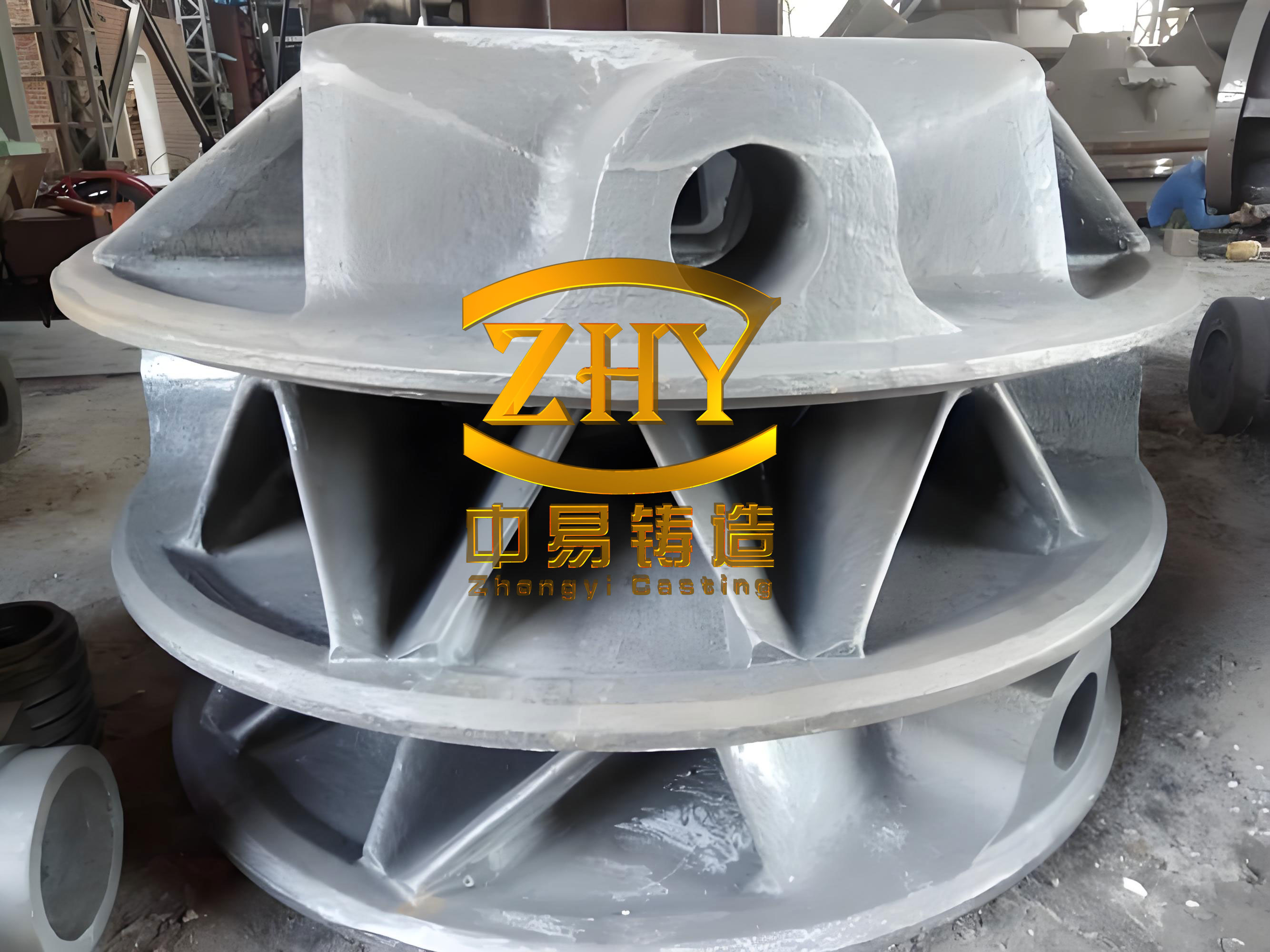
Alongside each production batch, separately cast keel-block test specimens were poured from the same ladle of treated ductile iron. These test coupons underwent the identical austempering cycle as the actual brackets. This ensured a direct correlation between the reported material properties and the components’ condition.
Material Test Results
The mechanical properties and microstructure of the heat-treated test specimens were rigorously evaluated. The target was to meet or exceed the QTD 800-10 specification (Tensile Strength ≥ 800 MPa, Elongation ≥ 10%, Hardness ~ 250-320 HBW). The results from two representative samples are tabulated below.
| Sample ID | Tensile Strength (MPa) | Elongation (%) | Hardness (HBW) |
|---|---|---|---|
| Batch-1 | 1061 | 10.0 | 331 |
| Batch-2 | 1061 | 13.0 | 336 |
Metallographic examination revealed the characteristic microstructure of high-quality ADI: a matrix of fine, acicular ferrite (bainitic ferrite) interlaced with carbon-enriched, stabilized austenite, with well-dispersed, spherical graphite nodules (nodularity >85%, size class 6). This microstructure is responsible for the excellent combination of properties measured. The strength significantly exceeded the 800 MPa minimum, while the elongation met the 10% target, validating our heat treatment parameters for this specific ductile iron casting chemistry and section size.
Vehicle Integration and Field Testing
Upon confirming the material met all specifications, the three types of ADI brackets were assembled onto prototype commercial vehicles for rigorous field testing. The test regimen covered a comprehensive range of conditions designed to exceed normal service life, including prolonged highway driving, fully loaded operation, severe braking scenarios, and traversal of rough, unpaved roads.
Upon completion of the entire test schedule, the vehicles were disassembled for detailed inspection. The ADI brackets showed no signs of failure, cracking, or permanent deformation. Their performance was indistinguishable from—and in terms of weight savings, superior to—the original, heavier components. The successful integration and validation proved that the redesign was not only analytically sound but also practically robust for real-world commercial vehicle applications.
Conclusion and Outlook
This development project successfully demonstrated the substantial benefits of applying Austempered Ductile Iron to structural automotive components. By transitioning three chassis brackets from QT450-10 to QTD 800-10 ADI and implementing a concurrent design optimization, we achieved an average weight reduction of approximately 18%, with one component shedding nearly 20% of its mass. Crucially, this was accomplished while maintaining and even improving the simulated and validated-in-service structural safety margins.
The project underscored several key points for the advancement of ductile iron castings in automotive engineering:
- The superior specific strength of ADI is a powerful enabler for lightweighting, directly contributing to fuel savings and reduced emissions.
- Successful application requires a holistic approach integrating material science, sophisticated mechanical design (FEA), and precise foundry and heat treatment process control.
- Design for manufacturability, particularly aiming for uniform sections, is essential to fully harness the properties of ADI and mitigate the effects of section sensitivity.
The three ADI brackets have now transitioned into series production, contributing to the weight-reduction goals of new vehicle platforms. This successful case study provides a strong technical foundation and confidence for expanding the use of high-performance ductile iron castings, particularly ADI, into other load-bearing chassis and powertrain applications. The ongoing development of even higher-strength or enhanced-wear-resistance ADI grades promises to open further avenues for innovation in the quest for lighter, stronger, and more efficient commercial vehicles.