
In the realm of modern manufacturing, ductile iron casting stands as a critical material due to its exceptional combination of strength, ductility, and cost-effectiveness. My research focuses on addressing persistent defects such as shrinkage porosity in ductile iron castings, particularly for demanding applications like wind turbine components. This study explores novel spheroidization and inoculation methods to harness graphite expansion effectively, thereby improving the integrity and performance of ductile iron castings. The goal is to develop a process that not only meets stringent mechanical requirements but also enhances the suitability of ductile iron casting for large-section parts.
The significance of ductile iron casting in industries like wind energy cannot be overstated. Wind power, as a renewable energy source, relies on robust components such as hubs, bases, and gearboxes, which are predominantly made from ductile iron grades like QT400-18AL. However, producing thick-section ductile iron castings without defects remains a challenge. Traditional methods often rely on extensive use of feeders and chills, which increase costs and complexity. An alternative approach leverages the inherent graphite expansion during solidification to counteract shrinkage, a concept known as self-feeding. Despite its potential, practical implementation in ductile iron casting has been limited due to inconsistencies in graphite morphology and distribution. My work aims to refine this by optimizing spheroidizing and inoculating agents to promote fine, numerous graphite nodules, thus maximizing the self-feeding effect in ductile iron casting.
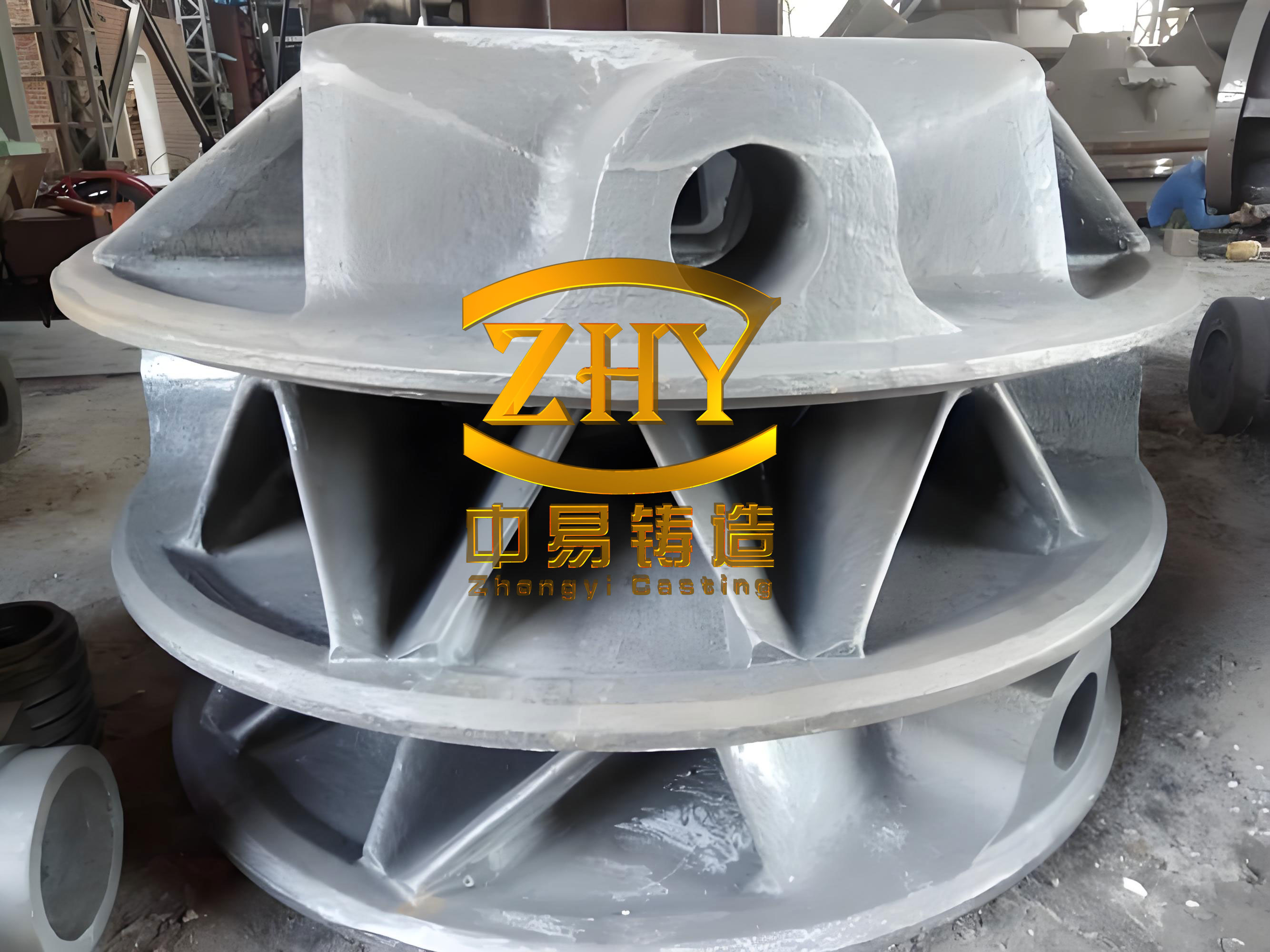
To understand the context, it is essential to review the metallurgy of ductile iron casting. Ductile iron, or nodular cast iron, derives its properties from the spherical graphite nodules embedded in a metallic matrix. The formation of these nodules is governed by spheroidization, typically using magnesium-based treatments, and inoculation, which enhances graphite nucleation. The self-feeding mechanism relies on the expansion associated with graphite precipitation during the eutectic reaction. This expansion can compensate for the liquid and solidification shrinkage, reducing porosity in ductile iron casting. The effectiveness depends on factors like graphite nodule count, size, and uniformity, which are influenced by the composition and processing parameters. Prior studies have highlighted the role of rare earth elements, such as lanthanum and cerium, in improving graphite morphology in ductile iron casting, but their application in thick sections requires further optimization.
In this investigation, I conducted experiments using two distinct process schemes for producing ductile iron casting components. The target material was QT400-18AL, specified for wind turbine hubs. The first scheme, denoted as Scheme 1, represented a conventional approach employing standard spheroidizer and inoculant, along with insulating feeders to promote directional solidification. The second scheme, Scheme 2, introduced innovative materials: a high-lanthanum spheroidizer, a Ba13 inoculant, and a bismuth-containing stream inoculant. The objective was to evaluate how these modifications impact defect formation and mechanical properties in ductile iron casting. To simulate thick-section conditions, a cube sample with a modulus of 5 cm was also cast alongside a full-scale hub, providing insights into the behavior of ductile iron casting under challenging geometries.
The experimental methodology involved careful control of melting, treatment, and casting processes. Raw materials included pig iron, steel scrap, and returns, with carbon additions to adjust composition. Melt chemistry was monitored using spectroscopic analysis and thermal analysis techniques. The base iron compositions for both schemes are summarized in Table 1, ensuring consistency in key elements like carbon and silicon, which are crucial for ductile iron casting quality.
| Scheme | C | Si | Mn | P | S | Mg |
|---|---|---|---|---|---|---|
| Scheme 1 | 3.47 | 1.35 | 0.14 | 0.018 | 0.016 | 0.0005 |
| Scheme 2 | 3.55 | 1.01 | 0.15 | 0.021 | 0.018 | 0.0008 |
Spheroidization and inoculation treatments were performed at 1460°C, with specific agent compositions detailed in Table 2. Scheme 1 used a conventional spheroidizer (A) with barium-silicon inoculant and a standard stream inoculant. In contrast, Scheme 2 utilized a high-lanthanum spheroidizer (B), combined with Ba13 inoculant and a bismuth-enriched stream inoculant. The treatment process aimed to achieve residual magnesium levels around 0.042% and sulfur below 0.012%, critical for successful nodularization in ductile iron casting. After treatment, the iron was poured at 1390°C into molds designed with bottom-gating systems to minimize turbulence and oxidation, key factors in ductile iron casting integrity.
| Agent Type | Si | Al | Ca | Ba | Mg | Ce | La | Bi | Particle Size (mm) |
|---|---|---|---|---|---|---|---|---|---|
| Spheroidizer A | 40-50 | <1.2 | 0.9-1.3 | 1-1.5 | 5.8-6.2 | 0.45 | 0.45 | – | 5-30 |
| Spheroidizer B | 40-50 | <1.2 | 0.9-1.3 | 1-1.5 | 5.8-6.2 | 0.30 | 0.60 | – | 5-30 |
| Ba13 Inoculant | 63-68 | 1-1.6 | 1.4-2.0 | 12-14 | – | – | – | – | 3-8 |
| Barium-Silicon Inoculant | >68 | <2 | 1-2 | 2-2.5 | – | – | – | – | 3-8 |
| Stream Inoculant 1 (Bi-containing) | 70-80 | 0.7-2.0 | 0.8-1.5 | – | – | – | 1.5-2.0 | 0.7-1.1 | 0.1-1 |
| Stream Inoculant 2 | 70-76 | 0.75-1.3 | 0.75-1.3 | – | – | – | 1.5-2.0 | – | 0.1-1 |
To assess the outcomes, non-destructive testing (ultrasonic testing, UT) was conducted on the cast hubs to detect shrinkage defects. Additionally, mechanical properties and microstructural characteristics were evaluated using attached test blocks and the cube sample. The cube, with a large modulus, allowed for examination of ductile iron casting behavior in heavy sections. Specimens were extracted from various locations to analyze gradients in properties and microstructure, reflecting the real-world challenges in ductile iron casting production.
The results from UT revealed significant differences between the two schemes. For Scheme 1, shrinkage cavities were detected at the parting line areas, with defect sizes up to 3.5 mm in equivalent diameter. This indicated that even with insulating feeders, some porosity persisted in the ductile iron casting. In contrast, Scheme 2, which replaced feeders with venting risers and employed the novel treatment, showed no超标 defects. The ductile iron casting produced under Scheme 2 passed UT standards, demonstrating the efficacy of the new approach in mitigating shrinkage through enhanced graphite expansion. This improvement can be attributed to the optimized spheroidization and inoculation, which promoted a finer and more numerous graphite population, thereby increasing the self-feeding capacity in ductile iron casting.
Mechanical property data from attached test blocks are presented in Table 3. Both schemes met the QT400-18AL specifications, but Scheme 2 exhibited superior low-temperature impact toughness, with values exceeding 15 J at temperatures as low as -40°C. This is crucial for ductile iron casting used in wind turbines, which operate in harsh environments. The tensile strength in Scheme 2 was slightly lower (379.5 MPa vs. 387.7 MPa in Scheme 1), but well within the required range, highlighting the balance achieved in ductile iron casting performance.
| Scheme | Tensile Strength (MPa) | Yield Strength (MPa) | Elongation (%) | Impact Energy at -20°C (J) | Impact Energy at -30°C (J) | Impact Energy at -40°C (J) |
|---|---|---|---|---|---|---|
| Scheme 1 | 387.7 | ~240 | 24 | 16.05 | 14.03 | 12.34 |
| Scheme 2 | 379.5 | ~230 | 25 | 15.8 | 15.41 | 15.17 |
Microstructural analysis provided deeper insights. Graphite nodule characteristics were quantified using image analysis software. In Scheme 1, the graphite nodule count was approximately 135 nodules/mm², with a size rating of 6-7 according to standard scales. For Scheme 2, the count increased to 165 nodules/mm², reflecting the impact of the high-lanthanum spheroidizer and effective inoculation. The nodules were finer and more uniformly distributed, which is beneficial for ductile iron casting quality. The increased nodule count enhances the graphite expansion effect, as more nucleation sites lead to simultaneous precipitation, amplifying the self-feeding pressure. This relationship can be expressed through a simplified model for expansion pressure in ductile iron casting:
$$ P_e = k \cdot N \cdot \Delta V_g $$
where \( P_e \) is the expansion pressure, \( k \) is a material constant, \( N \) is the graphite nodule count per unit volume, and \( \Delta V_g \) is the volumetric expansion per nodule due to graphite formation. By increasing \( N \) through improved inoculation, \( P_e \) rises, effectively countering shrinkage in ductile iron casting.
Furthermore, the role of lanthanum in the spheroidizer for ductile iron casting is noteworthy. Lanthanum has a higher affinity for sulfur and oxygen compared to cerium, forming stable compounds that act as nucleation sites. The sulfides of lanthanum, such as La₂S₃, have densities close to that of molten iron (around 7.2 g/cm³), promoting their dispersion and persistence as heterogeneous nuclei. This stability reduces magnesium loss and improves nodularization consistency in ductile iron casting. Additionally, the Ba13 inoculant serves as a covering agent, purifying the melt by removing sulfur and oxygen, further refining the graphite morphology in ductile iron casting.
The inclusion of bismuth in the stream inoculant, though traditionally considered an anti-nodularizing element, contributed to increased graphite nodule numbers in ductile iron casting. Bismuth is known to enhance undercooling and promote nucleation, leading to finer graphite without significantly affecting nodularity in moderate sections. This synergistic effect of multiple inoculants is key to achieving the desired microstructure in ductile iron casting.
Fractography of impact specimens at -40°C revealed ductile dimple fractures for Scheme 2, indicating good toughness. In contrast, Scheme 1 showed some cleavage features, suggesting inferior low-temperature performance. This aligns with the finer graphite and finer grain structure in Scheme 2, which impedes crack propagation in ductile iron casting.
Evaluation of the cube sample, with its 5 cm modulus, provided data on thick-section ductile iron casting behavior. Mechanical properties from different locations within the cube are summarized in Table 4. As expected, properties varied from the center to the surface, but all met the QT400-18AL requirements for sections over 60 mm. The center region exhibited some fragmented graphite, a common issue in thick ductile iron casting due to slow cooling, but the impact energy remained above 12 J, demonstrating adequate toughness.
| Location | Tensile Strength (MPa) | Yield Strength (MPa) | Elongation (%) | Average Impact Energy at -20°C (J) |
|---|---|---|---|---|
| Center (A’) | 367.4 | 226.0 | 14 | 12.26 |
| Mid-radius (B’) | 371.9 | 256.5 | 15 | 12.21 |
| Near-surface (C’) | 381.6 | 247.1 | 15 | 9.86 |
Microstructurally, the cube sample showed a transition from fragmented graphite at the center to well-formed spheroids near the surface. Pearlite was observed in some areas, particularly around graphite nodules, likely due to microsegregation of pearlite-stabilizing elements. However, the overall matrix remained predominantly ferritic, consistent with the grade requirements for ductile iron casting. The presence of pearlite in localized zones slightly reduced impact toughness, as seen in location C’, but the values were still acceptable for ductile iron casting in thick sections.
The success of Scheme 2 can be rationalized through kinetic and thermodynamic principles. The increased nodule count reduces the diffusion distance for carbon during solidification, accelerating graphite growth and expansion. This can be described by a diffusion-controlled growth model for graphite nodules in ductile iron casting:
$$ r(t) = \sqrt{D \cdot t} $$
where \( r(t) \) is the nodule radius at time \( t \), and \( D \) is the diffusion coefficient of carbon in the melt. With more nodules, the average growth time per nodule decreases, leading to smaller final sizes and more uniform expansion in ductile iron casting. Additionally, the self-feeding efficiency \( \eta \) can be defined as the ratio of expansion volume to shrinkage volume:
$$ \eta = \frac{V_{\text{expansion}}}{V_{\text{shrinkage}}} = \frac{N \cdot \frac{4}{3}\pi r^3 \cdot \beta}{V_{\text{shrinkage}}} $$
where \( \beta \) is the volumetric expansion factor per nodule. By maximizing \( N \) and optimizing \( r \) through inoculation, \( \eta \) approaches or exceeds 1, effectively eliminating shrinkage in ductile iron casting.
In practice, the processing parameters for ductile iron casting must be carefully controlled. The pouring temperature, treatment timing, and inoculant addition rates all influence the final microstructure. For instance, higher pouring temperatures can delay solidification, affecting nodule formation, while inadequate inoculation may lead to poor nodule counts. The novel combination used in Scheme 2 addresses these challenges by providing sustained nucleation throughout solidification, essential for heavy-section ductile iron casting.
Economic implications are also significant. By reducing or eliminating feeders, the yield of ductile iron casting improves, lowering material costs and simplifying molding. This makes the process more attractive for high-volume production of wind turbine components, where ductile iron casting is extensively used. Moreover, the enhanced mechanical properties, especially low-temperature toughness, extend the service life and reliability of ductile iron casting parts in demanding applications.
Future work could explore further optimization of inoculant compositions, perhaps incorporating other rare earth elements or nano-sized nuclei to push the boundaries of ductile iron casting performance. Computational modeling of solidification and stress development could also aid in designing casting geometries that fully exploit graphite expansion in ductile iron casting.
In conclusion, this study demonstrates that innovative spheroidization and inoculation methods can significantly improve the quality of ductile iron casting. By using a high-lanthanum spheroidizer, Ba13 inoculant, and bismuth-containing stream inoculant, graphite nodule count increases, enhancing self-feeding and reducing shrinkage defects in ductile iron casting. Mechanical properties meet or exceed specifications, even in thick sections, ensuring the suitability of ductile iron casting for critical applications like wind energy. The findings underscore the importance of microstructure control in advancing ductile iron casting technology, offering a pathway to more efficient and reliable manufacturing processes.