
The rapid expansion of offshore wind power, driven by the global transition towards renewable energy, has precipitated a surge in demand for critical turbine components. Among these, the main shaft stands as a linchpin of the drivetrain, responsible for transferring immense torque and supporting the rotor’s weight under the harsh and variable conditions of the marine environment. This operational context imposes exceptionally stringent requirements: the material must simultaneously exhibit high strength, superior toughness, excellent fatigue resistance, and reliable performance at sub-zero temperatures. While forged alloy steels have been the traditional choice, their production is constrained by the need for massive forging equipment, long lead times, and high costs. Consequently, the development of a high-integrity, cost-effective cast alternative has become a paramount technical and economic imperative. This document details a comprehensive research and development initiative focused on pioneering a novel ductile iron casting solution that meets and exceeds the rigorous demands of next-generation offshore wind turbines.
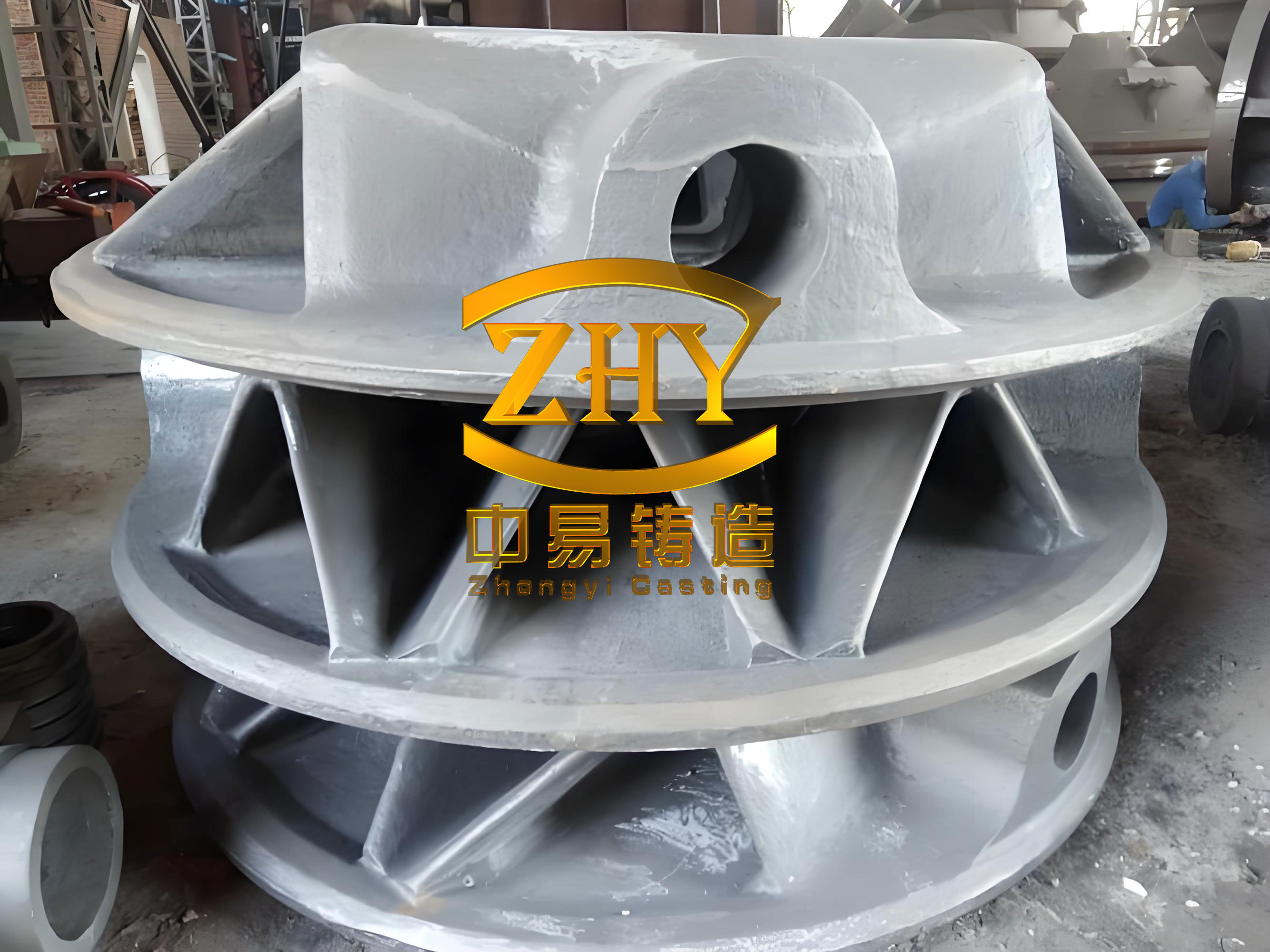
The target component is a large main shaft for a multi-megawatt offshore turbine, characterized by its substantial size, heavy section thicknesses (exceeding 300 mm in critical areas), and complex geometry. Such heavy-section ductile iron castings are notoriously challenging due to the propensity for graphite degeneration (e.g., chunk graphite), carbide formation, and segregation, all of which can severely degrade mechanical properties, particularly elongation and impact toughness. The technical specifications for the shaft mandate a unique combination of properties, including a tensile strength over 480 MPa, elongation above 12.5%, and, critically, a guaranteed impact energy at -20°C exceeding specified minimums—a requirement not typically covered by standard high-silicon ductile iron grades. Our development approach addressed this multifaceted challenge through a holistic strategy encompassing three core pillars: advanced material design, integrated casting process innovation, and optimized machining methodology.
Material Design and Metallurgical Foundation
The cornerstone of this development was the design of a proprietary cast iron chemistry and treatment process to achieve a solid-solution strengthened ferritic matrix with exceptional low-temperature toughness. Standard high-silicon grades (e.g., EN-GJS-500-14) offer good strength and ductility at room temperature but suffer from a high ductile-to-brittle transition temperature, rendering their low-temperature impact energy insufficient. Our objective was to decouple strength from brittle behavior.
The chemical composition was meticulously optimized through iterative experimentation. Carbon was controlled within a moderate range to prevent graphite flotation in heavy sections. Silicon, the primary solid-solution strengthener, was carefully balanced to achieve the target yield strength without excessively compromising low-temperature toughness. Manganese, phosphorus, and sulfur were suppressed to minimal levels to avoid pearlite stabilization, phosphide eutectic formation, and inclusion generation. Of particular importance was the control of trace elements. Elements like chromium and titanium that promote carbides were strictly limited. Conversely, controlled additions of elements like antimony (Sb) and bismuth (Bi) were employed to enhance graphite nodule count and morphology stability in heavy sections, counteracting the tendency for chunk graphite formation. The finalized target composition range is presented below.
| Element | Target Range (wt.%) | Rationale |
|---|---|---|
| C | 3.0 – 3.5 | Ensures adequate graphitization potential while preventing flotation. |
| Si | 3.6 – 3.8 | Primary solid-solution strengthener; balanced for strength vs. low-temp toughness. |
| Mn | ≤ 0.20 | Minimized to reduce pearlite and segregation tendency. |
| P | ≤ 0.04 | Minimized to avoid brittle phosphide networks. |
| S | ≤ 0.015 | Minimized to improve nodularity and reduce slag. |
| Mg | 0.045 – 0.055 | Essential for spheroidization; higher residual for heavy section stability. |
| RE (Ce, Y) | ≤ 0.015 | Controlled use of light/heavy Rare Earths to combat trace element interference. |
| Sb | ≤ 0.005 | Trace addition to inhibit degenerate graphite forms. |
| Bi | ≤ 0.020 | Trace addition to enhance nucleation and nodule count. |
| Cr, Ti | ≤ 0.05, < 0.02 | Strongly limited as carbide promoters. |
The melting and treatment process was equally critical. A synthetic iron base was created using a high percentage of premium steel scrap, along with high-purity pig iron and foundry returns, melted in a medium-frequency induction furnace. A key innovation was the use of a proprietary hybrid nodulizer, combining light and heavy rare-earth elements. This blend leverages the superior anti-fade properties and ability to neutralize trace elements of heavy REs (like Yttrium) with the cost-effectiveness and graphite-shaping role of light REs (like Cerium). The nodulizing reaction was conducted via the sandwich method in a treatment ladle.
A robust, multi-stage inoculation practice was implemented to ensure a high nodule count and a fully ferritic matrix:
1. Pre-inoculation: Addition to the covering material in the treatment ladle.
2. Post-inoculation: Addition during transfer (teapot-style pouring) from the treatment ladle to the pouring ladle.
3. Stream inoculation: Precise addition of a fine-grain inoculant into the metal stream during mold filling via an automated dispensing system.
The effectiveness of this metallurgical approach was first validated on representative 400 mm cubic test blocks. The results confirmed the attainment of the target microstructure and properties, as summarized in the following tables.
| Property | Test Result (Avg.) | Specification Requirement |
|---|---|---|
| Tensile Strength, Rm (MPa) | 530 | ≥ 480 |
| Yield Strength, Rp0.2 (MPa) | 410 | ≥ 380 |
| Elongation, A (%) | 16.5 | ≥ 12.5 |
| Impact Energy, KV (23°C) (J) | 11.7 | ≥ 10 (Avg) |
| Impact Energy, KV (-20°C) (J) | 7.8 | ≥ 6 (Avg) |
| Microstructural Feature | Result | Requirement |
|---|---|---|
| Nodularity (%) | > 90 | ≥ 90 |
| Nodule Count (nodules/mm²) | > 130 | High count desired |
| Ferrite Content (vol.%) | > 95 | ≥ 95 |
| Carbides + Steadite (vol.%) | < 1 | ≤ 1 |
Integrated Casting Process Innovation
Producing a sound, heavy-section ductile iron casting like a wind turbine shaft requires more than just the right chemistry; it demands a casting process designed for controlled solidification and feeding. The process was engineered around the principle of “directed solidification” and “natural feeding” to eliminate shrinkage defects.
The molding strategy employed a multi-part flask (four sections) with the large flange down. This orientation places the heaviest thermal mass at the bottom, facilitating a favorable temperature gradient. The core assembly was simplified to a single large core for the internal bore, enhancing dimensional accuracy. The gating system was a critically engineered component. A bottom-filling, open gating system with multiple ingates was designed based on the “large orifice outflow” theory to ensure a quiescent, non-turbulent fill. The key relationship for controlling metal velocity at the ingate is given by:
$$v = \frac{Q}{A}$$
where \(v\) is the flow velocity, \(Q\) is the volumetric flow rate, and \(A\) is the total cross-sectional area of the ingates. The system was designed to maintain \(v < 0.5 \, \text{m/s}\) at the ingates. Multiple ceramic foam filters were integrated into the runner and at each ingate to cleanse the metal of inclusions and further dampen turbulence.
The most significant innovation was the implementation of a “riserless” feeding approach, made possible by the extensive use of conforming (profile) chills. Dense arrays of iron chills, approximately 100 mm thick, were placed directly against the mold and core surfaces adjacent to all major thick sections of the shaft. This created a powerful chilling effect, rapidly freezing the outer layers and establishing a strong solid shell. The resultant volumetric contraction creates a suction effect, actively drawing liquid metal from the still-molten interior towards the solidifying walls—a process of natural or “self-feeding.” The efficacy of this method hinges on achieving a sufficient modulus (volume-to-surface-area ratio) difference and a controlled solidification sequence. Numerical simulation using MAGMA software was instrumental in optimizing the placement and size of these chills. The simulation predicted a sound casting with only minimal, dispersed porosity in the last-to-freeze areas, which was subsequently eliminated in the final design by adding strategic chilling. A simplified thermal criterion for this approach can be expressed as ensuring the solidification time of the chilled surface, \(t_s\), is significantly less than that of the thermal center, \(t_c\):
$$t_s << t_c$$
This process integration resulted in a dramatic increase in yield (cast weight / poured weight) to over 90%, compared to conventional risered approaches for similar castings, while simultaneously ensuring internal soundness verified by ultrasonic testing.
Precision Machining Strategy
The final dimensional and surface quality of the ductile iron casting is paramount for its assembly and function within the precision drivetrain. Machining such a large, heavy component efficiently and accurately presents its own set of challenges. To address this, a specialized machining cell was developed.
The primary operation for turning the large external diameters and faces utilizes a large, double-column vertical lathe (CNC). A key innovation here was the implementation of a multi-tool machining strategy. The lathe was equipped with three independent cutting tool posts operating simultaneously under synchronized CNC control. This allows for concurrent roughing or finishing operations on different sections of the shaft, drastically reducing the overall machining cycle time. The process parameters (cutting speed \(V_c\), feed rate \(f\), depth of cut \(a_p\)) were optimized for the specific ductile iron casting material to balance metal removal rate, tool life, and surface integrity. The material removal rate (MRR) for each tool can be approximated by:
$$MRR \approx V_c \cdot f \cdot a_p$$
By running three tools in parallel, the effective MRR is significantly multiplied, leading to a proportional increase in productivity.
For boring the internal diameters and machining the bolt hole patterns on the flanges, a high-precision floor-type boring and milling machine was employed. The entire machining process was validated through digital twin simulations to prevent collisions and optimize tool paths. This integrated approach to machining ensured that the high-quality metallurgical properties achieved in the casting were not compromised during finishing, and that final dimensional tolerances and surface finish specifications were consistently met.
Conclusion and Industrial Validation
The comprehensive R&D program described herein has successfully established a robust, industrially proven methodology for manufacturing large offshore wind turbine main shafts from high-performance ductile iron casting. The synergistic combination of a tailored metallurgical design, an innovative riserless casting process with intensive chilling, and an optimized precision machining strategy has overcome the traditional limitations associated with heavy-section ductile iron.
The developed material consistently achieves a superior property profile: tensile strength exceeding 500 MPa, elongation over 15%, and crucially, impact energies at -20°C reliably above 7 J, satisfying the most demanding offshore specifications. The casting process achieves an exceptional yield, minimizing material waste and energy consumption. The machining strategy ensures precision and efficiency in final part production.
This technology has been transferred to volume production, with over 100 shafts manufactured for various offshore turbine platforms. The consistent quality, demonstrated by a casting reject rate of less than 1% and full compliance with all non-destructive testing (UT, MT) standards, validates the robustness of the process. This ductile iron casting solution presents a compelling alternative to traditional forged shafts, offering comparable or superior performance at a significantly reduced total cost, thereby contributing to the economic viability and sustainable growth of the offshore wind energy sector.