
I study the melting-stage production scheduling problem for large wind turbine generator systems, with a focus on thick and large-section ductile iron castings. In modern offshore wind power, 8–12 MW class units have become a major demand driver. The hub, main shaft, bearing housing, and front frame of such units are often produced as heavy-section ductile iron castings. A single ductile iron casting of this type may weigh approximately 20–60 t. In many casting enterprises, the available medium-frequency furnaces have a much smaller safe melting capacity and a limited number of units. Therefore, a large ductile iron casting cannot be melted in one furnace in one heat. It must be produced by multiple furnaces melting simultaneously, and the liquid iron must be poured into the same mold through multiple pouring channels. This creates a difficult multi-heat scheduling problem: orders with different weights, different material grades, and different due dates must be allocated to parallel furnaces, while furnace capacity utilization and material compatibility must be respected.
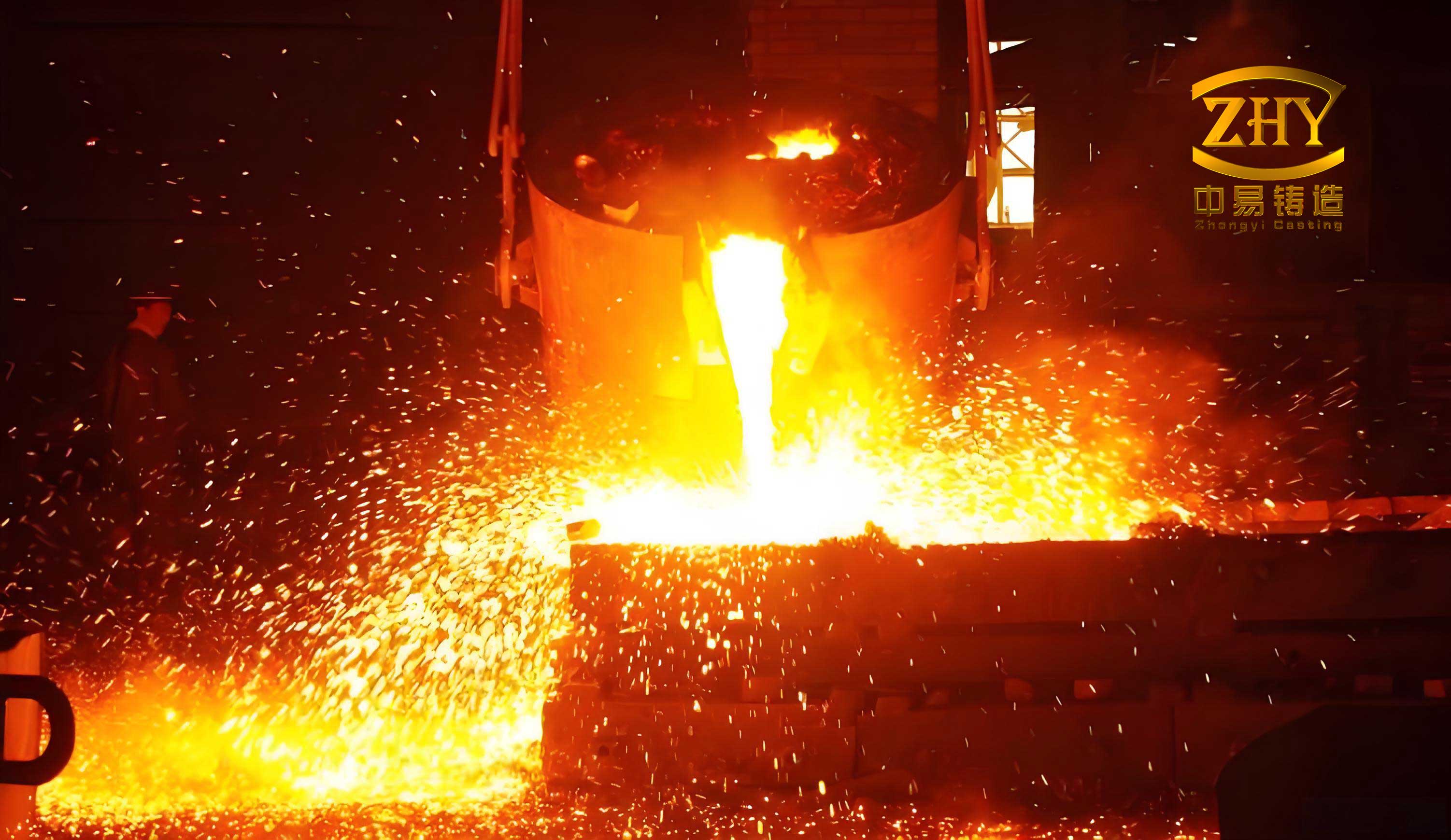
I define one heat as the amount of alloy melted by one furnace in one melting cycle. A heat plan is the grouping and scheduling of casting orders into heats. Only castings with the same material grade can be combined in one heat. When a ductile iron casting is heavier than the maximum safe melting capacity of a furnace, its melting task must be split across multiple heats and multiple furnaces. When a ductile iron casting is lighter than the furnace capacity, it usually cannot be split because of pouring-gate restrictions; it must be melted and poured by one furnace. Thus, the decision space contains both continuous splitting variables for large ductile iron castings and binary assignment variables for small ductile iron castings. This mixed structure makes the problem more complex than classical lot-sizing or parallel-machine batching problems.
Previous studies on heat planning have often assumed that every casting weight is below the maximum furnace capacity. That assumption fails for large wind turbine ductile iron castings. I therefore construct a multi-heat planning model that explicitly handles the case in which a single ductile iron casting exceeds the capacity of one furnace. The model considers delivery priority, furnace capacity utilization, and material compatibility. I decompose the problem into three subproblems: grouping castings by material, selecting the batch of castings to be produced in the planning horizon, and assigning the selected castings to parallel furnaces. I solve the batch selection problem with a hybrid genetic whale optimization algorithm, and I solve the assignment problem with integer linear programming. I validate the approach with data from a real casting enterprise. The results show that the proposed method improves average furnace capacity utilization from 86.57% to 95.89%, reduces the total number of heats from 42 to 39, and lowers energy consumption and preheating time. The method is especially suitable for large ductile iron castings in wind power applications.
Problem Description
In a sand casting enterprise, the production process includes molding, core making, melting, pouring, cooling, sand shaking, cleaning, and finishing. The molding stage and core-making stage can be performed in parallel on different machines. The melting stage is often the bottleneck because several castings can be grouped into one heat, but the furnace capacity is limited. For large ductile iron castings, the bottleneck is even more severe: a single ductile iron casting may require multiple furnaces to melt at the same time. The pouring stage must then combine the liquid iron from multiple heats into one mold. Therefore, the melting stage determines the rhythm of the entire production system.
I simplify the process as follows. Orders arrive with known casting weight, material grade, and due date. Each order corresponds to one ductile iron casting task. A task can be large or small relative to the maximum safe melting capacity. If the task weight is greater than the furnace capacity, the task can be split into multiple portions and assigned to different furnaces. If the task weight is less than or equal to the furnace capacity, the task cannot be split and must be assigned to exactly one furnace or left unplanned. Each furnace can melt only one material grade in one heat. Multiple tasks with the same material grade can be combined into one heat if their total weight does not exceed the furnace capacity. When several furnaces operate in parallel, their heats can be poured simultaneously into the same mold for a large ductile iron casting. The objective is to maximize the total melting value, which combines delivery priority and charged weight, while satisfying capacity and material constraints.
| Symbol | Meaning |
|---|---|
| \(K\) | Total number of heats or furnace loads in the plan |
| \(L\) | Total number of casting tasks or orders |
| \(N\) | Number of material grades |
| \(k\) | Furnace index, \(k=1,2,\dots,K\) |
| \(l\) | Task index, \(l=1,2,\dots,L\) |
| \(n\) | Material index, \(n=1,2,\dots,N\) |
| \(N_l\) | Total weight of task \(l\) |
| \(V_l\) | Remaining delivery time of task \(l\) |
| \(Q_k\) | Maximum safe melting capacity of furnace \(k\) |
| \(M_l\) | Material grade of task \(l\) |
| \(T_k\) | Material grade assigned to furnace \(k\) |
| \(P_{lk}\) | Proportion of task \(l\) assigned to furnace \(k\) |
| \(x_l\) | Binary variable equal to 1 if task \(l\) is planned |
The decision variable \(P_{lk}\) has different domains depending on the size of the ductile iron casting. For a large ductile iron casting with \(N_l > Q_k\), \(P_{lk}\) can be fractional, and the sum over furnaces must be either 1 or 0. For a small ductile iron casting with \(N_l \le Q_k\), \(P_{lk}\) is binary: it is 1 if the task is assigned to furnace \(k\), and 0 otherwise. This distinction reflects the physical pouring constraints of ductile iron castings.
Mathematical Model
I formulate the multi-heat melting scheduling problem as a mixed-integer nonlinear programming model. The objective is to maximize the total melting value. The melting value of a task is the product of its weight and its delivery priority. The delivery priority reflects how urgently the order must be produced. A common normalized priority is defined as follows:
$$
R_l = \frac{1}{1 + \lambda V_l}
$$
where \(\lambda > 0\) is a scaling parameter. A smaller remaining delivery time \(V_l\) yields a larger priority \(R_l\). The objective function is:
$$
\max Z = \sum_{k=1}^{K} \sum_{l=1}^{L} N_l P_{lk} R_l
$$
This objective simultaneously encourages high furnace capacity utilization and early production of urgent orders. If I used an additive objective, the model might prefer many small tasks instead of urgent large ductile iron castings. The multiplicative form aligns the melting value with both weight and urgency. The constraints are as follows:
$$
\sum_{k=1}^{K} P_{lk} = x_l, \quad \forall l
$$
$$
x_l \in \{0,1\}, \quad \forall l
$$
$$
\sum_{l=1}^{L} N_l P_{lk} \le Q_k, \quad \forall k
$$
$$
M_l P_{lk} = T_k P_{lk}, \quad \forall l,k
$$
$$
0 \le P_{lk} \le 1, \quad \text{if } N_l > Q_k
$$
$$
P_{lk} \in \{0,1\}, \quad \text{if } N_l \le Q_k
$$
Constraint \(\sum_{k=1}^{K} P_{lk} = x_l\) ensures that if a task is planned, its entire weight is allocated across heats; if it is not planned, no portion is allocated. The capacity constraint ensures that the total charged weight in each heat does not exceed the maximum safe melting capacity. The material constraint ensures that only tasks with the same material grade as the heat can be assigned to that heat. The domain constraints distinguish large ductile iron castings from small ductile iron castings. The furnace capacity utilization of heat \(k\) is:
$$
U_k = \frac{\sum_{l=1}^{L} N_l P_{lk}}{Q_k} \times 100\%
$$
The average furnace capacity utilization over \(K\) heats is:
$$
B^* = \frac{1}{K} \sum_{k=1}^{K} U_k
$$
I also define the material compatibility indicator \(\delta_{lk}\) as:
$$
\delta_{lk} =
\begin{cases}
1, & M_l = T_k \\
0, & M_l \ne T_k
\end{cases}
$$
Then the material constraint can be rewritten as:
$$
P_{lk} \le \delta_{lk}, \quad \forall l,k
$$
This linear form is convenient for computation. The model is a mixed-integer problem because \(x_l\) is binary, \(P_{lk}\) is binary for small ductile iron castings, and \(P_{lk}\) is continuous for large ductile iron castings.
| Constraint | Mathematical expression | Purpose |
|---|---|---|
| Complete allocation | \(\sum_{k=1}^{K} P_{lk} = x_l\) | All planned weight is assigned |
| Furnace capacity | \(\sum_{l=1}^{L} N_l P_{lk} \le Q_k\) | Do not exceed safe melting capacity |
| Material compatibility | \(P_{lk} \le \delta_{lk}\) | Only same material grade can be combined |
| Large casting split | \(0 \le P_{lk} \le 1\) for \(N_l > Q_k\) | Large ductile iron casting can be split |
| Small casting assignment | \(P_{lk} \in \{0,1\}\) for \(N_l \le Q_k\) | Small ductile iron casting cannot be split |
Solution Strategy
The model is difficult to solve directly because it combines batching, scheduling, and continuous splitting. I adopt a decomposition strategy. First, I divide all tasks into material groups. Second, I select a batch of tasks for the planning horizon by solving a 0–1 knapsack-like problem. Third, I assign the selected tasks to parallel furnaces by solving an integer linear program. This three-stage strategy reduces the combinatorial complexity and allows each subproblem to be solved with an appropriate method.
| Subproblem | Decision | Method |
|---|---|---|
| Material grouping | Separate tasks by material grade | Deterministic grouping |
| Batch selection | Choose which ductile iron castings to melt | Hybrid genetic whale optimization algorithm |
| Furnace assignment | Allocate selected weight to parallel furnaces | Integer linear programming |
For batch selection, I use a binary encoding. Each individual in the population has length \(L\). Gene \(l\) is 1 if task \(l\) is selected, and 0 otherwise. The fitness function is the total melting value:
$$
f(S) = \sum_{l \in S} N_l R_l
$$
where \(S\) is the set of selected tasks. The fitness function is subject to the furnace capacity constraint and the material grouping constraint. I also add a size-interval constraint to ensure that the selected batch can be feasibly assigned in the next stage. For example, if two furnaces have capacities 10 t and 20 t, the number of selected tasks heavier than 10 t must not exceed the number of furnaces with capacity 20 t. This constraint prevents infeasible selections.
Hybrid Genetic Whale Optimization Algorithm
The whale optimization algorithm is inspired by the bubble-net feeding behavior of humpback whales. It has a good exploration ability but can lose diversity in later iterations. The genetic algorithm has strong global search ability through selection, crossover, and mutation, but it depends on the initial population and may converge slowly. I combine them into a hybrid genetic whale optimization algorithm, abbreviated as HGWOA. The HGWOA uses whale position updates and genetic operators to balance exploration and exploitation.
In the standard whale optimization algorithm, the position of a search agent is updated as follows:
$$
\vec{D} = |\vec{C} \vec{X}^*(t) – \vec{X}(t)|
$$
$$
\vec{X}(t+1) = \vec{X}^*(t) – \vec{A} \vec{D}
$$
$$
\vec{A} = 2\vec{a}\vec{r}_1 – \vec{a}
$$
$$
\vec{C} = 2\vec{r}_2
$$
where \(\vec{X}^*(t)\) is the best solution found so far, \(\vec{X}(t)\) is the current solution, \(\vec{a}\) decreases linearly from 2 to 0, and \(\vec{r}_1\), \(\vec{r}_2\) are random vectors in \([0,1]\). When \(|\vec{A}| < 1\), the whale approaches the best solution. When \(|\vec{A}| \ge 1\), the whale moves randomly to explore the search space. The spiral update is:
$$
\vec{D}’ = |\vec{X}^*(t) – \vec{X}(t)|
$$
$$
\vec{X}(t+1) = \vec{D}’ e^{bl} \cos(2\pi l) + \vec{X}^*(t)
$$
where \(b\) is a constant defining the logarithmic spiral shape, and \(l\) is a random number in \([-1,1]\). The choice between the encircling mechanism and the spiral mechanism is controlled by a probability \(p\). In the HGWOA, I use \(p\) to decide whether to apply a genetic crossover or a mutation. When \(|\vec{A}| \ge 1\), I select a random individual for crossover. When \(|\vec{A}| < 1\), I select the best individual for crossover. This hybrid mechanism improves the search efficiency for the ductile iron casting scheduling problem.
| Parameter | Meaning | Value used in experiments |
|---|---|---|
| \(NIND\) | Population size | 500 |
| \(MAXGEN\) | Maximum iterations | 300 |
| \(p_c\) | Genetic crossover probability | 0.9 |
| \(p_m\) | Genetic mutation probability | 0.08 |
| \(C_1,C_2\) | Particle swarm acceleration constants | 0.7 |
| \(w\) | Particle swarm inertia weight | 0.8 |
| \(b\) | Spiral constant | 1.0 |
The HGWOA also includes a repair mechanism. If an individual violates the size-interval constraint, I sort the selected tasks in the violating interval by their melting value from smallest to largest and change their genes from 1 to 0 until the constraint is satisfied. If an individual violates the furnace capacity constraint, I sort the selected tasks by priority from smallest to largest and remove them until the total weight is within capacity. Then I sort the unselected tasks by priority from largest to smallest and add them until the next task would exceed capacity. This greedy repair improves the feasibility and quality of solutions.
Batch Assignment to Parallel Furnaces
After the HGWOA selects the batch of ductile iron castings, I solve the assignment problem. The selected tasks must be allocated to the available furnaces. For a large ductile iron casting, the weight can be split across multiple furnaces. For a small ductile iron casting, the whole weight must be assigned to one furnace. I use an integer linear programming solver for this subproblem. The constraints are:
$$
\sum_{k=1}^{K} N_l P_{lk} = N_l x_l, \quad \forall l
$$
$$
\sum_{l=1}^{L} N_l P_{lk} \le Q_k, \quad \forall k
$$
$$
P_{lk} \le \delta_{lk}, \quad \forall l,k
$$
$$
0 \le P_{lk} \le 1, \quad \text{if } N_l > Q_k
$$
$$
P_{lk} \in \{0,1\}, \quad \text{if } N_l \le Q_k
$$
The assignment result provides the exact weight of each ductile iron casting or portion of a ductile iron casting that must be melted in each furnace. Table 1 shows an example with three castings and two furnaces.
| Casting | Weight | Furnace 1 proportion | Furnace 2 proportion |
|---|---|---|---|
| 1 | \(N_1\) | \(P_{11}=1\) | \(P_{12}=0\) |
| 2 | \(N_2\) | \(P_{21}=0\) | \(P_{22}=1\) |
| 3 | \(N_3\) | \(P_{31}=0.8\) | \(P_{32}=0.2\) |
In this example, casting 3 is a large ductile iron casting because its weight exceeds the capacity of one furnace, so it is split between the two furnaces. Castings 1 and 2 are small ductile iron castings and are assigned entirely to one furnace each. This assignment ensures that all allocated weights satisfy capacity and material constraints.
Experimental Validation
I validate the proposed model and algorithm with real production data from a sand casting enterprise that produces wind power components. The enterprise uses two parallel medium-frequency furnaces, each with a maximum safe melting capacity of 20 000 kg. In a typical night shift, each furnace can run four heats, so the total planned number of heats is eight. To ensure sufficient liquid iron for pouring, the enterprise uses a ratio of casting gross weight to melting weight of 1:1.1. I use order data from the enterprise information system as the test set. The test set contains 191 castings, which can be divided into three material groups: QT400, QT500, and QT600.
| Material group | Material type | Number of castings |
|---|---|---|
| 1 | QT400 | 116 |
| 2 | QT500 | 21 |
| 3 | QT600 | 54 |
For one representative night, the algorithm produces a heat plan with two furnaces and multiple heats. Table 2 shows a selected example. Casting 98 is a large ductile iron casting with a gross weight of 21 800 kg, which exceeds the capacity of a single furnace. It is therefore split between furnace 1 and furnace 2. The other castings are small ductile iron castings and are assigned to furnace 2. The melting weight in furnace 1 is 20 000 kg, and the melting weight in furnace 2 is 9 943.1 kg in this simplified example.
| Casting number | Material | Gross weight (kg) | Furnace 1 melting weight (kg) | Furnace 2 melting weight (kg) |
|---|---|---|---|---|
| 9 | QT400 | 1 028 | 0 | 1 130.8 |
| 71 | QT400 | 1 240 | 0 | 1 364.0 |
| 23 | QT400 | 920 | 0 | 1 012.0 |
| 98 | QT400 | 21 800 | 20 000 | 3 980.0 |
| 15 | QT400 | 1 033 | 0 | 1 136.3 |
| 17 | QT400 | 1 100 | 0 | 1 320.0 |
The furnace capacity utilization for each heat is calculated with the utilization formula. Table 3 shows the results for four heats. The average utilization \(B^*\) is 99.77% in this example. This demonstrates that the model can fill the furnace capacity efficiently while respecting the splitting constraint of the large ductile iron casting.
| Heat number | Furnace 1 utilization (%) | Furnace 2 utilization (%) |
|---|---|---|
| 1 | 99.43 | 100.00 |
| 2 | 99.87 | 99.78 |
| 3 | 99.88 | 99.71 |
| 4 | 99.74 | 99.72 |
I compare the intelligent scheduling method with the manual scheduling method currently used by the enterprise. The manual method has an average furnace capacity utilization of 86.57% and requires 42 heats to complete the test set. The proposed method achieves an average furnace capacity utilization of 95.89%, an improvement of 10.76 percentage points. It also reduces the total number of heats to 39, a reduction of 7.14%. Because each heat requires preheating and energy, reducing the number of heats lowers energy consumption and improves the environmental performance of the melting stage.
| Method | Average furnace capacity utilization (%) | Total heats | Improvement |
|---|---|---|---|
| Manual scheduling | 86.57 | 42 | — |
| Proposed intelligent scheduling | 95.89 | 39 | +10.76% utilization; −7.14% heats |
Algorithm Comparison
I compare the HGWOA with a particle swarm optimization algorithm and a standard genetic algorithm. All algorithms use a population size of 500 and a maximum of 300 iterations. For each material group configuration, I run each algorithm 20 times independently. Table 4 reports the average runtime, the best fitness value, and the average fitness value. The test cases include one, two, and three material groups.
| Material groups | Algorithm | Average time (s) | Best fitness | Average fitness |
|---|---|---|---|---|
| 1 | PSO | 2.25 | \(3.1842\times10^4\) | \(2.9935\times10^4\) |
| 1 | GA | 6.34 | \(3.2178\times10^4\) | \(3.0114\times10^4\) |
| 1 | HGWOA | 11.12 | \(3.2945\times10^4\) | \(3.0521\times10^4\) |
| 2 | PSO | 3.42 | \(3.1911\times10^4\) | \(3.0222\times10^4\) |
| 2 | GA | 10.98 | \(3.2169\times10^4\) | \(3.0928\times10^4\) |
| 2 | HGWOA | 17.24 | \(3.2961\times10^4\) | \(3.1121\times10^4\) |
| 3 | PSO | 2.53 | \(3.1918\times10^4\) | \(3.0230\times10^4\) |
| 3 | GA | 7.98 | \(3.2113\times10^4\) | \(3.0898\times10^4\) |
| 3 | HGWOA | 12.18 | \(3.2969\times10^4\) | \(3.1125\times10^4\) |
The results show that as the number of material groups increases, the solution space becomes more complex and the runtime increases. The PSO algorithm converges quickly but often falls into local optima. The GA algorithm achieves better fitness than PSO but requires more iterations. The HGWOA achieves the best fitness values and the highest average fitness values in all test cases. Its convergence speed is also better than GA. After approximately 20 iterations, the HGWOA reaches a high objective value. Therefore, the hybrid genetic whale optimization algorithm is effective for the multi-heat scheduling problem of large ductile iron castings.
Discussion
The proposed model has several practical advantages. First, it explicitly represents the splitting of a large ductile iron casting across multiple furnaces. This is essential for wind turbine hub, main shaft, bearing housing, and front frame castings, whose weights often exceed the safe capacity of a single furnace. Second, it enforces material compatibility, so that different grades of ductile iron casting are not mixed in one heat. Third, it uses a delivery priority to protect urgent orders. Fourth, it maximizes furnace capacity utilization, which reduces the number of heats and lowers energy consumption. Fifth, it uses a decomposition strategy that makes the problem solvable within a reasonable computational time.
The model also has limitations. It assumes that the melting stage is the only bottleneck and that the upstream molding stage and downstream pouring stage have sufficient capacity. In real production, molding capacity and pouring time can affect the feasible start time of a heat. The current model also assumes that the material grade of each heat is known in advance. In practice, the material grade of a heat may be selected together with the batch. Future research can integrate molding capacity, pouring time windows, and furnace maintenance into the model. It can also consider uncertainties in order arrival, scrap rate, and furnace availability.
Conclusion
I have studied the multi-heat melting scheduling problem for large wind turbine ductile iron castings. I constructed a mixed-integer model that considers delivery priority, furnace capacity utilization, and material compatibility. The model allows large ductile iron castings to be split across multiple parallel furnaces while preventing small ductile iron castings from being split. I solved the model with a three-stage strategy: material grouping, batch selection with a hybrid genetic whale optimization algorithm, and furnace assignment with integer linear programming. I validated the method with real enterprise data. The results show that the proposed method increases average furnace capacity utilization from 86.57% to 95.89% and reduces the number of heats from 42 to 39. The HGWOA also outperforms PSO and GA in terms of solution quality and convergence. The method supports resource optimization, improves production efficiency, and reduces energy consumption in the melting of large ductile iron castings.
For future work, I plan to extend the model to include dynamic order arrivals, uncertain processing times, and coordinated scheduling with molding and pouring. I also plan to test the method on larger data sets with more material grades and more parallel furnaces. The proposed framework can be adapted to other heavy-section ductile iron casting production systems where multi-heat melting is required.