
In the realm of automotive component manufacturing, the production of durable and precise parts like oil pans is critical. These components, often made from ductile iron castings, serve as vital elements in engines, providing structural integrity and fluid containment. My experience in implementing the lost foam casting process for ductile iron oil pans has revealed both challenges and significant advantages over traditional sand casting methods. This article details the entire production journey, from initial design to final quality assurance, emphasizing practical solutions and technical insights. Throughout this discussion, the focus remains on optimizing the process for high-quality ductile iron castings, a material prized for its strength and ductility.
The lost foam casting process, also known as evaporative pattern casting, involves using a foam pattern that vaporizes upon contact with molten metal, leaving behind a precise cavity. This method is particularly suited for complex geometries like oil pans, which require intricate internal features and smooth surfaces. For ductile iron castings, the process must be carefully controlled to maintain material properties such as high tensile strength and elongation. The oil pan in question, with dimensions of 761 mm × 440 mm × 236 mm and a weight of 87 kg, features varying wall thicknesses from 10 mm to 40 mm. Specifications demand a tensile strength ≥450 MPa, elongation ≥10%, hardness between 160–210 HBW, and a microstructure with pearlite volume fraction below 25%, nodularity above 70%, and carbides below 0.5%. These requirements make ductile iron castings ideal for heavy-duty applications.
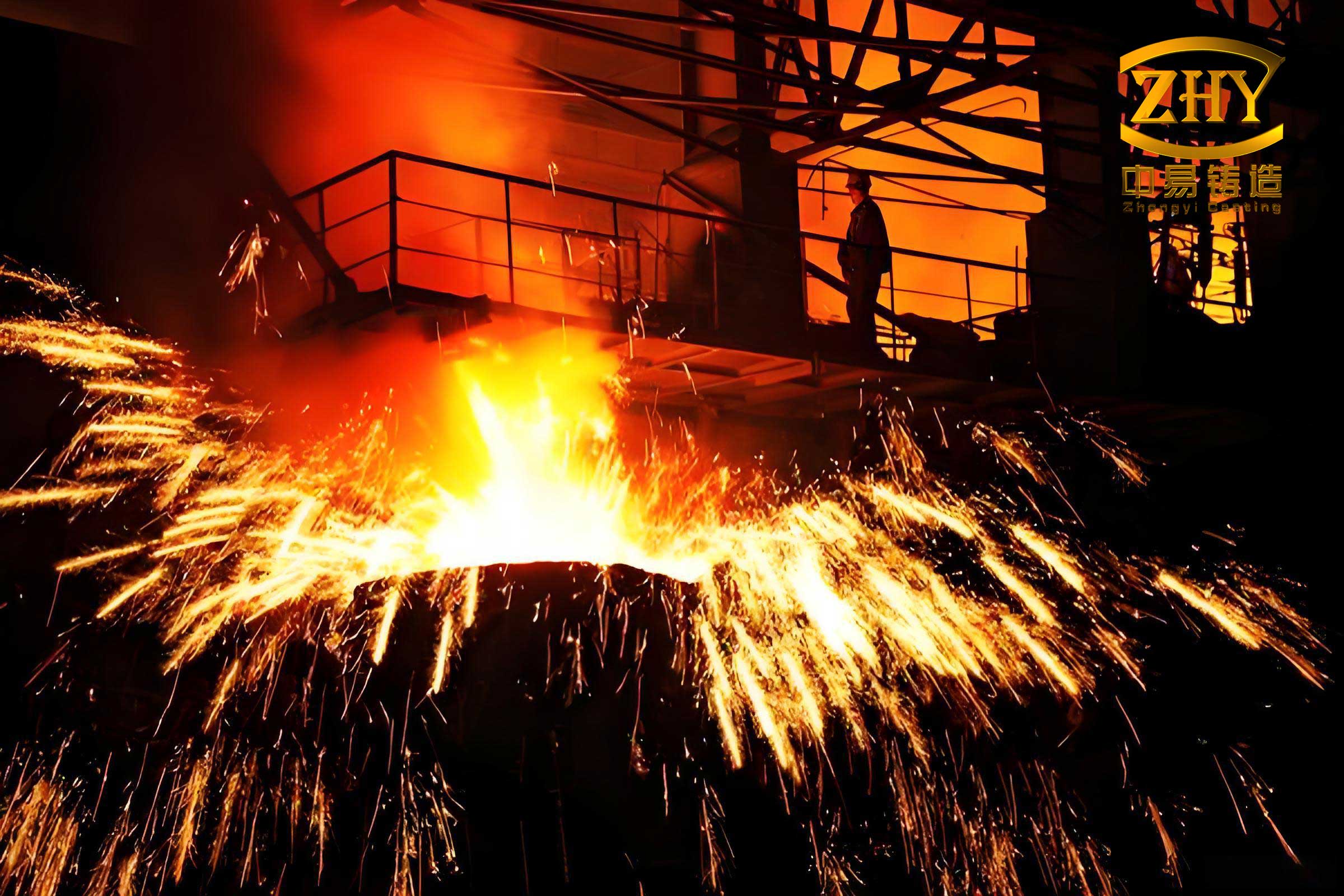
The production of ductile iron castings via lost foam casting involves four main stages: pattern making, molding and pouring, melting, and finishing. Each stage requires precise control to ensure the final product meets stringent standards. In this practice, we utilized a production line with a capacity of 15,000 tons per year per shift, using sand boxes of 1200 mm × 1000 mm × 1300 mm and a rate of 20 boxes per hour. This setup is typical for high-volume manufacturing of ductile iron castings, including engine blocks and transmission cases.
Pattern Making and Assembly
The first stage, pattern making, begins with pre-expansion of STMMA beads to a density of 20–22 g/L, followed by a 24-hour aging period to stabilize the foam. The pattern is then formed using a semi-automatic molding machine to create a single, integrated foam model. This integrated approach eliminates the need for cores, a key advantage for ductile iron castings with complex shapes. After formation, the pattern is dried naturally for 4 hours and then in a drying oven at 50±5°C with humidity below 30% for 72 hours, until mass stabilization. The gating system is designed as a bottom and intermediate stepped system, with a sprue diameter of 50 mm and five ingates each measuring 40 mm × 8 mm. Two slag traps are incorporated to reduce inclusions. To prevent distortion, anti-deformation ribs are added across the open face, ensuring dimensional accuracy in the final ductile iron castings. The pattern is then coated via manual dipping with a refractory slurry at 68–70° Bé, achieving a dried coating thickness of 1.2–1.5 mm after three coats. Each coat is dried for 24 hours at 50±5°C until mass consistency is reached.
| Material Grade | C (%) | Sifinal (%) | Mn (%) | S (%) | P (%) | Mgresidual (%) |
|---|---|---|---|---|---|---|
| QT450-10 | 3.8 ± 0.1 | 2.85 ± 0.1 | ≤0.35 | ≤0.03 | ≤0.07 | 0.04–0.06 |
The chemical composition is critical for achieving the desired properties in ductile iron castings. The carbon equivalent (CE) plays a vital role in fluidity and shrinkage behavior, calculated as:
$$ CE = C + \frac{Si + P}{3} $$
For our ductile iron castings, the target CE is 4.75–4.85%, which helps balance strength and ductility. The charge composition consists of 20% Q10 pig iron, 20% returns, and 60% steel scrap, with carburizer added to adjust carbon levels. The melting sequence involves charging pig iron first, followed by steel scrap, carburizer, and returns, all melted in a medium-frequency induction furnace.
Molding, Pouring, and Melting
In the molding stage, two patterns are arranged in a sand box filled with 20/40 mesh quartz sand. The process includes bottom sand compaction, pattern placement, sand raining, and three-dimensional vibration to ensure uniform packing. Pouring follows the “accurate-fast-slow” principle: once the sprue is ignited, a steady flow is maintained without interruption. The pouring temperature is set at 1450–1480°C, with a vacuum pressure of -0.04 to -0.06 MPa during pouring, held for over 10 minutes post-pour to solidify the ductile iron castings properly. The melting stage employs a wire-feeding nodularization process. A cored wire with 29–31% Mg is added at 0.9%, along with 1.1% 75SiFe inoculant, at a treatment temperature of 1580±5°C. This method ensures consistent nodularization for high-quality ductile iron castings.
| Parameter | Value | Unit |
|---|---|---|
| Pre-expansion Density | 20–22 | g/L |
| Drying Temperature | 50 ± 5 | °C |
| Coating Thickness | 1.2–1.5 | mm |
| Pouring Temperature | 1450–1480 | °C |
| Vacuum Pressure | -0.04 to -0.06 | MPa |
| Pouring Time | 46 | seconds |
| Nodularization Temperature | 1580 ± 5 | °C |
Challenges and Solutions in Producing Ductile Iron Castings
During initial trials, several defects emerged that are common in lost foam casting of ductile iron castings. Addressing these required targeted adjustments to the process parameters and design.
Carbon Defects
Carbon defects, unique to lost foam casting, occur when the foam pattern fails to vaporize completely, leaving carbon residues that manifest as black spots on or beneath the surface of ductile iron castings. This issue is influenced by pouring temperature, vacuum, and gating design. To mitigate it, we increased the pouring temperature to 1470±10°C and maintained a vacuum of -0.04 to -0.06 MPa. The gating system was optimized from a top-pour to a combined bottom and intermediate stepped design, reducing pouring time to 46 seconds and adding overflow vents at the highest points. These changes enhanced pattern vaporization, minimizing carbon inclusions in the ductile iron castings.
Low Surface Hardness
Initial hardness measurements averaged 156 HBW, below the required 160–210 HBW for ductile iron castings. This was attributed to slow cooling in the dry sand mold and the thick wall sections (up to 40 mm). To improve hardness, we oriented thicker sections downward to accelerate cooling and added 0.02% tin alloy to the ladle during tapping. The tin promotes pearlite formation, increasing hardness without compromising ductility. The resulting hardness exceeded 170 HBW, meeting specifications for ductile iron castings. The hardness relationship can be expressed as:
$$ HBW = k \cdot \sqrt{\frac{P}{A}} $$
where \( P \) is the applied load and \( A \) is the indentation area, but in practice, it depends on microstructure and cooling rates.
Leakage Due to Shrinkage Porosity
Leakage in pressure tests stemmed from shrinkage porosity at junctions with 40 mm wall thickness, where isolated hot spots formed during solidification of ductile iron castings. To address this, we adjusted the carbon equivalent to 4.75–4.85% to improve feeding characteristics and placed external chills at critical locations. The chills, attached with hot melt adhesive, accelerated cooling and reduced shrinkage. The solidification time \( t_s \) for a section can be estimated using Chvorinov’s rule:
$$ t_s = k \cdot \left( \frac{V}{A} \right)^n $$
where \( V \) is volume, \( A \) is surface area, and \( k \) and \( n \) are constants. By increasing \( A \) with chills, \( t_s \) decreases, minimizing porosity in ductile iron castings.
| Defect Type | Root Cause | Corrective Measures | Outcome |
|---|---|---|---|
| Carbon Defects | Incomplete pattern vaporization | Higher pouring temperature, optimized gating, increased vacuum | Eliminated surface carbon residues |
| Low Hardness | Slow cooling, thick sections | Orientation change, tin addition (0.02%) | Hardness ≥170 HBW |
| Leakage (Shrinkage) | Isolated hot spots, insufficient feeding | CE adjustment to 4.75–4.85%, external chills | No leakage in pressure tests |
Quality Assurance and Performance of Ductile Iron Castings
After implementing these solutions, batch production of ductile iron castings showed consistent quality. The mechanical properties were validated through tensile and hardness testing. Tensile strength \( \sigma_t \) and elongation \( \epsilon \) are critical for ductile iron castings, governed by microstructure. The nodularity \( N \) and pearlite fraction \( P_f \) influence these properties, as approximated by:
$$ \sigma_t \approx \alpha \cdot N + \beta \cdot P_f + \gamma $$
where \( \alpha \), \( \beta \), and \( \gamma \) are material constants. For our ductile iron castings, \( N > 70\% \) and \( P_f < 25\% \) ensured \( \sigma_t \geq 450 \) MPa and \( \epsilon \geq 10\% \). The absence of cores in lost foam casting reduced cleaning effort, with surface roughness achieving Ra 25–50 μm, compared to sand casting’s higher roughness. This makes the process cost-effective, with estimated savings over 20% for ductile iron castings.
The advantages of lost foam casting for ductile iron castings are multifold. It enables one-piece成型, eliminating parting lines and core joints that can weaken the structure. Dimensional accuracy is high, with tolerances within ±0.5 mm, reducing machining needs. Moreover, the process is environmentally friendlier due to reduced sand waste and lower energy consumption. However, it requires stringent control over pattern quality and pouring parameters to avoid defects like those discussed. For ductile iron castings, the cooling rate must be managed to prevent excessive ferrite formation, which can lower hardness. We monitored this through thermal analysis, using cooling curves to predict microstructure in ductile iron castings.
Future Perspectives and Optimization
To further enhance the production of ductile iron castings via lost foam casting, we are exploring advanced simulation tools. Computational fluid dynamics (CFD) can model foam decomposition and metal flow, predicting defect formation. For instance, the rate of pattern degradation \( \dot{m} \) can be expressed as:
$$ \dot{m} = A \cdot e^{-E/(RT)} $$
where \( A \) is a pre-exponential factor, \( E \) is activation energy, \( R \) is the gas constant, and \( T \) is temperature. Optimizing this can reduce carbon defects in ductile iron castings. Additionally, alloying elements like copper or nickel could be tested to improve hardness without affecting ductility. The economic aspect is also crucial; lost foam casting reduces labor and material costs, making ductile iron castings more competitive in automotive markets.
In conclusion, the lost foam casting process has proven highly suitable for manufacturing ductile iron castings such as oil pans. Through iterative adjustments in gating, temperature control, and cooling management, we achieved铸件 that meet rigorous mechanical and leak-tightness standards. The integration of chills, tin additions, and vacuum assistance addressed key defects, resulting in reliable ductile iron castings. This practice underscores the importance of a holistic approach, combining material science with process engineering. As demand for lightweight, high-performance components grows, lost foam casting will continue to be a valuable method for producing precision ductile iron castings, offering benefits in accuracy, cost, and sustainability.
The journey from trial to批量 production highlights the adaptability of lost foam casting for complex ductile iron castings. By sharing these insights, I aim to contribute to the broader foundry industry’s knowledge base, encouraging further innovation in ductile iron castings. Whether for oil pans or other critical parts, the principles outlined here—careful design, controlled parameters, and proactive problem-solving—are universally applicable to enhancing the quality and efficiency of ductile iron castings.