
In the production of ductile iron castings, particularly for pipes, our workshop faces significant challenges in managing smoke and dust emissions across various processes. These emissions arise from high-temperature operations involving molten iron handling, melting, pouring, and post-processing. To ensure environmental compliance and improve working conditions, we designed a comprehensive dust removal system tailored to each production station. This system not only meets national and industry standards but also reduces operational costs, saves energy, and enhances workplace safety. The key processes include iron transfer, melting, spheroidization, centrifugal casting, sand blowing, annealing, zinc spraying, grinding, coating, and core making. Each station has unique dust characteristics requiring specific capture and treatment methods. Below, we detail the design approaches, incorporating tables and formulas to summarize critical aspects, with repeated emphasis on ductile iron castings to highlight their centrality in our operations.
The workshop produces ductile iron castings for pipes with an annual capacity of 300,000 tons, utilizing equipment such as a 160-ton mixing furnace, medium-frequency induction furnaces, spheroidization stations, centrifugal casting machines, annealing furnaces, and finishing lines. Dust and smoke are generated during iron charging, tapping, melting, pouring, and other steps, necessitating targeted dust removal solutions. Our design philosophy integrates fixed and movable hoods, specialized filters, and automated controls to optimize collection efficiency while minimizing energy consumption. We focus on ductile iron castings because their production involves high-temperature processes that release particulate matter, including graphite dust, metal oxides, and organic vapors, which must be controlled to protect health and the environment.
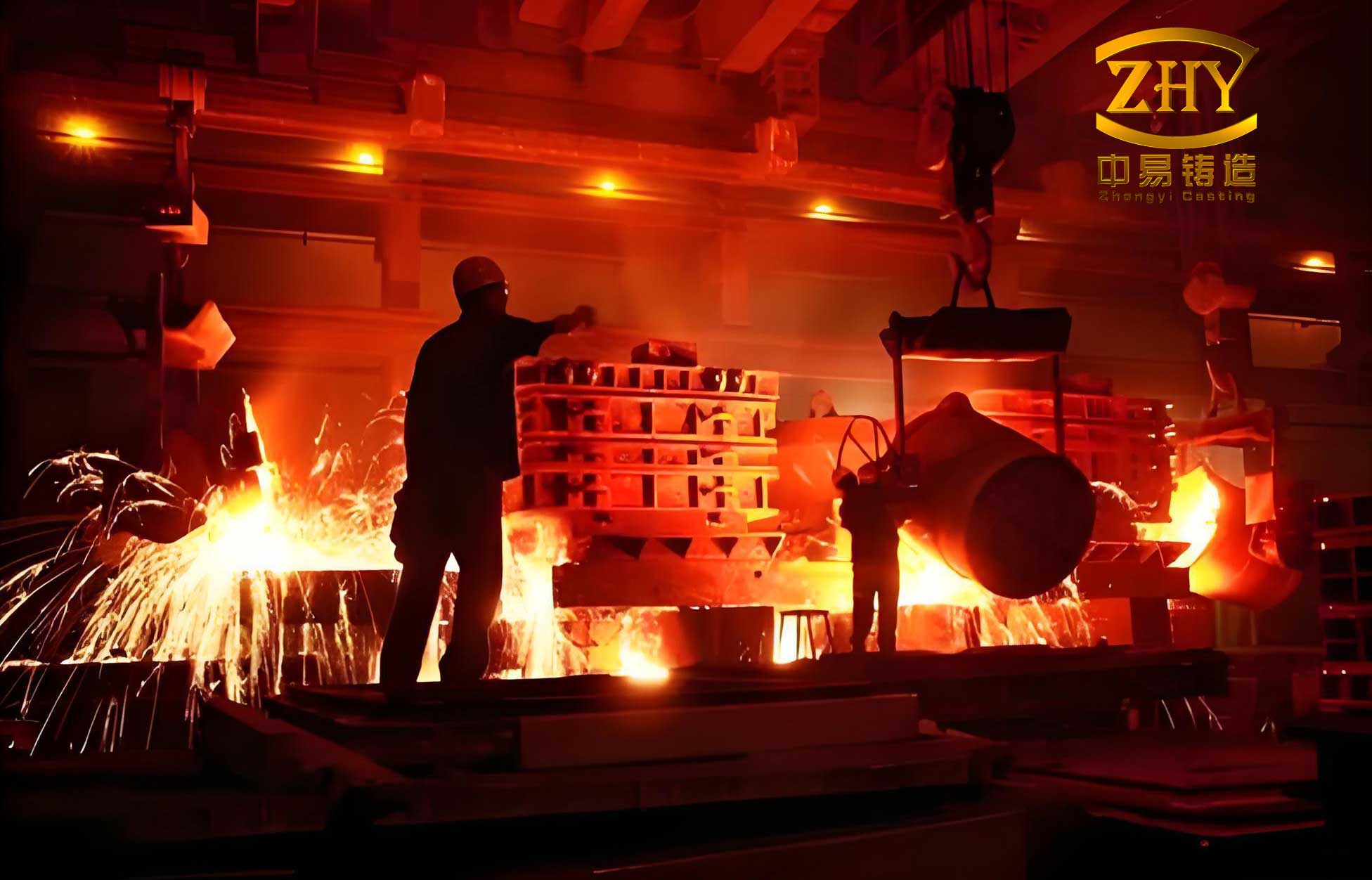
For the mixing furnace, dust emissions occur during charging of molten iron from blast furnace ladles and tapping into ladles for further processing. The dust primarily consists of graphite particles released from carbon in the iron. We implemented fixed hoods at ladle positions and movable hoods above charging chutes and tapping spouts. These hoods capture dust effectively by enclosing emission points during operations. The design ensures minimal heat loss and allows for maintenance access. The dust removal system for ductile iron castings in this station uses a combination of lateral and top suction to handle varying flow rates during charging and tapping cycles.
Medium-frequency induction furnaces and spheroidization stations present distinct challenges due to fluctuating smoke volumes during different phases. For melting ductile iron castings, smoke generation is low during melting and holding but high during charging and tapping, with sparks and fumes. Our solution involves adjustable electric valves on suction hoods that automatically regulate airflow based on furnace status signals. This dynamic control reduces energy waste by matching extraction rates to real-time needs. Similarly, the spheroidization station, where magnesium is injected into iron to form ductile iron castings, produces white smoke rich in particulates. We use fixed lateral hoods that enclose the treatment ladle, capturing emissions before they disperse into the workshop.
The centrifugal casting machine is critical for shaping ductile iron castings into pipes, involving multiple steps like slag removal, iron transfer via intermediate and扇形 ladles, and pouring into spinning molds. Dust arises from slag skimming, ladle transfers, and casting itself. We designed movable lateral hoods at transfer points and fixed canopy hoods at the machine head and tail. These hoods connect to ductwork via flexible metal hoses to accommodate machine movement. The system captures high-temperature smoke and dust, which are then treated in a baghouse filter. This ensures that emissions from producing ductile iron castings are controlled throughout the casting cycle.
Sand blowing at the furnace front removes residual sand cores from pipe sockets before annealing, generating dusty, hot air. Given the high temperature, we selected heat-resistant filter media for the dust collector. The hood is fixed to avoid safety risks for workers handling ductile iron castings. Zinc spraying applies a protective coating to ductile iron castings, but excess zinc powder poses explosion hazards and health risks. We implemented a moving hood that travels with the spray gun, collecting zinc dust through a telescopic duct. The dust collector is designed with explosion-proof features, such as spark detection and suppression, to mitigate risks associated with flammable zinc dust.
Internal grinding of ductile iron castings, both automated and manual, produces fine metallic dust that spreads rapidly due to high-speed grinding wheels. We employed local capture hoods positioned close to grinding points to intercept dust tangentially. These hoods are adjustable to follow worker movements, ensuring effective collection despite varying dust dispersion directions. For coating operations, volatile organic compounds (VOCs) from paints used on ductile iron castings are addressed using adsorption-concentration technology. Activated carbon filters capture VOCs, which are then desorbed and combusted, eliminating secondary pollution.
Core making for ductile iron castings involves triethylamine emissions during sand core hardening. This toxic gas requires chemical scrubbing. Our system uses a purification tower with phosphoric acid spray to neutralize triethylamine, followed by dehumidification layers to remove moisture before emission. The design ensures triethylamine concentrations are below regulatory limits, protecting workers and the environment.
To summarize the dust removal designs for ductile iron castings production, we present the following table that outlines key aspects of each station:
| Process Station | Dust/Smoke Characteristics | Dust Removal Design | Key Features |
|---|---|---|---|
| Mixing Furnace | Graphite dust from iron transfer; high-temperature emissions | Fixed hoods at ladle positions; movable hoods at chutes and taps | Minimizes heat loss; adaptable to operational cycles |
| Medium-Frequency Furnace | Variable smoke during charging/tapping; sparks and fumes | Adjustable hoods with electric valves; automated airflow control | Energy-efficient via signal-based regulation |
| Spheroidization Station | White smoke from magnesium injection; particulate-rich | Fixed lateral hoods enclosing treatment ladle | Captures emissions at source; integrates with ductwork |
| Centrifugal Casting Machine | Dust from slag skimming, ladle transfers, and pouring | Movable lateral hoods; fixed canopy hoods at head/tail | Flexible connections for machine movement |
| Sand Blowing | Hot, dusty air from core removal | Fixed hood with heat-resistant filters | Safety-focused; handles high temperatures |
| Zinc Spraying | Zinc powder; flammable and toxic | Moving hood with telescopic duct; explosion-proof design | Mitigates explosion risks; ensures powder collection |
| Internal Grinding | Fine metallic dust; high dispersion velocity | Local capture hoods near grinding points | Adjustable for worker mobility; effective tangential capture |
| Coating Operation | VOCs from paints; organic solvents | Adsorption with activated carbon; desorption and combustion | Destroys VOCs; no secondary pollution |
| Core Making | Triethylamine gas; toxic and odorous | Chemical scrubbing with phosphoric acid spray | Neutralizes gas; meets emission standards |
In designing these systems, we applied engineering principles to calculate required airflows and efficiencies. For instance, the airflow rate for a hood can be estimated using the formula: $$Q = A \times v$$ where \( Q \) is the volumetric flow rate (m³/s), \( A \) is the hood opening area (m²), and \( v \) is the capture velocity (m/s). Capture velocities vary based on dust type; for ductile iron castings processes, we typically use 0.5 to 1.5 m/s for low-energy emissions and up to 2.5 m/s for high-velocity sources like grinding. The overall dust removal efficiency is given by: $$\eta = \frac{C_{in} – C_{out}}{C_{in}} \times 100\%$$ where \( \eta \) is efficiency (%), \( C_{in} \) is inlet dust concentration (mg/m³), and \( C_{out} \) is outlet concentration. Our systems achieve efficiencies above 99% for particulate matter from ductile iron castings production.
Another critical aspect is pressure drop across the dust collector, which impacts fan energy consumption. The pressure drop can be modeled as: $$\Delta P = K \times \frac{\rho v^2}{2}$$ where \( \Delta P \) is pressure drop (Pa), \( K \) is a resistance coefficient, \( \rho \) is air density (kg/m³), and \( v \) is face velocity (m/s). We optimized hood and duct designs to minimize \( K \), reducing operational costs. For baghouse filters used in ductile iron castings workshops, the filtration velocity is kept low (e.g., 0.5-1.0 m/min) to ensure high collection efficiency and long filter life.
The selection of filter media is vital for handling diverse dust from ductile iron castings. For high-temperature zones like sand blowing, we use PTFE-coated fabrics resistant to temperatures up to 260°C. For zinc dust, anti-static filters prevent sparking. The dust concentration in each stream is monitored to adjust maintenance schedules. We estimate dust loading using: $$L = \frac{M}{Q \times t}$$ where \( L \) is loading (g/m³), \( M \) is mass of dust collected (g), \( Q \) is airflow (m³/s), and \( t \) is time (s). This helps in sizing hoppers and disposal systems.
Automation plays a key role in our dust removal system for ductile iron castings. Sensors detect operational states (e.g., furnace charging, pouring) and adjust damper positions to modulate airflow. This reduces energy use by up to 30% compared to constant-volume systems. The control logic is based on proportional-integral-derivative (PID) algorithms, where the error signal \( e(t) \) between desired and actual airflow is minimized: $$u(t) = K_p e(t) + K_i \int_0^t e(\tau) d\tau + K_d \frac{de(t)}{dt}$$ Here, \( u(t) \) is the control output to dampers, and \( K_p \), \( K_i \), \( K_d \) are tuning parameters. This ensures precise airflow matching for each phase of ductile iron castings production.
Economic analysis of the dust removal system shows significant benefits. The initial investment is offset by reduced waste, lower health-related costs, and compliance with environmental regulations. We calculate the payback period using: $$P = \frac{I}{S – O}$$ where \( P \) is payback period (years), \( I \) is initial investment (USD), \( S \) is annual savings (USD), and \( O \) is annual operating costs (USD). For our workshop producing ductile iron castings, the payback is estimated at 3-5 years due to energy savings and avoided fines.
In conclusion, our dust removal system for centrifugal pouring of ductile iron castings integrates tailored solutions for each process station, leveraging advanced hood designs, automated controls, and efficient filters. By repeatedly focusing on ductile iron castings, we emphasize the material’s specific challenges and solutions. The system not only meets emission standards but also enhances productivity and worker safety. Future improvements could involve real-time emission monitoring and AI-driven optimization to further reduce the environmental footprint of ductile iron castings production.