
In our foundry, we have been dedicated to the production of mining machinery components using lost foam casting. Faced with the challenge of manufacturing large quantities of small castings, we developed a specialized technique known as lost foam cluster casting. This method effectively addresses the production of components with low individual weight but high volume, fully leveraging the advantages of the lost foam process to improve efficiency and reduce costs. Over the years, we have refined this technology and applied it to various parts, including the spacer iron described in this article. In the following sections, I will detail the process design, material parameters, and key control points that have enabled us to achieve a yield exceeding 98% while maintaining dimensional accuracy and surface quality.
1. Characteristics of Lost Foam Cluster Casting
Lost foam casting (EPC) is a process where a pattern made of expandable polystyrene (EPS) or polymethyl methacrylate (EPMMA) foam is coated with a refractory coating. During pouring, the molten metal vaporizes the foam pattern, occupying the space it vacates to form the casting. Lost foam cluster casting is a variant of this process that is particularly suitable for batch production of small parts. In our experience, it offers the following advantages:
- Simplified and efficient mold assembly and box filling after clustering.
- The vertical sprue connects to ingates, which serve both as metal flow channels and as feeders for shrinkage compensation.
- High casting yield and process efficiency; we achieve a yield rate above 98% with multiple castings per flask.
- Using a 3-ton stopper rod ladle, top pouring, and bottom vacuum extraction, with a gating system cross-sectional area ratio of 1:1.1:2.4, ensuring smooth filling and matching our workshop’s 3 t/h medium-frequency induction furnace, ladle, and sand flask.
2. Analysis of Spacer Iron Casting Characteristics
The spacer iron casting weighs 24 kg and is a small, thick-walled component. It requires precision casting: a 22 mm diameter assembly hole and a 1:4 taper assembly surface are left unmachined, with tolerances of ±1 mm. The material is ZG270-500 (carbon steel equivalent to ASTM A148 grade 270-500). The casting must be free from defects such as gas porosity, sand inclusions, shrinkage porosity, and shrinkage cavities. Given our workshop’s production conditions and the nature of this component, the lost foam casting process is the ideal choice. It provides the required surface finish and dimensional accuracy. However, because the parts are small and we need high volumes, we selected the lost foam cluster casting technique to match the capacity of our equipment and improve productivity.
The following table summarizes the key parameters of the spacer iron casting:
| Parameter | Value |
|---|---|
| Weight per piece | 24 kg |
| Material | ZG270-500 (carbon steel) |
| Assembly hole diameter | 22 mm (unmachined) |
| Slope of assembly surface | 1:4 (unmachined) |
| Tolerance | ±1 mm |
| Required surface finish | Precision casting quality |
| Prohibited defects | Gas holes, sand inclusions, shrinkage, porosity |
3. Pattern (White Mold) Fabrication
We use EPS foam with a density of 18 g/cm³. The patterns are machined using a CNC router. The ingate dimensions are 15 mm × 15 mm, with a length of 150 mm. Two spacer iron patterns are glued at each end of the ingate, and a 5 mm × 5 mm chamfer is cut at the connection point. The vertical sprue dimensions are 40 mm × 25 mm, with a length of 500 mm. We then assemble the patterns onto the vertical sprue in clusters: each vertical sprue carries 7 pairs of spacer irons (14 pieces total), spaced 50 mm apart, with the assembly hole oriented upward. The cluster arrangement is shown schematically below, but we will not include the image reference from the original text; instead we describe the layout.
The pattern cluster is then dried and prepared for coating. To ensure consistent quality, we control the dimensional tolerances of the EPS patterns within ±0.2 mm.
4. Coating Composition and Preparation
The lost foam coating must possess not only the typical properties required for sand casting coatings (suspension, refractoriness, rheology) but also specific characteristics: good permeability to allow foam decomposition products to escape; high strength and rigidity to prevent deformation during handling and to support the dry sand during pouring; and excellent adhesion and application properties to form a uniform layer on the foam surface.
4.1 Raw Materials
Refractory materials: We use a combination of zircon sand flour and silica sand flour with different particle sizes, selected for their high refractoriness to resist metal penetration.
Liquid carrier: Although alcohol-based carriers (ethanol, methanol) dry quickly, they are flammable, expensive, and may chemically attack the foam. Therefore, we use water as the carrier, which is economical and safe.
Binder: We employ a high-temperature/low-temperature composite binder system. Clay provides high-temperature strength, while carboxymethyl cellulose (CMC) provides low-temperature green strength. This combination ensures both adequate permeability and sufficient coating integrity.
Suspending agent: Bentonite is used as a traditional suspending agent to prevent settling of the refractory particles.
Additives: A small amount of surfactant is added to improve wetting of the hydrophobic foam surface. Defoamer eliminates bubbles generated during mixing. To prevent cracking during drying, we add a small proportion of porous inorganic silicate fibers.
The final coating formulation is given in the table below:
| Component | Percentage (%) |
|---|---|
| Phenolic resin (low-temperature binder) | 4 |
| Zircon sand flour (fine) | 73 |
| Silica sand flour (medium) | 16 |
| White latex (PVAc emulsion) | 3 |
| Carboxymethyl cellulose (CMC) | 2 |
| Lithium-based bentonite | 2 |
| Water | Balance (approx. 100 – sum of others) |
Note: Water is added to achieve the desired consistency (typically 0.8–1.2 Pa·s viscosity measured by flow cup).
4.2 Coating Preparation Process
We first add surfactant and suspending agent (bentonite) to water and mix at high speed for 30–40 minutes. Then we add the refractory materials and defoamer, continue mixing for another 30 minutes, and finally add the binders (phenolic resin, white latex, CMC) and preservative. The mixture is stirred for 2 hours before being discharged into a coating tank for use.
The dried pattern clusters are dipped or brushed with the first coat, then dried in a forced-air oven at 45–55°C for 12 hours. After that, a second coat is applied and dried for another 12 hours. Any exposed areas or damaged spots are touched up to ensure a uniform coating thickness of 1.2–1.4 mm with no bare spots.
5. Gating System Design
5.1 Flask Design
The flask dimensions are 1000 mm × 1000 mm × 900 mm. Four vacuum pipes (70 mm diameter) are evenly distributed at the bottom to draw vacuum.
5.2 Gating System Configuration
We designed the gating system to ensure smooth filling and adequate feeding. The main sprue is 65 mm × 65 mm in cross-section. It connects to a 65 mm × 65 mm transverse runner shaped like a balance beam, which branches into two 65 mm × 60 mm lateral runners. Each lateral runner supplies five vertical sprues (40 mm × 25 mm). Each vertical sprue carries 7 pairs of spacer irons (14 castings) through 15 mm × 15 mm ingates.
The overall cross-sectional area ratio of the gating system is 1:1.1:2.4 (sprue: runner: ingate). This ratio ensures that the metal fills the mold cavity rapidly while maintaining a laminar flow front, reducing turbulence and gas entrapment. The cross-sectional areas are calculated as follows:
$$A_{\text{sprue}} = 65 \times 65 = 4225\ \text{mm}^2$$
$$A_{\text{runner}} = (65 \times 65) + 2 \times (65 \times 60) = 4225 + 7800 = 12025\ \text{mm}^2 \quad(\text{approximately})$$
$$A_{\text{ingate}} = 14\ \text{clusters} \times 7\ \text{pairs} \times 2\ \text{ingates per pair} \times (15\times15) = 14 \times 7 \times 2 \times 225 = 44100\ \text{mm}^2$$
However, the effective area ratio during pouring is controlled by the choke (usually the sprue base), and the actual flow is regulated. For simplicity, we use the ratio of the sprue to runner to ingate sections as 1:1.1:2.4, which we have validated through simulation and trials.
5.3 Filling and Packing
We use a rain-fill sand addition method combined with three-dimensional vibration to achieve uniform packing. Special attention is given to ensuring that the 22 mm assembly holes are completely filled with sand. We also place a triangular prismatic shield on top of the uppermost castings to protect the coating from direct impact of falling sand.
The final assembly, after cleaning, is shown in the following image (note: we insert the image hyperlink here):
With this gating system, the molten metal flows in a controlled manner, achieving proper distribution of flow and thermal fields. The castings meet dimensional requirements, have no flash defects, and the yield rate exceeds 98%.
6. Pouring Process
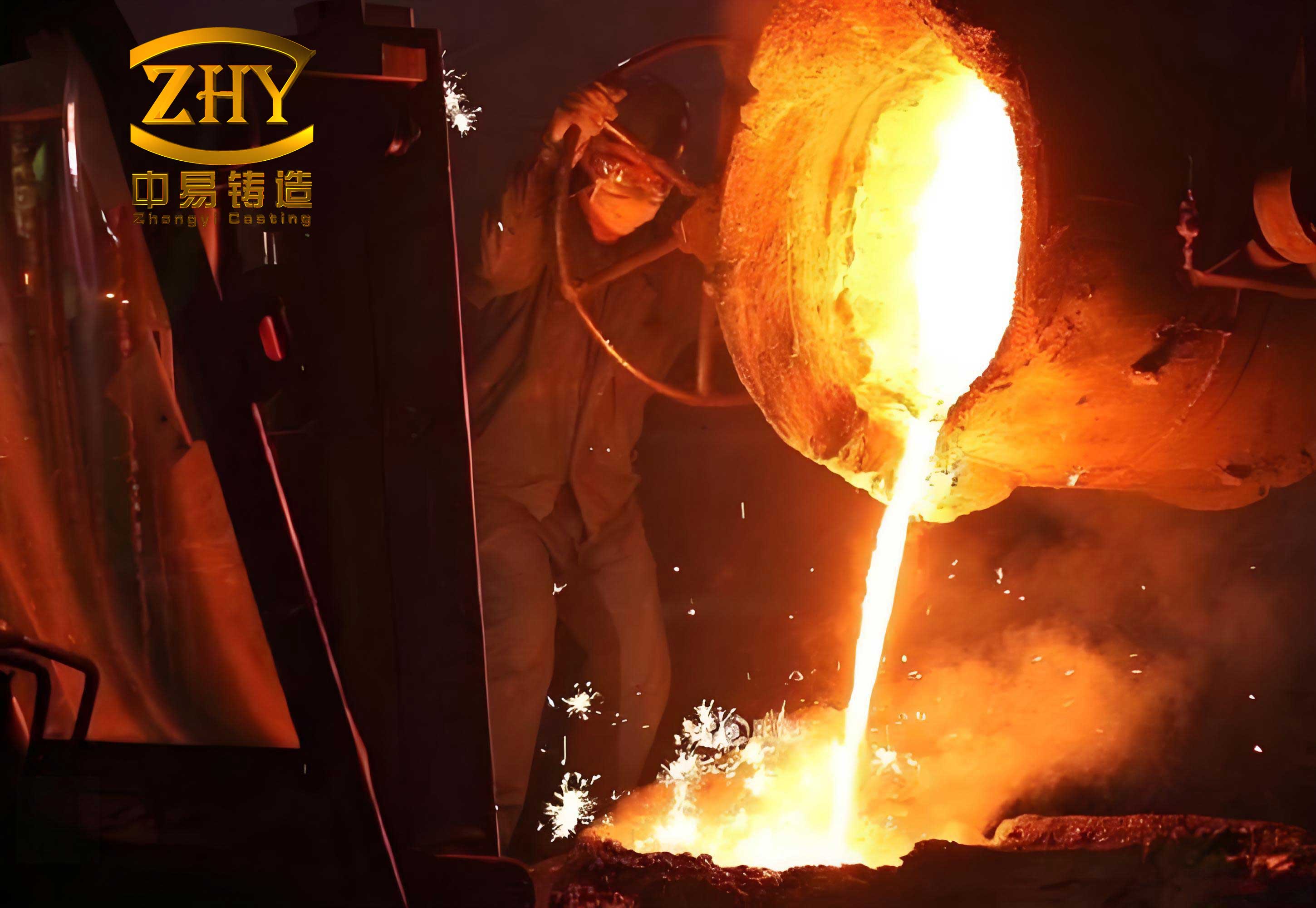
The steel is melted in a 3-ton medium-frequency induction furnace. The tapping temperature is 1700°C. After tapping, we allow the ladle to stand for 3–5 minutes for temperature homogenization and slag flotation. The pouring temperature is controlled at 1675–1680°C. The ladle nozzle diameter is 30 mm. We pour quickly while keeping the pouring cup full throughout the process. The vacuum level is maintained at 0.04–0.05 MPa (negative pressure). After the mold is filled, we perform a brief top-feeding (bumping) of the risers to reduce the risk of shrinkage defects. The critical parameters are summarized in the table below.
| Parameter | Value |
|---|---|
| Tapping temperature | 1700°C |
| Standing time after tapping | 3–5 min |
| Pouring temperature | 1675–1680°C |
| Ladle nozzle diameter | 30 mm |
| Pouring method | Fast, keep cup full |
| Vacuum level during pour | 0.04–0.05 MPa (40–50 kPa) |
| Post-fill feeding | Top bump on risers |
7. Defect Analysis and Prevention
7.1 Sand Adhesion (Burn-on)
Causes: The falling sand during filling can erode the coating on the top castings, leading to localized thinning or peeling. When molten metal penetrates through these weak spots, it solidifies with sand grains embedded on the surface, causing sand adhesion. A higher vacuum level increases metal fluidity, which can exacerbate penetration.
Preventive measures: We use a triangular prismatic shield placed above the top layer of castings to prevent direct impact of falling ceramic sand on the coating. Additionally, we control the coating application quality, use proper vacuum (around 50 kPa), and maintain the recommended pouring temperature. Trials confirmed that 50 kPa is the optimal vacuum for this casting.
7.2 Cold Shut and Misrun
Causes: In lost foam castings, the decomposition of the foam pattern absorbs a significant amount of heat, reducing the temperature of the molten metal and thereby decreasing its fluidity. This can lead to cold shuts or incomplete filling. Improper gating system design or pouring operation can also cause these defects. When the vacuum is too high, the metal at the mold walls advances faster than the center, forming a thin solidified shell that is not remelted by the subsequent metal, resulting in cold laps.
Preventive measures: We ensure a tapping temperature of 1700°C and cover the molten steel surface with an insulating cover to minimize heat loss. The gating system was redesigned to a top-pour arrangement with a short, direct sprue, reducing the flow length and ensuring smooth, rapid filling. The cross-sectional area ratio of 1:1.1:2.4 also promotes stable filling.
7.3 Other Considerations
- Carbon pickup: In lost foam steel castings, carbon from the foam can increase the carbon content of the steel. Therefore, we control the base chemistry at the lower limit of the specified range (0.27% maximum for ZG270-500). Each heat is sampled and analyzed to ensure consistent composition.
- Consistent operation: Strict adherence to pouring procedures is essential. Operators must ensure the pouring cup remains full to maintain a stable flow rate and avoid cold shuts or misruns.
Through careful control of these parameters, we have reduced the defect rate to below 2% across all spacer iron production lots.
8. Conclusions and Extensions
The application of lost foam cluster casting technology to the production of spacer irons has proven that this process is well-suited for small, high-precision, large-volume castings. It has enabled us to achieve high efficiency, improved working conditions (reduced dust and noise), and significantly lower production costs compared to traditional sand casting methods. The key success factors include the optimal coating formulation, precisely controlled gating system, and proper vacuum management. By following the parameters outlined in this article, we consistently obtain castings free of defects, with dimensional tolerances within ±1 mm and surface roughness suitable for unmachined functional surfaces.
Encouraged by these results, we have extended the lost foam cluster casting technology to other components such as counterweights, pressing blocks, motor horn nozzles, and water passages. In all cases, we have achieved similar improvements in quality and cost reduction. The versatility of the process allows us to adapt the cluster design to different part geometries, making it a powerful tool for modern foundry operations.
In summary, the lost foam cluster casting method represents a significant advancement for producing small and medium-sized steel castings in high volumes. With continuous refinement of coating materials, gating design, and process control, we believe this technology will play an increasingly important role in the production of complex and demanding castings for mining and other industries.
The image below illustrates the final cluster assembly after cleaning, showing the typical appearance of our lost foam castings cluster ready for pouring.
Note: The image shown is representative of the spacer iron cluster used in our production.