
As a casting engineer specializing in high-performance components, I have extensively worked with ductile iron castings, particularly for safety-critical applications like elevator traction wheels. These ductile iron castings demand exceptional quality, with stringent requirements against defects such as shrinkage porosity, cracks, and hardness variations. In this article, I will delve into the application of proportional solidification theory—often referred to as equilibrium solidification—to optimize the manufacturing process for ductile iron castings, specifically traction wheels. My focus is on how this theory guides design decisions to achieve uniform solidification, enhance mechanical properties, and ensure reliability. Throughout this discussion, the term “ductile iron castings” will be emphasized to underscore its centrality in advanced foundry practices.
The core challenge with ductile iron castings like traction wheels lies in their geometry: they are typically wheel-like structures with significant wall-thickness variations, leading to thermal gradients during solidification. Traditional methods, such as using risers or chill plates in isolation, often fall short in eliminating shrinkage defects or controlling hardness disparities. Proportional solidification theory addresses this by promoting a balanced thermal field, where solidification proceeds uniformly from multiple points, minimizing temperature differences. For ductile iron castings, this is crucial due to the material’s graphitization expansion, which can offset solidification shrinkage if properly harnessed. The theory hinges on principles like controlled feeding, optimal gating design, and strategic use of chills to achieve a “self-feeding” effect in ductile iron castings.
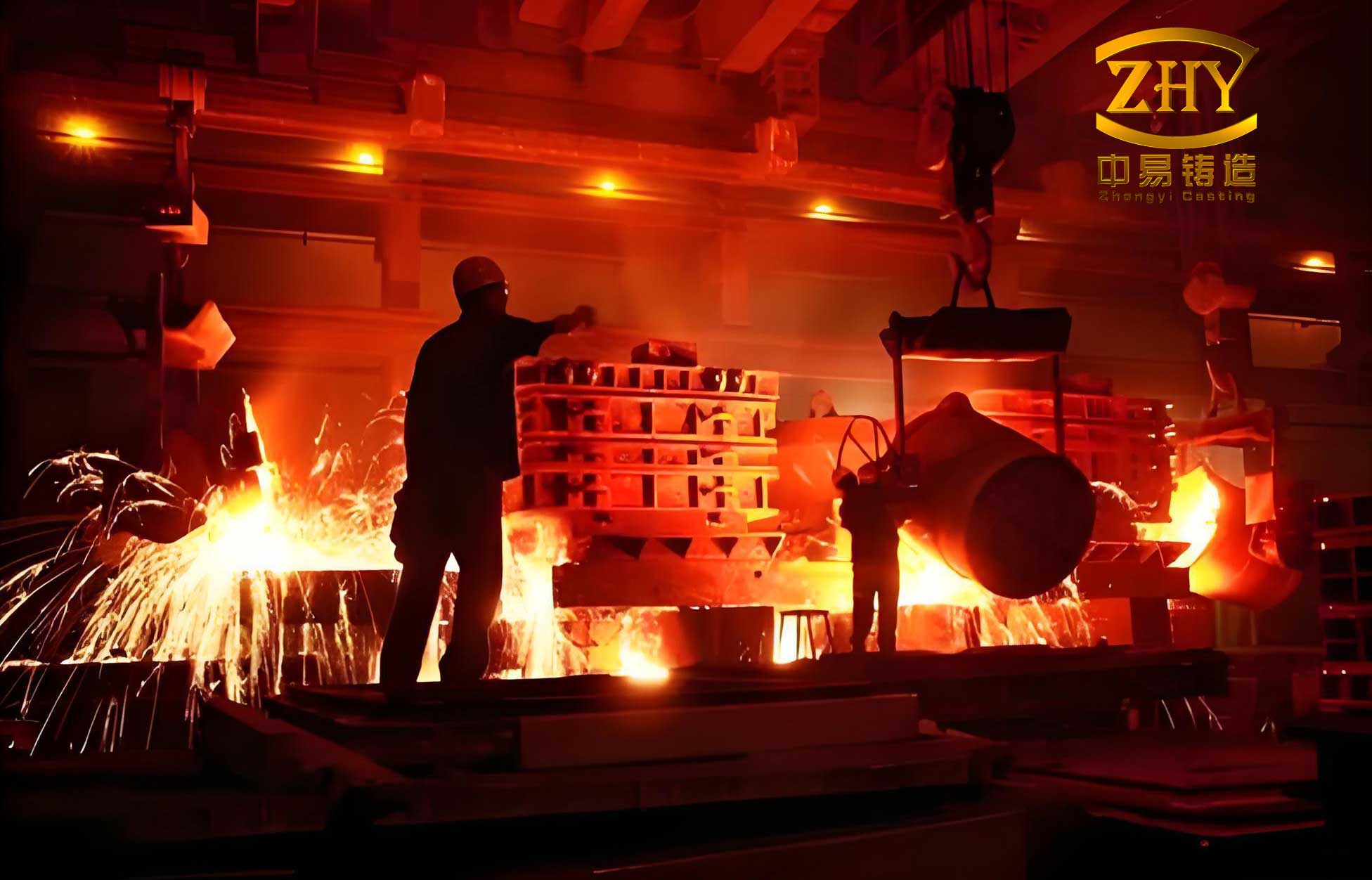
In my experience, the success of ductile iron castings relies on a holistic approach that integrates metallurgy, thermodynamics, and fluid dynamics. Proportional solidification theory can be mathematically modeled to predict solidification behavior. For instance, the solidification time (t) for a section of a casting can be approximated using Chvorinov’s rule: $$ t = C \left( \frac{V}{A} \right)^n $$ where \( V \) is the volume, \( A \) is the surface area, \( C \) is a constant dependent on mold material and casting conditions, and \( n \) is an exponent typically around 2 for sand molds. For ductile iron castings, this equation helps estimate local cooling rates, which influence graphite nodule formation and shrinkage tendencies. Additionally, the temperature gradient (\( \nabla T \)) across the casting is critical: $$ \nabla T = \frac{T_h – T_c}{d} $$ where \( T_h \) and \( T_c \) are temperatures at hot and cold spots, respectively, and \( d \) is the distance. Proportional solidification aims to minimize \( \nabla T \) by designing gating and cooling systems that equalize thermal distribution in ductile iron castings.
To illustrate the practical application, let’s consider the traction wheel as a case study. This ductile iron casting weighs 118 kg, with a material grade equivalent to QT600-3, requiring high tensile strength, elongation, and uniform hardness. The key specifications for such ductile iron castings include chemical composition, mechanical properties, and defect-free criteria. Below is a table summarizing the target composition for these ductile iron castings:
| Element | Target Range (wt%) | Role in Ductile Iron Castings |
|---|---|---|
| Carbon (C) | 3.6–3.9 | Promotes graphitization, enhances fluidity |
| Silicon (Si) | 2.1–2.3 | Strengthens ferrite, increases carbon equivalent |
| Manganese (Mn) | 0.3–0.4 | Improves hardenability and strength |
| Phosphorus (P) | < 0.04 | Minimized to avoid brittleness |
| Sulfur (S) | < 0.02 | Low levels aid nodularization |
| Magnesium (Mg) | 0.04–0.065 | Essential for spheroidal graphite formation |
The carbon equivalent (CE) is kept below 4.6% to balance castability and mechanical properties, calculated as: $$ CE = C + \frac{Si + P}{3} $$ For ductile iron castings, controlling CE is vital to prevent excessive shrinkage or poor graphitization. Mechanical property targets for these ductile iron castings include tensile strength >600 MPa, yield strength >370 MPa, and elongation >3%, with a pearlitic-ferritic matrix. Achieving this in ductile iron castings demands precise solidification control, which proportional solidification theory facilitates through gating design.
In the initial process design for these ductile iron castings, I explored several gating and feeding strategies. The first scheme involved a central gating system with eight short, thin, and wide ingates—dimensions 40 mm × 10 mm × 40 mm, each with a cross-sectional area of 4 cm², totaling 32 cm². This was coupled with a ring-shaped runner (high trapezoidal section, 5 cm² each, four units) and a single sprue of 50 mm diameter (20 cm² area). This open gating system aimed for high flow rate and low velocity, ensuring smooth filling. However, early trials with side risers (kiss risers) on the wheel periphery resulted in insufficient feeding and hardness variations, as the risers were not hot enough to compensate for shrinkage in ductile iron castings. A second scheme incorporated chill plates on the outer circle alongside risers, which reduced shrinkage but still led to inconsistent hardness due to residual thermal gradients.
The breakthrough came with applying proportional solidification theory rigorously, leading to a riser-free design. The key was to position the gating at the inner bore, using multiple ingates to distribute heat evenly, and employing external chill plates to accelerate cooling at thick sections. This created a uniform temperature field, leveraging the graphitization expansion of ductile iron castings to offset shrinkage without risers. The solidification process can be modeled using a heat transfer equation: $$ \frac{\partial T}{\partial t} = \alpha \nabla^2 T + \frac{Q}{\rho c_p} $$ where \( T \) is temperature, \( t \) is time, \( \alpha \) is thermal diffusivity, \( Q \) is heat source (e.g., latent heat), \( \rho \) is density, and \( c_p \) is specific heat. For ductile iron castings, the latent heat from graphitization acts as an internal heat source, which proportional solidification manages by synchronizing cooling rates.
To quantify the benefits, I conducted extensive testing on production batches of these ductile iron castings. Hardness was measured at 60 points on the wheel—36 on the outer circumference and 24 on the upper and lower faces—using Brinell hardness tests. The results showed remarkable consistency, with all values within HB 190–235 and a maximum deviation of HB 15, meeting the stringent requirements for ductile iron castings. Destructive testing of the rope grooves revealed no shrinkage porosity or cavities, confirming the effectiveness of the riser-free approach. Mechanical property tests exceeded specifications, with tensile strength reaching 680–700 MPa and elongation of 8–10%. Microstructural analysis indicated pearlite content >90%, with the remainder ferrite, and graphite nodularity >80% (grade 6–7). Below is a table summarizing the mechanical and metallurgical outcomes for these ductile iron castings:
| Property | Target | Achieved in Ductile Iron Castings |
|---|---|---|
| Tensile Strength | >600 MPa | 680–700 MPa |
| Yield Strength | >370 MPa | 400–420 MPa |
| Elongation | >3% | 8–10% |
| Hardness (HB) | 190–235 | 200–230, Δ ≤15 |
| Pearlite Content | Not specified | >90% |
| Graphite Nodularity | High | >80%, Grade 6–7 |
The success of this methodology hinges on the principles of proportional solidification, which can be expressed through empirical rules for ductile iron castings. For instance, the feeding demand (\( F \)) of a section is related to its modulus (\( M = V/A \)): $$ F = k \cdot M $$ where \( k \) is a factor dependent on alloy composition and cooling conditions. In ductile iron castings, the graphitization expansion reduces \( F \), allowing for riser-less designs if thermal equilibrium is maintained. The gating ratio used—sprue:runner:ingate = 1:1:1.6 (based on cross-sectional areas)—ensured rapid filling without turbulence, critical for defect-free ductile iron castings. Additionally, the chill plates, with thickness matching the wheel’s outer wall, provided controlled cooling to eliminate hot spots. The solidification sequence was simulated using finite difference methods, with results showing a temperature differential of less than 50°C across the casting during critical phases, which is optimal for ductile iron castings.
Further analysis involves the kinetics of graphite nucleation and growth in ductile iron castings, described by equations like: $$ \frac{dN}{dt} = A \exp\left(-\frac{Q}{RT}\right) $$ where \( N \) is the number of nodules, \( A \) is a pre-exponential factor, \( Q \) is activation energy, \( R \) is the gas constant, and \( T \) is temperature. Uniform cooling promoted by proportional solidification enhances nodule count and uniformity, contributing to the mechanical integrity of ductile iron castings. In practice, the process parameters for these ductile iron castings included a pouring temperature of 1350–1400°C, a pouring time of 15–20 seconds, and sand mold properties with adequate permeability to avoid gas defects. The elimination of risers not only improved yield but also reduced cleaning costs, showcasing the economic benefits of this approach for ductile iron castings.
To generalize the application, I developed guidelines for designing ductile iron castings using proportional solidification theory. These include: (1) locating gates at regions with lower thermal demand to balance heat distribution, (2) using multiple thin ingates to minimize flow velocity and erosion, (3) incorporating chills at thick sections to match cooling rates, and (4) optimizing chemical composition to leverage graphitization expansion. For complex ductile iron castings, computational tools can aid in predicting solidification patterns. The key equations for modeling include the energy conservation equation: $$ \rho c_p \frac{\partial T}{\partial t} = \nabla \cdot (k \nabla T) + \rho L \frac{\partial f_s}{\partial t} $$ where \( k \) is thermal conductivity, \( L \) is latent heat, and \( f_s \) is solid fraction. This, coupled with boundary conditions for chills and molds, allows for virtual prototyping of ductile iron castings.
In summary, the application of proportional solidification theory has revolutionized the production of high-integrity ductile iron castings like traction wheels. By focusing on thermal equilibrium through strategic gating and chilling, I achieved defect-free components with consistent properties. The data underscores that ductile iron castings can meet stringent safety standards without reliance on traditional risers, reducing material waste and enhancing productivity. Future work could explore advanced alloys or digital twin simulations to further optimize ductile iron castings. This hands-on experience confirms that proportional solidification is not just a theory but a practical framework for excellence in ductile iron castings, ensuring they perform reliably in demanding applications such as elevator systems. The iterative process of testing and refinement highlights the importance of a scientific approach to casting, where every parameter is tuned to harness the inherent benefits of ductile iron castings.