
In my experience as a casting process engineer, working with gray cast iron components presents unique challenges, especially when dealing with thin-wall structures that require high dimensional accuracy and surface quality. Gray cast iron, known for its excellent castability, wear resistance, and damping capacity, is widely used in automotive and machinery parts, but its processing demands careful optimization to avoid defects. This article details my firsthand account of designing and refining the casting process for a thin-wall gray cast iron housing, a critical component in speed reducers. The housing, made of high-performance gray cast iron similar to EN-GJL-200, features complex inner cavities, uniform wall thicknesses ranging from 5.5 mm to 12.5 mm, and large轮廓尺寸 of approximately 194 mm x 145 mm x 162.5 mm. With stringent requirements for CT8级 dimensional accuracy, freedom from surface defects like sand holes and porosity, and post-machining leak-tightness tests, this project underscored the intricacies of gray cast iron casting. Initial attempts using shell mold and shell core processes revealed issues such as gas porosity and sand contamination, prompting a comprehensive redesign. Through iterative improvements, including changes to the gating system, mold design, sand handling, and melting practices, we achieved a stable批量 production process. Throughout this journey, the focus remained on enhancing the properties of gray cast iron, leveraging its graphite microstructure for superior performance. Key aspects like fluid dynamics during pouring, solidification behavior, and metallurgical control were analyzed using formulas and tables to guide decision-making. Below, I elaborate on the initial process, problem analysis, optimized solutions, and validation outcomes, emphasizing the role of gray cast iron in achieving success.
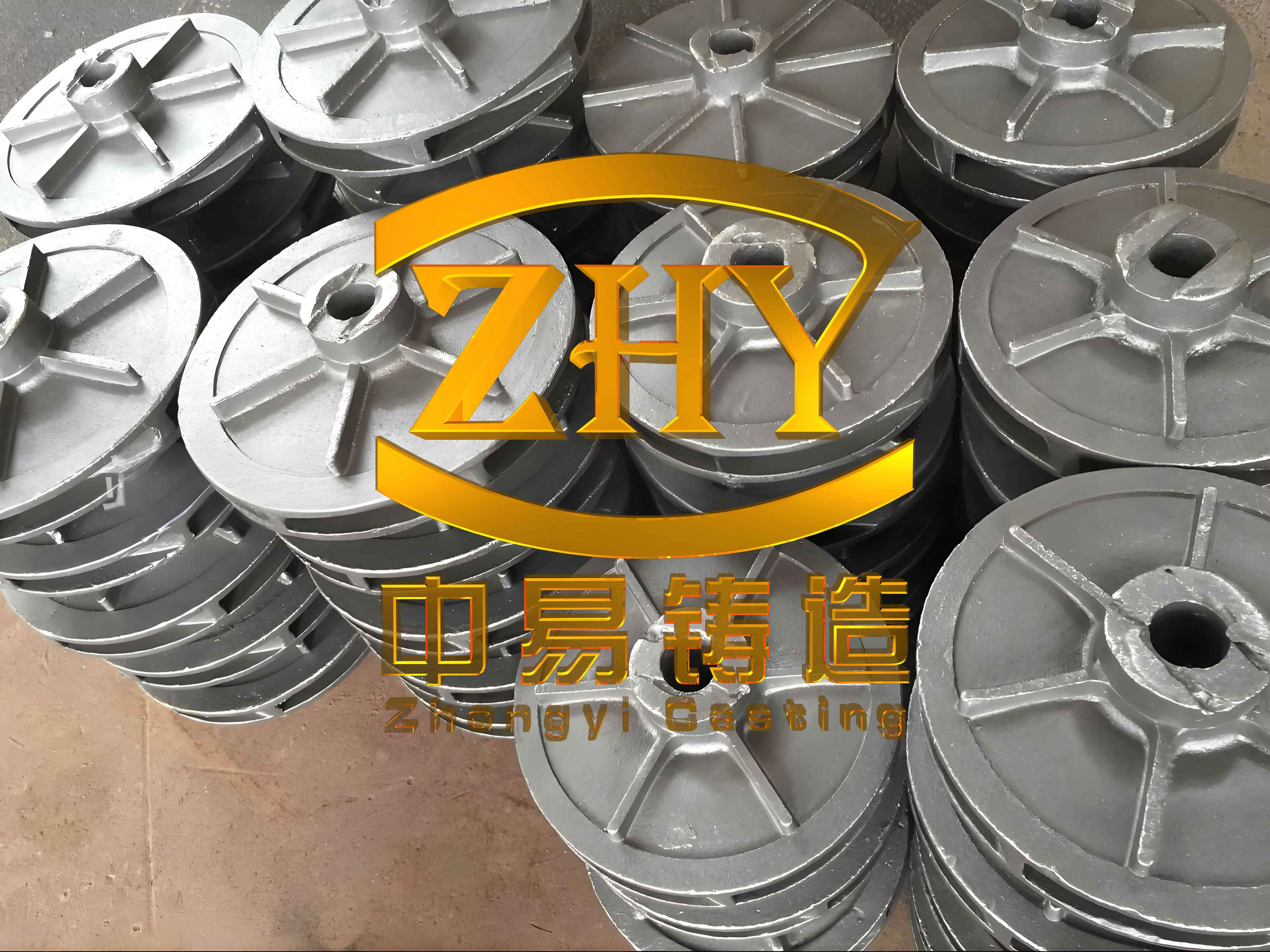
The initial casting process for the gray cast iron housing was based on a shell mold and shell core approach, chosen to address the part’s intricate geometry. The housing had 14 slender grooves on its exterior and minimal draft angles under 1°, making traditional pattern withdrawal difficult. Shell molding, using resin-coated sand, was deemed suitable for forming both the external shape and internal cavities of this gray cast iron component. The design involved creating a shell mold for the outer轮廓 and a shell core for the inner cavity, which was then coated, dried, and assembled within green sand molds for pouring. Each mold box contained six castings, with a total weight of around 72 kg, including 21 kg of shell mold and core materials. The gray cast iron melt was introduced through a top-gating system with a封闭-开放式 design, using ratios of sprue to runner to gate areas set at $$ A_{sprue} : A_{runner} : A_{gate} = 1.2 : 1.0 : 1.4 $$. To ensure cleanliness, a ceramic foam filter was placed in the runner, and side risers of 40 mm diameter were added for feeding, with one riser serving two gray cast iron castings. Vent pins were installed on the shell mold to facilitate gas escape. However, during trial and small-batch production, defects emerged, primarily gas porosity on the upper surfaces of the castings, as shown in the image below, along with occasional白口 and high hardness issues after machining. The scrap rate reached 15%, highlighting the need for process refinement. Additionally, core sand from the shell materials entered the green sand recycling system, affecting mold sand stability and causing friability, which further exacerbated defects. This underscored the sensitivity of gray cast iron to gas entrapment and sand-related issues.
To analyze the defects, we considered multiple factors inherent to gray cast iron casting. First, the侵人性气孔 were likely caused by gas generation from the thick shell cores positioned in the drag (lower mold half), which failed to vent adequately before the gray cast iron solidified. The gas pressure buildup, estimated using the ideal gas law $$ PV = nRT $$, where P is pressure, V is volume, n is moles of gas, R is the gas constant, and T is temperature, could exceed the metallostatic pressure of the iron, leading to bubble formation. Second, low pouring temperatures around 1350°C reduced fluidity, increasing the risk of皮下气孔 in gray cast iron. The fluidity length L can be modeled as $$ L = k \cdot \Delta T \cdot t_f $$, where k is a constant, ΔT is the superheat, and t_f is the freezing time, indicating that higher temperatures improve filling and gas expulsion. Third, contamination from shell sand into the green sand system altered its properties, such as reducing bond strength and increasing permeability, which can be quantified by the sand’s compactability and AFS grain fineness number. Fourth,白口 and high hardness in gray cast iron stemmed from inadequate inoculation or excessive cooling rates, promoting cementite formation instead of graphite. The carbon equivalent (CE) plays a crucial role, calculated as $$ CE = \%C + \frac{\%Si + \%P}{3} $$, with lower CE values increasing chilling tendencies. Based on this, we formulated an optimization plan targeting gating, molding, and melting parameters to enhance the gray cast iron casting quality.
The optimized casting process involved several key changes, each supported by theoretical principles and empirical data. First, we switched from a top-gating to a bottom-gating system, placing all gray cast iron castings in the cope (upper mold half). This allowed gas from the cores to rise naturally with the metal front, reducing侵人性气孔 risks. The gating ratio was adjusted to $$ A_{sprue} : A_{runner} : A_{gate} = 1.5 : 1.2 : 1.0 $$ for smoother flow, and a auxiliary core (labeled 3# core) was designed to facilitate bottom pouring and positioning, eliminating the need for side risers. This improved yield by reducing total mold weight to 60 kg. Second, we replaced the shell mold for the exterior with green sand molding, addressing the sand contamination issue. The slender grooves and方台 features were successfully released using optimized pattern designs and sand additives, ensuring dimensional stability for the gray cast iron part. Third, the core was redesigned to weigh only 2.1 kg, down from 3.5 kg, easing handling and reducing gas generation. Fourth, pouring temperatures were increased to 1400–1440°C, enhancing fluidity and gas venting, as per the fluidity equation. Fifth, melting practices for gray cast iron were refined: manganese addition was reduced to 4 kg per ton of iron, post-inoculation was increased from 0.1% to 0.15%, and silicon was added to raise the CE, preventing白口. The target CE was set above 4.0, calculated using the formula above. These changes were summarized in comparative tables to illustrate the impact on gray cast iron properties.
| Parameter | Initial Process | Optimized Process | Impact on Gray Cast Iron |
|---|---|---|---|
| Gating System | Top-gating, closed-open | Bottom-gating, with auxiliary core | Reduced turbulence, better gas expulsion in gray cast iron |
| Mold Type | Shell mold for exterior | Green sand mold for exterior | Minimized sand contamination, improved surface finish of gray cast iron |
| Core Weight | 3.5 kg per core | 2.1 kg per core | Lower gas generation, fewer defects in gray cast iron |
| Pouring Temperature | ~1350°C | 1400–1440°C | Enhanced fluidity, reduced porosity in gray cast iron |
| Riser Design | Side risers (40 mm) | No risers, using gating pressure | Higher yield, adequate feeding for gray cast iron solidification |
| Melting Adjustments | Standard inoculation | Increased Si, reduced Mn, higher inoculation | Controlled graphite formation, prevented白口 in gray cast iron |
To further quantify the improvements, we applied casting science formulas. For instance, the solidification time of the gray cast iron housing was estimated using Chvorinov’s rule: $$ t = B \left( \frac{V}{A} \right)^2 $$, where t is solidification time, V is casting volume, A is surface area, and B is a mold constant. For the thin-wall sections (5.5 mm thickness), V/A is small, leading to rapid solidification that can trap gas. By increasing pouring temperature, we extended the time available for gas escape, as shown by the relationship $$ t_{gas} \propto \frac{\eta}{\Delta P} $$, where η is melt viscosity and ΔP is pressure differential. The viscosity of gray cast iron decreases with temperature, per the Arrhenius equation $$ \eta = \eta_0 e^{E_a / RT} $$, where E_a is activation energy. Additionally, the gating design was optimized using Bernoulli’s principle for incompressible flow: $$ \frac{v^2}{2} + gz + \frac{P}{\rho} = \text{constant} $$, ensuring平稳 filling to avoid oxide inclusion in gray cast iron. The gas venting capacity was modeled as $$ Q = k \cdot A \cdot \sqrt{\frac{2 \Delta P}{\rho}} $$, where Q is gas flow rate, A is vent area, and ρ is gas density, justifying the removal of shell mold vents in favor of natural上升. These calculations reinforced our empirical observations and guided the process tweaks for gray cast iron.
Production validation of the optimized process involved trial runs of 30 samples followed by批量 production of over 200 gray cast iron castings. The results demonstrated significant improvements: the 14 slender grooves and方台 features released cleanly from the green sand molds, with sharp轮廓 and no visible defects. Gas porosity on the upper surfaces was reduced to a scrap rate below 1%, confirming the effectiveness of bottom-gating and higher pouring temperatures for gray cast iron. Machining trials revealed no白口 or high hardness issues, attributed to the adjusted melting practice that promoted graphite precipitation in gray cast iron. Mechanical properties met the required tensile strength of ≥200 MPa and hardness of 180–220 HB, as verified through testing. For surface treatment, the castings were coated with RAL7035 light gray primer, achieving a uniform thickness of 40–100 μm, which adhered well due to the improved surface quality of the gray cast iron. The successful批量 production of 2,000 units further validated the process stability, with包装 using Euro-standard wooden crates and anti-rust bags ensuring safe transportation. Throughout this phase, continuous monitoring of sand properties and melt chemistry ensured consistency in gray cast iron quality, highlighting the importance of integrated process control.
| Property | Initial Gray Cast Iron | Optimized Gray Cast Iron | Test Method |
|---|---|---|---|
| Tensile Strength (MPa) | 190–210 | 205–220 | ASTM A48 |
| Hardness (HB) | 185–230 | 180–215 | Brinell Hardness Test |
| Carbon Equivalent (CE) | 3.8–4.0 | 4.1–4.3 | Calculation from melt analysis |
| Graphite Structure | Type A, some undercooled | Type A, uniform flakes | Metallography |
| Defect Rate (Porosity) | 15% | <1% | Visual and machining inspection |
| Dimensional Accuracy | CT9 | CT8 | Coordinate measuring machine |
In conclusion, the redesign of the thin-wall gray cast iron housing casting process underscored several key lessons for high-performance gray cast iron applications. First, bottom-gating systems provide superior gas venting and平稳 filling, crucial for minimizing porosity in gray cast iron. The gating ratio formula $$ \sum A_{gate} = \frac{Q}{\mu \sqrt{2gH}} $$, where Q is flow rate, μ is discharge coefficient, g is gravity, and H is head height, helped optimize runner and gate sizes. Second, replacing shell molds with green sand for exterior forming reduced sand contamination and improved mold sand stability, benefiting long-term production of gray cast iron parts. Third, core weight reduction and design modifications lowered gas generation, aligning with the ideal gas law to prevent侵人性气孔. Fourth, precise control of pouring temperature and melting parameters, such as CE and inoculation, is essential to avoid白口 and ensure proper graphite formation in gray cast iron. The relationship between cooling rate and graphite morphology can be expressed as $$ \lambda = f(G, t) $$, where λ is graphite size, G is temperature gradient, and t is time, emphasizing the need for balanced solidification. Finally, iterative validation through trials and批量 runs is vital for process refinement in gray cast iron casting. This experience reaffirms that gray cast iron, with its unique combination of castability and performance, requires tailored approaches to overcome thin-wall challenges. By leveraging formulas, tables, and empirical data, we achieved a robust process that delivers high-quality gray cast iron components consistently, contributing to advancements in casting technology for industrial applications.