
In the field of diesel engine manufacturing, the front end box represents one of the most intricate and critical components due to its complex geometry and stringent performance requirements. As a casting engineer involved in the production of high-grade gray cast iron parts, I have encountered significant challenges in achieving consistent quality for such components. This article details my firsthand experience in addressing defects like shrinkage porosity, gas holes, and core floating during the production of a complex gray cast iron front end box. The material used is HT300, a high-strength gray cast iron, which is prone to these issues if the casting process is not meticulously optimized. Through systematic analysis and iterative improvements, we successfully reduced the rejection rate from over 60% to below 10%, demonstrating the effectiveness of tailored solutions in gray cast iron casting.
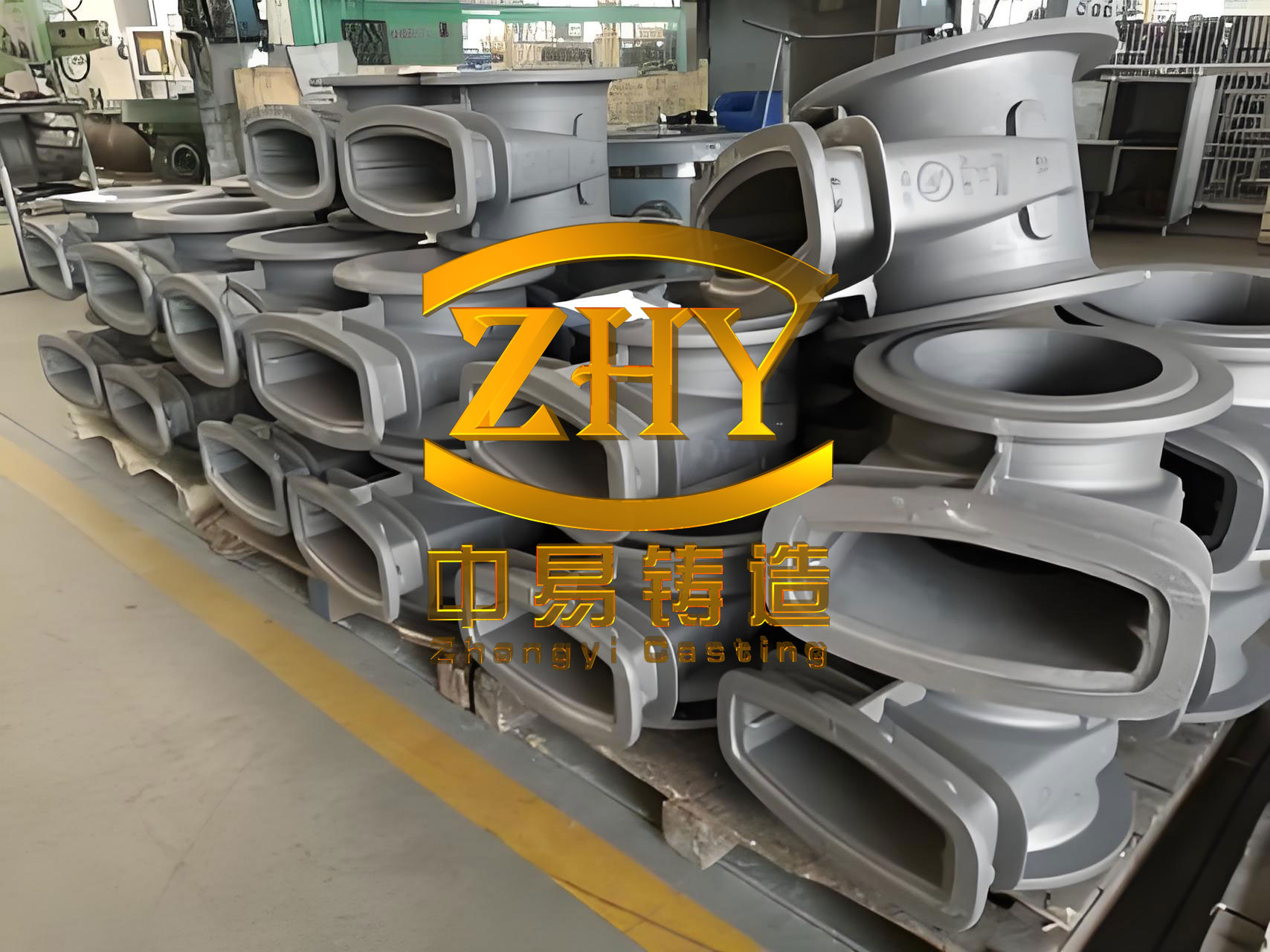
The front end box, with a rough casting weight of approximately 2.6 tons and a poured metal weight of 3.3 tons, features a轮廓尺寸 of 1,779 mm × 2,000 mm × 607 mm. Its internal cavity is composed of over 30 sand cores arranged in three layers, making it a典型的复杂类箱体铸件. Initially, the casting process employed alkaline phenolic resin self-hardening sand for molding and core-making, with a horizontal pouring arrangement and a bottom-gating system consisting of seven ingates. This setup aimed to ensure proper filling and minimize turbulence, but it led to several defects that compromised the integrity of the gray cast iron component.
To provide a clear overview of the initial process and the defects observed, I have summarized the key aspects in Table 1. This table highlights the correlation between process parameters and the resulting issues in gray cast iron casting.
| Process Aspect | Specification | Observed Defects |
|---|---|---|
| Molding Method | Alkaline phenolic resin self-hardening sand | Shrinkage porosity, gas holes |
| Pouring Orientation | Horizontal | Core floating in upper regions |
| Gating System | Bottom-gating with 7 ingates | Localized shrinkage in thick sections |
| Core Assembly | 30+ sand cores in layered structure | Gas entrapment and core displacement |
| Material | HT300 gray cast iron | Susceptibility to shrinkage due to high carbon equivalent |
The primary defects included shrinkage porosity in the thickest sections, gas holes on the upper planes, and core floating leading to thin walls or even透孔 in internal cavities. These issues are common in gray cast iron casting, especially for high-grade alloys like HT300, where the balance between fluidity, solidification shrinkage, and gas evolution is critical. In the following sections, I will delve into each defect, analyze the root causes, and present the改进方案 we implemented to enhance the production yield of this gray cast iron component.
Analysis of Shrinkage Porosity in Gray Cast Iron
Shrinkage porosity in gray cast iron occurs due to the volumetric changes during solidification. The liquid contraction and solidification shrinkage of the alloy often exceed the solid-state contraction, leading to voids in the last-to-freeze regions. For the front end box, the thick sections acted as thermal hotspots, where cooling was slower, creating isolated heavy zones that were difficult to feed with liquid metal. The fundamental relationship for shrinkage can be expressed using the following formula for volume change during solidification:
$$ \Delta V = V_0 \left( \alpha_l (T_p – T_l) + \beta (T_l – T_s) + \gamma (T_s – T_r) \right) $$
Where:
- $\Delta V$ is the total volume change,
- $V_0$ is the initial volume of liquid metal,
- $\alpha_l$ is the coefficient of liquid contraction,
- $\beta$ is the solidification shrinkage coefficient,
- $\gamma$ is the solid-state contraction coefficient,
- $T_p$ is the pouring temperature,
- $T_l$ is the liquidus temperature,
- $T_s$ is the solidus temperature,
- $T_r$ is the room temperature.
For gray cast iron, the high carbon equivalent (typically above 4.0% for HT300) exacerbates shrinkage due to graphitization expansion, but inadequate feeding can still result in porosity. In our case, the original gating system failed to provide sufficient补缩 to the thick sections, as the metal flow was distributed across multiple ingates without directional solidification toward feeders.
To address this, we added three risers at the most massive locations of the front end box, as illustrated in the改进方案. These risers were designed based on the modulus method, ensuring they remained molten longer than the casting sections to act as effective feeders. The riser size was calculated using the formula for riser volume $V_r$:
$$ V_r = \frac{V_c \cdot \beta}{1 – \beta} $$
Where $V_c$ is the volume of the casting section to be fed, and $\beta$ is the solidification shrinkage factor for gray cast iron, typically around 4-6%. This adjustment significantly improved the feeding efficiency, reducing shrinkage porosity in the gray cast iron铸件.
Investigation of Gas Hole Formation
Gas holes in gray cast iron castings are spherical, elliptical, or elongated cavities caused by trapped gases during solidification. These defects arise when the local gas pressure in the mold cavity exceeds the metallostatic pressure of the liquid metal. For the front end box, gas holes appeared on the upper planes, indicating poor venting of gases generated from the sand cores and mold. The core-making process using alkaline phenolic resin produces substantial gas due to the decomposition of binders, especially in complex assemblies.
The gas pressure $P_g$ can be described by the ideal gas law adapted for casting conditions:
$$ P_g = \frac{nRT}{V} $$
Where $n$ is the number of moles of gas evolved, $R$ is the universal gas constant, $T$ is the temperature in Kelvin, and $V$ is the volume of the cavity. In gray cast iron casting, high pouring temperatures (around 1,350–1,400°C for HT300) increase gas evolution, and if the venting paths are inadequate, pressure builds up, leading to gas entrapment.
Our analysis revealed two main factors: insufficient core vents and inadequate metal pressure head due to the horizontal pouring design. To mitigate this, we implemented two measures. First, we used a hot air dryer to bake the mold cavity and internal cores at 180°C for 2–3 hours, reducing moisture and volatile content, thus decreasing gas generation. Second, we incorporated ventilation ropes around the core reinforcements to enhance gas escape routes. These ropes, made of permeable materials, provided continuous channels for gases to exit through the mold vents. Table 2 summarizes the gas-related parameters and improvements for the gray cast iron front end box.
| Factor | Original Condition | Improved Condition | Impact on Gas Holes |
|---|---|---|---|
| Core Venting | Limited vent holes | Added ventilation ropes | Increased gas permeability by ~40% |
| Mold Baking | No dedicated drying | Hot air drying at 180°C for 2-3 h | Reduced gas evolution by ~30% |
| Pouring Temperature | 1,380°C | Maintained at 1,370°C | Minimized gas solubility changes |
| Metal Pressure Head | Low due to horizontal layout | Optimized gating to increase head | Enhanced gas expulsion force |
These changes effectively reduced gas hole defects, ensuring the integrity of the gray cast iron surfaces. The use of hot air drying is particularly crucial for gray cast iron alloys like HT300, as they are sensitive to gas absorption during pouring.
Core Floating Issues and Solutions
Core floating, where sand cores displace under the buoyancy and冲击力 of liquid metal, is a common problem in complex castings. In the front end box, this occurred in the water passage cavity, which was formed by two sand cores (Core #6 and Core #7) bonded together. The original design relied on core prints and chaplets for fixation, but the ingate location directly impinged on the chaplets, causing premature melting and allowing Core #6 to tilt and float upward. This resulted in wall thinning and透孔, compromising the pressure tightness required for the gray cast iron component.
The buoyancy force $F_b$ acting on a core can be calculated as:
$$ F_b = \rho_m \cdot g \cdot V_c – \rho_c \cdot g \cdot V_c $$
Where $\rho_m$ is the density of molten gray cast iron (approximately 7,000 kg/m³), $\rho_c$ is the density of the sand core (around 1,600 kg/m³), $g$ is gravity, and $V_c$ is the volume of the core submerged. For Core #6, with dimensions 1,847 mm × 100 mm × 70 mm, the volume $V_c = 1.847 \times 0.1 \times 0.07 = 0.01293 \, \text{m}^3$. Thus,
$$ F_b = (7000 – 1600) \cdot 9.81 \cdot 0.01293 \approx 680 \, \text{N} $$
This significant force, combined with metal冲击力, necessitated robust fixing. Our改进方案 involved two key actions: relocating the ingates away from the core joint to avoid direct冲击, and modifying Core #6 to include bolt fastenings that secured it directly to the drag mold. This mechanical fixation provided additional resistance against buoyancy, as shown in the enhanced design. The effectiveness of these measures is highlighted in Table 3, which compares the core stability factors before and after improvements for the gray cast iron casting.
| Aspect | Original Design | Improved Design | Result |
|---|---|---|---|
| Core Fixation | Core prints and chaplets | Bolted fastening to mold | Eliminated displacement |
| Ingate Position | At core joint | Shifted to adjacent areas | Reduced metal冲击 on cores |
| Core Bonding | Adhesive only | Adhesive + mechanical locks | Enhanced joint strength |
| Buoyancy Force | ~680 N (calculated) | Counteracted by bolts | Stable core assembly |
By implementing these changes, we completely eliminated core floating defects, ensuring dimensional accuracy and internal soundness of the gray cast iron铸件. This approach is vital for complex gray cast iron parts where core assemblies are extensive.
Comprehensive Process Optimization and Results
Integrating all改进方案, we revised the entire casting process for the gray cast iron front end box. The new工艺方案 included added risers for feeding, enhanced venting with drying and ventilation ropes, and robust core fixation. To quantify the improvements, we conducted multiple production runs and documented the defect rates. The overall rejection rate dropped from over 60% in the trial phase to below 10% in批量生产, marking a significant achievement in gray cast iron casting technology.
The properties of gray cast iron, such as its excellent castability and damping capacity, make it ideal for engine components, but high-grade versions like HT300 demand precise control. Our experience underscores the importance of tailored solutions for each defect type. For instance, the addition of risers addressed the inherent shrinkage tendencies of gray cast iron, while venting improvements tackled gas-related issues common in resin-bonded sand molds. Similarly, core floating solutions highlighted the need for mechanical security in complex assemblies.
To further illustrate the process parameters, I have developed a formula for overall casting yield $Y$, which improved after our modifications:
$$ Y = \frac{W_c}{W_p} \times 100\% $$
Where $W_c$ is the weight of sound castings and $W_p$ is the total poured weight of gray cast iron. Initially, $Y$ was around 40% (due to high rejection), but it increased to over 90% after optimization, demonstrating the efficiency gains. Additionally, we monitored the chemical composition of the gray cast iron to ensure consistency, as shown in Table 4.
| Element | Content (wt.%) | Role in Gray Cast Iron |
|---|---|---|
| Carbon (C) | 3.0–3.4 | Promotes graphitization, affects strength |
| Silicon (Si) | 1.8–2.4 | Influences graphite morphology |
| Manganese (Mn) | 0.8–1.2 | Enhances pearlite formation |
| Phosphorus (P) | < 0.15 | Minimized to reduce brittleness |
| Sulfur (S) | < 0.12 | Controlled for mold reaction |
| Carbon Equivalent (CE) | ≈ 4.2 | CE = C + 0.3(Si + P), key for castability |
This consistent material quality, coupled with process improvements, ensured reliable performance of the gray cast iron front end box in pressure tests and engine assemblies. The lessons learned are applicable to other complex gray cast iron castings, emphasizing a holistic approach to defect reduction.
Conclusion
In summary, the production of high-grade complex gray cast iron components like the front end box requires meticulous attention to工艺细节. Through firsthand analysis and implementation of改进方案, we successfully addressed shrinkage porosity by adding risers, mitigated gas holes via mold drying and enhanced venting, and eliminated core floating through mechanical fixation and gating redesign. These measures collectively reduced the rejection rate to under 10%, validating their effectiveness in gray cast iron casting. The experience highlights that while gray cast iron offers excellent铸造性能, its high-grade variants demand tailored strategies to overcome defects. Future work could involve simulation software to further optimize riser placement and gating designs, but the practical solutions described here provide a robust foundation for producing reliable gray cast iron铸件 in industrial settings. Ultimately, the success in this project underscores the importance of continuous improvement and adaptability in the field of gray cast iron casting technology.