
In my extensive experience within the foundry industry, the production of high-quality cast components, particularly those made from grey cast iron, remains a cornerstone of modern manufacturing. The ability to precisely control the microstructure of grey cast iron, specifically the matrix phases like pearlite and the morphology of graphite, is paramount for achieving desired mechanical properties such as tensile strength and hardness. This article, written from my first-person perspective as a practitioner, delves deeply into the practical methodologies and theoretical underpinnings for controlling pearlite content and promoting the formation of D-type graphite in grey cast iron castings, with a focus on applications like compressor cylinders. The principles discussed are universally applicable to enhancing the performance of grey cast iron components.
The fundamental characteristics of grey cast iron are derived from its unique microstructure, which consists of a metallic matrix (ferrite and pearlite) embedded with flake graphite. The shape, size, and distribution of this graphite critically influence the material’s properties. While traditional A-type graphite is common, D-type graphite—a finer, undercooled graphite form—often provides a better combination of strength and thermal conductivity for certain applications. Achieving a specific balance, such as 20-30% pearlite with predominantly D-type graphite, requires a synergistic approach involving alloy design, controlled solidification, and tailored heat treatment.
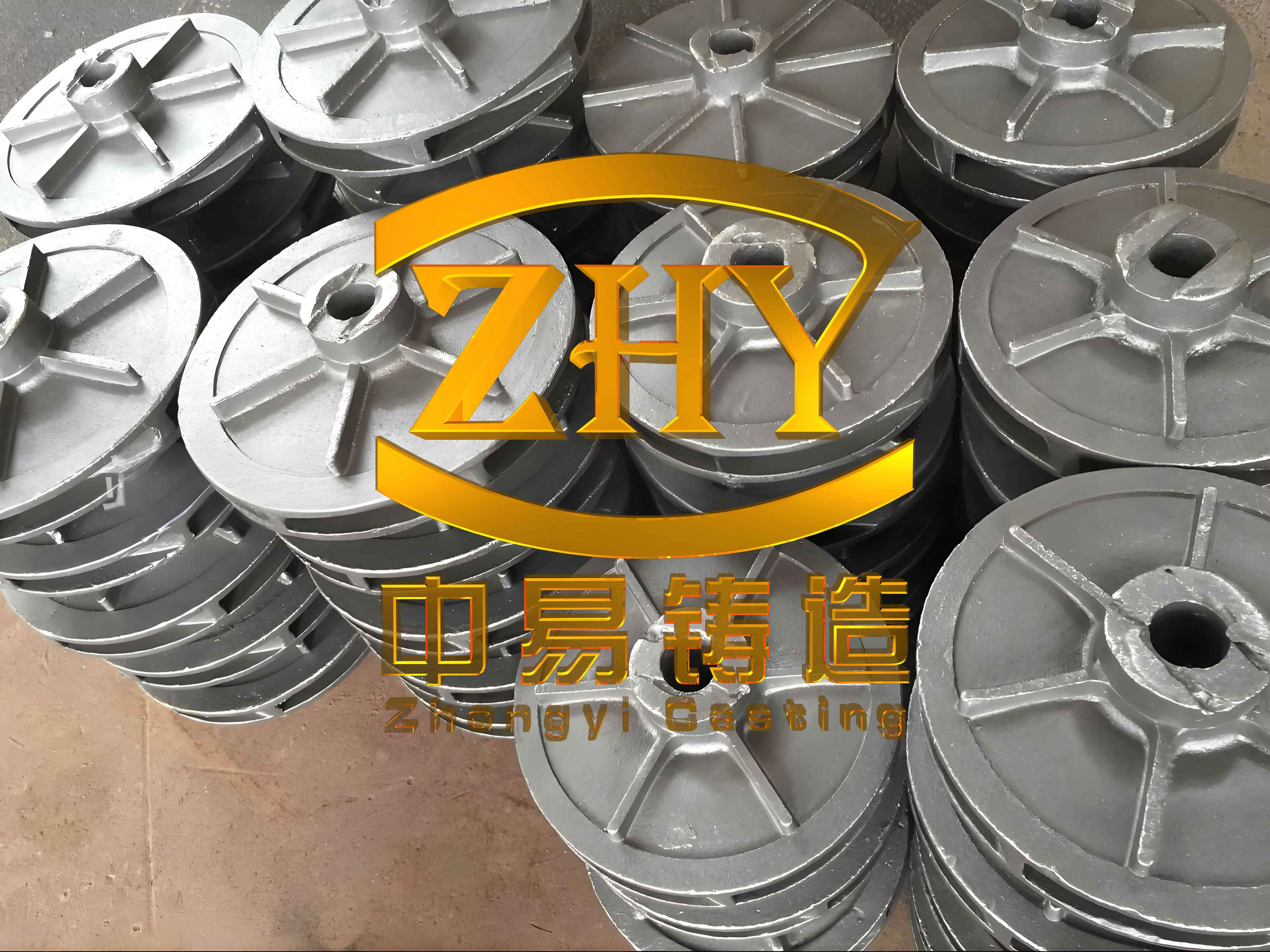
My experimental work began with addressing the primary challenge: inducing D-type graphite in grey cast iron. The key lies in manipulating the cooling rate during solidification. In standard sand casting, cooling is relatively slow, allowing graphite flakes to grow freely into larger A-type or fern-like (F-type) forms. To promote D-type graphite, a significantly higher cooling rate is necessary to increase undercooling and restrict graphite growth. I implemented a dedicated cooling system within the metal mold. This system, as illustrated in the linked figure, utilizes a pressurized water network flowing through channels drilled directly into the mold blocks. This active cooling imposes a rapid heat extraction, fundamentally altering the solidification kinetics. The relationship between cooling rate ($\dot{T}$) and graphite morphology can be conceptually described by considering the undercooling ($\Delta T$):
$$
\Delta T \propto \dot{T}^{n}
$$
where $n$ is a positive exponent. Higher $\dot{T}$ leads to greater $\Delta T$, shifting the solidification regime towards the metastable region where D-type graphite nucleates and grows. Without such forced cooling, achieving consistent D-type graphite in grey cast iron is exceedingly difficult, as the process defaults to the stable growth of A-type graphite.
However, rapid cooling alone for grey cast iron can lead to undesirable effects, such as increased chilling (formation of cementite at the surface). Therefore, the cooling medium temperature must be optimized; my trials found maintaining cooling water at approximately 40°C effectively suppressed A-type graphite while minimizing excessive white iron layers. This precise thermal management is a critical step in the production of high-integrity grey cast iron components.
The second critical aspect is controlling the matrix structure. A fully ferritic matrix is soft, while a pearlitic matrix contributes to higher strength and wear resistance. The target of 20-30% pearlite in a normalized condition requires alloying. I investigated several alloying elements for grey cast iron, including Cu, Cr, and Ti. The results, consolidated in the table below, clearly show the pronounced effect of titanium.
| Element | Addition (wt.%) | Brinell Hardness (HB) | Pearlite Content | Carbide Content | Predominant Graphite Type | Heat Treatment |
|---|---|---|---|---|---|---|
| Sn | 0.01 | 151, 156, 163 | ~15% | Negligible | A, F | 920°C × 1h, Air Cool |
| Cu | 0.30 | 170, 185, 182 | ~20% | <1% | D | 920°C × 1h, Forced Air Cool |
| Cr | 0.13 | 174, 189 | ~25% | >1% | D | 920°C × 1h, Forced Air Cool |
| Ti (as Fe-Ti) | 0.10 | 184, 182, 193 | ~20% | Negligible | D | 920°C × 2h, Forced Air Cool |
| Ti (as Fe-Ti) | 0.15 | 187, 192, 198 | ~35% | Negligible | D | 920°C × 2h, Forced Air Cool |
Titanium proved to be exceptionally effective for grey cast iron. It acts as a potent inoculant and hardener. Titanium increases the undercooling capacity of the iron melt and provides heterogeneous nucleation sites, refining the overall microstructure. The strengthening mechanism can be related to the formation of fine, stable titanium carbonitride (Ti(C,N)) particles that pin grain boundaries and dislocations. The increase in hardness and pearlite content with Ti addition is approximately linear within a range, which can be modeled as:
$$
\text{HB} \approx \text{HB}_0 + k_{Ti} \cdot [\text{Ti}]
$$
where $\text{HB}_0$ is the base hardness of the unalloyed grey cast iron, $k_{Ti}$ is a strengthening coefficient, and [Ti] is the weight percent of titanium. However, excessive titanium (beyond ~0.3%) in grey cast iron leads to the formation of complex intermetallic phases at grain boundaries, embrittling the material and degrading machinability. Therefore, for the target microstructure, the optimal titanium addition range for this grade of grey cast iron is 0.1% to 0.2%.
The final, indispensable step for this specific grey cast iron specification is the heat treatment cycle. Normalization is not merely for stress relief but is crucial for stabilizing the microstructure, dissolving any minor carbides formed during rapid cooling, and ensuring the target pearlite fraction. The process I established involves heating the castings to 920 ± 10°C, holding for 2 hours to achieve full austenitization, followed by rapid cooling in a strong air stream. The cooling must be sufficiently fast to avoid the ferrite nose on the Continuous Cooling Transformation (CCT) diagram for grey cast iron. The time ($t_{650}$) to cool from the austenitizing temperature to below 650°C should be less than 2 minutes:
$$
t_{650} < 120 \text{ seconds}
$$
This rapid cooling suppresses the high-temperature transformation to ferrite, forcing the austenite to transform into a fine, uniformly distributed pearlitic structure upon further cooling. The entire thermal cycle is depicted in the following conceptual formula, where $T(t)$ represents the temperature profile:
$$
T(t) = \begin{cases}
920^\circ\text{C} & \text{for } 0 \leq t \leq 7200 \text{s (soaking)} \\
920^\circ\text{C} – \beta t & \text{for } t > 7200 \text{s (cooling, } \beta \text{ is high cooling rate)}
\end{cases}
$$
Controlling the charging temperature (below 500°C) and minimizing transfer time to the cooling zone are essential procedural details to ensure consistency in every batch of grey cast iron.
Beyond the specific process for compressor cylinders, these principles have broad implications for the foundry sector. The demand for high-performance grey cast iron is growing in automotive, machinery, and hydraulic applications. Each application may require a slight variation in the pearlite-to-ferrite ratio or graphite type. For instance, brake discs made from grey cast iron benefit from high pearlite content and Type A graphite for thermal fatigue resistance, while certain engine blocks might utilize a mixed graphite structure. The general framework—alloy design (using elements like Ti, Cu, Mo), controlled solidification cooling, and precise heat treatment—remains valid. Computational modeling can further optimize these parameters. The cooling rate $\dot{T}$ can be linked to the geometry of the casting and mold design via the Fourier heat equation:
$$
\rho C_p \frac{\partial T}{\partial t} = \nabla \cdot (k \nabla T)
$$
where $\rho$ is density, $C_p$ is specific heat, $k$ is thermal conductivity, and $T$ is temperature. Solving this for a grey cast iron casting in a metal mold with active cooling allows for the prediction of solidification patterns and microstructure development.
Furthermore, the quality of raw materials for grey cast iron cannot be overstated. The base iron composition must be consistent. The target chemical composition for the grade discussed typically falls within these ranges, which I meticulously maintain: Carbon (C): 3.2–3.6%, Silicon (Si): 2.4–2.7%, Manganese (Mn): 0.6–1.0%, Phosphorus (P): ≤0.35%, Sulfur (S): ≤0.15%. Minor elements like lead (Pb) and tin (Sn) are kept very low as they can promote undesirable graphite forms. The melting practice, often in medium-frequency induction furnaces, ensures homogeneity and precise temperature control before pouring into the prepared, cooled molds.
In parallel to the work on grey cast iron, my research also touched upon challenges in aluminum casting, such as achieving exceptionally high yield strength in AlSi9Cu3(Fe) alloys. While the metallurgy differs, the philosophical approach is similar: a combination of composition control and thermal processing. For aluminum, the solution often involves a T5 or T6 heat treatment cycle (solution heat treatment, quenching, and artificial aging) to precipitate strengthening phases. The yield strength ($\sigma_y$) can be enhanced by age hardening, described approximately by the relationship:
$$
\sigma_y = \sigma_0 + \alpha G b \sqrt{\rho} + \beta \frac{Gb}{L}
$$
where $\sigma_0$ is the lattice friction stress, $G$ is the shear modulus, $b$ is the Burgers vector, $\rho$ is the dislocation density, $L$ is the precipitate spacing, and $\alpha, \beta$ are constants. However, returning to the core theme, the methodologies for grey cast iron are distinct and revolve around graphite and matrix control rather than precipitation hardening.
The economic aspect of using titanium in grey cast iron is favorable compared to more expensive alloys like copper or tin, especially when added in the form of ferrotitanium. This has allowed for the production of grey cast iron components that meet stringent international specifications at a competitive cost. The consistency achieved through the integrated process of controlled cooling, titanium alloying, and forced-air normalization has been proven over hundreds of production melts, with the grey cast iron properties consistently showing a tensile strength above 300 MPa and hardness between 180-190 HB, alongside the required 20-30% pearlite and D-type graphite.
To conclude, the successful production of advanced grey cast iron components hinges on a holistic understanding and control of the process chain. The key takeaways from my work are: First, the formation of D-type graphite in grey cast iron is fundamentally governed by achieving a high cooling rate during solidification, which requires an engineered cooling system within the mold. Second, the pearlite content in the grey cast iron matrix can be effectively and economically raised through the controlled addition of titanium, within the 0.1-0.2% range, which also refines the microstructure. Third, a well-defined normalization heat treatment with rapid cooling is essential to fix the desired microstructure and eliminate processing-induced defects. These principles, when applied diligently, enable the reliable manufacture of high-performance grey cast iron castings that satisfy the most demanding applications, underscoring the enduring relevance and adaptability of grey cast iron in modern engineering.