
In the field of marine engineering, the piston of a ship’s engine stands as a critical component, demanding exceptional surface quality and internal mechanical properties. Traditional casting methods often struggle with issues such as slag inclusion, shrinkage porosity, hardness inhomogeneity, and dimensional distortion. Through our extensive research and development, we have pioneered the application of sand coated iron mold casting for producing high-performance marine engine pistons. This process, known for its precision and reliability, addresses these challenges effectively. The sand coated iron mold casting technique involves creating a rigid iron mold coated with a thin layer of resin-bonded sand, which combines the benefits of metal mold cooling with the flexibility of sand casting. In this article, I will detail our comprehensive study on this process, covering design, control parameters, defect mitigation, and economic viability, all from a first-person perspective as part of our engineering team.
The sand coated iron mold casting process begins with a thorough analysis of the piston’s structure and performance requirements. Marine engine pistons typically exhibit significant wall thickness variations and complex geometries, as illustrated in the product drawing and sectional view. Dimensional tolerances must adhere to strict standards, such as DIN 1685 GTB16 grade, while mechanical properties include tensile strength ≥700 MPa, pearlite content ≥90%, ferrite content ≤10%, spheroidization grade ≥1, hardness 250-290 HBW, and internal soundness verified by X-ray inspection to level 1. These stringent criteria necessitate a casting method that ensures uniformity, precision, and minimal defects. Our evaluation of various processes led us to select sand coated iron mold casting over alternatives like resin sand molding, due to its superior cooling rates, dimensional stability, and cost-effectiveness.
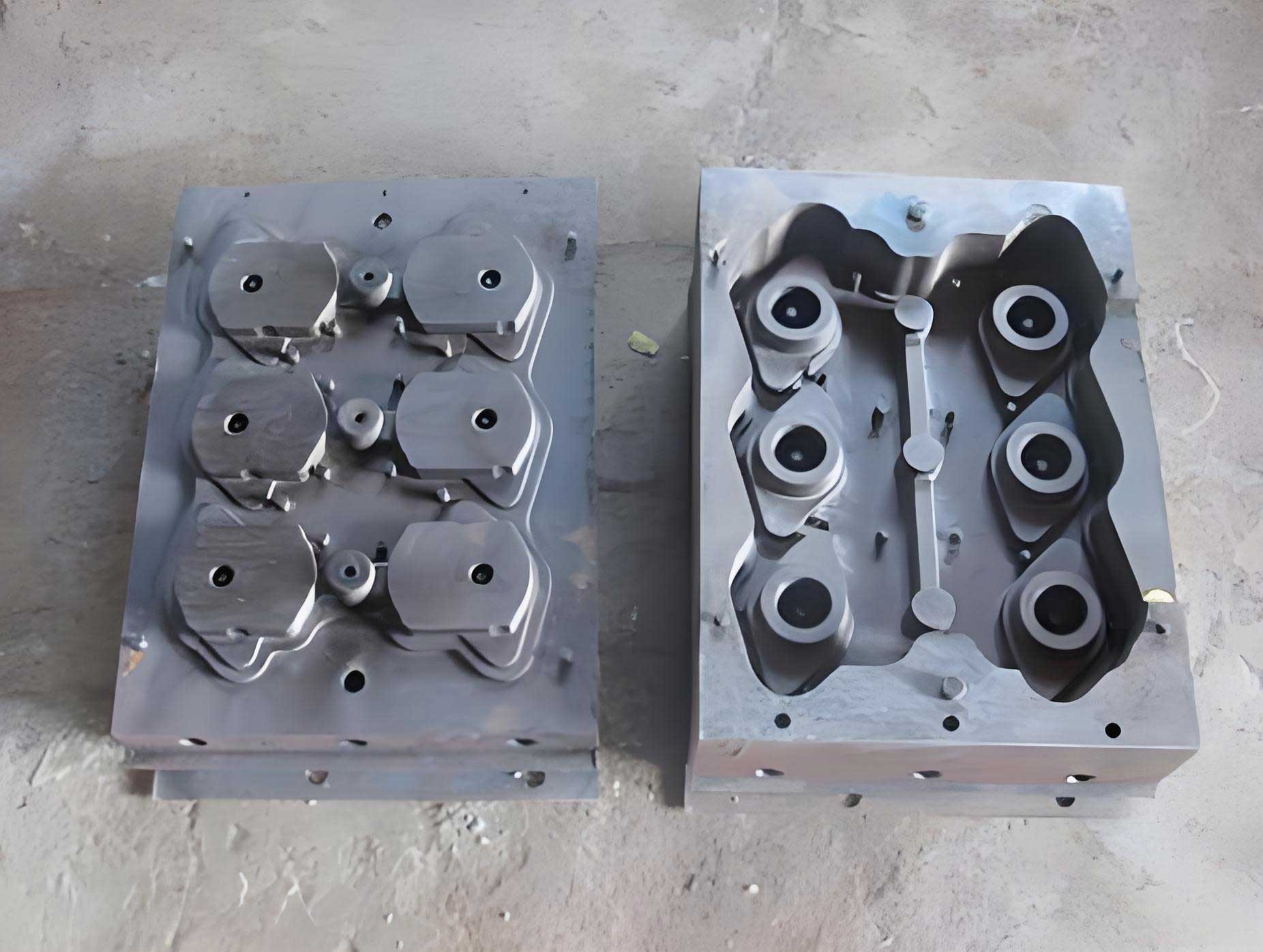
To quantify the advantages of sand coated iron mold casting, we compared it with resin sand molding using key metrics. The table below summarizes this comparison, highlighting why sand coated iron mold casting is preferable for marine engine pistons.
| Parameter | Resin Sand Molding | Sand Coated Iron Mold Casting |
|---|---|---|
| Dimensional Accuracy | Moderate, prone to deformation | High, due to rigid mold |
| Cooling Rate | Slower, leading to coarse grains | Faster, resulting in fine grains |
| Process Yield | 50-60% | ≥90% |
| Defect Rate | 5-10% | 2-5% |
| Environmental Impact | Solid waste generation | No solid waste, sand 100% recyclable |
| Labor Skill Requirement | High | Moderate |
| Cost Efficiency | Lower due to higher scrap and lower yield | Higher due to reduced scrap and improved yield |
The design of the mold and gating system is crucial in sand coated iron mold casting. We adopted a bottom-gating system with ceramic filters to ensure clean metal flow and minimize turbulence. This design reduces slag inclusion and promotes smooth filling, allowing gases to escape efficiently. Additionally, risers are placed above the thick sections, such as the piston crown, to compensate for shrinkage during solidification. The cores are also made using iron cores coated with sand, leveraging graphite expansion to achieve dense castings. The mold design, as shown in the figure, optimizes thermal management and feeding. The cooling effect of the iron mold can be described by the heat transfer coefficient, which influences the solidification time. For sand coated iron mold casting, the heat transfer coefficient (h) is higher than in resin sand molds, leading to faster cooling. This can be expressed using Fourier’s law of heat conduction: $$ q = -k \nabla T $$ where q is heat flux, k is thermal conductivity, and ∇T is temperature gradient. In sand coated iron mold casting, the iron mold’s high k accelerates heat extraction, refining the microstructure.
Material selection and chemical composition are pivotal for achieving the desired mechanical properties. We used QT700-2 nodular iron, with adjustments to promote pearlite formation and enhance strength. The composition ranges are summarized in the table below, derived from our experimental trials.
| Element | Composition Range (wt%) | Role in Sand Coated Iron Mold Casting |
|---|---|---|
| Carbon (C) | 3.3-3.8 | Enhances fluidity and reduces shrinkage |
| Silicon (Si) | 1.8-2.5 | Promotes graphitization and pearlite |
| Manganese (Mn) | 0.1-0.5 | Increases hardenability and strength |
| Copper (Cu) | 0.4-0.9 | Stabilizes pearlite and improves wear resistance |
| Magnesium (Mg) | 0.025-0.06 | Facilitates spheroidization of graphite |
| Aluminum (Al) | ≤0.025 | Minimizes gas formation |
| Phosphorus (P) | ≤0.05 | Reduces brittleness |
| Sulfur (S) | ≤0.01 | Prevents slag inclusion and improves Mg efficiency |
The carbon equivalent (CE) is a critical parameter in iron casting, calculated as: $$ CE = C + \frac{Si + P}{3} $$ For our composition, CE ranges from 4.0 to 4.5, near the eutectic point, which enhances fluidity and reduces shrinkage tendencies in sand coated iron mold casting. This optimization is essential for preventing defects like porosity and ensuring sound castings.
Process control in sand coated iron mold casting involves multiple stages: mold preparation, melting, spheroidization and inoculation, pouring, and heat treatment. Each stage requires precise parameters to maintain quality. For mold preparation, the iron mold temperature is controlled at around 230°C. If too low, the coated sand may not fully cure, leading to weak shells and high gas evolution; if too high, the sand can burn or cure prematurely, causing defects like sand sticking. The relationship between mold temperature (T_m) and curing time (t_c) can be approximated by: $$ t_c = A e^{-E/(RT_m)} $$ where A is a constant, E is activation energy, and R is the gas constant. We monitored this closely to ensure optimal shell strength.
Melting is performed in medium-frequency induction furnaces, with a tapping temperature of approximately 1500°C. High temperature and cleanliness are vital in sand coated iron mold casting to avoid inclusions and cold shuts. The melting energy required can be estimated using: $$ Q = m C_p \Delta T + m L_f $$ where m is mass, C_p is specific heat, ΔT is temperature rise, and L_f is latent heat of fusion. We maintained strict slag removal practices to ensure metal purity.
Spheroidization and inoculation are critical for achieving the required nodular graphite structure. We used FeSiMg8Rt3 spheroidizer, with additions tailored to the base sulfur content. Inoculation was done twice: first with 0.2-0.3% ferrosilicon during spheroidization, and second with 0.1% stream inoculation using a calcium-barium复合孕育剂 during pouring. The inoculation efficiency (η) can be modeled as: $$ \eta = \frac{N_{graphite}}{N_{potential}} $$ where N_{graphite} is the number of graphite nuclei formed, and N_{potential} is the potential nucleation sites. Fine-grained inoculants (60 mesh) were used to maximize nucleation and delay fade.
Pouring control in sand coated iron mold casting emphasizes speed and continuity. We employed a “fast-slow” sequence to avoid turbulence and ensure proper feeding. The pouring time (t_p) is related to the gating system design and can be calculated using Bernoulli’s principle: $$ t_p = \frac{V}{A \sqrt{2gH}} $$ where V is mold volume, A is gating cross-sectional area, g is gravity, and H is metallostatic head. Temperature was monitored at the ladle tail, and any metal below 1450°C was returned to the furnace to prevent quality issues.
Heat treatment is necessary for QT700-2 material to stabilize mechanical properties. Our protocol involved high-temperature normalizing at 910°C ± 20°C for 3 hours, followed by air cooling to room temperature. After rough machining, stress relief annealing was conducted at 600°C ± 20°C for 3 hours, with a controlled cooling rate below 50°C/h to avoid secondary stresses and bainite formation. The kinetics of phase transformation can be described by the Avrami equation: $$ X = 1 – e^{-kt^n} $$ where X is fraction transformed, k is rate constant, t is time, and n is exponent. This treatment ensured uniform microstructure and met the hardness and strength targets.
Defect analysis and mitigation are integral to refining the sand coated iron mold casting process. We identified common defects and developed countermeasures, as summarized in the table below.
| Defect Type | Root Causes in Sand Coated Iron Mold Casting | Corrective Actions |
|---|---|---|
| Poor Spheroidization | Insufficient spheroidizer, high sulfur, high temperature | Adjust spheroidizer dosage based on S content; use uniform粒度; limit pouring time to 20 min |
| Gas Porosity | Low metal temperature, high mold moisture, poor venting | Maintain tapping temperature >1500°C; dry molds and compressed air lines; enhance mold排气 |
| Slag Inclusion | Inadequate slag removal, poor ladle design, premature inoculation | Use multiple slag removers; check ladle spout for slag挡; inoculate during pouring stream |
| Shrinkage Porosity | Low CE, high pouring temperature, fast pouring | Optimize CE near eutectic; increase metallostatic head; adopt “fast-slow” pouring sequence |
These measures significantly reduced defect rates, demonstrating the robustness of sand coated iron mold casting. For instance, gas porosity can be minimized by ensuring proper venting in the mold design, which relates to the gas permeability (P) of the sand coat: $$ P = \frac{k_g}{\mu} $$ where k_g is permeability coefficient, and μ is gas viscosity. We selected sands with high P to facilitate gas escape.
The economic applicability of sand coated iron mold casting is a key advantage. Compared to resin sand molding, this process offers substantial cost savings through higher yield, lower scrap, and reduced cleaning efforts. The table below quantifies these benefits based on our production data.
| Economic Factor | Resin Sand Molding | Sand Coated Iron Mold Casting | Improvement |
|---|---|---|---|
| Process Yield | 50-60% | 90-95% | 30-40% increase |
| Scrap Rate | 5-10% | 2-5% | 50-80% reduction |
| Cleaning Cost | Baseline | 10-20% lower | Significant savings |
| Material Usage | Higher due to heavier risers | 2-10% weight reduction | Direct material saving |
| Environmental Cost | Solid waste disposal needed | Zero waste, sand recycled | Eco-friendly advantage |
The overall cost savings can be estimated using: $$ Savings = (Y_{sc} – Y_{rs}) \times C_{metal} + (R_{rs} – R_{sc}) \times C_{scrap} + \Delta C_{cleaning} $$ where Y is yield, R is scrap rate, C_{metal} is metal cost, C_{scrap} is scrap handling cost, and ΔC_{cleaning} is cleaning cost difference. Our analysis showed that sand coated iron mold casting reduces quality-related costs by over 80%, making it highly economical for mass production of marine engine pistons.
In conclusion, our research confirms that sand coated iron mold casting is an optimal method for manufacturing high-performance marine engine pistons. The process leverages the rapid cooling of iron molds to refine microstructure, combined with the flexibility of sand coats to achieve complex shapes. Key success factors include precise chemical composition control, stringent process parameters, and proactive defect management. The sand coated iron mold casting technique not only meets rigorous mechanical and dimensional standards but also offers significant economic and environmental benefits. We have successfully applied this process to produce pistons with tensile strengths exceeding 700 MPa, pearlite content above 90%, and excellent machinability. Future work could explore automation in sand coated iron mold casting to further enhance consistency and reduce labor costs. We believe that sand coated iron mold casting holds great potential for other critical castings in marine and automotive industries, paving the way for more efficient and sustainable manufacturing practices.
Throughout this study, we emphasized the importance of integrated design and control in sand coated iron mold casting. The synergy between mold geometry, material science, and thermal dynamics enables the production of superior castings. As we continue to refine this process, we aim to develop predictive models for defect formation using simulation tools, further optimizing the sand coated iron mold casting parameters. This approach will help in scaling up production while maintaining the high quality standards required for marine applications. The journey of mastering sand coated iron mold casting has been rewarding, and we are confident in its widespread adoption for advanced casting needs.