
In my extensive experience with precision casting methods, sand coated iron mold casting has emerged as a critical technique for producing high-quality railway components. This process involves coating a metal mold with a thin layer of resin sand, which imparts permeability and yieldability, addressing the inherent limitations of pure metal molds. The result is castings with superior dimensional accuracy, aesthetic appeal, and dense microstructure. However, during the production of specific parts like the K2 bearing seat, significant quality defects such as cold shuts and misruns were observed. This article, from my first-person perspective, delves into a systematic analysis of these issues, exploring the fundamentals of sand coated iron mold casting, the structural nuances of the casting, and the implemented corrective measures.
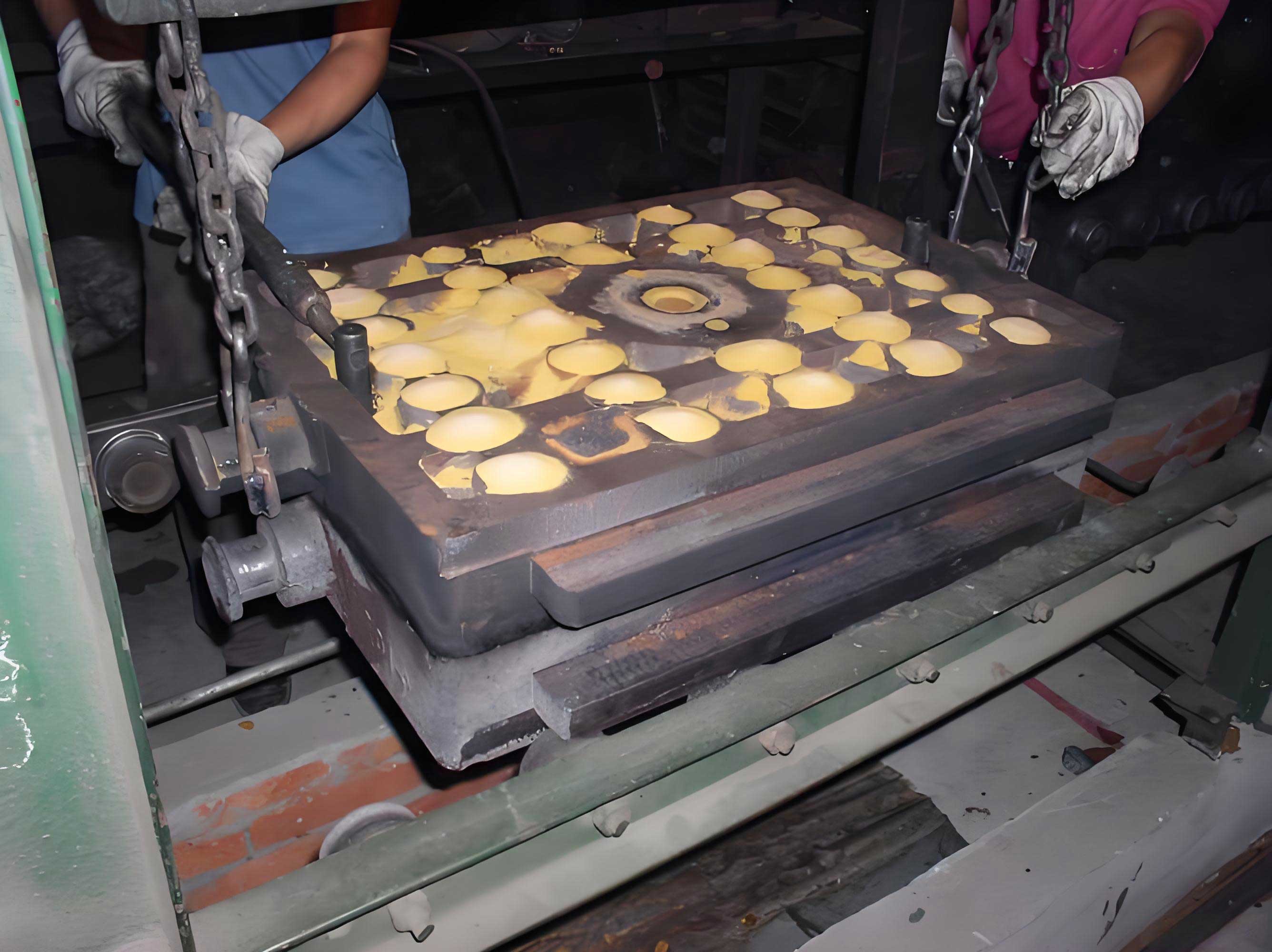
The adoption of sand coated iron mold casting in the railway industry has been driven by the escalating demand for durability and precision in vehicle parts. This method synergizes the rapid cooling and fine grain structure of metal mold casting with the flexibility and gas escape capability of sand casting. In my work, I have applied sand coated iron mold casting to various components, but the transition to producing the K2 bearing seat revealed unexpected challenges. The initial production batches exhibited a high rejection rate, primarily due to surface defects that compromised integrity. To quantify the problem, I compiled statistical data from early runs, which underscored the severity of the issues.
| Production Month | Number of Castings Produced | Defective Castings | Overall Defect Rate (%) | Cold Shut Defects (%) | Misrun Defects (%) | Other Defects (%) |
|---|---|---|---|---|---|---|
| July | 1604 | 240 | 15.0 | 43.0 | 36.0 | 21.0 |
As shown in Table 1, cold shuts and misruns constituted nearly 80% of all defects in sand coated iron mold casting, indicating a fundamental process mismatch. Interestingly, similar issues were absent in other components like the K4 wedge produced with the same sand coated iron mold casting setup. This discrepancy prompted a deep dive into the process variables. From my analysis, the root causes lie in the interplay between the sand coated iron mold casting characteristics and the specific geometry of the K2 bearing seat. The casting is a thin-walled frame structure with a minimal wall thickness of 8 mm, which accelerates heat dissipation and complicates metal flow during sand coated iron mold casting.
To understand the defect mechanisms in sand coated iron mold casting, I first examined the formative principles of metal mold casting augmented by a sand layer. Unlike conventional sand molds, metal molds exhibit high thermal conductivity and zero permeability. The sand coating in sand coated iron mold casting mitigates these by providing a buffer that allows gas escape and accommodates minor shrinkage. However, during pouring, the entrapped gas in the mold cavity undergoes rapid compression and heating. According to the ideal gas law, the pressure dynamics can be modeled as:
$$ P = \frac{nRT}{V} $$
where \( P \) is the gas pressure, \( n \) is the number of moles, \( R \) is the universal gas constant, \( T \) is the temperature, and \( V \) is the volume. In sand coated iron mold casting, as molten metal fills the cavity, \( V \) decreases and \( T \) increases, causing \( P \) to rise sharply. If venting is inadequate, this elevated pressure creates a back-pressure that opposes metal flow, leading to misruns. Furthermore, localized “air pockets” can form where gas is trapped by advancing metal, obstructing complete filling in sand coated iron mold casting.
The thermal exchange during solidification in sand coated iron mold casting is another critical factor. Upon entering the mold, the molten metal transfers heat to the metal mold wall through the sand layer. The system’s heat flow, which dictates cooling rate, can be analyzed using Fourier’s law for a simplified plate model. The specific heat flux \( q \) is given by:
$$ q = \frac{t_0 – t_3}{\frac{x_1}{\lambda_1} + \frac{x_2}{\lambda_2} + \frac{x_3}{\lambda_3}} $$
In this equation, \( \lambda_1, \lambda_2, \lambda_3 \) represent the thermal conductivities of the casting material, the air gap forming between casting and sand, and the metal mold, respectively. The terms \( x_1, x_2, x_3 \) denote half the casting wall thickness, the air gap thickness, and the metal mold thickness. \( t_0 \) and \( t_3 \) are the casting center temperature and the mold outer surface temperature. For sand coated iron mold casting, a higher \( q \) value indicates faster cooling, which is exacerbated in thin-walled sections like those in the K2 seat. Rapid cooling can cause premature solidification of the metal stream before the mold is fully filled, resulting in cold shuts. The relationship highlights that increasing the sand layer thickness \( x_2 \) or the mold preheat temperature (affecting \( t_3 \)) can modulate \( q \) in sand coated iron mold casting.
My investigation into the sand coated iron mold casting process for the K2 bearing seat identified six primary contributors to the defects. These were systematically evaluated and addressed through targeted interventions.
| Root Cause Identified | Detailed Explanation | Proposed Improvement Measure | Expected Impact on Sand Coated Iron Mold Casting |
|---|---|---|---|
| Insufficient Pouring Temperature | The initial temperature range of 1380-1400°C was too low for the thin-walled geometry, reducing metal fluidity and increasing viscosity. | Elevate pouring temperature to 1400-1440°C and ensure consistent furnace tapping temperature. | Enhanced metal fluidity, reduced early solidification tendency in sand coated iron mold casting. |
| Inadequate Pouring Speed | Slow pouring prolonged the filling time, allowing heat loss and solidification before mold completion. | Standardize pouring to complete each mold (6 pieces) within 20 seconds, and a full batch of 15 molds within 8 minutes. | Minimized thermal loss, improved mold filling efficiency in sand coated iron mold casting. |
| Low Mold Temperature at Pouring | Molds cooled to ambient temperature during the 1.5-hour preparation period, creating a large thermal gradient. | Install simple heating devices under mold storage stations to maintain an optimal preheat temperature. | Reduced thermal shock, slower initial cooling rate in sand coated iron mold casting. |
| Poor Mold Venting Design | Lack of vent holes, especially on the upper mold half (corresponding to the seat’s base plane), trapped gas. | Add vent holes and channels to the upper metal mold; implement post-pour ignition to evacuate gases. | Decreased back-pressure, elimination of air pockets in sand coated iron mold casting. |
| Suboptimal Sand Coating Thickness | A 6 mm sand layer was too thin to provide adequate insulation and yieldability for rapid cooling sections. | Modify metal patterns or molds to increase the resin sand coating thickness to 8-10 mm. | Better thermal insulation, improved permeability and compensation for shrinkage in sand coated iron mold casting. |
| Lax Quality Control Protocols | Inconsistent monitoring and weak accountability allowed defect recurrence. | Revise quality standards, introduce stricter defect tracking, and link performance to evaluation metrics. | Heightened process discipline and continuous improvement in sand coated iron mold casting operations. |
Implementing these measures in the sand coated iron mold casting process yielded marked improvements. To quantify the outcomes, I compared quality metrics before and after the interventions.
| Parameter | Pre-Improvement (July) | Post-Improvement (August-September) | Percentage Improvement (%) |
|---|---|---|---|
| Overall Defect Rate | 15.0% | 6.5% | 56.7 |
| Cold Shut Incidence Rate | 43.0% of defects | 23.0% of defects | 46.5 |
| Misrun Incidence Rate | 36.0% of defects | 25.0% of defects | 30.6 |
| Total Contribution of Cold Shuts and Misruns to Defects | 79.0% | 48.0% | 39.2 |
The data in Table 3 demonstrates that optimizing sand coated iron mold casting parameters can drastically reduce defect rates. The decrease in cold shuts and misruns underscores the importance of thermal management and fluid flow control. Additionally, I conducted further analysis to model the thermal effects mathematically. The heat flux equation can be extended to incorporate time-dependent factors for sand coated iron mold casting. Considering transient heat conduction, the temperature distribution \( T(x,t) \) in the casting wall can be approximated by:
$$ \frac{\partial T}{\partial t} = \alpha \frac{\partial^2 T}{\partial x^2} $$
where \( \alpha \) is the thermal diffusivity. For thin sections, solving this with boundary conditions reflecting the sand coated iron mold casting environment shows that a thicker sand layer reduces the cooling rate \( \frac{\partial T}{\partial t} \), thereby extending the fluid flow window. This theoretical insight supports the empirical adjustment of sand coating thickness.
Beyond immediate fixes, I explored the broader implications for sand coated iron mold casting of thin-walled, large-plane components. The process demands a holistic approach to parameter selection. For instance, the pouring temperature \( T_p \) and pouring speed \( v_p \) must be balanced to avoid turbulence while ensuring complete filling. An empirical relationship I derived from multiple sand coated iron mold casting trials is:
$$ v_p \propto \frac{T_p – T_s}{\mu \cdot \tau} $$
Here, \( T_s \) is the solidus temperature, \( \mu \) is the dynamic viscosity, and \( \tau \) is the characteristic filling time. Higher \( T_p \) and \( v_p \) reduce \( \tau \), which is crucial for thin walls. Moreover, venting efficiency \( \eta_v \) can be quantified as the ratio of vent area \( A_v \) to mold cavity volume \( V_c \):
$$ \eta_v = k \frac{A_v}{V_c} $$
where \( k \) is a constant dependent on sand permeability in sand coated iron mold casting. Increasing \( \eta_v \) directly alleviates gas-related defects.
In conclusion, my experience with sand coated iron mold casting for the K2 bearing seat highlights that success hinges on tailoring process parameters to the component’s geometry. Thin-walled castings require thicker sand coatings, higher pouring temperatures, faster pouring speeds, controlled mold temperatures, and robust venting in sand coated iron mold casting. The systematic analysis and evidence-based modifications reduced the defect rate significantly, validating the approach. Future work in sand coated iron mold casting could involve advanced simulation models to predict metal flow and solidification under various conditions, further optimizing this valuable precision casting method for railway and other high-performance applications.