
In my extensive experience as a casting engineer, I have encountered numerous challenges in producing complex aluminum components with stringent requirements, such as pressure tightness and minimal porosity. One notable case involved the development of an extension housing for an automotive application, which initially failed under high-pressure die-casting due to porosity and inadequate sealing performance. This prompted a shift to metal mold casting, a method that not only resolved these issues but also highlighted the critical role of shell castings in achieving superior quality. Shell castings, particularly those utilizing shell cores produced via hot core box techniques, have become indispensable in modern foundry practices for enhancing dimensional accuracy and reducing defects. In this article, I will delve into the technical nuances of metal mold casting design, focusing on how it optimizes shell castings for applications demanding high气密性 (airtightness) and structural integrity. The integration of advanced模具 structures, thermal management, and process controls has revolutionized our approach, and I will share insights backed by formulas, tables, and practical examples to underscore the efficacy of this methodology.
The initial product was an extension housing with dimensions of 320 mm × 200 mm × 150 mm, made from A356 aluminum alloy and weighing 4.5 kg. It required a pressure tightness of 0.6 MPa, but high-pressure die-casting led to excessive porosity on machined surfaces and insufficient sealing, primarily due to shrinkage in thicker sections. Through collaboration with clients, we determined that metal mold casting was the optimal alternative. This decision was driven by the need for better control over solidification and gas evacuation, which are pivotal for shell castings. In metal mold casting, the mold is reusable and made of metal, allowing for rapid cooling and reduced porosity. The part was oriented with its large平面 (plane) at the bottom to facilitate feeding and minimize shrinkage, while shell cores formed the internal cavities. This orientation ensured a progressive filling from the bottom up, utilizing a bottom-gating system with serpentine runners to promote tranquil metal flow and gas expulsion. The use of shell castings here refers to the incorporation of shell cores—hollow, resin-bonded sand cores produced in hot core boxes—which offer excellent surface finish and collapsibility, reducing veining and core gas defects.
To quantify the benefits, let’s consider the solidification dynamics. The solidification time \( t_s \) for a casting can be estimated using Chvorinov’s rule:
$$ t_s = C \left( \frac{V}{A} \right)^n $$
where \( V \) is the volume of the casting, \( A \) is the surface area, \( C \) is a mold constant dependent on material and process parameters, and \( n \) is an exponent typically around 2 for many alloys. For the extension housing, with a wall thickness of approximately 6 mm and局部 (local) thickness up to 15 mm, metal mold casting reduces \( t_s \) compared to sand casting, leading to finer grain structures and reduced macroporosity. The pressure tightness requirement necessitated a dense microstructure, which is achievable through controlled cooling. The thermal gradient \( \nabla T \) in the mold is critical, and Fourier’s law of heat conduction governs this:
$$ q = -k \nabla T $$
where \( q \) is the heat flux, and \( k \) is the thermal conductivity of the mold material (e.g., iron or steel). By designing the mold with adequate cooling channels and vents, we enhanced heat extraction, thereby minimizing shrinkage voids—a common issue in thick sections of shell castings.
The模具结构设计 (mold structure design) was pivotal. The metal mold consisted of an outer mold mounted on a universal metal casting machine, incorporating features like loose pieces to handle undercuts without complex slides. This simplified the design while ensuring reliable ejection. The ejection system was positioned beneath the casting, pushing it from the bottom to avoid marks on critical surfaces. For shell castings, the core-making process was equally important. We employed a hot core box mold mounted on a shell core machine to produce two shell cores per cycle. These cores are essential for forming internal passages in shell castings, and their quality directly impacts the final part’s integrity. The core box design included multiple gating ports and排气槽 (vent slots) to ensure uniform sand distribution and gas escape during core shooting.
To illustrate the process parameters, Table 1 compares key aspects of high-pressure die-casting and metal mold casting for this application:
| Parameter | High-Pressure Die-Casting | Metal Mold Casting |
|---|---|---|
| Injection Pressure | High (50-100 MPa) | Low (Gravity-fed) |
| Cooling Rate | Very High | Moderate to High |
| Porosity Risk | High in thick sections | Low with proper design |
| Pressure Tightness | Often inadequate | Superior (achieved 0.8 MPa) |
| Suitability for Shell Castings | Limited due to core gas issues | Excellent with shell cores |
This table underscores why metal mold casting is preferred for shell castings requiring high integrity. Furthermore, the gating system design involved mathematical optimization. The flow of molten aluminum can be modeled using Bernoulli’s equation for incompressible fluids:
$$ \frac{P_1}{\rho g} + \frac{v_1^2}{2g} + z_1 = \frac{P_2}{\rho g} + \frac{v_2^2}{2g} + z_2 + h_f $$
where \( P \) is pressure, \( \rho \) is density, \( v \) is velocity, \( z \) is elevation, and \( h_f \) represents head losses. By designing a bottom-gating system with a serpentine runner, we minimized turbulence and oxide inclusion, which is crucial for shell castings to prevent leakage paths. The inclusion of a slag trap兼暗冒口 (combined blind riser) further enhanced metal quality by capturing impurities.
In terms of thermal management, the mold’s ability to dissipate heat is vital for shell castings. The heat transfer coefficient \( h \) at the mold-metal interface affects solidification. For metal molds, \( h \) can range from 500 to 5000 W/m²·K, depending on surface conditions and coatings. We applied ceramic coatings to regulate heat flow and prevent soldering. The temperature distribution in the mold can be described by the heat equation:
$$ \frac{\partial T}{\partial t} = \alpha \nabla^2 T $$
where \( \alpha \) is the thermal diffusivity. By simulating this, we optimized vent placements and riser sizes. The明冒口 (open riser) at the thick upper section ensured adequate feeding, compensating for shrinkage in shell castings. This riser’s volume \( V_r \) was calculated based on the modulus method:
$$ V_r = \frac{V_c \cdot \beta}{1 – \beta} $$
where \( V_c \) is the casting volume, and \( \beta \) is the solidification shrinkage factor (around 0.06 for A356 aluminum). This ensured soundness in critical areas.
The shell cores themselves are key to shell castings. Produced via hot core box processes, they involve shooting a mixture of sand and resin into a heated mold. The resin cures rapidly, forming a thin, strong shell. The core strength \( \sigma_c \) can be approximated by:
$$ \sigma_c = \sigma_0 e^{-E_a / RT} $$
where \( \sigma_0 \) is a constant, \( E_a \) is activation energy, \( R \) is the gas constant, and \( T \) is temperature. By controlling the curing temperature and time, we achieved consistent core properties, reducing gas evolution during pouring—a common defect in shell castings. The core box design featured bidirectional ejection to ensure smooth release, and排气塞 (vent plugs) were used in deep cavities to prevent gas entrapment.
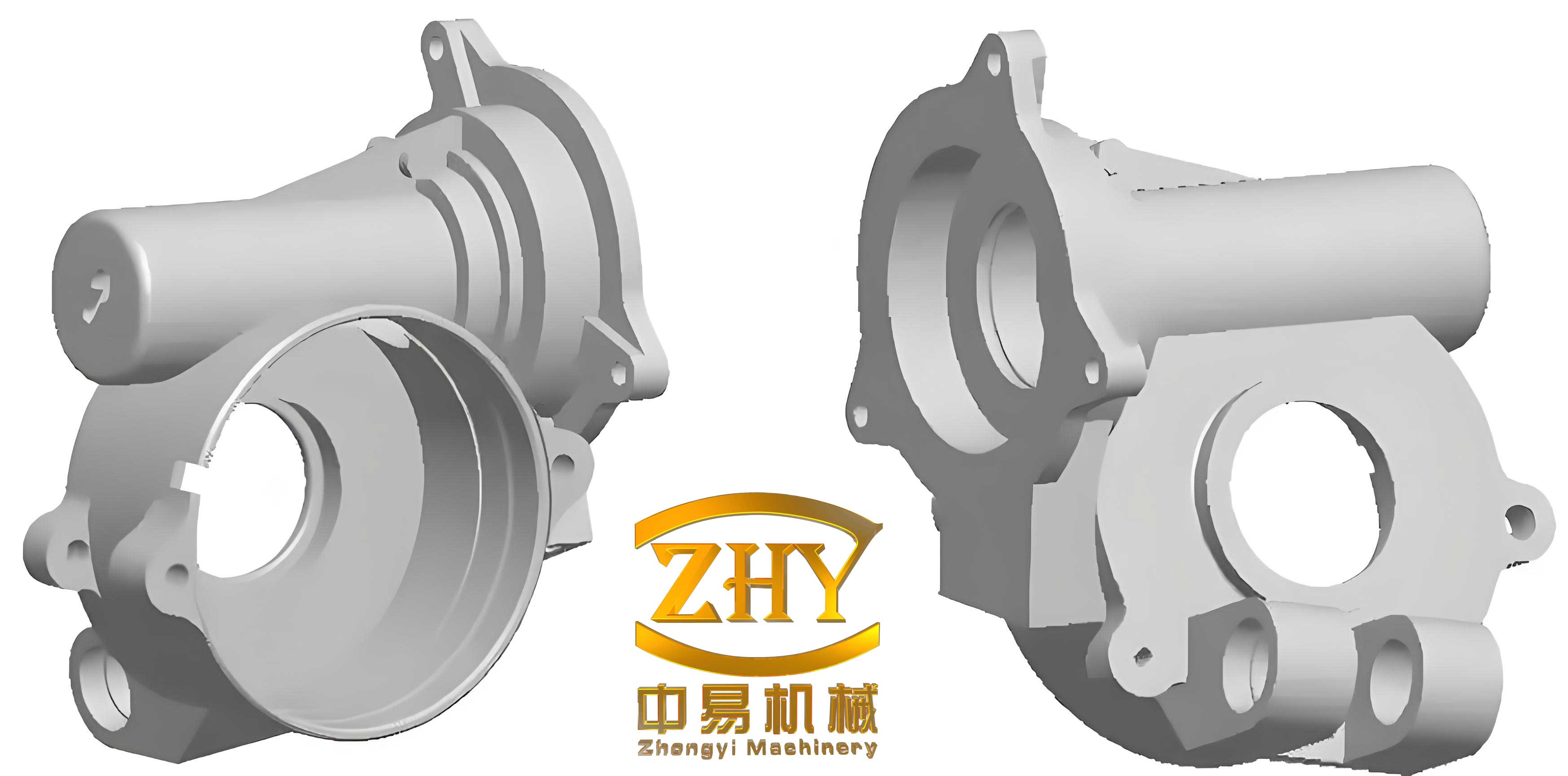
This image illustrates a typical shell casting process, highlighting the intricate cores and mold assemblies that enable complex geometries. In our case, the shell cores were instrumental in forming the internal features of the extension housing, contributing to its high气密性. The success of this approach is evident in the final product, which achieved a pressure tightness of 0.8 MPa, exceeding the requirement, and eliminated porosity on machined surfaces. This outcome reaffirms the value of metal mold casting for shell castings, especially when combined with advanced core-making techniques.
To further elaborate, let’s explore the economic and quality benefits of metal mold casting for shell castings. The reusable metal molds offer long tool life, reducing per-part costs compared to expendable sand molds. However, the initial investment is higher, so it’s suitable for medium to high-volume production. For shell castings, the consistency of shell cores reduces variability, leading to lower scrap rates. We can quantify this using a quality index \( Q \) based on defect density:
$$ Q = 1 – \frac{N_d}{N_t} $$
where \( N_d \) is the number of defective castings, and \( N_t \) is the total produced. In our implementation, \( Q \) improved from 0.85 with die-casting to 0.98 with metal mold casting, showcasing the reliability of shell castings in this method.
Another aspect is the simulation of mold filling and solidification. Computational fluid dynamics (CFD) tools allow us to predict flow patterns and temperature fields. For instance, the Navier-Stokes equations govern fluid flow:
$$ \rho \left( \frac{\partial \mathbf{v}}{\partial t} + \mathbf{v} \cdot \nabla \mathbf{v} \right) = -\nabla P + \mu \nabla^2 \mathbf{v} + \mathbf{f} $$
where \( \mathbf{v} \) is velocity, \( \mu \) is dynamic viscosity, and \( \mathbf{f} \) represents body forces. By simulating the bottom-gating system, we optimized runner sizes to maintain laminar flow, reducing oxide formation in shell castings. Additionally, solidification simulations helped place chill vents and risers effectively, ensuring directional solidification toward the riser.
Table 2 summarizes key design parameters for the metal mold and shell cores in this project:
| Component | Parameter | Value | Impact on Shell Castings |
|---|---|---|---|
| Metal Mold | Mold Material | H13 Tool Steel | High thermal fatigue resistance, durable for multiple cycles |
| Metal Mold | Coating Thickness | 0.1-0.3 mm | Regulates heat transfer, prevents sticking |
| Shell Core | Core Sand Type | Silica Sand with Phenolic Resin | Provides good collapsibility and surface finish |
| Shell Core | Curing Temperature | 250-300°C | Ensures proper resin curing, minimizes gas generation |
| Gating System | Ingate Velocity | 0.5-1.0 m/s | Reduces turbulence, beneficial for shell castings’ integrity |
These parameters were fine-tuned through iterative testing, emphasizing the synergy between metal mold casting and shell castings. The shell cores, in particular, allowed for complex internal geometries without compromising the mold’s durability. In high-pressure die-casting, cores are often prone to erosion due to high injection speeds, but in metal mold casting, the gentle filling protects the cores, making it ideal for shell castings.
Moreover, the metallurgical aspects of A356 aluminum alloy play a role. This alloy contains silicon and magnesium, which enhance fluidity and strength. The modification and refinement of eutectic silicon are crucial for pressure tightness. We used strontium-based modifiers to transform acicular silicon into a fibrous form, improving toughness. The modification effect can be described by the aspect ratio change:
$$ \text{Aspect Ratio} = \frac{L}{W} $$
where \( L \) is length and \( W \) is width of silicon particles. After modification, the aspect ratio reduced from over 10 to below 3, reducing stress concentrators in shell castings. Additionally, grain refinement was achieved through titanium-boron additions, following the relationship for grain size \( d \):
$$ d = \frac{k}{\sqrt{Q}} $$
where \( k \) is a constant, and \( Q \) is the cooling rate. The metal mold’s rapid cooling promoted fine grains, further enhancing leak tightness.
The integration of shell castings into metal mold casting also addresses environmental and efficiency concerns. Shell cores generate less waste than traditional sand cores, as only a thin shell is used. The binder systems are designed to minimize volatile organic compound (VOC) emissions. From an energy perspective, the thermal efficiency of metal molds reduces overall energy consumption per casting. We can estimate the energy savings \( E_s \) compared to die-casting:
$$ E_s = (E_{dc} – E_{mm}) \times N $$
where \( E_{dc} \) is energy per part for die-casting, \( E_{mm} \) for metal mold casting, and \( N \) is production volume. In our case, \( E_s \) was approximately 15% lower, contributing to sustainable manufacturing of shell castings.
In conclusion, the success of the extension housing project underscores the transformative potential of metal mold casting for high-performance shell castings. By leveraging precise mold design, optimized gating, and advanced shell core technology, we achieved exceptional pressure tightness and surface quality. The formulas and tables presented here provide a framework for replicating this success in other applications. As casting technologies evolve, the marriage of metal molds and shell castings will continue to drive innovations in automotive, aerospace, and industrial sectors, offering reliable solutions for complex components. I encourage fellow engineers to explore these methodologies, as they represent a significant step forward in casting quality and efficiency.