
In my experience working with complex castings, particularly in the automotive and machinery sectors, shell castings often present significant challenges due to their intricate geometries and material properties. Shell castings, such as differential cases, are critical components where defects like shrinkage porosity can lead to high scrap rates and substantial financial losses. This article details my firsthand account of designing and improving the casting process for a differential case shell casting, emphasizing the methodologies that can be applied broadly to shell castings. Through iterative modifications, we successfully reduced defect rates from nearly 95% to around 3%, providing valuable insights for similar shell castings production.
Shell castings are typically used in applications requiring high strength and durability, such as in differential systems for construction machinery. The material involved here is nodular iron, which, while offering excellent mechanical properties, is prone to shrinkage defects due to graphite expansion during solidification. The specific shell casting discussed has a complex structure with multiple thermal centers, making it susceptible to porosity. Initial production runs revealed severe shrinkage cavities in bolt holes, rendering most parts unusable. This prompted a comprehensive review and enhancement of the casting process, focusing on principles applicable to various shell castings.
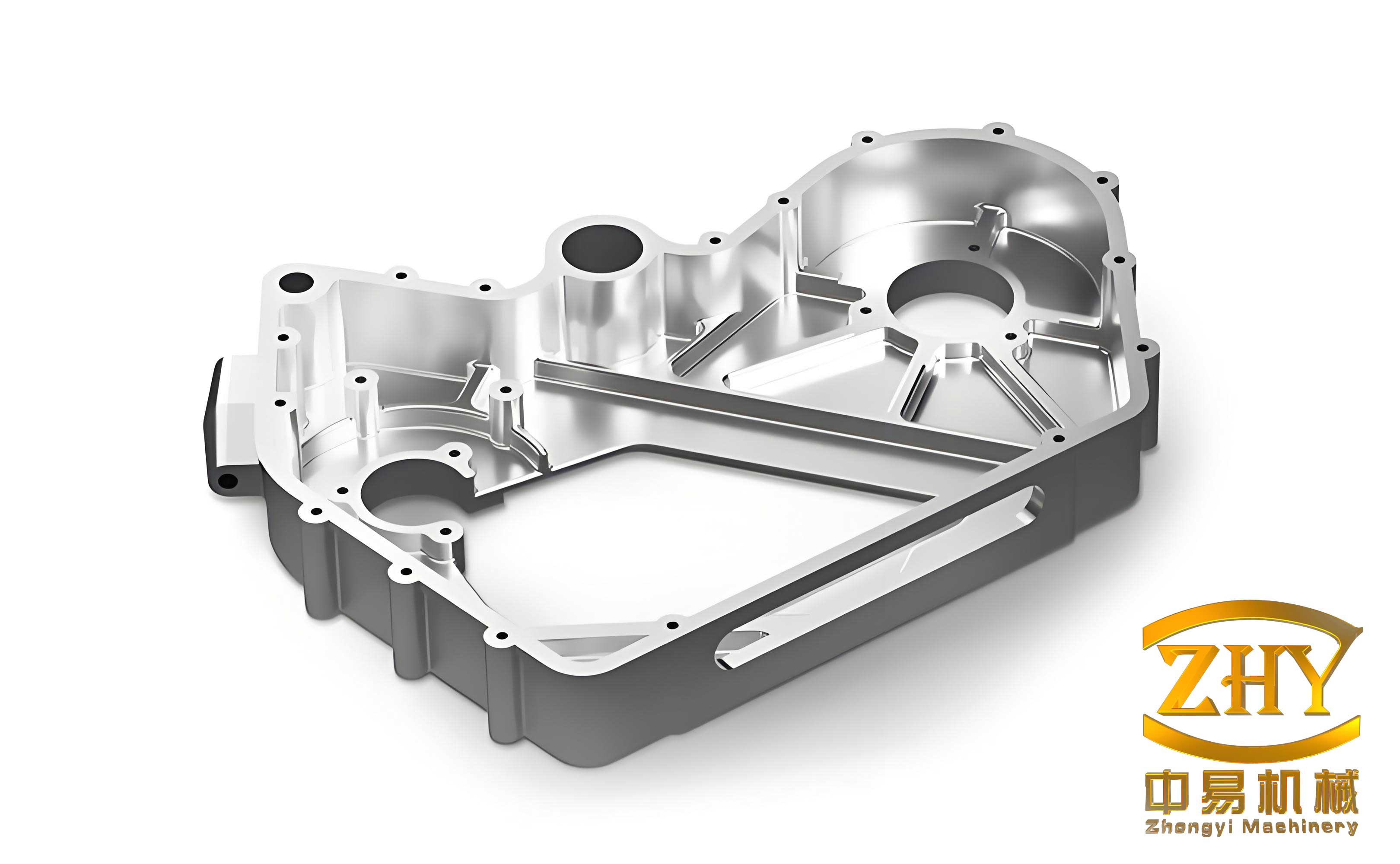
The background of this shell casting involves material specifications akin to QT550-6 nodular iron, with tensile strength of 550 MPa, yield strength of 380 MPa, elongation of 6%, and hardness of 187–255 HB. For shell castings, controlling microstructure is crucial; the base structure consists of pearlite and ferrite without strict ratios. Defect acceptance criteria are based on radiographic standards, where shrinkage or porosity within a 38.10 mm square must not exceed certain dimensions. Table 1 summarizes the defect acceptance levels for shell castings, which guided our quality assessments.
| Defect Type | Grade | Acceptability | Maximum Size in 38.10 mm Square |
|---|---|---|---|
| Shrinkage (Category CD) | 1-3 | Acceptable | ≤12.70 mm |
| Porosity (Category CC) | 1-3 | Acceptable | ≤25.40 mm |
| Shrinkage (Category CD) | 5 | Unacceptable | >12.70 mm |
| Porosity (Category CC) | 5 | Unacceptable | >25.40 mm |
The initial process design for this shell casting followed a standard workflow: concept, simulation, mold design, and validation. Using solidification simulation software, we predicted minimal shrinkage, but practical factors led to discrepancies. The shell casting was parted at the flange and large-diameter end, with the large end in the drag and the small end in the cope. To address thermal centers, we incorporated four risers and an exothermic riser at the small end, as illustrated in Figure 5 of the original content. Resin sand molding was chosen due to the complexity and low volume typical of such shell castings. Chemical composition was set within ranges: C ≈ 3.8%, Si ≈ 2.5%, Mn ≈ 0.5%, with S and P below 0.02%, and Cu additions for enhanced properties.
During trial production of 10 shell castings, radiographic and dissection tests showed acceptable defect levels, with shrinkage within Grade 3. However, scaling up to 200 pieces revealed catastrophic shrinkage porosity, primarily in bolt holes near thermal centers, with a defect rate over 95%. This highlighted the limitations of simulation for shell castings and underscored the need for empirical adjustments. The shrinkage occurred mostly at risers connected to the gating system, suggesting localized overheating and inadequate feeding.
To improve shell castings quality, we considered four key strategies common in nodular iron casting: increasing mold stiffness to resist graphite expansion, enhancing graphite volume through carbon content and inoculation, optimizing pouring temperature to reduce liquid shrinkage, and using risers with chills for effective feeding. Based on defect analysis, we modified the process by adding chills and adjusting riser placement. Specifically, we removed two risers and the exothermic riser, added two new risers at critical thermal centers, and incorporated a chill at the large-diameter base. This approach aimed to better control solidification in shell castings. The revised layout is shown in Figure 8 of the original content, though not referenced here per instructions.
The effectiveness of process improvements for shell castings can be quantified using solidification models. For instance, the solidification time \(t\) for a casting section can be estimated by Chvorinov’s rule:
$$t = k \left( \frac{V}{A} \right)^2$$
where \(t\) is the solidification time, \(V\) is the volume, \(A\) is the surface area, and \(k\) is a mold constant. For shell castings with complex shapes, this rule helps identify hot spots. Additionally, the feeding distance \(L\) for risers in nodular iron can be approximated by:
$$L = \frac{T_{\text{pour}} – T_{\text{solidus}}}{C \cdot \rho \cdot \Delta H}$$
where \(T_{\text{pour}}\) is the pouring temperature, \(T_{\text{solidus}}\) is the solidus temperature, \(C\) is the specific heat, \(\rho\) is the density, and \(\Delta H\) is the latent heat. These formulas guide riser placement in shell castings. Table 2 compares key parameters before and after improvement for this shell casting.
| Parameter | Initial Process | Improved Process |
|---|---|---|
| Number of Risers | 5 (including exothermic) | 4 (with chills) |
| Chill Usage | None | 1 at base |
| Pouring Temperature | ≈1380°C | ≈1380°C |
| Chemical Composition (C, Si, Mn) | 3.8%, 2.5%, 0.5% | 3.8%, 2.5%, 0.5% |
| Defect Rate (Shrinkage) | 95% | 3% |
| Process Yield | Low | High |
After implementing changes, we tested 12 shell castings: 3 were dissected and 9 had bolt holes machined. No shrinkage was found in dissected samples, and machined parts showed no defects. Subsequent batches of 50 and 200 shell castings confirmed consistency, with only 6 out of 200 exhibiting minor porosity within acceptable limits. This demonstrates the robustness of the improved process for shell castings. The reduction in scrap rate from 95% to 3% signifies a major cost saving and reliability boost for shell castings production.
Further analysis of shell castings involves microstructural control. The graphite nodule count \(N\) per unit area influences properties and is given by:
$$N = \frac{6 \cdot f_{\text{graphite}}}{\pi \cdot d_{\text{avg}}^3}$$
where \(f_{\text{graphite}}\) is the volume fraction of graphite and \(d_{\text{avg}}\) is the average nodule diameter. For shell castings, maintaining high nodularity (over 90%) and appropriate matrix (e.g., 80% pearlite) is essential. Our process achieved this through careful inoculation and cooling control. Table 3 lists material properties achieved in the improved shell castings.
| Property | Value | Standard |
|---|---|---|
| Tensile Strength | 550-600 MPa | ASTM A536 |
| Yield Strength | 380-400 MPa | ASTM A536 |
| Elongation | 6-8% | ASTM A536 |
| Hardness | 187-255 HB | Brinell |
| Nodularity | >90% | Micrographic |
| Pearlite Content | ≈80% | Micrographic |
In discussing shell castings, it’s important to consider economic aspects. The process yield \(Y\) can be expressed as:
$$Y = \frac{N_{\text{good}}}{N_{\text{total}}} \times 100\%$$
where \(N_{\text{good}}\) is the number of defect-free shell castings and \(N_{\text{total}}\) is the total produced. Initially, \(Y\) was about 5%, but after improvement, it rose to 97%. This highlights the impact of process optimization on shell castings profitability. Additionally, energy consumption per casting can be modeled, but for brevity, we focus on quality metrics.
The role of mold rigidity in shell castings cannot be overstated. Using resin sand with adequate stiffness helps counteract graphite expansion, reducing the need for extensive feeding. The pressure \(P\) generated during solidification due to expansion is:
$$P = \alpha \cdot \Delta V \cdot E$$
where \(\alpha\) is the expansion coefficient, \(\Delta V\) is the volume change, and \(E\) is the modulus of elasticity. For shell castings, a rigid mold contains this pressure, minimizing macroshrinkage. Our setup included locked molds to prevent lifting, which is common in shell castings production.
Looking forward, shell castings can benefit from advanced techniques like simulation-aided design and real-time monitoring. However, practical trials remain indispensable. For this differential case shell casting, further refinements could increase yield, such as optimizing riser sizes or using multiple chills. The general principles—combining risers and chills, controlling chemistry, and ensuring mold stiffness—are transferable to other shell castings, whether for automotive, aerospace, or industrial applications.
In conclusion, the journey from high scrap rates to reliable production for this shell casting underscores the importance of iterative process improvement. Shell castings, by nature, demand careful attention to thermal management and feeding systems. By integrating empirical data with theoretical models, we achieved a robust process that minimizes defects. This experience serves as a blueprint for enhancing shell castings across various industries, ensuring quality and efficiency in manufacturing complex components.