
In my extensive experience in the foundry industry, the casting of wear-resistant high manganese steel, particularly the Mn13 grade, represents a critical and complex process that demands meticulous attention to detail. This high manganese steel casting is renowned for its exceptional combination of toughness and wear resistance, making it indispensable in mining and heavy machinery applications. The essence of high manganese steel casting lies in its unique metallurgical properties, which are achieved through precise control of composition, casting techniques, and heat treatment. Throughout this article, I will delve into the comprehensive process, emphasizing key aspects such as chemical composition, patternmaking, pouring, heat treatment, and quality assurance, all while highlighting the term “high manganese steel casting” to underscore its significance.
The foundation of high manganese steel casting begins with understanding its metallurgical characteristics. High manganese steel, especially Mn13, is an austenitic steel that exhibits remarkable work-hardening behavior. Under impact or high-stress conditions, the surface undergoes rapid hardening, reaching hardness levels of 500 to 700 HBW, while the core retains high toughness. This property makes it ideal for components subjected to abrasive and impact wear, such as crusher liners, mill rings, and excavator teeth. The casting process for high manganese steel must be tailored to exploit these attributes, ensuring that the final product meets stringent performance standards.
Let me start by discussing the chemical composition, which is pivotal in high manganese steel casting. The standard Mn13 grade typically contains carbon (C) between 1.00% and 1.45%, manganese (Mn) from 11.00% to 14.00%, silicon (Si) up to 1.00%, with strict limits on sulfur (S) and phosphorus (P). These elements play specific roles: carbon aids in forming a single-phase austenite matrix and provides solid solution strengthening, while manganese stabilizes the austenitic structure. The manganese-to-carbon ratio (Mn/C) is crucial; a ratio around 10 yields optimal strength and toughness, whereas lower ratios can enhance wear resistance. Phosphorus is a detrimental element, as it promotes the formation of brittle phosphide networks, increasing cracking susceptibility. Therefore, in high manganese steel casting, careful selection of raw materials, such as low-phosphorus ferromanganese and scrap steel, is essential. To summarize, Table 1 outlines the typical chemical composition ranges for Mn13 high manganese steel casting.
| Element | Weight Percentage (%) | Role in High Manganese Steel Casting |
|---|---|---|
| Carbon (C) | 1.00–1.45 | Promotes austenite formation and solid solution strengthening |
| Manganese (Mn) | 11.00–14.00 | Stabilizes austenite, improves toughness and strength |
| Silicon (Si) | 0.30–1.00 | Acts as a deoxidizer, reduces oxidation during melting |
| Sulfur (S) | ≤0.04 | Impurity that can cause hot tearing; must be minimized |
| Phosphorus (P) | ≤0.09 | Harmful element leading to brittleness; controlled strictly |
The metallurgical principles behind high manganese steel casting can be expressed through thermodynamic and kinetic equations. For instance, the solubility of carbon in austenite as a function of temperature can be described by the following relationship, which is vital for understanding the water toughening process:
$$ C_s = C_0 \exp\left(-\frac{Q}{RT}\right) $$
where \( C_s \) is the solubility limit, \( C_0 \) is a constant, \( Q \) is the activation energy, \( R \) is the gas constant, and \( T \) is the temperature in Kelvin. During the casting of high manganese steel, the goal is to achieve a homogeneous austenitic structure with minimal carbides. The formation of carbides, such as (Fe,Mn)₃C, can be predicted using phase diagram calculations, emphasizing the need for precise heat treatment. Additionally, the work-hardening behavior, a hallmark of high manganese steel casting, can be modeled using the following empirical formula for surface hardness increase:
$$ H = H_0 + k \cdot \epsilon^n $$
where \( H \) is the hardened surface hardness, \( H_0 \) is the initial hardness, \( k \) is a material constant, \( \epsilon \) is the strain, and \( n \) is the work-hardening exponent. This equation underscores why high manganese steel casting is so effective in wear applications, as the surface hardens dynamically under impact.
Moving to the casting process itself, the use of lost foam (or evaporative pattern) casting is prevalent in high manganese steel casting due to its ability to produce complex shapes with minimal machining. In our practice, we prioritize dimensional accuracy, as high manganese steel components are difficult to weld or machine after casting due to work hardening. The patternmaking stage involves accounting for a solidification shrinkage of approximately 6%, which is higher than that of carbon steels. We design the gating and risering systems to ensure adequate feeding and prevent shrinkage defects. For example, the riser size can be calculated based on Chvorinov’s rule:
$$ t_s = B \left( \frac{V}{A} \right)^2 $$
where \( t_s \) is the solidification time, \( B \) is a mold constant, \( V \) is the volume, and \( A \) is the surface area. This principle guides us in optimizing the riser design for high manganese steel casting, ensuring sound castings free from porosity and cracks.
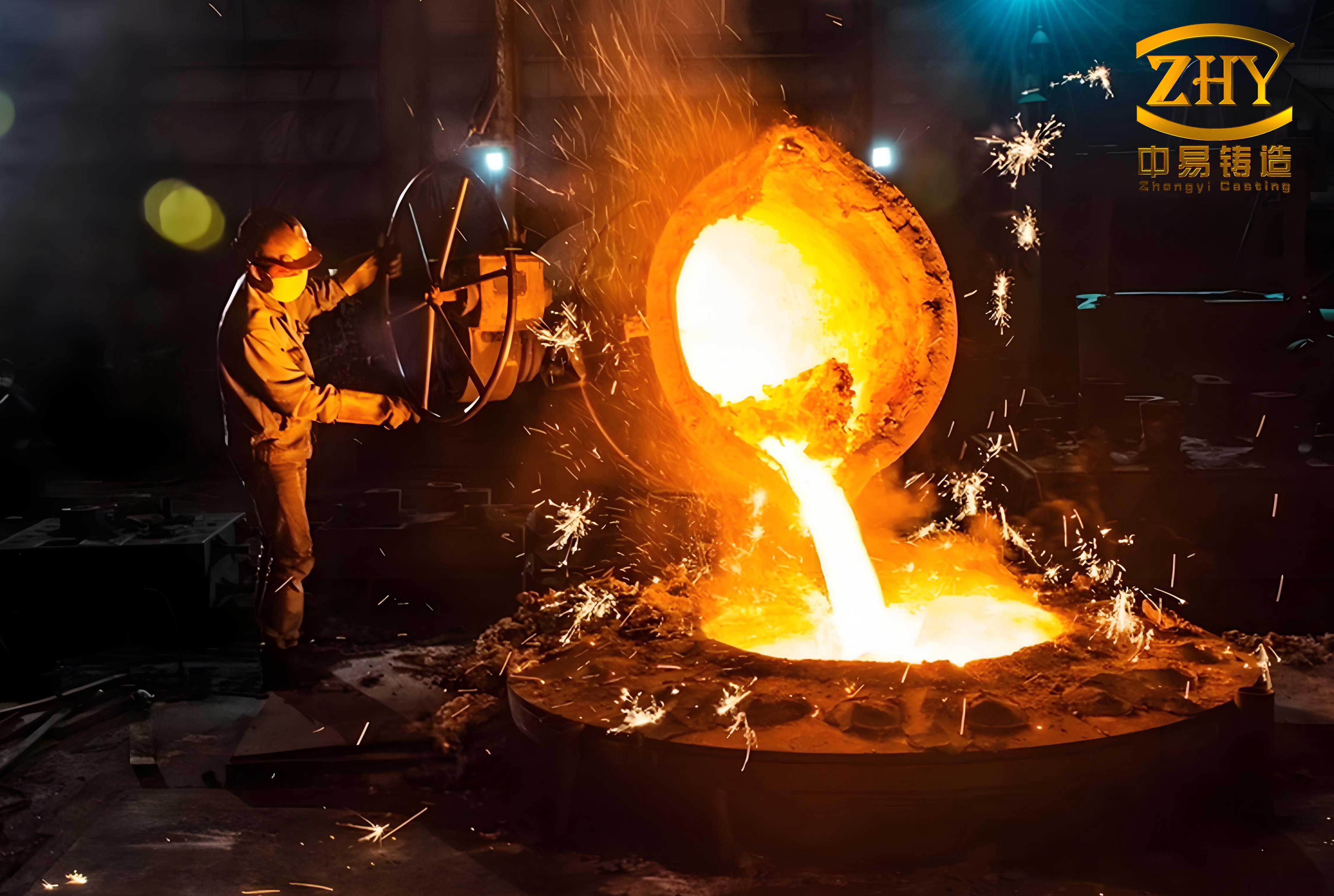
The melting and pouring stages are critical in high manganese steel casting. We typically melt the steel in electric arc furnaces, aiming for a tapping temperature of around 1540°C to ensure proper fluidity and degassing. During melting, vigorous boiling is encouraged to remove impurities and gases. The pouring temperature is carefully controlled between 1450°C and 1480°C, followed by a holding period of 5 to 10 minutes to allow inclusions to float out. However, prolonged holding can lead to excessive manganese oxidation, adversely affecting the chemistry. The reaction between manganese oxide (MnO) and silica (SiO₂) from mold materials can cause veining or penetration defects, so we use neutral or basic coatings, such as those based on magnesia, to protect the mold. Table 2 summarizes key parameters in the pouring process for high manganese steel casting.
| Parameter | Value or Range | Importance in High Manganese Steel Casting |
|---|---|---|
| Tapping Temperature | ~1540°C | Ensures complete melting and gas removal |
| Pouring Temperature | 1450–1480°C | Balances fluidity and minimal oxidation |
| Holding Time | 5–10 minutes | Allows inclusion flotation and镇静 (sedimentation) |
| Mold Coating | Magnesia-based | Prevents metal-mold reactions and粘沙 (sand sticking) |
| Vacuum Dewaxing Time | Adapted to wall thickness | Controls pattern removal without defects |
After casting, the high manganese steel must undergo water toughening (quenching) to achieve the desired austenitic microstructure. This heat treatment involves heating the castings to above 1040°C, typically 1050–1100°C, to dissolve carbides into the austenite matrix, followed by rapid quenching in water. The water temperature and quality are critical; we use water at ambient temperature with low impurity content to avoid uneven cooling or stress cracking. The transformation during water toughening can be described using the Avrami equation for phase transformation kinetics:
$$ X = 1 – \exp(-kt^n) $$
where \( X \) is the fraction of carbides dissolved, \( k \) is a rate constant, \( t \) is time, and \( n \) is an exponent. This process is essential in high manganese steel casting to eliminate brittle carbides and ensure a uniform austenitic structure. If cooling is too slow, carbides may reprecipitate along grain boundaries, compromising toughness. Therefore, we monitor the quenching process closely, especially for thick sections where cooling rates might be inadequate.
Quality control is integral to high manganese steel casting. We perform rigorous chemical analysis using techniques like carbon-sulfur analyzers and spectrophotometry. For carbon and sulfur, we employ combustion methods where the sample is burned, and the gases are measured. The principle involves reactions such as:
$$ \text{C} + \text{O}_2 \rightarrow \text{CO}_2 $$
$$ \text{S} + \text{O}_2 \rightarrow \text{SO}_2 $$
These gases are then analyzed to determine content. For silicon, manganese, and phosphorus, spectrophotometry is used, based on Beer-Lambert law:
$$ A = \epsilon \cdot c \cdot l $$
where \( A \) is absorbance, \( \epsilon \) is molar absorptivity, \( c \) is concentration, and \( l \) is path length. We calibrate instruments with certified reference materials to ensure accuracy. Mechanical testing, including hardness and impact tests, is also conducted. Table 3 lists the typical mechanical properties of Mn13 high manganese steel casting after water toughening.
| Property | Value | Test Standard |
|---|---|---|
| Tensile Strength | ≥700 MPa | ASTM A128 |
| Yield Strength | ≥350 MPa | ASTM A128 |
| Elongation | ≥35% | ASTM A128 |
| Impact Toughness | ≥100 J | Charpy test at 20°C |
| Surface Hardness (Work-Hardened) | 500–700 HBW | Brind hardness test |
In high manganese steel casting, defect prevention is a constant focus. Common issues include hot tears, porosity, and sand inclusions. Hot tearing, often due to high phosphorus content or improper cooling, can be mitigated by optimizing the manganese-to-carbon ratio and using low-phosphorus materials. Porosity, resulting from gas entrapment, is addressed through effective degassing during melting and proper gating design. We also employ statistical process control (SPC) to monitor variables, using control charts to track chemical composition and mechanical properties over time. For instance, the control limits for carbon content in high manganese steel casting might be set at ±0.05% from the target, ensuring consistency.
The applications of high manganese steel casting are vast, spanning mining, construction, and industrial machinery. Components like crusher jaws, cone liners, and rail crossings benefit from the material’s wear resistance. In each case, the casting process is adapted to the component’s geometry and service conditions. For example, for large castings like mill liners, we use multiple gates to ensure even filling and reduce turbulence. The economic impact of high manganese steel casting is significant, as it extends equipment life and reduces downtime, making it a preferred choice in harsh environments.
To further elaborate on the metallurgy, the austenite stability in high manganese steel casting can be assessed using the stacking fault energy (SFE), which influences work-hardening. The SFE, \( \gamma_{\text{sf}} \), can be estimated from composition using empirical equations:
$$ \gamma_{\text{sf}} = \gamma_0 + \sum k_i \cdot X_i $$
where \( \gamma_0 \) is a base value, \( k_i \) are coefficients, and \( X_i \) are element concentrations. This relates directly to the deformation mechanisms in high manganese steel casting, explaining why it hardens so effectively. Additionally, the kinetics of carbide dissolution during water toughening can be modeled with diffusion equations, such as Fick’s second law:
$$ \frac{\partial C}{\partial t} = D \frac{\partial^2 C}{\partial x^2} $$
where \( C \) is concentration, \( t \) is time, \( D \) is the diffusion coefficient, and \( x \) is position. This underscores the importance of temperature and time in heat treatment for high manganese steel casting.
In conclusion, the casting of high manganese steel, particularly Mn13, is a sophisticated process that integrates metallurgical science with practical foundry techniques. From raw material selection to final inspection, every step must be meticulously controlled to achieve the desired properties. The use of lost foam casting, precise heat treatment, and rigorous quality assurance ensures that high manganese steel casting meets the demands of abrasive and impact applications. As technology advances, innovations in simulation and automation are further enhancing the reliability and efficiency of high manganese steel casting. Through continuous improvement and adherence to standards, we can produce high-performance components that drive industrial progress. This deep dive into high manganese steel casting highlights its complexity and value, reinforcing why it remains a cornerstone in wear-resistant materials engineering.
Reflecting on my hands-on experience, I emphasize that success in high manganese steel casting hinges on a holistic approach. Training personnel, maintaining equipment, and fostering a culture of quality are as important as technical parameters. By sharing these insights, I hope to contribute to the broader knowledge base in foundry practices, ensuring that high manganese steel casting continues to evolve and thrive in modern manufacturing.