
In the field of heavy machinery, the reliability of core components dictates the performance and longevity of the entire equipment. Among these, the shell casting for a vibrator assembly in a road compactor stands out as a critical part. My experience in developing casting processes has consistently highlighted the demanding nature of such components. This shell functions as the housing for an eccentric counterweight; as this weight rotates, it generates substantial centrifugal force which is transformed into directed vibrational energy for soil and asphalt compaction. This operating principle subjects the shell to intense, cyclical stresses within harsh environments involving dust, vibration, and impact. Consequently, the cast shell must exhibit exceptional metallurgical integrity, dimensional accuracy, and freedom from internal defects to ensure safe and durable operation. Non-destructive testing methods like Penetrant Testing (PT), Ultrasonic Testing (UT), and Radiographic Testing (RT) are standard requirements, underscoring the high-quality threshold.
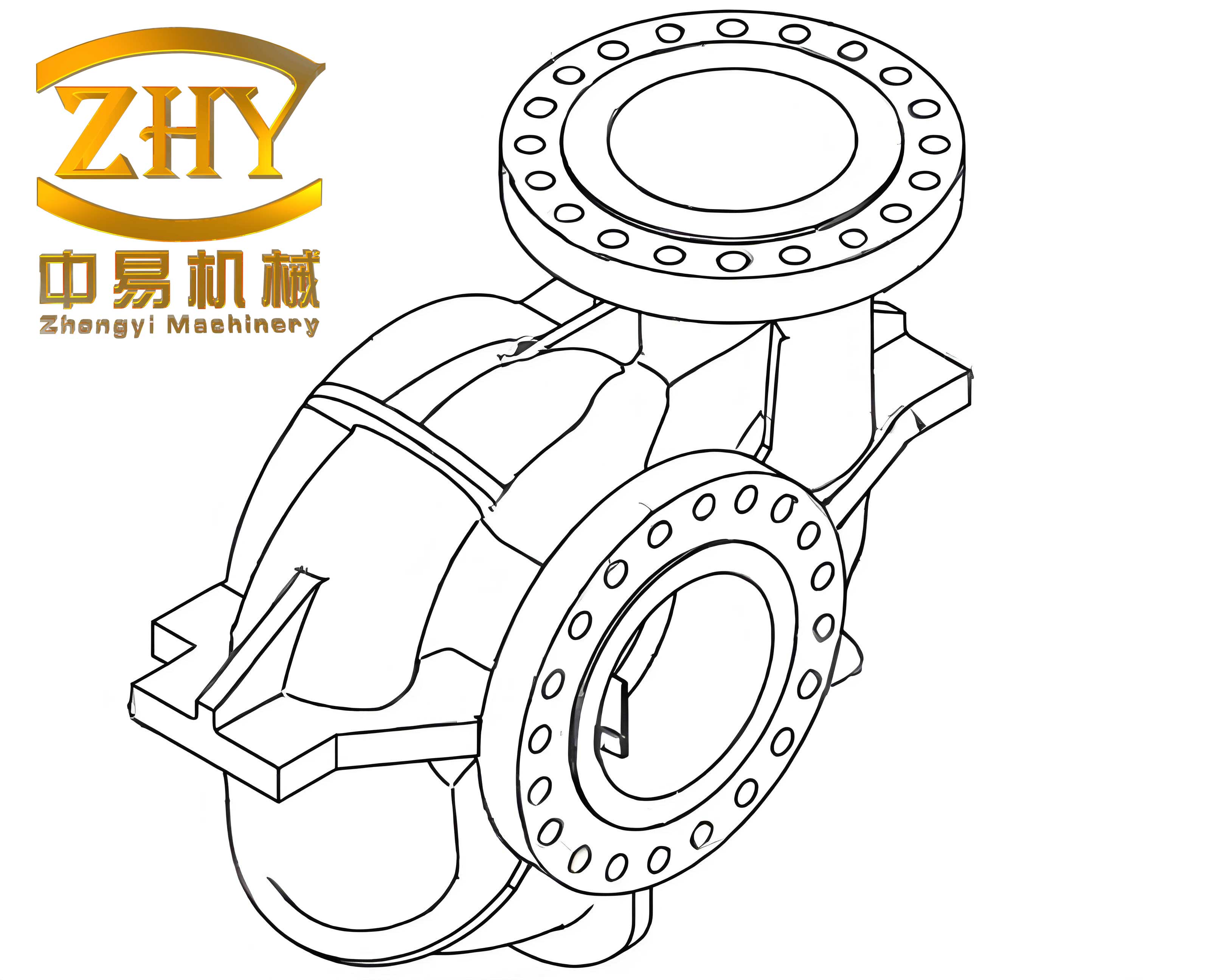
The geometry of these shell castings is complex. It resembles a basin or a shallow pot with a prominent external flange at its top opening. The internal cavity features a central hub (or wheel hub) at its base, reinforced with ribs for structural stiffness. The wall thickness varies significantly, transitioning from relatively thin sections to much thicker areas at the hub and flange. This variation presents a classic foundry challenge: achieving soundness in both thin and thick sections simultaneously within the same casting. The material specified is a ductile iron (nodular graphite iron), grade QT450-12, which provides the necessary combination of strength, ductility, and toughness. The chemical composition and mechanical property requirements for these shell castings are stringent, as summarized below.
| Element | Specification (wt.%) |
|---|---|
| C | 3.5 – 3.9 |
| Si | 2.4 – 2.8 |
| Mn | ≤ 0.4 |
| P | ≤ 0.05 |
| S | ≤ 0.02 |
| Cr | ≤ 0.08 |
| Mg | 0.025 – 0.055 |
| Ti | ≤ 0.025 |
| Property | Minimum Requirement |
|---|---|
| Tensile Strength | 415 MPa |
| Yield Strength | 275 MPa |
| Elongation | 7 % |
| Hardness (HBW) | 156 – 217 |
Furthermore, the microstructure is controlled: graphite should be predominantly nodular (spheroidal) with a nodularity rating ≥90% and a graphite size grade of 5-8. The matrix should contain ≤10% pearlite and ≤1% carbides. Achieving this consistently in complex shell castings is the core of the process challenge.
Initial Process and Inherent Deficiencies
The original manufacturing process for these shell castings employed a conventional top-pouring gating system using furan no-bake resin sand molds. The casting was oriented with its flange face upwards. The gating system consisted of a central downsprue feeding a runner bar, from which multiple flat gates entered the casting cavity directly at the flange level. The gating ratio was approximately:
$$\Sigma S_{sprue} : \Sigma S_{runner} : \Sigma S_{gate} = 1 : 1.75 : 1.3$$
Multiple exothermic risers were placed on the top flange and within the internal hub area, supplemented by chill plates in strategic locations. While this method offered simplicity, a detailed analysis revealed systemic issues that compromised the quality and cost-effectiveness of producing these shell castings.
The primary defects observed were shrinkage porosity/cavities in the thicker hub section and non-metallic inclusions (slag) dispersed within the casting body. The root causes were intrinsically linked to the process design:
- Top-Pouring Turbulence: The high drop height of the molten metal during top-pouring caused severe turbulence and splashing within the mold cavity. This turbulent flow entrapped air and promoted the oxidation of the iron, generating copious amounts of oxide slag (dross). These inclusions were carried into the casting body and could not effectively float out to the risers located at the top.
- Inefficient Feeding: Although the risers on the top flange were positioned correctly for that region, the feeding path to the lower, thicker hub section was long and indirect. The solidification sequence did not establish a proper temperature gradient to direct shrinkage from the hub towards the risers. Consequently, the hub, being a thermal center, developed isolated liquid pools that eventually formed shrinkage porosity.
- Poor Economic Metrics: The process was wasteful. The use of standard rectangular sand boxes for a roughly circular shell casting resulted in excessive mold material usage, quantified by a high sand-to-metal ratio of 7:1. The casting yield (weight of good casting vs. total poured weight) was a mere 62%. These factors, combined with a scrap rate of around 8%, rendered the production of these shell castings costly and inefficient.
A Comprehensive Process Optimization Strategy
To overcome these challenges, a holistic redesign of the foundry process was undertaken, focusing on controlled filling, enhanced feeding, and overall efficiency. The new methodology can be termed an “Integrated Mid-Pour Filtering and Feeding System.”
1. Gating System Re-engineering: From Top to Middle-Pour
The most critical change was abandoning the top-pour approach. The new system was designed as a pressurized, bottom-to-middle gating scheme. The downsprue is connected to a runner system that channels metal upwards into the mold cavity through two ingates located at a mid-height position on the shell casting’s side wall. This significantly reduces the falling distance and velocity of the molten iron as it enters the cavity. The flow is inherently more quiescent, minimizing turbulence, air entrainment, and oxide formation. The gating ratio was optimized via simulation to:
$$\Sigma S_{sprue} : \Sigma S_{runner} : \Sigma S_{gate} = 1 : 1.1 : 0.9$$
This ratio promotes a faster fill of the gates and runners relative to the sprue, helping to keep them full and prevent slag aspiration, while the slight pressurization aids in mold filling.
2. Enhanced Filtration and Inclusion Control
To achieve the highest metal cleanliness, ceramic foam filters were integrated directly into the horizontal runner bars. As the metal flows from the sprue into the runner, it is forced through the porous filter matrix. This action effectively traps macroscopic slag, deoxidation products, and other non-metallic inclusions. The filtration efficiency $\eta_f$ for particles above a certain size threshold can be conceptually related to the filter pore size $d_p$ and metal flow characteristics:
$$\eta_f \propto \frac{1}{d_p} \cdot f(Re)$$
where $Re$ is the Reynolds number of the flow. By placing filters after the sprue and before the metal enters the casting cavity, we ensure that only clean metal feeds the intricate sections of the shell castings.
3. Optimized Feeding with Insulated Risers
The feeding strategy was completely revised based on solidification simulation results. The number and size of risers were reduced. Instead of multiple exothermic risers, the design now utilizes a combination of smaller exothermic sleeves on the top flange and specially designed, larger insulated risers integrated into the gating system itself. These insulated risers, connected directly to the casting at hot spots identified by simulation, lose heat much more slowly than the casting. This maintains a liquid feed path for a longer duration, effectively compensating for the volumetric shrinkage during solidification. The required riser volume $V_{riser}$ can be estimated based on the feeding demand of the casting section it serves:
$$V_{riser} \geq \frac{V_{casting\_section} \cdot \beta}{\eta_{riser}}$$
where $\beta$ is the solidification shrinkage factor of ductile iron (approximately 4-6%), and $\eta_{riser}$ is the riser efficiency (higher for insulated risers). This optimized system eliminated shrinkage defects in the critical hub area.
4. Integrated Mold Assembly and Sand Savings
A significant innovation was the creation of a pre-assembled mold core package. The upper and lower portions of the shell casting mold (the “cope” and “drag” equivalents for the shell’s shape) are produced as precise shell molds using coated sand. This package includes pre-formed cavities for the insulated risers, filter chambers, and the sprue. This entire assembly is then placed into the main molding flask and backed up with regular resin sand. This method offers exceptional dimensional accuracy and repeatability.
Furthermore, the molding box itself was redesigned. Instead of a standard rectangular box, a custom, tapered cylindrical box that closely follows the contour of the shell castings was fabricated and fixed inside the standard production flask. This dramatically reduces the amount of resin sand required per mold, directly lowering the sand-to-metal ratio. The new ratio was calculated as:
$$Sand-to-Metal\ Ratio_{new} = \frac{Weight\ of\ Sand\ in\ Tapered\ Box}{Weight\ of\ Finished\ Casting} \approx 2.5:1$$
This represents a massive reduction from the initial 7:1 ratio.
5. Metallurgical Refinements: Inoculation and Spheroidization
The molten metal treatment was also fine-tuned to support the improved casting process. While maintaining the target chemistry, the spheroidizing agent was switched to a lanthanum (La)-containing ferrosilicon magnesium alloy. Lanthanum is known to modify the eutectic solidification behavior of ductile iron, reducing the chilling tendency (formation of carbides) and minimizing the propensity for shrinkage porosity. A multi-stage inoculation practice was employed:
- Pre-inoculation: Adding a small amount of inoculant to the ladle before receiving the treated iron.
- Post-inoculation: Adding a primary inoculant (high-Barium type) during the transfer of metal to the pouring ladle.
- Late Inoculation: Applying a stream inoculant (low-Barium type) during the actual pouring of each shell casting.
This vigorous inoculation ensures a high count of graphite nucleation sites, promoting a fine, uniform nodular graphite structure and preventing undercooled graphite forms. The effectiveness of inoculation in increasing nodule count $N$ can be described by:
$$N = k_I \cdot \Delta T_{under} \cdot [Inoculant]^m$$
where $k_I$ is a constant, $\Delta T_{under}$ is the undercooling, and $m$ is an exponent. Higher $N$ leads to better mechanical properties and reduced shrinkage.
| Process Parameter | Original Process | Optimized Process |
|---|---|---|
| Gating Type | Top-Pour, Dispersed | Bottom/Middle-Pour, Focused |
| Gating Ratio (ΣSs:ΣSr:ΣSg) | 1 : 1.75 : 1.3 | 1 : 1.1 : 0.9 |
| Number of In-gates | 10 (flat) | 2 (round) |
| Filtration | 2 Filters in Runner | Integrated Filter Chambers in Runner |
| Riser System | Multiple Exothermic Riser | Combined Insulated + Exothermic Riser |
| Mold Type | Full Resin Sand in Rectangular Box | Shell Mold Assembly in Tapered Cylindrical Box |
| Sand-to-Metal Ratio | 7 : 1 | 2.5 : 1 |
| Casting Yield | 62% | 80% |
| Pouring Temperature | 1380-1420 °C | 1380-1420 °C |
| Typical Scrap Rate | ~8% | <2% |
Results and Validation of the Optimized Process
The implementation of this integrated optimized process yielded transformative results for the production of pavement compactor shell castings. The most immediate improvement was the virtual elimination of the previously dominant defect modes. Radiographic (X-ray) inspection of production castings consistently showed soundness, achieving Grade 1 quality levels with no detectable shrinkage porosity or macro-inclusions. Destructive sectioning of sample shell castings confirmed the absence of internal shrinkage in the critical hub region.
The metallurgical quality was consistently superior. Tensile tests performed on specimens machined from the castings themselves (body coupons) exceeded the specification requirements. For instance, typical results included a tensile strength of 455 MPa, yield strength of 308 MPa, and elongation of 18.5%, with hardness values well within the specified band. Microstructural evaluation revealed a fully ferritic matrix with a high nodule count, nodularity consistently above 90%, and no undesirable carbides. This demonstrated that the combination of the controlled filling, enhanced feeding, and refined metallurgical practice perfectly preserved the desired ductile iron microstructure in these complex shell castings.
The economic impact was equally significant. The casting yield increased from 62% to 80%, meaning less molten metal was required to produce each good shell casting. The sand-to-metal ratio plummeted from 7:1 to 2.5:1, drastically reducing resin and sand consumption, waste disposal costs, and energy for sand reclamation. The overall scrap/rework rate fell from 8% to below 2%. These factors collectively led to a substantial reduction in the total production cost per shell casting, while simultaneously improving quality and reliability. This optimized process has proven robust and scalable, enabling the high-volume manufacture of over 30,000 shell castings annually with exceptional quality consistency.
Conclusion
The journey from a problematic conventional process to a robust, high-yield manufacturing solution for pavement compactor shell castings underscores the power of systematic foundry engineering. The key to success lay not in a single change, but in the synergistic integration of several optimized subsystems:
- Replacing turbulent top-pouring with a calm, filtered middle-pour gating system to ensure metal cleanness.
- Employing solidification simulation to design an efficient, minimal-riser feeding system utilizing insulating technology to eliminate shrinkage.
- Adopting an integrated shell mold assembly within a contoured box to achieve dimensional precision and dramatic material savings.
- Fine-tuning the metallurgy with advanced inoculants and spheroidizers to guarantee the specified microstructure and properties.
This holistic approach successfully resolved the conflicting demands of quality, complexity, and cost for these critical ductile iron shell castings. The principles demonstrated—controlled filling, scientific feeding, and integrated mold design—are universally applicable and provide a valuable framework for optimizing the production of other complex, high-integrity castings across various industries.