
In the field of diesel engine manufacturing, the oil pan, also known as the lower crankcase, plays a critical role in enclosing the crankcase and serving as a reservoir for lubricating oil. It collects and stores oil returning from friction surfaces and dissipates heat. For heavy-duty diesel engines, where strength is paramount, nodular cast iron, specifically grade QT450-10, is often preferred due to its excellent mechanical properties, including high tensile strength and ductility. This material, characterized by its graphite spheroids embedded in a ferritic or pearlitic matrix, offers a superior combination of strength and toughness compared to gray cast iron. The production of such components via traditional sand casting can be challenging due to complex geometries, such as undercuts and internal cavities, which may require costly cores and result in increased finishing work. In contrast, lost foam casting, an exact molding process, presents a viable alternative by enabling one-piece integral molding, high dimensional accuracy, and reduced cleaning efforts. In this article, I will detail the application of lost foam casting for producing a nodular cast iron oil pan, addressing common defects and optimization strategies, while emphasizing the benefits of this process for nodular cast iron components.
The lost foam casting process involves several key stages: pattern making, coating, molding, melting, pouring, and cleaning. For the nodular cast iron oil pan, the process begins with the creation of a foam pattern. Expandable polystyrene (EPS) or copolymer beads, such as STMMA, are pre-expanded to a density of 20–22 g/L and aged for 24 hours to stabilize. The pattern is then molded using a semi-automatic molding machine to form a precise replica of the oil pan, with dimensions of 761 mm × 440 mm × 236 mm and a weight of 87 kg. After molding, the pattern is dried naturally for 4 hours and then in a drying oven at 50±5°C with humidity below 30% for 72 hours until mass stabilization. To prevent distortion during casting, anti-deformation ribs are added to the open face of the pattern. The gating system is designed as a bottom and intermediate stepped system with three levels, featuring a sprue of φ50 mm and five ingates of 40 mm × 8 mm each, along with two slag traps. This design ensures smooth metal flow and reduces turbulence, which is crucial for minimizing defects in nodular cast iron.
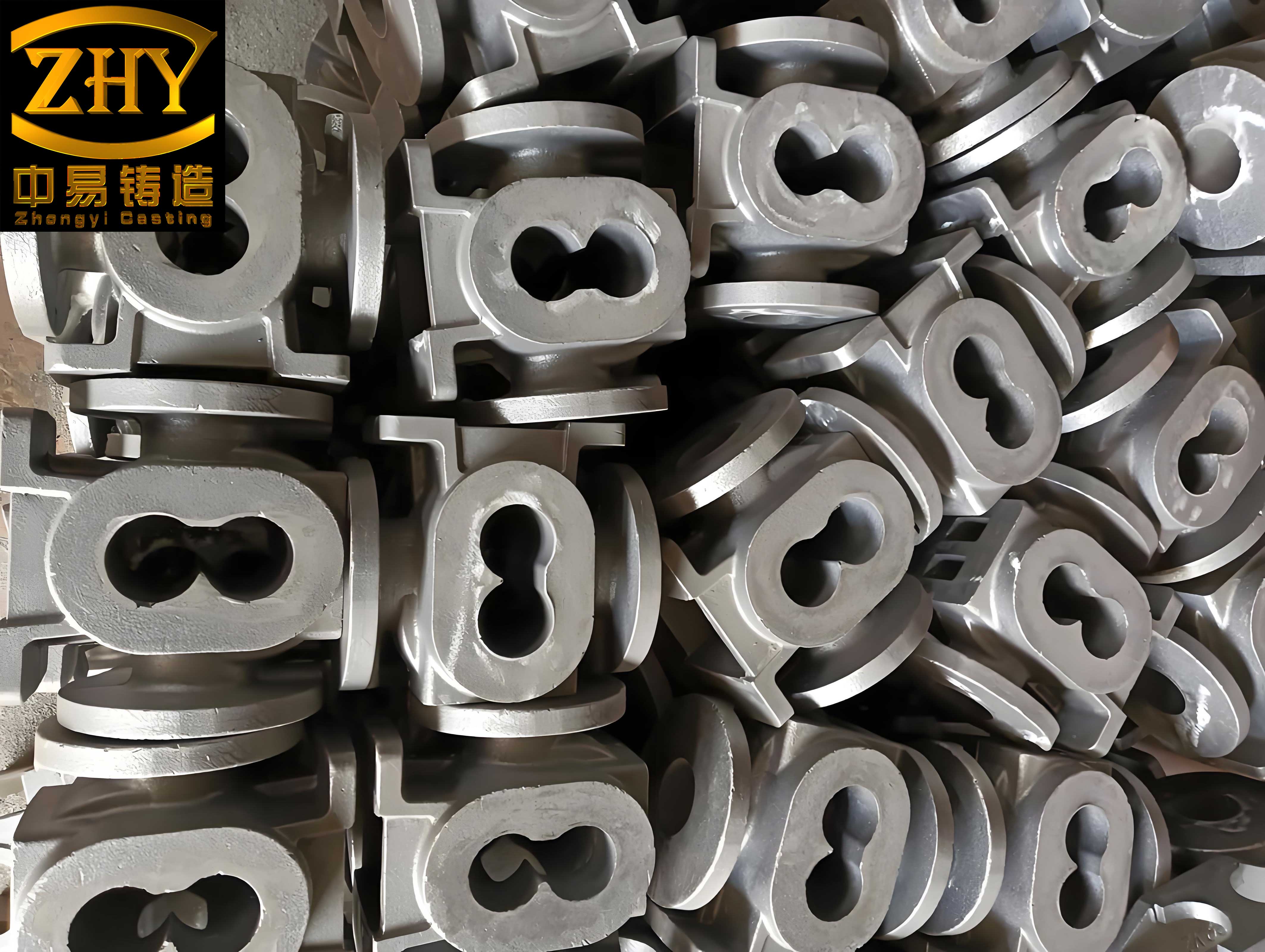
The coated pattern is then subjected to molding. Quartz sand of 20/40 mesh is used as the molding medium. The process involves bottom sand compaction, pattern placement, sand raining, and three-dimensional vibration to ensure uniform packing. Two patterns are arranged in a single flask measuring 1200 mm × 1000 mm × 1300 mm. Pouring is conducted following the “accurate-quick-slow” principle: once the sprue is filled, a steady flow is maintained without interruption. The pouring temperature is set between 1450°C and 1480°C, with a vacuum pressure of -0.04 to -0.06 MPa during pouring, held for over 10 minutes after completion to ensure complete degradation of the foam and solidification of the nodular cast iron.
Melting and treatment of nodular cast iron are critical to achieving the desired microstructure and properties. The charge composition consists of 20% pig iron (Q10), 20% returns, and 60% steel scrap, with carburizer added to adjust carbon content. The chemical composition target for QT450-10 nodular cast iron is summarized in Table 1. The melting sequence involves charging pig iron first, followed by steel scrap, carburizer, and returns, all processed in a medium-frequency induction furnace.
| Element | Target Range (wt%) |
|---|---|
| C | 3.7–3.9 |
| Si (final) | 2.75–2.95 |
| Mn | ≤0.35 |
| S | ≤0.03 |
| P | ≤0.07 |
| Mg (residual) | 0.04–0.06 |
Nodularization and inoculation are achieved via cored-wire injection, a method that enhances efficiency and consistency. The cored wire contains 29–31% Mg and is added at 0.9% of the iron weight, while 75% FeSi inoculant is added at 1.1%. The treatment temperature is maintained at 1580±5°C. The reaction kinetics can be described by the following formula for magnesium recovery: $$ \eta_{Mg} = \frac{Mg_{residual}}{Mg_{added}} \times 100\% $$ where η_Mg represents the efficiency of magnesium absorption, typically ranging from 40% to 60% in practice. This treatment ensures the formation of spheroidal graphite in the nodular cast iron, crucial for its mechanical properties.
After pouring, the castings are cooled, shaken out, and cleaned. The runners and gates are removed manually, followed by shot blasting to improve surface finish. The final nodular cast iron oil pan is inspected for dimensional accuracy and integrity before delivery.
During initial trials, several defects were encountered, including carbon defects, low surface hardness, and leakage due to shrinkage porosity. Carbon defects are unique to lost foam casting and result from incomplete gasification of the foam pattern, leading to carbon residues in the casting. To mitigate this, the pouring temperature was increased to 1470±10°C, and vacuum pressure was optimized to -0.05 MPa on average. Additionally, the gating system was redesigned to a stepped configuration, reducing pouring time to 46 seconds and adding overflow vents at the highest points to evacuate gases. The relationship between foam degradation and temperature can be expressed using the Arrhenius equation: $$ k = A e^{-E_a/(RT)} $$ where k is the degradation rate constant, A is the pre-exponential factor, E_a is the activation energy, R is the gas constant, and T is the temperature in Kelvin. Higher temperatures accelerate foam decomposition, minimizing carbon defects in nodular cast iron.
Low surface hardness, measured at 156 HB initially, was attributed to slow cooling in the dry sand mold, especially in thick sections up to 40 mm. To address this, the pattern orientation was adjusted to place thicker sections downward, enhancing heat dissipation. Moreover, 0.02% tin alloy was added to the ladle to promote pearlite formation, increasing hardness to over 170 HB. The effect of alloying on hardness can be modeled using the following empirical formula for nodular cast iron: $$ HB = a + b \cdot C_{eq} + c \cdot Sn $$ where a, b, and c are constants, C_eq is the carbon equivalent, and Sn is the tin content. Carbon equivalent is calculated as: $$ C_{eq} = C + \frac{Si + P}{3} $$ For nodular cast iron, a typical range for C_eq is 4.3–4.8, and adjustments were made to maintain it at 4.75–4.85% to balance strength and ductility.
Leakage issues stemmed from shrinkage porosity at hot spots, particularly at junctions with 40 mm thickness. This was resolved by optimizing the carbon equivalent and applying external chills attached to the pattern with hot glue. The solidification time for a section can be estimated using Chvorinov’s rule: $$ t = B \left( \frac{V}{A} \right)^n $$ where t is solidification time, V is volume, A is surface area, B is a mold constant, and n is an exponent typically around 2. By adding chills, the effective surface area increases, reducing solidification time and promoting directional solidification in nodular cast iron.
To further elaborate on the metallurgy of nodular cast iron, the nodularization process involves the addition of magnesium to transform graphite from flake to spheroidal form. The reaction can be summarized as: $$ Mg + S \rightarrow MgS $$ $$ Mg + O \rightarrow MgO $$ These reactions reduce sulfur and oxygen levels, facilitating graphite spheroidization. The inoculant, usually ferrosilicon, provides nucleation sites for graphite, enhancing nodule count and uniformity. The microstructure of nodular cast iron typically consists of ferrite, pearlite, or a mixture, depending on cooling rates and alloying. For QT450-10, the matrix should contain less than 25% pearlite, with a nodularity above 70% and carbides below 0.5%. These parameters ensure the desired mechanical properties: tensile strength ≥450 MPa, elongation ≥10%, and hardness 160–210 HB.
The lost foam process offers distinct advantages for producing nodular cast iron components. Compared to sand casting, it eliminates the need for cores, reduces machining allowances, and improves surface finish to Ra 25–50 μm. Additionally, it allows for complex geometries without parting lines, minimizing flash and burrs. However, process control is crucial to avoid defects. Key parameters are summarized in Table 2.
| Parameter | Optimal Range | Influence on Quality |
|---|---|---|
| Pouring Temperature | 1450–1480°C | Reduces carbon defects, ensures fluidity |
| Vacuum Pressure | -0.04 to -0.06 MPa | Removes degradation gases, minimizes porosity |
| Pattern Density | 20–22 g/L | Affects gas evolution and surface finish |
| Coating Thickness | 1.2–1.5 mm (dry) | Provides barrier, controls cooling rate |
| Carbon Equivalent | 4.75–4.85% | Balances strength and ductility in nodular cast iron |
| Mg Residual | 0.04–0.06% | Ensures effective nodularization |
| Cooling Time | 10+ minutes under vacuum | Prevents distortion and shrinkage |
In terms of process optimization, mathematical modeling can be employed to simulate fluid flow, heat transfer, and solidification. For instance, the Navier-Stokes equations govern metal flow: $$ \rho \left( \frac{\partial \mathbf{u}}{\partial t} + \mathbf{u} \cdot \nabla \mathbf{u} \right) = -\nabla p + \mu \nabla^2 \mathbf{u} + \mathbf{f} $$ where ρ is density, u is velocity, p is pressure, μ is viscosity, and f represents body forces. Coupled with the heat conduction equation: $$ \rho C_p \frac{\partial T}{\partial t} = \nabla \cdot (k \nabla T) + Q $$ where C_p is specific heat, k is thermal conductivity, T is temperature, and Q is heat source from foam degradation. These models help predict defect formation and guide parameter adjustments for nodular cast iron castings.
Furthermore, statistical methods like Design of Experiments (DOE) can be used to identify critical factors. For example, a response surface methodology can optimize hardness and tensile strength by varying pouring temperature, vacuum pressure, and alloy additions. A typical regression model might look like: $$ Y = \beta_0 + \beta_1 X_1 + \beta_2 X_2 + \beta_3 X_3 + \beta_{12} X_1 X_2 + \epsilon $$ where Y is a response variable (e.g., hardness), X_i are process variables, β are coefficients, and ε is error. This approach enhances reproducibility and quality in nodular cast iron production.
The economic benefits of lost foam casting for nodular cast iron are significant. By integrating pattern assembly and reducing post-casting operations, overall costs can decrease by over 20% compared to sand casting. Additionally, the environmental impact is lowered due to reduced sand waste and energy consumption. The table below compares the two processes for nodular cast iron oil pan production.
| Aspect | Sand Casting | Lost Foam Casting |
|---|---|---|
| Pattern/Core Making | Requires separate cores and molds | Integral foam pattern, no cores needed |
| Dimensional Accuracy | ±1–2 mm typical | ±0.5 mm or better |
| Surface Finish | Ra 50–100 μm | Ra 25–50 μm |
| Cleaning and Finishing | Extensive grinding and deburring | Minimal, mainly gate removal |
| Material Utilization | Lower due to runners and scrap | Higher, with optimized gating |
| Production Cost | Higher labor and tooling costs | Lower, especially for complex shapes |
| Suitability for Nodular Cast Iron | Good, but prone to defects in thick sections | Excellent, with proper control of cooling |
Looking ahead, advancements in lost foam technology, such as improved foam materials and automated coating systems, could further enhance the production of nodular cast iron components. For instance, using biodegradable foams may reduce environmental impact, while real-time monitoring of pouring parameters via sensors can increase consistency. Research into alloy development, such as adding copper or nickel to nodular cast iron, can also improve properties like wear resistance and thermal conductivity.
In conclusion, lost foam casting is a highly suitable process for manufacturing nodular cast iron oil pans. It enables one-piece integral molding, high dimensional precision, and reduced cleaning efforts, leading to cost savings and quality improvements. By addressing defects through optimized parameters, such as pouring temperature, vacuum pressure, and alloy additions, consistent production of high-integrity nodular cast iron castings can be achieved. The versatility of this process makes it applicable to other nodular cast iron parts in automotive and industrial sectors, contributing to lightweight and durable component design. As the demand for efficient manufacturing grows, lost foam casting will continue to play a pivotal role in advancing nodular cast iron technology.
To reinforce key concepts, here is a summary of defect prevention measures for nodular cast iron in lost foam casting, based on the experiences shared:
| Defect Type | Root Cause | Corrective Actions | Impact on Nodular Cast Iron |
|---|---|---|---|
| Carbon Defects | Incomplete foam gasification | Increase pouring temperature to 1470°C; optimize gating; use higher vacuum (-0.05 MPa) | Reduces surface imperfections and improves machinability |
| Low Hardness | Slow cooling in thick sections | Reorient pattern; add 0.02% Sn alloy; control carbon equivalent at 4.8% | Enhances hardness to 170+ HB, meeting specs for nodular cast iron |
| Leakage (Shrinkage) | Porosity at hot spots | Apply external chills; adjust Ceq to 4.75–4.85%; improve feeding | Ensures pressure tightness and structural integrity |
| Graphite Degeneration | Inadequate nodularization | Maintain Mg residual at 0.04–0.06%; use efficient inoculation | Preserves spheroidal graphite morphology in nodular cast iron |
| Dimensional Variation | Pattern distortion or coating issues | Implement anti-deformation ribs; control coating thickness and drying | Achieves tight tolerances for assembly |
Finally, the success of producing nodular cast iron via lost foam casting hinges on a holistic approach that integrates material science, process engineering, and quality control. By leveraging formulas such as those for solidification time and alloy effects, alongside empirical data from tables, manufacturers can fine-tune their operations. The nodular cast iron oil pan serves as a testament to the adaptability and efficiency of this method, paving the way for broader applications in the casting industry. As I reflect on this practice, it is clear that continuous innovation and attention to detail are essential for harnessing the full potential of nodular cast iron in modern manufacturing.