
As a foundry engineer specializing in advanced casting techniques, I have extensively explored the integration of cold box core assembly molding into the production of nodular cast iron components. This process, while well-established for other metals, presents unique opportunities and challenges when applied to nodular cast iron, a material prized for its strength, ductility, and wear resistance. The demand for high-quality, small-to-medium nodular cast iron parts, particularly in industries like plastic injection molding, has driven the need for more efficient and precise manufacturing methods. Traditional green sand or resin sand molding often falls short in terms of dimensional accuracy, surface finish, and production speed for complex, high-volume runs. In this comprehensive analysis, I will detail the entire cold box process from material selection to economic impact, substantiating claims with technical data, formulas, and comparative tables. The core objective is to demonstrate how this method enhances the production of nodular cast iron castings, delivering superior quality and significant cost savings.
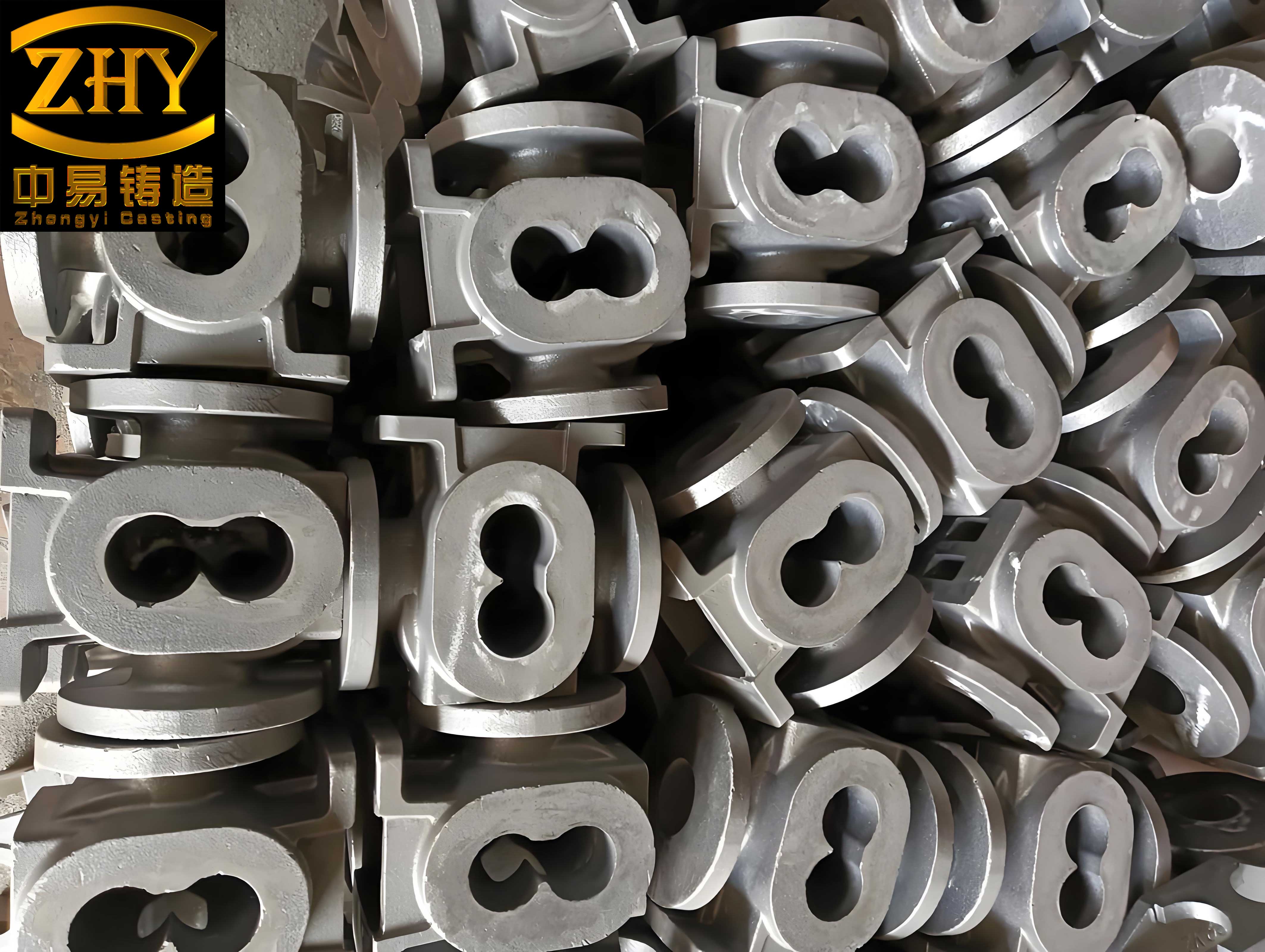
The foundation of any successful casting process lies in the meticulous selection of molding materials. For cold box core assembly molding of nodular cast iron, this involves four critical aspects: sand, resin, mold wall thickness, and coating. Each element directly influences the mold’s integrity, the casting’s surface quality, and the overall economics of producing nodular cast iron parts.
First, the choice of sand is paramount. To withstand the high temperatures of molten nodular cast iron, which typically ranges from 1350°C to 1420°C, a sand with high refractoriness is essential. We utilize silica sand with a SiO₂ content exceeding 92%. The grain size distribution is a compromise between surface finish and gas permeability. Finer grains produce smoother mold surfaces, leading to better finish on the nodular cast iron casting, but they increase resin consumption and can hinder venting. After rigorous testing, a grain fineness number (GFN) corresponding to 50/100 mesh (approximately 0.15-0.3 mm) was found optimal. The sand’s base properties can be described by its specific surface area ($S_v$) and packing density ($\rho_p$), which affect resin requirement. An empirical relation for initial resin demand can be approximated as:
$$ R_d \propto \frac{S_v}{\rho_p} $$
where $R_d$ is the resin demand per unit mass of sand. For our 50/100 mesh sand, $S_v$ is approximately 250-300 cm²/g, and $\rho_p$ is around 1.6 g/cm³.
Second, the resin system, typically a phenolic urethane cold box resin, is catalyzed by a tertiary amine gas like triethylamine (TEA). The resin addition percentage is critical for achieving adequate tensile strength in the core. Insufficient resin leads to weak molds prone to erosion or breakage during pouring of nodular cast iron, while excess resin is wasteful and can generate excessive gases, causing defects. Through systematic strength testing, we determined an optimal resin addition level of 1.8% by weight of sand. The core tensile strength ($\sigma_t$) as a function of resin content ($C_r$) and curing time ($t_c$) follows a logarithmic growth pattern, which can be modeled for our system as:
$$ \sigma_t = A \cdot \ln(B \cdot C_r \cdot t_c + 1) $$
where $A$ and $B$ are constants derived from experimental data. At 1.8% resin and a standard 10-15 second gassing cycle, we consistently achieve a tensile strength of 180-220 N/cm², which is sufficient for handling and resisting metallostatic pressure from nodular cast iron.
| Parameter | Specification/Value | Remarks for Nodular Cast Iron |
|---|---|---|
| Sand Type | High-purity Silica Sand | SiO₂ > 92%, ensures refractoriness |
| Grain Size (Mesh) | 50/100 | Balances surface finish and permeability |
| Resin Type | Phenolic Urethane | Triethylamine (TEA) catalyzed |
| Resin Addition (%) | 1.8 | Optimized for strength and cost |
| Typical Tensile Strength (N/cm²) | 180-220 | Measured after 1 hour cure |
| Mold Wall Thickness (mm) | 18-22 | Ensures rigidity for nodular cast iron pours |
Third, the mold wall thickness is a design parameter crucial for mechanical stability. For nodular cast iron castings weighing less than 50 kg, a wall thickness of 18-22 mm provides the necessary rigidity to prevent mold deformation or rupture under the pressure of the molten metal. The required thickness ($T_w$) can be conceptually related to the metallostatic pressure head ($h$) and the mold material’s allowable stress ($\sigma_{allow}$) using a simplified plate bending model:
$$ T_w \geq k \cdot \sqrt{\frac{P \cdot L^2}{\sigma_{allow}}} $$
where $P = \rho_{iron} \cdot g \cdot h$ is the pressure, $\rho_{iron}$ is the density of nodular cast iron (~7000 kg/m³), $g$ is gravity, $L$ is a characteristic mold dimension, and $k$ is a safety factor. Our chosen range satisfies this for typical small components.
Fourth, the application of a refractory coating is non-negotiable for producing clean-surface nodular cast iron castings. We employ a graphite-based coating applied via total dipping. This ensures a uniform, continuous layer that protects the sand from direct contact with the molten nodular cast iron, preventing burn-on and improving surface finish. The coating thickness ($\delta_c$) is controlled between 0.2-0.3 mm. Its effectiveness in preventing metal penetration can be related to its viscosity ($\eta$) and the capillary pressure ($P_c$) in the sand pores:
$$ P_c = \frac{4 \gamma \cos\theta}{d_p} $$
where $\gamma$ is the surface tension of molten nodular cast iron, $\theta$ is the contact angle, and $d_p$ is the average sand pore diameter. A good coating increases $\theta$, reducing metal penetration.
The heart of the cold box process is the specialized equipment and the core assembly strategy. We utilize automated core shooting machines paired with precision metal tooling. The core shooter injects the sand-resin mixture into the sealed metal core box at pressures around 4-6 bar. The amine catalyst is then injected, causing near-instantaneous curing. This rapid cycle time—often less than 60 seconds per core—is a key productivity driver for nodular cast iron part manufacturing.
The gating and risering design for nodular cast iron in a cold box assembly requires careful consideration of the material’s solidification characteristics. Nodular cast iron exhibits a mushy solidification mode due to graphite expansion, which often allows for feeding without large risers. Therefore, our designs typically employ a pressurized gating system with a choke at the sprue base to ensure rapid, turbulent-free filling. A common ratio used is:
$$ A_{sprue} : A_{runner} : A_{ingate} = 1.0 : 1.2 : 1.1 $$
This helps in achieving a smooth fill and minimizing dross formation. Risers are often omitted for small, uniformly thick nodular cast iron castings, relying on the graphitic expansion for internal feeding. Venting is integrated into the core design through strategically placed vents or permeable areas in the core box to allow gases from the binder decomposition to escape.
The stacking method is a distinctive advantage of the core assembly process. Cores are designed as two halves (copes and drags) that interlock. Multiple castings are produced by stacking these core assemblies vertically. Each core acts as the drag for the casting above and the cope for the casting below. They are bonded at the periphery with a core assembly adhesive. The number of layers ($N$) can be adjusted based on production needs, dramatically increasing yield per pour. The total height ($H_{stack}$) is limited by the metallostatic pressure on the bottom cores:
$$ H_{stack} \leq \frac{\sigma_{core}}{\rho_{iron} \cdot g} $$
where $\sigma_{core}$ is the compressive strength of the cured core. For our cores, this allows stacks of 5-8 layers for typical small nodular cast iron parts.
| Feature | Traditional Sand Molding | Cold Box Core Assembly Molding |
|---|---|---|
| Typical Mold Making Time | 30-60 minutes per mold | 1-2 minutes per core (assembly in 5 min) |
| Gating System Complexity | Often requires filters, large risers | Simplified, often riserless for small nodular cast iron parts |
| Max Castings per Mold/Stack | Usually 1-2 | 5-10 (via vertical stacking) |
| Dimensional Accuracy (CT Grade) | CTG 10-12 | CTG 8-9 (per ISO 8062) |
| Minimum Feasible Hole Diameter (as-cast) | > 25 mm | > 15 mm for nodular cast iron |
The melting and pouring parameters for nodular cast iron must be precisely controlled to complement the cold box mold’s characteristics. The pouring temperature is a critical variable. For cold box molds, we maintain a range of 1350°C to 1380°C. Higher temperatures increase the thermal load on the organic binder, risking mold wall movement and gas defects, while lower temperatures promote mistruns in thin sections. The ideal temperature ($T_{pour}$) can be related to the casting modulus ($M_c = V/A$, volume to surface area ratio) and the sand’s thermal properties:
$$ T_{pour} = T_{liquidus} + \Delta T_{superheat} $$
For nodular cast iron with a liquidus around 1150°C-1180°C, a superheat ($\Delta T_{superheat}$) of 170-230°C is typical. We target 200°C superheat.
Pouring time is kept short to maintain metal fluidity and minimize temperature drop. For a stack of nodular cast iron castings with a total weight $W_{total}$ (kg) and an effective gating area $A_g$ (cm²), an empirical pouring time ($t_p$) in seconds can be estimated using Chvorinov’s rule modified for filling:
$$ t_p \approx \frac{W_{total}}{k_f \cdot A_g \cdot \sqrt{h}} $$
where $h$ is the effective sprue height in cm, and $k_f$ is a fluidity factor for nodular cast iron (approx. 0.6-0.8). We aim for a turbulent-free but rapid fill, typically 8-15 seconds for a stack.
Inoculation is vital for achieving the desired graphite morphology in nodular cast iron. We use a combined method: ladle inoculation with 0.5% FeSi75 (75% Si) for base nucleation, followed by a late stream inoculation during pouring with 0.10%-0.15% sulfur-oxygen inoculant. This dual approach ensures a high count of small, well-formed graphite nodules. The efficiency of inoculation ($E_{inj}$) can be conceptualized in terms of nodule count ($N_n$):
$$ N_n = N_0 + \alpha \cdot C_{inj} \cdot e^{-\beta \cdot t} $$
where $N_0$ is the baseline nodule count from magnesium treatment, $C_{inj}$ is the inoculant addition, $t$ is the time between inoculation and solidification, and $\alpha$, $\beta$ are constants. Our process minimizes $t$, maximizing $N_n$.
The production outcomes validate the superiority of the cold box process for nodular cast iron. Visually, castings exhibit significantly smoother surfaces with minimal flash and veining. This is a direct result of the high dimensional accuracy and surface finish of the cold box cores. The reduction in finishing labor is substantial.
Metallographic analysis confirms excellent microstructure. Typical results from casting sections show a nodularity exceeding 93%, graphite size of ASTM 7 (20-30 µm), and a nodule count above 250 nodules/mm². The pearlite/ferrite ratio can be controlled through cooling rate and alloying, but the core process itself does not adversely affect microstructure. The graphite nodule count ($N_v$) relates to the cooling rate ($\dot{T}$) and inoculation efficacy:
$$ N_v \propto (\dot{T})^n \cdot E_{inj} $$
with $n$ being a positive exponent. The rapid but consistent cooling in thin-walled cold box molds favors a fine, uniform structure in nodular cast iron.
Brinell hardness measurements on castings fall consistently within the range of 165-182 HB, meeting the specifications for ductile, as-cast nodular cast iron components. The hardness ($HB$) can be correlated to the matrix structure via a linear mix rule:
$$ HB \approx f_{\alpha} \cdot HB_{\alpha} + f_{p} \cdot HB_{p} $$
where $f_{\alpha}$ and $f_{p}$ are ferrite and pearlite fractions, and $HB_{\alpha}$ ~ 150, $HB_{p}$ ~ 250.
The most compelling evidence comes from quantitative metrics on yield, productivity, and cost. The ability to cast holes as small as 15 mm diameter eliminates machining for many features, directly saving material and labor. The stacking method multiplies output per molding and pouring cycle. A detailed comparison for a family of injection machine components made from nodular cast iron reveals stark improvements.
| Component Name | Weight (kg) | Reduction (%) | Raw Material Cost Saving per Piece (USD)* | Daily Output (Pieces)** | Defect Rate Reduction (Percentage Points) | ||
|---|---|---|---|---|---|---|---|
| Traditional Sand | Cold Box | Difference | |||||
| Long Hinge | 19.50 | 17.90 | 1.60 | 8.2 | 9.60 | 100 vs. 12 | ~4.5 |
| Small Hinge | 1.80 | 1.55 | 0.25 | 13.9 | 1.50 | 100 vs. 10 | ~5.0 |
| Hook Hinge Type 1 | 7.70 | 6.60 | 1.10 | 14.3 | 6.60 | 80 vs. 8 | ~4.0 |
| Hook Hinge Type 2 | 9.30 | 8.20 | 1.10 | 11.8 | 6.60 | 80 vs. 8 | ~3.5 |
*Based on a raw nodular cast iron cost of ~$0.60/kg. **Cold Box vs. Traditional output.
The economic benefits extend beyond mere weight savings. The overall cost per piece ($C_{total}$) can be modeled as:
$$ C_{total} = C_{metal} \cdot W + C_{molding} + C_{finishing} + C_{scrap} $$
where $C_{metal}$ is metal cost per kg, $W$ is casting weight, $C_{molding}$ is mold-making cost, $C_{finishing}$ is cleaning/machining cost, and $C_{scrap}$ is cost attributed to defects. For cold box produced nodular cast iron:
• $W$ is lower due to reduced machining allowance and cored holes.
• $C_{molding}$ is higher initially (metal tooling) but lower per piece at high volume due to speed.
• $C_{finishing}$ plummets due to less flash and fewer machining operations.
• $C_{scrap}$ decreases due to lower defect rates (cold shuts, slag inclusions, sand-related defects).
The net effect is a significant reduction in $C_{total}$, often between 15-25% for suitable nodular cast iron components.
The productivity surge is quantifiable. If a traditional process produces $P_t$ pieces per day with a cycle time $t_t$, and the cold box process produces $P_c$ with cycle time $t_c$, the productivity index ($\Pi$) is:
$$ \Pi = \frac{P_c / t_c}{P_t / t_t} $$
For our cases, $\Pi$ ranges from 6 to 10. This capacity increase is crucial for meeting market demands for nodular cast iron parts.
In conclusion, the adoption of cold box core assembly molding for the production of nodular cast iron components represents a transformative step in foundry practice. While challenges such as initial tooling investment, amine handling, and size limitations for very large nodular cast iron castings exist, the benefits for high-volume, precision small-to-medium parts are undeniable. The process delivers superior dimensional accuracy, excellent surface finish, enhanced metallurgical quality, and dramatic improvements in production efficiency and cost-effectiveness. As the industry continues to seek ways to produce higher quality nodular cast iron more competitively, the cold box core assembly method stands out as a robust and highly advantageous manufacturing solution. Its continued development and adaptation will undoubtedly play a key role in the future of nodular cast iron casting technology.