
In the field of engineering materials, nodular cast iron has been a cornerstone since its industrial adoption in the 1960s, with continuous advancements in production technology. According to the national standard GB/T 1348-2019 for nodular cast iron castings, the highest tensile strength for as-cast pearlitic nodular cast iron is 800 MPa, while the highest elongation for as-cast ferritic nodular cast iron is 22%. However, pearlitic nodular cast iron typically exhibits high strength but low elongation, whereas ferritic nodular cast iron offers high elongation but lower strength. For instance, the standard specifies that pearlitic nodular cast iron with a tensile strength of 800 MPa has an elongation of only 2%, and ferritic nodular cast iron with an elongation of 22% has a tensile strength of 350 MPa. Achieving both high strength and high elongation in nodular cast iron would not only enhance product quality and reliability but also expand its application range, particularly in enabling lightweight designs for automotive components. Overseas research has made strides in this area, with notable examples including Si-solid-solution strengthened high-strength, high-elongation ferritic nodular cast iron and SiBoDur nodular cast iron. Studies show that Si-solid-solution strengthened fully ferritic nodular cast iron can achieve tensile strengths of 500 MPa and 600 MPa with elongations of 14% and 10%, respectively, and has been applied in Europe. However, such materials often exhibit poor low-temperature impact resistance, posing fracture risks in colder regions like northeastern China. Therefore, in our development of high-performance nodular cast iron, such as QT600-10, we avoided the high-Si solid-solution strengthening approach.
High-performance nodular cast iron in investment casting (precision casting) is rarely reported. To meet user demands for product lightweighting, our team embarked on developing high-performance mixed-matrix nodular cast iron QT600-10 in 2016, followed by high-performance pearlitic nodular cast iron QT700-8 and QT800-5 in 2018. Preliminary data collection and extensive trials using single-cast Y-block samples helped establish the technical requirements for metallographic and mechanical properties of these high-performance pearlitic nodular cast iron grades, as summarized in Table 1. These grades, QT700-8 and QT800-5, exhibit mechanical properties that significantly surpass those specified in GB/T 1348-2019, filling a gap in the investment casting industry for high-strength, high-ductility nodular cast iron. A comparison of tensile strength and elongation between our high-performance pearlitic nodular cast iron and the national standard grades is illustrated in Figure 1.
| Category | Grade | Condition | Metallographic Requirements | Mechanical Properties | |||||
|---|---|---|---|---|---|---|---|---|---|
| Nodularity Grade | Pearlite (%) | Carbides (%) | Yield Strength (MPa) | Tensile Strength (MPa) | Elongation (%) | Hardness (HBW) | |||
| High-Performance Pearlitic Nodular Cast Iron | QT700-8 | As-cast | 1–3 | 55–85 | ≤ 3 | ≥ 420 | ≥ 700 | ≥ 8 | 225–305 |
| High-Performance Pearlitic Nodular Cast Iron | QT800-5 | As-cast | 1–3 | ≥ 75 | ≤ 3 | ≥ 480 | ≥ 800 | ≥ 5 | 245–335 |
Table 1: Technical requirements for metallographic and mechanical properties of high-performance pearlitic nodular cast iron.
The development of these high-performance nodular cast iron grades involved addressing several challenges unique to investment casting. Unlike sand casting, investment casting uses pre-heated ceramic shells, resulting in slower cooling during eutectic solidification but faster cooling during eutectoid transformation due to thinner shell walls. This distinct cooling behavior necessitates tailored approaches in composition design, spheroidization, inoculation, and grain refinement. Our development process focused on three main areas: optimizing chemical composition for cost-effectiveness and performance, developing stable spheroidization and inoculation techniques suitable for small-scale investment casting, and implementing grain refinement measures leveraging the rapid eutectoid cooling in investment casting. The overall development strategy is summarized in Figure 2.
First, we determined the chemical composition for high-performance pearlitic nodular cast iron. Carbon equivalent (CE) control is critical in investment casting because the slow eutectic cooling can lead to graphite flotation and degenerated graphite forms if the iron is hypereutectic. Through extensive trials, we established that the pre-spheroidization CE should be controlled at $$CE = C + 0.3(Si + P) \approx 4.20\% \pm 0.05\%$$, resulting in a post-inoculation CE of 4.25%–4.35%. This range minimizes graphite abnormalities while reducing shrinkage defects, as shown in Table 2.
| Measured Pre-spheroidization CE (%) | Calculated Post-spheroidization CE (%) | Graphite Morphology | Shrinkage Defects | Judgment |
|---|---|---|---|---|
| 4.10 | 4.20 | Acceptable | 10%–40% | NG |
| 4.15 | 4.25 | Acceptable | 0.5%–2% | OK |
| 4.20 | 4.30 | Acceptable | 0.5%–1% | OK |
| 4.25 | 4.35 | Occasional large graphite nodules | 0.5%–1% | OK |
| 4.30 | 4.40 | Graphite flotation | 0.5%–1% | NG |
Table 2: Effect of carbon equivalent on graphite morphology and shrinkage defects in investment casting nodular cast iron.
For alloying elements, we selected copper (Cu) as a pearlite promoter due to its cost-effectiveness and moderate effect, avoiding expensive nickel (Ni) and brittle-inducing elements like chromium (Cr) or tin (Sn). Molybdenum (Mo) was added at 0.2%–0.3% in QT800-5 to refine pearlite and enhance strength. Silicon (Si) content was optimized for each grade: 2.0%–2.4% for QT800-5, 2.2%–2.6% for QT700-8, and 2.6%–3.0% for QT600-10. Manganese (Mn) was controlled to balance strength and elongation, with lower levels for higher ductility grades. Harmful trace elements like phosphorus (P), sulfur (S), and titanium (Ti) were strictly limited to P ≤ 0.035%, S ≤ 0.02%, and Ti ≤ 0.04% to ensure high performance. Magnesium (Mg) and cerium (Ce) were maintained at 0.04%–0.06% and 0.01%–0.02%, respectively, for stable nodularity. The detailed chemical compositions are summarized in Table 3.
| Grade | Pre-spheroidization CE | Pre-spheroidization C (%) | Pre-spheroidization Si (%) | Post-spheroidization Si (%) | Mn (%) | P (%) | S (%) | Cu (%) | Mo (%) | Ti (%) | Mg (%) | Ce (%) |
|---|---|---|---|---|---|---|---|---|---|---|---|---|
| QT800-5 | 4.15–4.25 | 3.75–3.90 | 1.1–1.3 | 2.0–2.4 | 0.5–0.7 | ≤ 0.035 | ≤ 0.02 | 0.7–0.9 | 0.2–0.3 | ≤ 0.04 | 0.035–0.060 | 0.01–0.02 |
| QT700-8 | 4.15–4.25 | 3.65–3.85 | 1.3–1.5 | 2.2–2.6 | 0.3–0.5 | ≤ 0.035 | ≤ 0.02 | 0.5–0.7 | – | ≤ 0.04 | 0.035–0.060 | 0.01–0.02 |
| QT600-10 | 4.15–4.25 | 3.55–3.75 | 1.7–1.9 | 2.6–3.0 | 0.2–0.4 | ≤ 0.035 | ≤ 0.02 | 0.4–0.6 | – | ≤ 0.04 | 0.035–0.060 | 0.01–0.02 |
Table 3: Chemical composition ranges (mass fraction, %) for high-performance nodular cast iron in investment casting.
To achieve stable spheroidization in small-scale investment casting ladles (typically 500 kg or less), we developed a proprietary wire-feeding process using low-Mg, high-Ba cored wire. Traditional plunge methods or standard wire-feeding led to unstable Mg residuals and poor nodularity due to short treatment times. Our cored wire composition, as shown in Table 4, combines spheroidizing and inoculating agents, enabling consistent Mg levels of 0.04%–0.06% and effective inoculation with barium (Ba).
| Component | Mg | Si | RE (La-rich) | Ba | Ca | MgO | Al | Fe |
|---|---|---|---|---|---|---|---|---|
| Content (%) | 8–12 | 52–60 | 2.0–3.0 | 9–11 | 2–3 | ≤ 1.5 | ≤ 1.5 | Balance |
Table 4: Chemical composition of core powder in specialized cored wire for investment casting nodular cast iron.
Inoculation in investment casting posed a challenge because common post-inoculation techniques like stream inoculation or in-mold inoculation are impractical due to mobile pouring cups and pre-heated shells. We devised a triple inoculation method: (1) pre-inoculation with 0.3%–0.5% FeSi75 in the spheroidizing ladle during tapping, (2) inoculation via Ba in the cored wire during spheroidization, and (3) transfer ladle inoculation with 0.4%–0.6% FeSi75 (1–4 mm granular) when pouring from the spheroidizing ladle to the pouring ladle. This approach effectively combats inoculation fading and ensures fine graphite formation. Temperature control was also critical; we maintained tapping temperatures at 1460–1490°C, post-spheroidization temperatures at 1420–1450°C, and first-pour temperatures at 1360–1400°C to balance fluidity and avoidance of fading.
Grain refinement was achieved by exploiting the rapid eutectoid cooling in investment casting. We implemented a controlled cooling strategy where mold clusters were spaced at least 60 mm apart during pouring and cooling, as illustrated in Figure 3. After pouring, natural air cooling was allowed for 15 minutes, followed by forced air cooling at 3–5 m/s using fans. This accelerates cooling during the eutectoid transformation, leading to finer pearlite and enhanced mechanical properties. The relationship between cooling rate and pearlite fineness can be approximated by $$d = k \cdot \dot{T}^{-n}$$ where \(d\) is the pearlite interlamellar spacing, \(\dot{T}\) is the cooling rate, and \(k\) and \(n\) are material constants. Our forced cooling increased \(\dot{T}\) during eutectoid, reducing \(d\) and thereby increasing strength without compromising ductility.
The microstructures of our high-performance pearlitic nodular cast iron grades were evaluated extensively. For QT800-5, nodularity grades of 2–3 with pearlite content of 85%–95% and negligible carbides were consistently achieved. For QT700-8, nodularity grades of 2–3 with pearlite content of 65%–75% and no carbides were observed. Representative micrographs show well-formed graphite nodules in a fine pearlitic matrix, confirming the effectiveness of our process controls. The mechanical properties were assessed using separately cast Y-blocks, with results summarized in Table 5. All samples met or exceeded the target requirements, demonstrating the success of our development.
| Grade | Condition | Hardness (HBW) | Yield Strength (MPa) | Tensile Strength (MPa) | Elongation (%) | Judgment |
|---|---|---|---|---|---|---|
| QT800-5 | As-cast | 255, 272, 263 | 497, 535, 521 | 817, 845, 824 | 6.1, 5.2, 5.7 | OK |
| QT700-8 | As-cast | 242, 248, 255 | 431, 457, 462 | 727, 742, 752 | 9.1, 8.3, 8.5 | OK |
Table 5: Mechanical property results for high-performance pearlitic nodular cast iron QT800-5 and QT700-8 (room temperature testing).
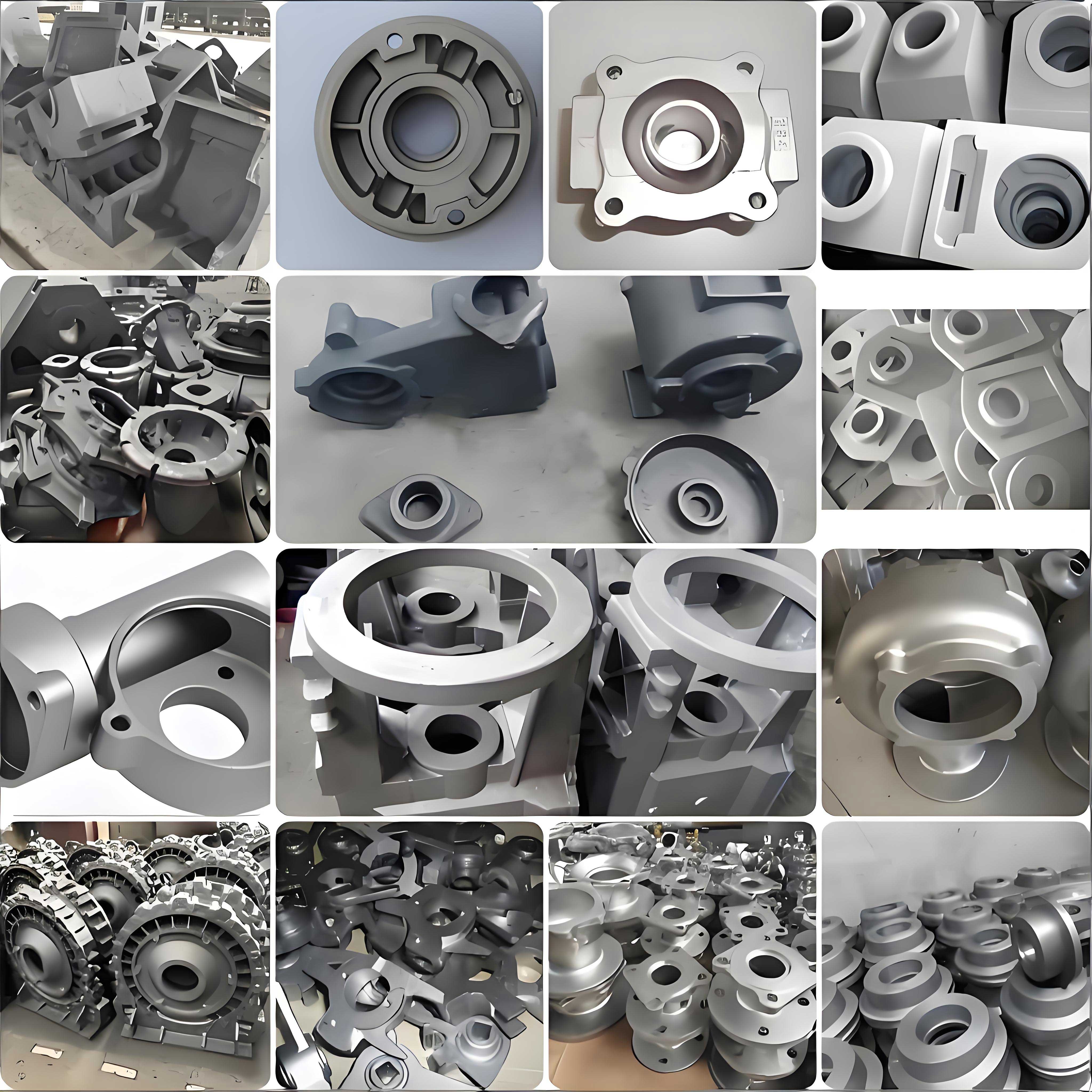
The development of these high-performance nodular cast iron grades has enabled their application in critical components such as front support beams and protective brackets, where lightweight design and high reliability are paramount. The combination of high strength and good ductility in these nodular cast iron materials is attributed to the synergistic effects of composition optimization, stable spheroidization and inoculation, and grain refinement through controlled cooling. Our approach avoids expensive alloying elements like nickel and molybdenum in QT700-8, keeping costs low while achieving performance goals. Furthermore, the use of steel scrap as the primary charge material reduced levels of harmful elements like P, S, and Ti, enhancing consistency and sustainability.
In conclusion, we have successfully developed and applied high-performance pearlitic nodular cast iron grades QT800-5 and QT700-8 in investment casting. Key achievements include: (1) establishing a cost-effective chemical composition with precise carbon equivalent control tailored to investment casting conditions; (2) developing a low-Mg, high-Ba cored wire and wire-feeding spheroidization process that ensures stable nodularity in small ladles; (3) implementing a triple inoculation method to overcome inoculation fading in the absence of post-inoculation techniques; and (4) leveraging eutectoid cooling acceleration through mold cluster spacing and forced air cooling for grain refinement. These advancements have resulted in nodular cast iron materials with tensile strengths of 700–800 MPa and elongations of 5%–9%, surpassing standard grades and enabling new applications in lightweight engineering. Future work may focus on further optimizing cooling strategies and exploring digital process controls to enhance reproducibility and expand the range of high-performance nodular cast iron grades for precision casting.