
In my extensive experience with sand casting for high-grade nodular cast iron components, I have frequently encountered challenges related to shrinkage defects, such as shrinkage cavities and porosity. These defects typically occur at hot spots or isolated solidification zones within castings, ultimately compromising product integrity and delivery. To address these issues, the strategic use of chills—metal or other chilling materials placed in molds to enhance localized cooling rates—has proven invaluable. This article delves into the application of chills in nodular cast iron casting, covering material selection, pretreatment methods, practical implementations, and theoretical insights, with an emphasis on optimizing casting quality.
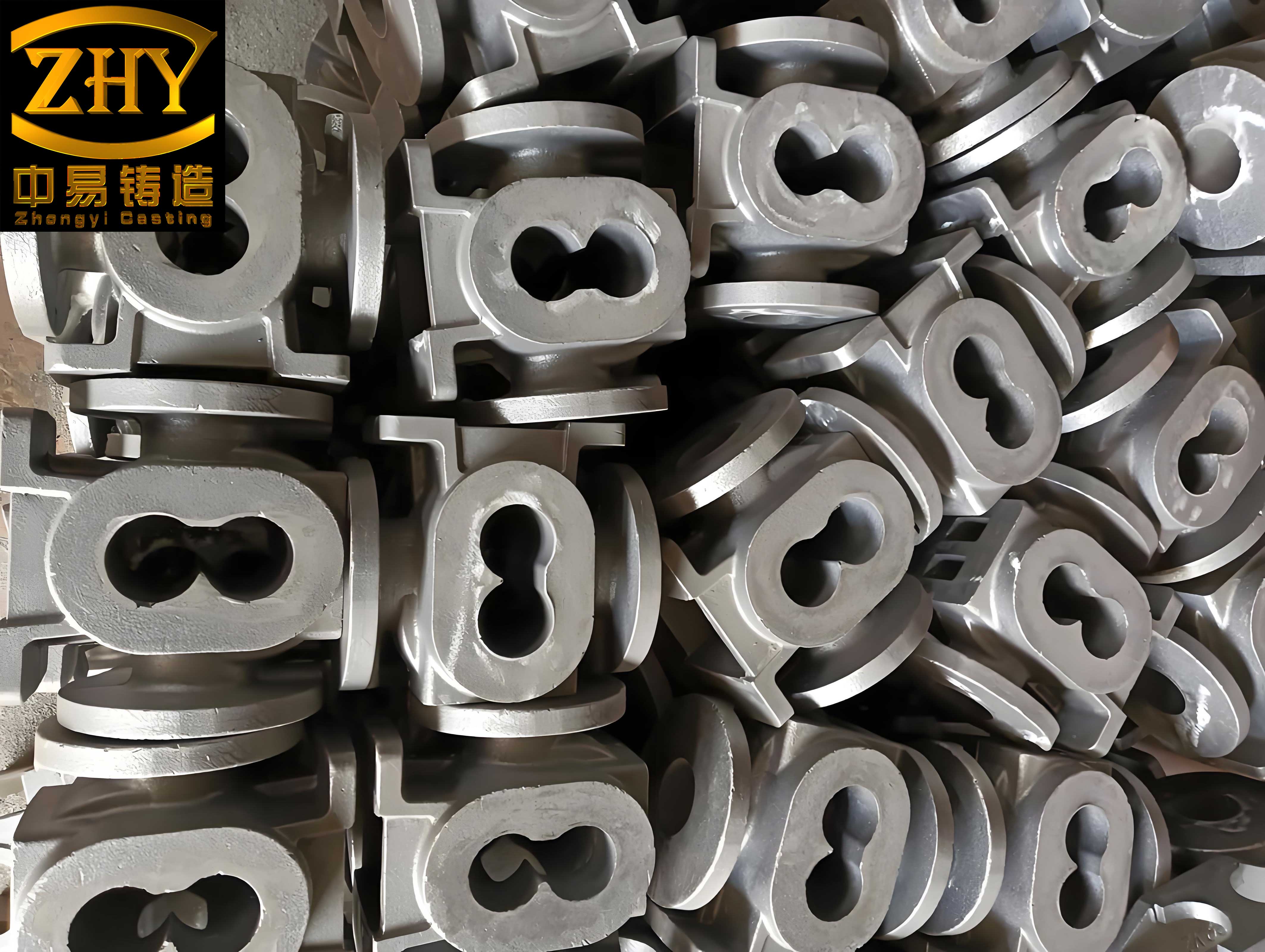
Nodular cast iron, characterized by its graphite spheroids embedded in a ferritic or pearlitic matrix, offers excellent mechanical properties like high strength, ductility, and wear resistance. However, during solidification, the unique solidification behavior of nodular cast iron can lead to shrinkage issues due to graphitization expansion, which may not fully compensate for liquid contraction. This necessitates effective cooling control, where chills play a critical role by extracting heat rapidly, promoting directional solidification, and minimizing isolated liquid pools. In practice, the judicious use of chills can prevent defects in nodular cast iron, ensuring sound castings for demanding applications such as wind turbine components.
The effectiveness of chills in nodular cast iron casting depends on various factors, including material properties, geometry, and processing conditions. Below, I explore these aspects in detail, supported by tables and formulas to summarize key concepts. Throughout this discussion, the term “nodular cast iron” will be reiterated to underscore its relevance in casting processes.
Materials for Chills
Chills are available in diverse materials, each with distinct thermal and physical properties that influence their performance in nodular cast iron casting. The selection of chill material is crucial, as it directly affects cooling efficiency, compatibility with the casting, and economic feasibility. Based on my observations, common chill materials include cast iron, steel, graphite, chromite sand, and steel shot. The choice often hinges on thermal conductivity, melting point, reusability, and cost.
To illustrate, consider the thermal conductivity (k), which governs the rate of heat extraction. For nodular cast iron, which has a thermal conductivity of approximately 30-40 W/m·K, chills with higher k values are preferred for rapid cooling. The heat flux (q) from the casting to the chill can be approximated using Fourier’s law:
$$q = -k \nabla T$$
where ∇T is the temperature gradient. A higher k enhances q, accelerating solidification. Below is a table summarizing typical chill materials used in nodular cast iron casting:
| Material | Thermal Conductivity (W/m·K) | Melting Point (°C) | Density (g/cm³) | Advantages | Disadvantages |
|---|---|---|---|---|---|
| Cast Iron (e.g., HT200) | ~50-60 | ~1200 | 7.2 | Cost-effective, reusable, good thermal mass | Prone to oxidation, heavy |
| Steel (e.g., Q235) | ~50-60 | 7.8 | High strength, durable, excellent chilling | Higher cost, may require welding for handles | |
| Graphite (Standard) | ~100-150 | Sublimes at ~3650 | 1.5-1.6 | Superior thermal conductivity, lightweight | Brittle, expensive, limited reusability |
| Graphite (High-Purity) | ~150-200 | Sublimes at ~3650 | 1.8-2.1 | Enhanced chilling, low thermal expansion | Very costly, fragile |
| Chromite Sand with Furan Resin | ~2-3 | N/A (aggregate) | ~4.5 | Good chilling effect, moldable | Not reusable, requires binder |
| Steel Shot with Water Glass Binder | ~50 | N/A (aggregate) | ~7.8 | High surface area, conforms to complex shapes | May need dispersants, labor-intensive |
For nodular cast iron, the selection often involves a trade-off. Cast iron chills are economical for large-scale production, while graphite chills excel in applications requiring intense cooling without adding excessive weight. Steel chills offer a balance, but their higher melting point makes them suitable for nodular cast iron with pouring temperatures around 1350-1400°C. The chilling power (C) of a material can be quantified as:
$$C = k \cdot \rho \cdot c_p$$
where ρ is density and c_p is specific heat capacity. This parameter helps compare materials; for instance, graphite has a high C due to its elevated k, despite lower ρ.
In nodular cast iron casting, the goal is to achieve directional solidification toward feeders or risers. Chills facilitate this by modifying the solidification time (t_s), which for a simple shape follows Chvorinov’s rule:
$$t_s = B \left( \frac{V}{A} \right)^2$$
where V is volume, A is surface area, and B is a mold constant that incorporates chill effects. By placing chills, A increases locally, reducing t_s and preventing shrinkage in hot spots of nodular cast iron.
Pretreatment of Chills
Before deployment, chills must undergo pretreatment to ensure effectiveness and safety. This involves surface preparation and anti-detachment measures, critical for maintaining mold integrity and preventing defects in nodular cast iron castings.
Surface Treatment
The surface of chills must be clean, dry, and free of contaminants to promote optimal heat transfer and avoid gas entrapment. For nodular cast iron, any moisture or rust can lead to porosity, so pretreatment varies by material:
- Cast Iron Chills: These are typically cleaned via shot blasting or manual grinding. Shot blasting is preferred for efficiency and consistency, as it removes scale and rust, enhancing thermal contact. After cleaning, a thin coating of refractory paint or graphite wash is applied to prevent fusion with the nodular cast iron.
- Steel Chills: Similar to cast iron, steel chills are shot-blasted or machined. Due to their higher melting point, they may require less frequent coating, but a light application of zirconia-based涂料 is advisable for nodular cast iron to avoid sticking.
- Graphite Chills: Graphite surfaces are inherently smooth and non-wetting, so they often need only inspection for cracks or wear. Reusability is key; after each use, they should be checked and recycled if intact. Coating is generally unnecessary, but a diesel torch can be used for drying before mold assembly.
- Other Materials: Chromite sand and steel shot are bonded within the mold, so their surfaces are treated as part of molding. For instance, water glass binders with溃散剂 (dispersants) ensure collapsibility after solidification of nodular cast iron.
Post-treatment, chills are often baked using diesel blowtorches or hot-air blowers inserted into molds to eliminate residual moisture, a crucial step for nodular cast iron to prevent gas-related defects.
Anti-Detachment Measures
To prevent chills from dislodging during mold handling or pouring, secure attachment is essential. Different materials require tailored solutions:
| Chill Material | Anti-Detachment Method | Description |
|---|---|---|
| Cast Iron | Integral Handles | Handles are cast onto non-working surfaces, providing anchorage in sand. |
| Steel | Welded Handles | Handles are welded onto sides, allowing firm embedding in mold walls. |
| Graphite | Machined Grooves | Grooves or slots are cut into edges, enabling mechanical interlock with sand. |
| Chromite Sand | Binder Integration | The sand mixture itself bonds to mold, secured by furan resin. |
| Steel Shot | Binder and Mesh | Shot is mixed with water glass and sometimes enclosed in wire mesh. |
These measures ensure chills remain stationary, maintaining consistent cooling for nodular cast iron. For example, in heavy-section nodular cast iron castings, welded handles on steel chills prevent displacement under molten metal pressure.
Theoretical Framework for Chill Design
Designing effective chills for nodular cast iron involves thermal analysis to predict solidification patterns. The heat transfer process can be modeled using the transient heat conduction equation:
$$\frac{\partial T}{\partial t} = \alpha \nabla^2 T$$
where α is thermal diffusivity, given by α = k/(ρ·c_p). For nodular cast iron, typical α values range from 1.0-1.5 × 10⁻⁵ m²/s. When a chill is inserted, boundary conditions change; at the chill-casting interface, the heat flux continuity applies:
$$k_{cast} \frac{\partial T}{\partial x} \bigg|_{cast} = k_{chill} \frac{\partial T}{\partial x} \bigg|_{chill}$$
This equation highlights the importance of matching k between the nodular cast iron and chill material. For instance, graphite’s high k ensures rapid heat extraction, reducing the temperature gradient in the casting.
The effectiveness of a chill in preventing shrinkage in nodular cast iron can be assessed using the modulus method, where the casting modulus (M_c = V/A) is compared to the chill modulus (M_ch). To eliminate shrinkage, the condition is often:
$$M_ch \geq M_c \cdot f$$
where f is a safety factor (typically 1.2-1.5 for nodular cast iron). For complex geometries, computer-aided engineering (CAE) simulations are employed, as seen in practical examples below.
Practical Applications and Case Studies
In my work, chills have been instrumental in solving shrinkage issues in nodular cast iron components. Here, I present two illustrative cases involving step chills and material selection, backed by CAE results.
Step Chills for Geometrical Challenges
Castings with step-like structures, such as flanges or ribs, are prone to isolated solidification zones in nodular cast iron. To address this, step-shaped chills are designed to conform to the geometry, providing uniform cooling. Consider a nodular cast iron part with a阶梯 structure: the thicker sections solidify slower, risking shrinkage. By placing a step chill that mirrors the contour, the cooling rate is balanced.
The heat extraction rate (Q) from such a chill can be estimated as:
$$Q = \int_{A} q \, dA = – \int_{A} k \frac{dT}{dx} \, dA$$
For a step chill with varying cross-sections, numerical integration is used. In practice, a 3D model of the chill, as shown in simulations, confirms that step chills eliminate hot spots in nodular cast iron, ensuring sound casting.
Material Selection Based on Casting Geometry
The choice between cast iron and graphite chills depends on the specific geometry of the nodular cast iron component. Two scenarios demonstrate this:
- Scenario 1: Thick Flange with Thin Walls – A nodular cast iron part features a central thick flange sandwiched between thin walls. CAE simulations reveal that using graphite chills around the flange results in an isolated liquid pool, whereas cast iron chills promote directional solidification. This is because cast iron has higher thermal mass (ρ·c_p), providing sustained cooling for the thicker section of nodular cast iron. The solidification time ratio can be expressed as:
$$R = \frac{t_{s,with chill}}{t_{s,without chill}}$$
For cast iron chills, R < 0.5, indicating effective chilling for nodular cast iron.
- Scenario 2: Thin Cylinder with Thick Connection – Another nodular cast iron component has a thin cylindrical wall connected to a thick disk. Here, graphite chills outperform cast iron ones: simulations show that cast iron chills create an isolated zone at the junction, while graphite chills, with their superior k, extract heat quickly without causing premature solidification in thin areas. The cooling efficiency (η) can be defined as:
$$\eta = \frac{T_{pour} – T_{solidus}}{t_{cool}}$$
where T_{pour} is pouring temperature, T_{solidus} is solidus temperature of nodular cast iron (around 1150°C), and t_{cool} is cooling time to solidus. For graphite, η is higher, benefiting thin-thick transitions in nodular cast iron.
These cases underscore that for nodular cast iron, chill material must be matched to geometry: cast iron for sustained cooling in heavy sections, graphite for rapid heat removal in complex shapes.
Advanced Considerations and Formulas
To optimize chill usage in nodular cast iron casting, deeper thermal analysis is valuable. The dimensionless Biot number (Bi) indicates the relative importance of internal vs. external heat transfer:
$$Bi = \frac{h L}{k_{cast}}$$
where h is the heat transfer coefficient at the chill interface, and L is a characteristic length of the casting. For nodular cast iron, Bi > 1 suggests that chilling is controlled by internal conduction, justifying thick chills. Conversely, Bi < 1 implies surface-dominated cooling, favoring thin or high-k chills like graphite.
The solidification shrinkage in nodular cast iron, due to liquid contraction and graphitization, can be quantified. The volumetric shrinkage (ΔV) is:
$$\Delta V = V_l \beta_l + V_s \beta_s – V_g \beta_g$$
where V_l, V_s, V_g are volumes of liquid, solid, and graphite phases; β_l, β_s, β_g are contraction coefficients. For typical nodular cast iron, ΔV is positive, necessitating feeding. Chills reduce ΔV by shortening the feeding distance, which for a plate-like nodular cast iron casting is:
$$L_f = \frac{T_{pour} – T_{solidus}}{G} \cdot \sqrt{\alpha t}$$
where G is temperature gradient, and t is time. With chills, G increases, decreasing L_f and minimizing shrinkage.
Furthermore, the effect of chills on microstructure of nodular cast iron can be analyzed. The cooling rate (Ṫ) influences graphite nodule count (N):
$$N = A \cdot \dot{T}^n$$
where A and n are constants. Faster cooling from chills increases N, enhancing mechanical properties of nodular cast iron. This relationship highlights the dual role of chills in defect prevention and property improvement.
Tables for Comparative Analysis
To aid in chill selection for nodular cast iron, below are additional tables summarizing key parameters.
| Metric | Cast Iron Chill | Steel Chill | Graphite Chill | Chromite Sand |
|---|---|---|---|---|
| Thermal Effusivity (√(kρc_p)) in J/(m²·K·s⁰·⁵) | ~15,000 | ~16,000 | ~20,000 | ~5,000 |
| Typical Reuse Cycles | Single use | |||
| Cost per Unit (Relative) | Low | Medium | High | Low |
| Impact on Nodular Cast Iron Surface Finish | Good | Excellent | Very Good | Fair |
| Casting Section Thickness (mm) | Cast Iron Chill Thickness (mm) | Graphite Chill Thickness (mm) | Cooling Time Reduction (%) |
|---|---|---|---|
| 20-30 | 10-15 | 5-10 | 40-50 |
| 30-50 | 15-25 | 10-15 | 50-60 |
| 50-100 | 25-40 | 15-25 | 60-70 |
| >100 | 40-60 | 25-40 |
These tables guide foundry engineers in selecting chills for nodular cast iron based on section size and desired outcomes.
Conclusion
In summary, the application of chills is a proven strategy to mitigate shrinkage defects in nodular cast iron casting. Through careful material selection, proper pretreatment, and geometric adaptation, chills enhance cooling efficiency, promote directional solidification, and improve casting integrity. Theoretical models, such as heat transfer equations and modulus methods, provide a foundation for chill design, while practical cases demonstrate the importance of matching chill properties to casting geometry. For nodular cast iron, which is widely used in critical industries, optimizing chill usage not only prevents defects but also refines microstructure, contributing to superior performance. As casting technologies evolve, continued research into chill materials and simulations will further advance the quality of nodular cast iron components.
This article, drawn from hands-on experience, underscores that chills are indispensable tools in the foundry, particularly for high-grade nodular cast iron. By integrating thermal principles with practical insights, foundries can achieve reliable production of sound castings, meeting the stringent demands of modern engineering applications.