
The planetary carrier is a critical transmission component within a wind turbine gearbox, directly承受并传递着巨大的动载荷和静载荷. Its performance and reliability are paramount for the entire power train system. Typically manufactured from high-strength nodular cast iron (ductile iron), such as grade EN-GJS-700-2U, these components feature关键壁厚 exceeding 100 mm, classifying them as heavy-section nodular cast iron castings. The inherent slow cooling and prolonged solidification times in such castings present significant manufacturing challenges, including risks of nodular graphite degeneration, graphite distortion, flotation, and difficulties in achieving a high pearlite content in the as-cast condition. This article systematically investigates the foundry process for a 2 MW wind turbine planet carrier, utilizing numerical simulation for optimization and detailing key metallurgical and heat treatment practices to achieve the stringent quality requirements.
The casting, with a finished weight of approximately 3,260 kg, possesses a complex geometry characterized by a central hub with thick mounting bosses (long and short axes), support plates (辅板), and connecting columns. The critical areas, such as the fillet radii where the long axes meet the lower support plate and the roots of the columns, represent massive thermal junctions. These regions are subject to rigorous non-destructive testing (NDT) standards, including Magnetic Particle Inspection (MPI per EN 1369, Level 2 for关键部位) and Ultrasonic Testing (UT per EN 12680-3, Level 1-3 depending on zone). The target material properties, to be verified on both attached test blocks and casting本体, are: tensile strength (Rm) ≥ 650 MPa, yield strength (Rp0.2) ≥ 370 MPa, elongation (A) ≥ 1%, with a microstructure featuring nodularity ≥ Grade 2, graphite size ≥ Grade 5, and pearlite content ≥ 75%.
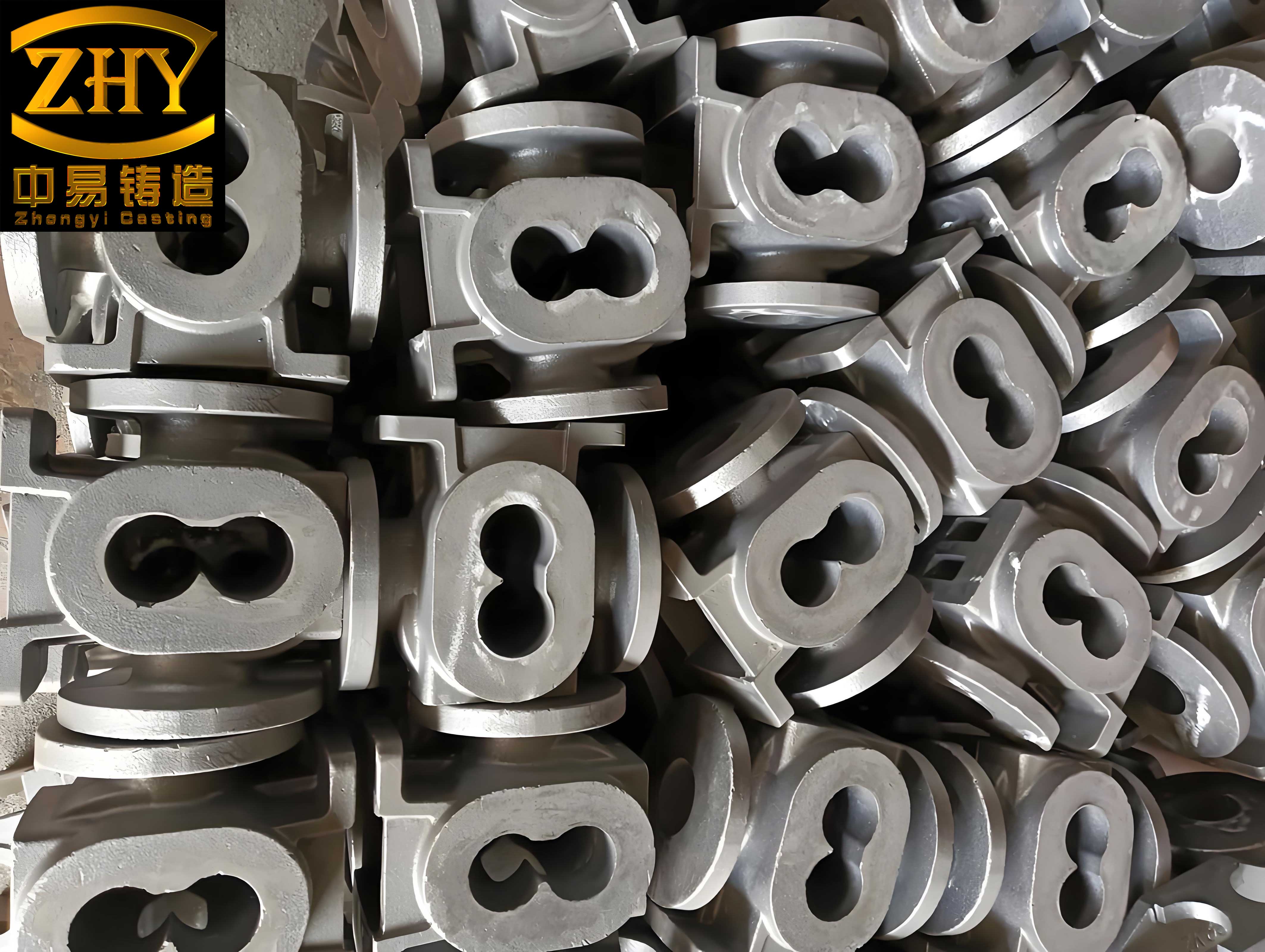
Foundry Process Design and Analysis
The design philosophy for heavy-section nodular cast iron castings must prioritize control over shrinkage porosity, graphite morphology, and metallurgical consistency. A three-part molding system using furan resin sand was adopted for造型 efficiency, eliminating complex cores between the upper and lower support plates. The parting lines were strategically placed to facilitate molding and placement of chills.
The gating and feeding system was designed based on the principles of controlled filling and directional solidification towards effective feeders.
- Pouring Position & Gating System: To ensure the highest integrity in the critical long axes, the casting was oriented with these axes in the drag (lower mold). A bottom-gating system with multiple ingates was employed. This design promotes tranquil mold filling, minimizes turbulence and oxide film formation, and reduces the risk of slag and gas entrainment. A four-unit gating system (downsprue, runner, ingates) was designed using the pressurized system principles for nodular cast iron, with a total ingate area of approximately 100.5 cm² (via eight ceramic pipes). A filter and pouring basin were incorporated upstream of the ingates to further calm the metal flow and trap inclusions.
- Feeding & Cooling Strategy (Risers & Chills): While theoretical calculations might suggest the feasibility of feeding without risers for high-modulus sections, the alloying additions (e.g., Mn, Cu) increase the shrinkage tendency. Therefore, a combination of risers and chills was deemed necessary for process reliability. Three necked-down exothermic risers were placed on the short axes. These serve a dual purpose: providing liquid metal feed and acting as flow-offs for cooler, initial metal. The strategic use of chills is perhaps the most crucial aspect. Chills accelerate local cooling at热节s, improve microstructure by reducing graphite degeneration risk, and, importantly, advance the timing of liquid contraction in the chilled region. This allows the gating system to compensate for this shrinkage before it solidifies, effectively reducing the total volumetric shrinkage that must be fed later. Chills were applied at critical locations: the bearing and pin bore areas, and most importantly, at the junctions of the long axes with the lower support plate.
Metallurgical Design for Heavy-Section Nodular Cast Iron
The chemical composition and treatment of the melt are foundational to achieving the desired properties in thick-walled nodular cast iron castings like the planet carrier. The selection aims to balance graphite formation, matrix structure, and defect minimization.
Chemical Composition Control:
- Carbon Equivalent (CE): A high CE promotes good fluidity and石墨化 expansion, aiding feeding. However, excessively high CE leads to graphite flotation and degeneration in heavy sections. A controlled range of CE = 4.2–4.3% was targeted. The carbon equivalent is calculated as:
$$CE = \%C + \frac{\%Si + \%P}{3}$$
For our target, this implies a carbon content in the range of 3.5–3.8%. - Silicon: A critical element. While silicon is a strong graphitiser and aids nodularization, high levels promote ferrite formation and can exacerbate chunk graphite formation in thick sections. A “low-silicon” principle (2.0–2.2% final) was followed to suppress these effects and promote a pearlitic matrix.
- Alloying Elements (Cu, Mn): Copper is an excellent pearlite promoter without forming carbides, enhancing strength and hardness uniformly across the section. A content of 0.5–0.6% was specified. Manganese, a carbide stabilizer, was restricted to ≤0.5% to avoid pearlite banding and undue hardenability.
- Residual Magnesium and Rare Earths: Maintaining sufficient residual Mg (0.04–0.06%) is vital to counteract fading during long solidification. Yttrium-based heavy rare earth elements were chosen for their strong anti-fade properties and ability to improve graphite nodule count and圆整度. Residual rare earths were controlled within 0.02–0.03%.
The target base iron composition before treatment and the final target ranges are summarized below:
| Element | Base Iron Target | Final Casting Target |
|---|---|---|
| C | 3.5 – 3.8% | 3.5 – 3.7% |
| Si | 1.2 – 1.4% | 2.0 – 2.2% |
| Mn | ≤ 0.5% | ≤ 0.5% |
| P | ≤ 0.05% | ≤ 0.05% |
| S | ≤ 0.015% | ≤ 0.015% |
| Cu | 0.5 – 0.6% | 0.5 – 0.6% |
| Mg (res.) | – | 0.04 – 0.06% |
| RE (res.) | – | 0.02 – 0.03% |
Nodularization and Inoculation Practice: A sandwich method was used for treatment. A yttrium-based heavy rare earth magnesium ferrosilicon alloy (approx. 5.5-6.2% Mg, 0.8-1.2% RE, 45% Si) was used as the nodularizer at an addition rate of 1.15–1.25%. For inoculation, a multi-stage approach is essential for长效性和石墨形核. A primary inoculation with a Ba-containing高效孕育剂 (0.6% addition) was performed during treatment, followed by a decisive stream inoculation during pouring (0.15% addition).
Melting and Pouring Parameters: The melt was superheated to 1500–1550°C to ensure charge dissolution and purification. The pouring temperature was deliberately lowered to 1340–1360°C. This reduces total solidification time (tsolid), which can be approximated for a simple shape by the Chvorinov’s rule:
$$t_{solid} = k \left( \frac{V}{A} \right)^n$$
where $V/A$ is the volume-to-surface area ratio (modulus), and $k$ and $n$ are constants. Lowering pouring temperature decreases $t_{solid}$, mitigating nodularizer fading and graphite degeneration. It also reduces the total liquid contraction volume, easing the feeding demand. However, temperature must remain high enough to avoid mistruns and allow slag separation.
Numerical Simulation and Process Optimization
MAGMA soft ware was employed to simulate the initial process design. The filling analysis confirmed smooth, non-turbulent filling with front velocities below 2 m/s. The solidification simulation, however, revealed critical shortcomings in the original chill design.
The initial simulation predicted isolated liquid pools (hot spots) at the end of solidification in the column roots and, most severely, at the long-axis-to-lower-plate junctions. Porosity criteria algorithms indicated a high probability of shrinkage porosity in these areas. The issue stemmed from the massive, centrally located热节 at the long axis root, where散热 was poor, and the local chills were insufficient to create a directed solidification pattern towards the risers or other feeding sources.
The optimization strategy focused on radically altering the thermal dynamics at this critical junction:
- Enhanced Axis Cooling: A continuous external chill was applied along the entire length of each long axis. This ensured the axis itself solidified before the junction热节, establishing a solidification gradient.
- Junction热节 Management: A ring of chills was placed on the lower support plate around the base of each long axis. This served to disperse the concentrated热节, breaking a potential large shrinkage cavity into dispersed, micro-scale porosity that is more acceptable or can be eliminated.
The optimized simulation results showed a dramatic improvement. The long axes solidified first, maintaining open feeding paths to the junctions for longer. The final isolated liquid zones were shifted to less critical areas, such as the mid-sections of columns and the interior of the support plate. The predicted shrinkage porosity in the critical fatigue zones was eliminated. Furthermore, the overall solidification time was reduced, decreasing the window for metallurgical degradation. This virtual optimization provided a high-confidence roadmap for the trial production.
Heat Treatment for Property Enhancement
Achieving the required high pearlite content (≥75%) and tensile strength (≥650 MPa) in the as-cast condition for such a heavy-section nodular cast iron casting is extremely difficult due to the inherently slow cooling rate in the mold. Therefore, a normalizing heat treatment is indispensable.
The critical parameter in normalizing is the cooling rate after austenitization. Insufficient cooling leads to the transformation of austenite into ferrite and coarse pearlite, failing to achieve the desired strength. The designed thermal cycle was:
- Austenitization: 900–920°C for 5–8 hours to ensure complete austenitization and homogenization.
- Normalizing (Controlled Cooling): Rapid出炉 and forced air cooling (风冷) to approximately 550°C. Special attention was paid to ensuring uniform and adequate cooling across all sections, particularly the long轴内圆 areas which have poorer散热. For批量生产, even雾冷 (fog cooling) might be necessary to achieve the required transformation kinetics uniformly across multiple castings in a single furnace charge. The cooling rate must exceed the critical rate to avoid the ferrite nose on the CCT diagram for this alloyed nodular cast iron.
- Stress Relieving/Tempering: Heating to 560–570°C for 4–6 hours, followed by furnace cooling to below 150°C. This step relieves casting and transformation stresses and tempers the matrix, ensuring good machinability and dimensional stability.
The effectiveness of the cooling rate ($\dot{T}$) can be related to the resulting pearlite fraction ($F_P$) through empirical relationships often derived from JMAK-type equations for the pearlite transformation:
$$ F_P = 1 – \exp(-k(T, \dot{T}) \cdot t^n) $$
where $k$ is a rate constant dependent on temperature $T$ and cooling rate $\dot{T}$, $t$ is time, and $n$ is an exponent. Higher $\dot{T}$ increases $k$, promoting greater $F_P$.
Production Verification and Results
The optimized process was implemented in trial production. The first-off casting underwent comprehensive inspection. Non-destructive Testing (UT and MT) results met all specification requirements. Mechanical properties were tested on both the attached test blocks and本体 samples machined from critical, heavy-section areas (long axis root).
The results, summarized in the table below, confirmed the success of the integrated process. Both the attached test block and the casting本体 properties exceeded the minimum requirements of EN-GJS-700-2U. The本体 properties, while slightly lower than the test block due to less favorable cooling conditions during heat treatment, comfortably met the targets. Microstructural analysis confirmed球化率 Grade 2, graphite size Grade 6, and pearlite content between 80-98% in the本体 samples.
| Property / Requirement | Specification (EN-GJS-700-2U) | Attached Test Block Result | Casting本体 Result (Avg. from 4 locations) |
|---|---|---|---|
| Tensile Strength, Rm (MPa) | ≥ 650 | 917 | ~718 |
| Yield Strength, Rp0.2 (MPa) | ≥ 370 | 521 | ~406 |
| Elongation, A (%) | ≥ 1 | 5 | ~4.4 |
| Hardness (HB) | 210 – 305 | 290 | ~264 |
| Nodularity | ≥ Grade 2 | Grade 2 | Grade 2 |
| Graphite Size | ≥ Grade 5 | Grade 6 | Grade 6 |
| Pearlite Content | ≥ 75% | ~98% | ~82.5% |
Following the successful validation, the process was固化 for serial production. Over one thousand castings have been manufactured with a consistent yield rate exceeding 98%, demonstrating the robustness and reliability of the developed工艺 for this demanding nodular cast iron component.
Conclusions
The successful production of high-integrity wind turbine planetary carriers from heavy-section nodular cast iron requires a holistic approach integrating sophisticated process design, precise metallurgical control, and tailored heat treatment.
- Process Design: A bottom-gating, multi-ingate system combined with a strategic mix of exothermic risers and intensive chilling is essential. Numerical simulation is a powerful tool for optimizing the placement and size of chills to enforce directional solidification and eliminate shrinkage in critical zones in such complex nodular cast iron castings.
- Metallurgical Control: A chemical composition based on a moderate carbon equivalent (CE 4.2–4.3), controlled low silicon (~2.1%), alloying with copper (0.5–0.6%), and restricted manganese (<0.5%) forms the foundation. The use of a yttrium-based heavy rare earth nodulizer combined with multi-stage inoculation is critical to maintain nodule count and morphology during prolonged solidification. A lowered pouring temperature (~1350°C) reduces solidification time and feeding demand.
- Heat Treatment: Normalizing is necessary to achieve the high pearlite fraction and corresponding mechanical properties. The cooling rate after austenitization is the most critical factor; forced air or fog cooling must be applied rigorously, with special measures for areas with poor散热, to ensure a fully pearlitic matrix throughout the heavy sections of the nodular cast iron casting.
This comprehensive methodology,从数值模拟到生产验证, provides a reliable framework for manufacturing其他厚大断面球墨铸铁件 (other heavy-section nodular cast iron castings) for demanding applications in wind energy and other heavy industries.