
In the realm of metal casting, the production of high-performance components like crankshafts for automotive applications demands precision and reliability. Among various materials, nodular cast iron, also known as ductile iron, is favored for its excellent mechanical properties, including high strength, ductility, and wear resistance, making it ideal for crankshafts. However, the casting process for nodular cast iron is complex due to its propensity for defects such as shrinkage cavities and porosity, which can compromise structural integrity. To address these challenges, numerical simulation tools have become indispensable for optimizing casting parameters and reducing trial-and-error costs. In this work, I explore the application of EKK CAPCAST, a finite element-based casting simulation software, to analyze and optimize the casting process for a nodular cast iron crankshaft. By comparing results with other software like Anycasting and implementing data from JMatPro for material properties, I aim to demonstrate how EKK CAPCAST enables detailed defect prediction and quantitative analysis, leading to effective process improvements.
The casting simulation begins with defining the thermal and physical properties of nodular cast iron. Since EKK CAPCAST’s database may not include specific data for grades like QT820-3, I use JMatPro, a material properties simulation software, to compute key parameters based on the chemical composition. For nodular cast iron, critical properties include density, thermal conductivity, specific heat, surface tension, and expansion coefficients, all of which influence fluid flow and solidification behavior. The latent heat of fusion is calculated as 258 J/g, with a solidus temperature of 1,140 °C and a liquidus temperature of 1,164 °C. These values are essential for accurate simulation, as they govern the phase change during cooling. In general, the solidification of nodular cast iron involves a wide freezing range, leading to mushy zone formation, which can exacerbate shrinkage defects. The heat transfer during solidification can be described by the Fourier equation: $$ \frac{\partial T}{\partial t} = \alpha \nabla^2 T $$ where \( T \) is temperature, \( t \) is time, and \( \alpha \) is thermal diffusivity, given by \( \alpha = \frac{k}{\rho c_p} \), with \( k \) as thermal conductivity, \( \rho \) as density, and \( c_p \) as specific heat. For nodular cast iron, the values vary with temperature, necessitating tabulated data. Below is a table summarizing key thermal properties computed via JMatPro for QT820-3 nodular cast iron.
| Property | Value | Unit |
|---|---|---|
| Density (liquid) | 6,900 | kg/m³ |
| Thermal Conductivity (at 1,200 °C) | 35 | W/(m·K) |
| Specific Heat (average) | 750 | J/(kg·K) |
| Latent Heat | 258,000 | J/kg |
| Solidus Temperature | 1,140 | °C |
| Liquidus Temperature | 1,164 | °C |
| Surface Tension | 1.2 | N/m |
With these properties defined, the next step involves pre-processing in EKK CAPCAST’s MESHID module. The crankshaft casting geometry, including the gating system, risers, and mold, is modeled in UG and exported as an STL file. EKK CAPCAST utilizes tetrahedral finite element meshing, which excels at capturing complex curvatures and details. For this nodular cast iron crankshaft, the mesh is refined to approximately 3 million elements to ensure high accuracy. In comparison, software like Anycasting often uses hexahedral or polyhedral cells, which may not replicate曲面 as precisely. The casting type is set to sand casting with green sand as the mold material. Initial pouring conditions include a temperature of 1,400 °C and a pouring time of 10 seconds. The gating system is designed with a sprue, runner, and ingates, following the principle of decreasing cross-sectional areas to promote smooth filling. The modulus method is applied to identify hot spots, where the modulus \( M \) is calculated as \( M = \frac{V}{A} \), with \( V \) as volume and \( A \) as surface area. For nodular cast iron components, areas with higher modulus tend to solidify later, increasing shrinkage risk.
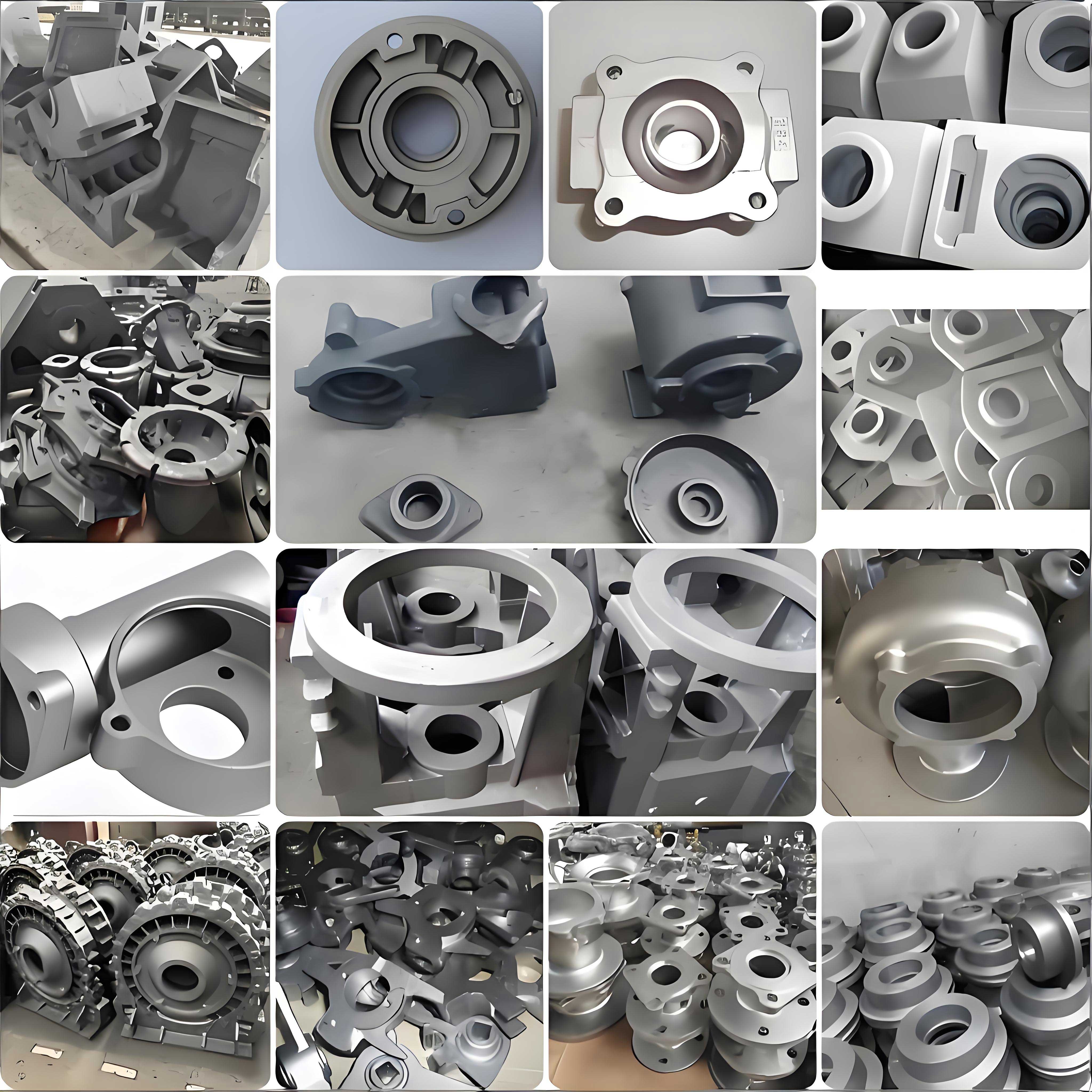
The filling simulation reveals that molten nodular cast iron flows steadily into the mold cavity without turbulence or splashing. This is crucial for minimizing defects like oxide inclusions and gas entrapment, which are common in nodular cast iron due to its high surface tension. The velocity profile can be analyzed using the Navier-Stokes equations: $$ \rho \left( \frac{\partial \mathbf{v}}{\partial t} + \mathbf{v} \cdot \nabla \mathbf{v} \right) = -\nabla p + \mu \nabla^2 \mathbf{v} + \rho \mathbf{g} $$ where \( \mathbf{v} \) is velocity, \( p \) is pressure, \( \mu \) is dynamic viscosity, and \( \mathbf{g} \) is gravity. For nodular cast iron, the viscosity is temperature-dependent, and EKK CAPCAST incorporates this variation to predict flow patterns accurately. The filling sequence shows that metal enters from the bottom and rises uniformly, with all four crankshaft cavities filled within 10 seconds. This aligns with Anycasting results, but EKK CAPCAST provides more detailed velocity vectors and pressure distributions, aiding in optimizing gating design for nodular cast iron castings.
Solidification analysis is where EKK CAPCAST truly shines. The software tracks temperature evolution over time, identifying isolated molten pools that lead to shrinkage cavities. For nodular cast iron, the solidification process is characterized by a long mushy zone, as described by the Scheil-Gulliver model: $$ C_s = k C_0 (1 – f_s)^{k-1} $$ where \( C_s \) is solid composition, \( C_0 \) is initial composition, \( k \) is partition coefficient, and \( f_s \) is solid fraction. However, for practical simulation, EKK CAPCAST uses enthalpy-based methods to account for latent heat release. The results indicate that regions with high modulus, such as the main journals of the crankshaft, solidify last. Specifically, the third main journal exhibits a large isolated molten pool, indicating a high risk of shrinkage defects. This is quantified using the Niyama criterion, often applied to predict porosity in castings: $$ NY = \frac{G}{\sqrt{T}} $$ where \( G \) is temperature gradient and \( T \) is cooling rate. For nodular cast iron, a low Niyama value correlates with shrinkage porosity. EKK CAPCAST allows direct measurement of potential shrinkage volume, enabling quantitative analysis. Below is a table comparing solidification times and isolated pool volumes for different crankshaft sections, based on EKK CAPCAST simulation at 1,400 °C pouring temperature.
| Crankshaft Section | Solidification Time (s) | Isolated Molten Pool Volume (mm³) |
|---|---|---|
| First Main Journal | 520 | 2.08 |
| Second Main Journal | 530 | 2.66 |
| Third Main Journal | 550 | 3.98 |
| Fourth Main Journal | 545 | 3.87 |
To validate EKK CAPCAST’s accuracy, I compare it with Anycasting software. Both predict similar defect locations, but EKK CAPCAST offers finer mesh resolution and more intuitive visualization of internal solidification. For instance, EKK CAPCAST displays the entire 3D solidification sequence, while Anycasting requires cross-sectional views. Moreover, EKK CAPCAST’s temperature-time curves from virtual thermocouples show distinct stages: liquid cooling, eutectic plateau, and solid cooling. For nodular cast iron, the eutectic plateau reflects undercooling, with a temperature drop of about 10 °C below the liquidus, consistent with实际 behavior due to graphite nucleation. This is captured well by EKK CAPCAST but less accurately by Anycasting. The cooling curve equation can be approximated as: $$ T(t) = T_0 – \frac{h A}{\rho c_p V} t $$ during initial cooling, where \( T_0 \) is pouring temperature, \( h \) is heat transfer coefficient, and \( A/V \) is surface area-to-volume ratio. For nodular cast iron, the heat transfer coefficient with green sand is around 500 W/(m²·K), varying with interface conditions.
Based on the simulation findings, I proceed to optimize the casting process for nodular cast iron. The first parameter adjusted is pouring temperature. While higher temperatures improve fluidity and feeding, they also increase液态收缩, potentially worsening shrinkage. To find the optimum, I simulate pouring temperatures from 1,370 °C to 1,420 °C and measure the shrinkage cavity volume in the third main journal using EKK CAPCAST’s ISO volume tool. The results are summarized in the table below, showing a minimum at 1,390 °C for all crankshafts. This trend can be modeled using a quadratic function: $$ V(T) = aT^2 + bT + c $$ where \( V \) is shrinkage volume and \( T \) is pouring temperature. For nodular cast iron, the coefficients depend on geometry and material properties.
| Pouring Temperature (°C) | Shrinkage Volume – Crankshaft 1 (mm³) | Shrinkage Volume – Crankshaft 2 (mm³) | Shrinkage Volume – Crankshaft 3 (mm³) | Shrinkage Volume – Crankshaft 4 (mm³) |
|---|---|---|---|---|
| 1,370 | 2.285 | 2.720 | 3.874 | 3.852 |
| 1,380 | 2.180 | 2.706 | 3.805 | 3.823 |
| 1,390 | 2.044 | 2.594 | 3.794 | 3.773 |
| 1,400 | 2.077 | 2.656 | 3.975 | 3.867 |
| 1,410 | 2.092 | 2.667 | 4.055 | 3.985 |
| 1,420 | 2.167 | 2.677 | 4.209 | 4.032 |
The data indicates that lowering the pouring temperature to 1,390 °C reduces shrinkage by approximately 5-10% for most crankshafts, but it does not eliminate defects entirely. Therefore, a second optimization step involves adding chills at the third connecting rod journal to accelerate cooling of the third main journal. Chills are metallic inserts that absorb heat rapidly, modifying the solidification sequence. The effectiveness of chills can be estimated using the Chvorinov’s rule: $$ t_s = B \left( \frac{V}{A} \right)^n $$ where \( t_s \) is solidification time, \( B \) is a mold constant, and \( n \) is an exponent (typically 2 for sand molds). By placing chills, the effective surface area \( A \) increases, reducing \( t_s \) for the hot spot. In EKK CAPCAST, I model chills as steel blocks with high thermal conductivity and simulate the process at 1,390 °C pouring temperature. The results show that the isolated molten pool in the third main journal disappears completely by 550 seconds, and shrinkage volume drops to zero. This is confirmed by comparing Niyama criterion maps before and after chill addition.
To quantify the improvement, I analyze the temperature gradient and cooling rate. With chills, the cooling rate \( \dot{T} \) in the third main journal increases significantly, which can be expressed as: $$ \dot{T} = \frac{T_l – T_s}{t_s} $$ where \( T_l \) and \( T_s \) are liquidus and solidus temperatures. For nodular cast iron, a higher cooling rate promotes finer graphite nodules and reduces shrinkage tendency. Additionally, the thermal modulus of the chilled region decreases, shifting the solidification order. The table below compares key parameters before and after optimization for the third main journal of the nodular cast iron crankshaft.
| Parameter | Before Optimization (1,400 °C, no chills) | After Optimization (1,390 °C, with chills) |
|---|---|---|
| Solidification Time (s) | 550 | 480 |
| Shrinkage Volume (mm³) | 3.98 | 0.00 |
| Peak Temperature Gradient (K/mm) | 15 | 25 |
| Cooling Rate at Eutectic (K/s) | 0.5 | 1.2 |
| Niyama Criterion Value | 0.8 | 2.5 |
The success of this optimization highlights the power of EKK CAPCAST for nodular cast iron casting simulation. Its finite element approach allows for precise modeling of complex geometries and accurate defect prediction. Moreover, the software enables quantitative analysis of shrinkage volumes, which is crucial for quality control in nodular cast iron production. In contrast to other software, EKK CAPCAST’s tetrahedral meshing better captures curved surfaces, and its algorithms account for material-specific behaviors like undercooling in nodular cast iron. From a broader perspective, simulation-driven optimization reduces scrap rates and enhances the mechanical properties of nodular cast iron components, contributing to sustainable manufacturing.
In conclusion, through this study, I demonstrate that EKK CAPCAST is an effective tool for simulating and optimizing the casting process of nodular cast iron crankshafts. By integrating JMatPro data, fine meshing, and advanced finite element methods, the software provides detailed insights into filling and solidification, enabling both qualitative and quantitative defect analysis. Optimizing pouring temperature to 1,390 °C and adding chills at strategic locations eliminates shrinkage cavities in critical areas. This approach can be extended to other nodular cast iron castings, leveraging simulation to achieve high-integrity parts. The continuous evolution of software like EKK CAPCAST promises further advancements in the foundry industry, particularly for challenging materials like nodular cast iron.