
The production of heavy-section nodular cast iron castings, typically defined as those with wall thicknesses exceeding 100 mm, represents a pinnacle of foundry metallurgical skill. The pursuit of consistent, high-quality material in such massive castings hinges on a profound understanding and precise control of molten metal chemistry. While factors like melt purity and temperature are crucial, the elemental composition forms the foundational blueprint upon which the final microstructure and mechanical properties are built. Deviations or imbalances can lead to a host of defects, from degenerate graphite forms and excessive carbide formation to severe segregation and impaired mechanical performance. Therefore, the selection and control of chemical elements is not merely a preparatory step but the central strategic decision in manufacturing heavy-section nodular cast iron. This discussion delves into the intricate roles of various elements, categorizing them based on their primary functions and influence, to establish a framework for designing robust chemical compositions for these demanding applications.
The performance envelope of heavy-section nodular cast iron is dictated by its unique solidification characteristics. The prolonged cooling times inherent to thick sections create an environment ripe for elemental segregation, graphite degeneration, and the destabilization of the desired ferritic or pearlitic matrix. Consequently, the chemical composition must be engineered not just for final properties but specifically to counteract these adverse slow-cooling effects. The key is to achieve a harmonious balance that promotes a high count of well-formed spheroidal graphite, suppresses unwanted phases like chunky or exploded graphite and carbides, and ensures homogeneity throughout the massive cross-section. This balance is struck through the careful management of main elements, strategic use of alloying elements, and the controlled application of trace elements.
1. The Foundational Role of Main Elements
The main elements—Carbon (C), Silicon (Si), Manganese (Mn), Sulfur (S), and Phosphorus (P)—constitute the bulk of the nodular cast iron matrix and establish its fundamental character. Their concentrations set the stage for graphite formation, matrix structure, and castability.
Carbon and Silicon: These are the primary graphitizing elements. Carbon provides the substance for graphite nucleation and growth. In heavy-section nodular cast iron, a higher carbon equivalent (CE) is generally beneficial for improving graphitization potential, feeding characteristics, and reducing shrinkage tendency. The carbon equivalent is commonly calculated as:
$$CE = \%C + \frac{1}{3}(\%Si + \%P)$$
For heavy sections, a CE in the range of 4.2% to 4.3% is often considered optimal to ensure proper feeding and minimize shrinkage porosity. However, the individual amounts must be carefully balanced. Excessively high carbon can lead to graphite flotation in very thick sections, while high silicon, though it strengthens ferrite, significantly raises the ductile-to-brittle transition temperature, which is detrimental for low-temperature applications. Therefore, silicon content is usually restricted, with lower limits applied for increasing wall thicknesses. A typical guideline is to maintain carbon between 3.4–3.7% and silicon between 1.8–2.2% for ferritic grades of heavy-section nodular cast iron.
Manganese: Manganese is a pearlite promoter and increases hardenability. Its most significant drawback in heavy-section nodular cast iron is its strong tendency to segregate at the boundaries of eutectic cells during slow cooling. This segregation can lead to the formation of intercellular carbides or stabilize pearlite in localized regions, severely impairing toughness and ductility. For ferritic grades, manganese must be kept as low as possible, ideally below 0.3%. Even for pearlitic grades, it is rarely allowed above 0.5% in heavy sections to avoid excessive segregation.
Sulfur and Phosphorus: These are universally considered detrimental impurities, and their control is paramount. Sulfur is a powerful anti-nodularizing element; it reacts with magnesium and cerium from the nodulizing treatment, consuming them and potentially leading to fading and degenerate graphite. While very low residual sulfur is desired post-treatment, a minimal amount in the base iron (e.g., 0.01–0.03%) is necessary to provide nucleation sites. Phosphorus is a severe embrittling element. It forms steadite, a hard, brittle phosphide eutectic that networks along grain boundaries. Its segregation tendency is exacerbated in slow-cooling heavy sections. To maintain adequate toughness, phosphorus levels in heavy-section nodular cast iron are typically stridently controlled to a maximum of 0.02–0.03%.
| Main Element | Primary Role/Effect | Typical Target Range for Heavy-Section Nodular Cast Iron | Key Considerations for Thick Sections |
|---|---|---|---|
| Carbon (C) | Graphitizer, affects fluidity and shrinkage. | 3.4 – 3.7 % | High CE (4.2-4.3%) preferred for feeding. Risk of graphite flotation at very high C. |
| Silicon (Si) | Graphitizer, ferrite strengthener. | 1.8 – 2.2 % | Higher Si raises brittle transition temperature. Content often reduced as section size increases. |
| Manganese (Mn) | Pearlite promoter, increases hardenability. | 0.1 – 0.4 % (Ferritic: <0.3%) | Pronounced negative segregation. Kept low to prevent intercellular carbides and preserve toughness. |
| Sulfur (S) | Anti-nodularizing element. | 0.01 – 0.03 % (base iron) | Consumes nodulizers. Very low residual S desired after treatment, but some base S aids nucleation. |
| Phosphorus (P) | Forms brittle intergranular phosphides. | < 0.02 – 0.03 % | Severe segregation in slow cooling. Must be minimized to prevent embrittlement. |
2. Nodulizing Elements: Magnesium and Rare Earths
The transformation of graphite from flakes to spheres is achieved through the addition of nodulizing elements, primarily Magnesium (Mg) and Rare Earths (RE, like Cerium, La). Their residual levels post-treatment are critical process control parameters.
Magnesium (Mg): Magnesium is the workhorse of nodularization. It has a strong affinity for sulfur and oxygen, purifying the melt. Its vaporization during treatment causes agitation, promoting homogeneity. The key parameter is residual magnesium (Mg_res). An optimal level (typically 0.04–0.06%) ensures a high graphite nodule count and good nodularity. However, excess residual magnesium increases the tendency for carbide formation, can promote dross defects, and widens the solidification range, potentially increasing shrinkage porosity susceptibility. The relationship can be conceptualized as needing sufficient Mg to neutralize interfering elements and promote spheroid growth:
$$[Mg]_{effective} = [Mg]_{residual} – k[S]_{residual} – \Sigma(k_i[Int]_i)$$
where $[Int]_i$ represents other interfering elements and $k$, $k_i$ are interaction coefficients.
Rare Earths (RE): Rare earth elements are powerful desulfurizers and deoxidizers. They are particularly effective in counteracting the deleterious effects of certain trace “interfering” elements (like Pb, Sb, Bi) that can disrupt graphite spheroidization. In heavy-section nodular cast iron, rare earths are often used in conjunction with magnesium to improve nodulizing fade resistance over long processing and solidification times. A typical combined treatment might aim for a residual RE level of 0.01–0.03%. The ratio of residual RE to residual S is sometimes monitored, with a target near 1.5–2.0 for optimal performance in thick sections.
3. Strategic Use of Alloying Elements
Alloying elements are added in moderate amounts (usually less than 2-3% total) to achieve specific matrix structures or enhance particular properties in heavy-section nodular cast iron.
Copper (Cu) and Nickel (Ni): Both are graphitizing elements that promote pearlite formation and strengthen the matrix without forming carbides. They improve hardenability and uniformity of properties across thick sections. Nickel is especially valued in low-temperature ferritic grades because it strengthens ferrite and improves toughness without significantly raising the ductile-brittle transition temperature. Copper is more cost-effective but can increase susceptibility to micro-shrinkage if over-added. Typical additions range from 0.5–1.5% for Ni and up to 0.8% for Cu in heavy-section nodular cast iron.
Molybdenum (Mo): Molybdenum is a potent hardenability agent that distributes evenly, resisting segregation better than manganese. It is used to ensure a fully pearlitic or ausferritic matrix in thick sections or to impart high-temperature strength. It refines the eutectic cell structure and improves uniformity. Additions are usually in the range of 0.1–0.3%.
Chromium (Cr) and Vanadium (V): These are strong carbide formers and must be used with extreme caution. While they can increase strength, hardness, and wear resistance, their powerful tendency to form stable carbides, especially in the intercellular regions of slowly cooled heavy-section nodular cast iron, can catastrophically reduce ductility and toughness. If used, levels are kept very low, often below 0.1%.
| Alloying Element | Primary Role/Effect | Typical Addition Range for Heavy Sections | Considerations & Risks |
|---|---|---|---|
| Copper (Cu) | Pearlite promoter, strengthens matrix, mild graphitizer. | 0.2 – 0.8 % | Improves uniformity. High levels may increase shrinkage tendency. |
| Nickel (Ni) | Pearlite/ferrite strengthener, graphitizer, improves low-temperature toughness. | 0.5 – 1.5 % | Excellent for low-temperature grades. Reduces section sensitivity. |
| Molybdenum (Mo) | Powerful hardenability agent, refines structure, improves high-temperature strength. | 0.1 – 0.3 % | Resists segregation. Essential for heavy-section pearlitic or ADI grades. |
| Chromium (Cr) | Strong carbide former, pearlite promoter. | < 0.05 – 0.1 % | High risk of intercellular carbides and embrittlement in thick sections. Use sparingly. |
| Vanadium (V) | Strong carbide former, strengthens matrix. | < 0.1 % | Similar to Cr. Can cause severe embrittlement due to carbide networks. |
4. The Delicate Art of Trace and Minor Elements
Elements added in very small quantities (often a few hundredths of a percent) can have disproportionately large effects on the microstructure of heavy-section nodular cast iron. Their use is a delicate art, often requiring the presence of rare earths to mitigate potential harm.
Antimony (Sb) and Tin (Sn): Both are powerful pearlite promoters. In minute amounts (0.005–0.02%), they can be used to ensure a fully pearlitic matrix in thick sections where manganese alone is insufficient due to its segregation. They segregate to the graphite/liquid interface, stabilizing the growth front. However, over-addition leads to graphite degeneration (compacted or spiky forms) and embrittlement.
Bismuth (Bi): Bismuth is intriguing. When added alone, it is a strong anti-nodularizer. However, in the presence of sufficient rare earths, it forms stable compounds that act as potent nuclei for graphite. In heavy-section nodular cast iron, controlled additions of Bi (0.005–0.01%) with RE can significantly increase graphite nodule count, improve nodularity, and reduce the risk of degenerate graphite forms like chunky graphite, which is a common plague in thick sections. The beneficial interaction can be thought of as RE “neutralizing” Bi’s harmful effect and transforming it into a useful tool.
Lead (Pb) and Tellurium (Te): These are severe interfering elements if present as impurities. However, in extremely controlled, minute traces (ppm levels), and under the protection of RE, they have been reported to sometimes improve graphite morphology in heavy-section nodular cast iron by affecting the stability of the austenite shell around growing nodules. This is a highly specialized practice and is generally avoided due to the high risk of causing defects.
The effect of these elements often relates to their segregation coefficient, $k$, defined as the ratio of their concentration in the solid to that in the liquid at the interface during solidification. For elements with $k < 1$ (like Sb, Sn), they enrich in the last-to-freeze liquid, impacting final stage solidification and graphite growth. The lever rule from equilibrium phase diagrams gives an approximation of segregation:
$$C_s = k C_0$$
$$C_l = C_0 [1 + (1-k)f_s] / [1 – (1-k)f_s]$$
where $C_s$ is solid concentration, $C_l$ is liquid concentration, $C_0$ is nominal composition, and $f_s$ is solid fraction. In reality, non-equilibrium conditions in heavy-section nodular cast iron make segregation more complex.
| Trace Element | Typical Controlled Addition | Effect with RE Protection | Risk of Over-Addition |
|---|---|---|---|
| Antimony (Sb) | 0.005 – 0.02 % | Promotes pearlite, can stabilize graphite growth. | Graphite degeneration (compacted), embrittlement. |
| Tin (Sn) | 0.02 – 0.08 % | Strong pearlite promoter for thick sections. | Embrittlement, increased shrinkage tendency. |
| Bismuth (Bi) | 0.005 – 0.01 % | Increases nodule count, fights chunky graphite. | Without RE, causes graphite flake formation. |
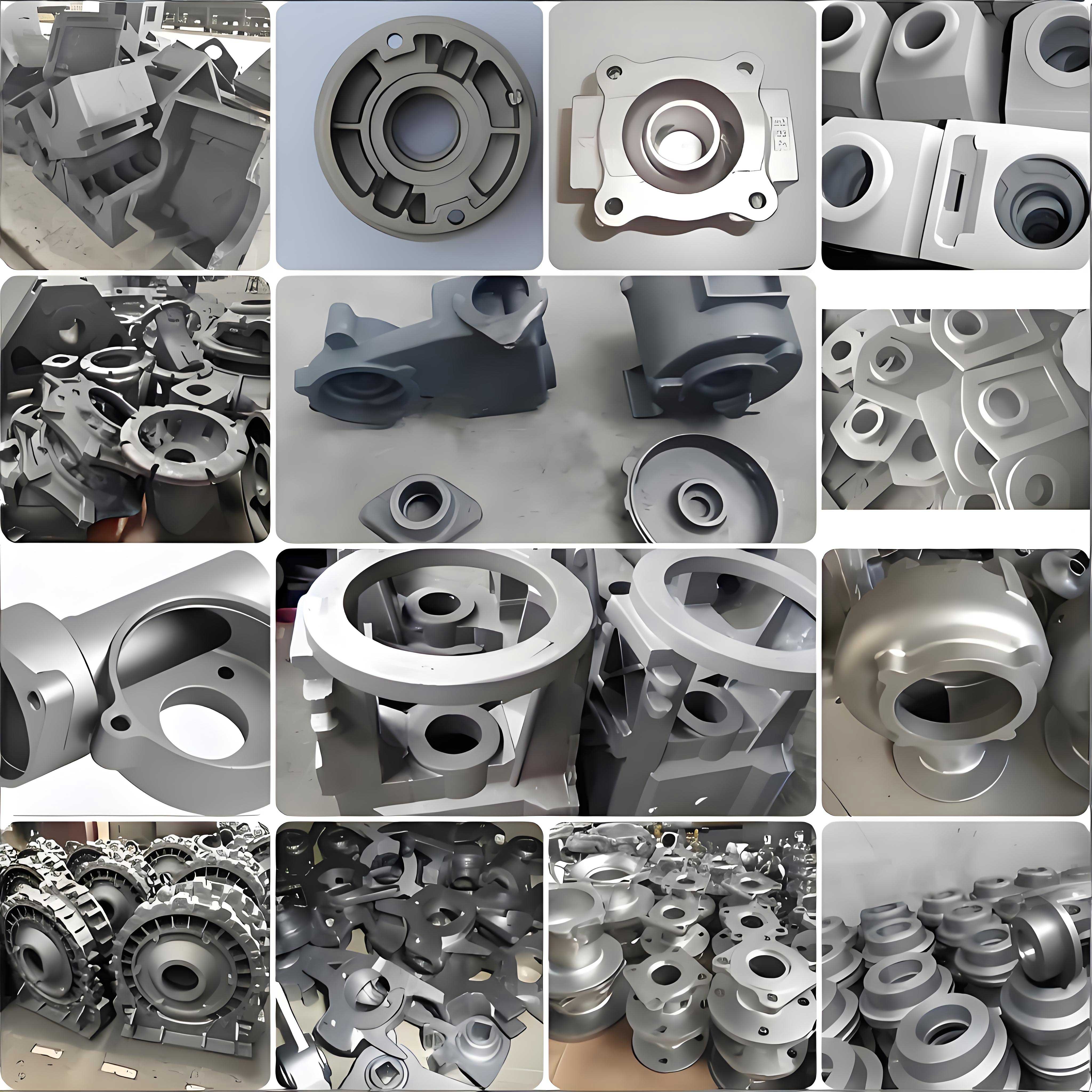
5. Composition Design in Practice: Case Studies for Heavy-Section Nodular Cast Iron
The theoretical principles of chemistry control are crystallized in practical production. Here are illustrative examples of how compositions are tailored for specific heavy-section nodular cast iron components.
Case 1: Large Injection Molding Machine Platen (Ferritic Grade): A platen weighing over 50 tons with a maximum wall thickness of ~480 mm, required to have good machinability and moderate strength (e.g., QT500-7). The focus is on preventing degenerate graphite and achieving a predominantly ferritic matrix with good toughness. The chemistry would emphasize low Mn and P, controlled Si for low-temperature transition, and possibly a small Ni addition for toughness enhancement and uniformity. A high carbon equivalent ensures soundness.
Case 2: Hydraulic Cylinder Barrel (Pearlitic Grade): A cylinder barrel with a thick wall (~300 mm) requires high strength (QT600-3 or higher) and pressure tightness. The composition must promote a uniform, fine pearlitic matrix throughout the thick section. Alloying with Cu and/or Ni is common, and a small, controlled addition of Sn or Sb might be used to guarantee pearlite formation in the core. Molybdenum could be added to increase hardenability and ensure strength uniformity. Residual magnesium must be tightly controlled to avoid micro-shrinkage that compromises pressure integrity.
Case 3: Bearing Housing for Heavy Machinery (Low-Temperature Ferritic Grade): For applications like wind energy or mining, bearing housings made of heavy-section nodular cast iron (e.g., EN-GJS-400-18U-LT) require excellent elongation and impact toughness at sub-zero temperatures. The chemistry is austere: very low Mn (<0.2%), very low P (<0.02%), controlled Si (often lower end of range), and strategic use of Ni (0.5-1.0%) to strengthen ferrite without harming low-temperature properties. Rare earth treatment is critical to counteract trace elements.
The following table summarizes example target chemistries for these hypothetical but representative cases of heavy-section nodular cast iron.
| Element | Case 1: Thick Ferritic Platen (QT500-7) | Case 2: High-Strength Cylinder (QT600-3) | Case 3: Low-Temp Bearing Housing (EN-GJS-400-18U-LT) |
|---|---|---|---|
| C | 3.6 – 3.7 % | 3.5 – 3.6 % | 3.6 – 3.7 % |
| Si | 1.9 – 2.1 % | 2.0 – 2.2 % | 1.8 – 2.0 % |
| Mn | < 0.25 % | 0.3 – 0.4 % | < 0.20 % |
| P | < 0.03 % | < 0.03 % | < 0.02 % |
| S (base) | < 0.02 % | < 0.02 % | < 0.015 % |
| Mg_res | 0.04 – 0.05 % | 0.04 – 0.05 % | 0.04 – 0.05 % |
| Cu | — | 0.4 – 0.6 % | — |
| Ni | 0.3 – 0.5 % (optional) | — | 0.7 – 1.0 % |
| Mo | — | 0.1 – 0.2 % (optional) | — |
| Sn/Sb | — | Sn: 0.02 – 0.04 % | — |
| CE | ~4.3 % | ~4.2 % | ~4.3 % |
6. Synthesis and Concluding Principles
Mastering the chemistry of heavy-section nodular cast iron is an exercise in systems engineering. No single element acts in isolation; each influences the behavior of others and the overall solidification system. The primary goal is to design a composition that achieves thermodynamic and kinetic stability for the desired microstructure—fine, well-formed spheroidal graphite embedded in a uniform, defect-free matrix of the required phase (ferrite, pearlite, or ausferrite).
Key governing principles emerge:
- Combat Segregation: Minimize elements with low segregation coefficients (k << 1) like Mn, P, and certain trace elements. This is fundamental to achieving property uniformity in heavy-section nodular cast iron.
- Promote Graphite Stability: Ensure sufficient graphitizing potential (via C, Si, CE) and effective nodulization (via Mg, RE) to counteract the long time available for graphite degeneration during slow cooling. The graphite nodule count, $N_v$, is a critical metric influenced by nucleation potency, which is affected by chemistry and cooling rate, $\dot{T}$: $N_v \propto f(Composition, \dot{T}^{-n})$. In thick sections, $\dot{T}$ is very small, making compositional control of nucleation even more vital.
- Control Matrix Phase: Use alloying and trace elements strategically to “steer” the matrix transformation during the extended cooling cycle, whether towards ferrite (low Mn, Ni) or pearlite (Cu, Sn, Sb, controlled Mn).
- Ensure Soundness: A properly calculated carbon equivalent and controlled residual magnesium level are essential to promote eutectic expansion and minimize shrinkage porosity, a major concern in heavy-section nodular cast iron.
Ultimately, the successful production of heavy-section nodular cast iron relies on a composition that is in perfect harmony with the casting’s geometry, the production process (gating, risering, cooling rate), and the final technical specifications. It is a tailored recipe, not a generic formula. The continuous pursuit is to leverage this deep chemical understanding to fully unlock the material’s potential, guarantee the unwavering consistency and reliability of massive castings, and do so within a framework of economic viability. This is the essence of the metallurgical craft applied to heavy-section nodular cast iron.