
The relentless pursuit of lightweighting and emission reduction within the commercial vehicle industry has catalyzed a significant material evolution. Among various contenders like low-alloy cast steels, forgings, and aluminum alloys, high-performance nodular cast iron (often referred to as ductile iron) has secured a prominent position due to its exceptional combination of high specific strength, good ductility and toughness, excellent wear resistance, and superior damping capacity. My focus here is to delve into the application landscape of the 800–1000 MPa grade high-performance nodular cast iron within the domestic heavy-duty truck chassis sector, examining its technical requirements, process innovations, implementation case studies, and the prevailing challenges.
The fundamental appeal of high-performance nodular cast iron lies in its unique microstructure, where the graphite exists in spheroidal form, effectively bluntifying crack tips and imparting both strength and ductility. For chassis components, which endure complex multiaxial stresses, vibrations, and impact loads, this combination is critical. The 800-1000 MPa grade represents a class of materials that pushes the boundaries of traditional ferritic or pearlitic grades, offering a compelling alternative for weight-saving design while maintaining or enhancing structural integrity. The primary production routes for these chassis components, such as various brackets and supports, include sand casting, lost foam casting, and investment casting.
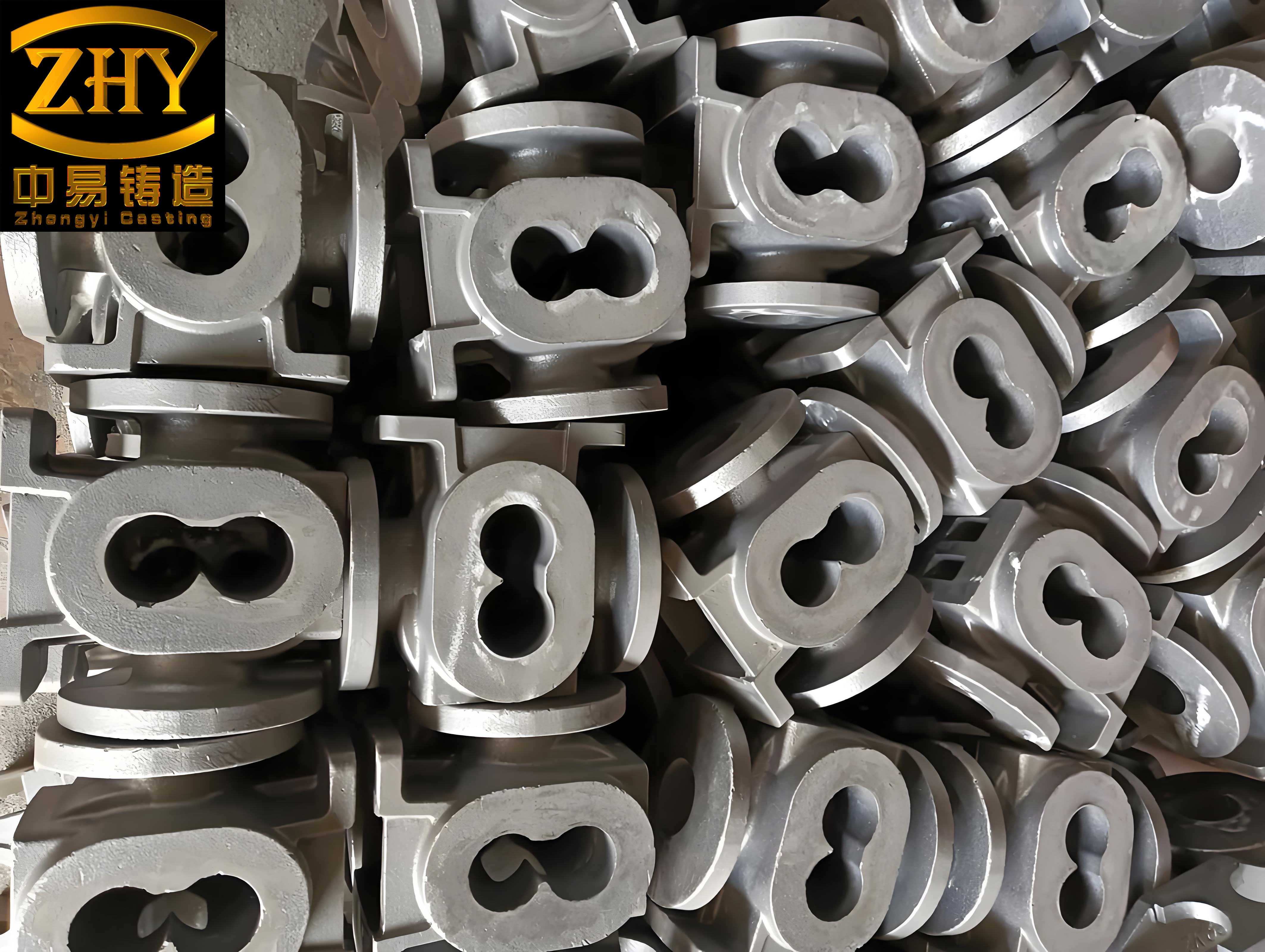
The application spectrum broadly bifurcates into two categories: as-cast supplied components and austempered ductile iron (ADI) castings. Each path has its distinct metallurgical and processing philosophy to achieve the target performance envelope.
As-Cast High-Performance Nodular Cast Iron Components
Achieving tensile strengths of 800 MPa or higher in the as-cast condition demands extraordinarily stringent control over the entire manufacturing chain. It begins with raw material selection: high-purity pig iron is essential to minimize trace elements like Ti, Sb, Pb, and others that interfere with graphite nodulization. Similarly, selected steel scrap must be low in Mn, P, and S. The predominant grade targeted for chassis applications is QT800-5, with a density of approximately 7.3 g/cm³, a minimum tensile strength ($R_m$) of 800 MPa, yield strength ($R_{p0.2}$) of 480 MPa, elongation (A) of 5%, and a hardness range of 245–335 HBW. The key technological measures involve:
- Alloying for Matrix Strengthening: Elements like Copper (Cu) and Manganese (Mn) are added in controlled amounts to promote a strong, predominantly pearlitic matrix without excessive carbide formation. A typical base iron chemistry might aim for: $C \approx 3.3-3.5\%$, $Si \approx 2.3-2.5\%$, $Mn \approx 0.8-1.0\%$, $Cu \approx 0.7-0.9\%$.
- Advanced Nodulizing and Inoculation: The process employs low-Mg, low-rare earth nodulizers (e.g., FeSiMg6RE2) to achieve a high nodule count with minimal dross. A multi-stage inoculation strategy is critical, using barium-containing ferrosilicon inoculants (e.g., 75SiFe for ladle treatment, 4-8mm BaFeSi for pouring stream, and 2-4mm BaFeSi for in-mold inoculation) to ensure graphite nodule refinement and counteract chilling tendencies.
The goal is to achieve a matrix with pearlite content $ \geq 85\% $ and a nodularity rating of 1 or 2, directly yielding the desired mechanical properties without subsequent heat treatment. Pioneering foundries have demonstrated that through meticulous process control, the as-cast nodular cast iron can reliably meet the QT800-5 specification.
A transformative technology in this domain is the pure magnesium convertor process, as utilized by companies like Georg Fischer (GF). In this method, magnesium metal is vaporized in a sealed reaction chamber, allowing for highly efficient and calm treatment. The advantages are profound: it allows treatment of high-sulfur base iron (up to 0.2% S), achieves high Mg recovery rates (~60%), minimizes temperature loss (~40°C less than conventional methods), and crucially, does not introduce additional silicon, offering greater flexibility in final chemistry control. Coupled with automated, pressure-controlled pouring furnaces that maintain consistent temperature and composition under a protective atmosphere, this technology enables the production of very high-quality, consistent as-cast nodular cast iron components.
Austempered Ductile Iron (ADI) Components
Austempered Ductile Iron represents a paradigm shift, where the as-cast nodular cast iron is subjected to a specific heat treatment to engineer a unique matrix microstructure called ausferrite—a mixture of acicular ferrite and high-carbon, thermally stable austenite. This structure eliminates brittle carbides and grants ADI an outstanding combination of strength and toughness, far surpassing conventional grades. The standard GB/T 24733-2009 defines several ADI grades, with those relevant for chassis being QTD800-10, QTD900-8, and QTD1050-6. Their mechanical properties are summarized below:
| Grade | Tensile Strength, $R_m$ (MPa) | Yield Strength, $R_{p0.2}$ (MPa) | Elongation, $A$ (%) |
|---|---|---|---|
| QTD800-10 | 800 | 500 | 10 |
| QTD900-8 | 900 | 600 | 8 |
| QTD1050-6 | 1050 | 700 | 6 |
The basic physical properties include an elastic modulus of ~170 GPa, a Poisson’s ratio of 0.28, and a density of about 7.7 g/cm³. The standard heat treatment process involves:
1. Austenitizing: Heating the casting to $850-950^\circ\text{C}$ to obtain a homogeneous austenite matrix saturated with carbon.
2. Quenching: Rapidly transferring the part to a salt bath or fluidized bed furnace at the ausferrite transformation temperature, typically between $250^\circ\text{C}$ and $400^\circ\text{C}$.
3. Isothermal Holding: Maintaining the temperature for 1-4 hours to allow the complete transformation to ausferrite.
4. Cooling: Air cooling to room temperature.
The resulting microstructure provides exceptional fatigue strength and wear resistance. In heavy-duty truck chassis, ADI is strategically used to replace standard nodular cast iron grades, forged steel parts (like 40Cr), or cast steel components. Notable applications and trials include replacing multiple chassis parts on high-mobility trucks, achieving weight savings of nearly 40%, and developing lighter, more robust front axles, steering knuckles, and wheel hubs for mining and haulage trucks.
Current Application Landscape in Domestic Heavy-Duty Trucks
The adoption of 800-1000 MPa grade nodular cast iron is expanding across major Chinese commercial vehicle manufacturers. The table below provides a snapshot of its implementation:
| OEM / Supplier | Component Examples | Application Stage / Vehicle Type |
|---|---|---|
| Shaanxi Automobile Group | Balance Shaft Bracket, Front Extension Beam Bracket, Leaf Torsion Spring Bracket, Plate Spring Bracket | Heavy-Duty Trucks (Batch Production) |
| FAW Group | Tow Hook, Plate Spring Bracket | Medium/Heavy-Duty Trucks |
| Dongfeng Motor Corporation | Chassis Left/Right Brackets, Gear Housings, Control Arms, Steering Knuckles (for trial) | Heavy-Duty Trucks, Off-road Vehicles |
| Specialized Foundries (e.g., Henan ADI, Hebei Hengji) | Quick-Change Brackets, Lock Hooks, Spring Guides, Tow Hooks, ADI Brackets & Hangers | Engineering Machinery, Heavy-Duty Trucks |
Detailed Application Case Study: Balance Shaft Bracket Lightweighting
A concrete example illustrating the power of high-performance nodular cast iron is the redesign of a balance shaft bracket for a heavy-duty truck. The original component, manufactured in QT500-7, weighed 51 kg. The objective was to utilize QT800-5 to enable a more efficient design.
Design Optimization & CAE Analysis: The design was revised with uniform wall thickness principles (reducing main walls from 14-16 mm to 12 mm) to suit the casting characteristics of nodular cast iron. Finite Element Analysis (FEA) was performed under critical loading scenarios:
– Vertical Load Case: $F_z = 220 \text{ kN}$
– Braking Load Case: $F_z = 90 \text{ kN}$, $F_x = 120 \text{ kN}$
The constraints simulated the actual bolting conditions to the frame. The optimized design, weighing only 36 kg, maintained equivalent or better stress distribution and safety factors compared to the original. The mass reduction of 15 kg translates to a 29% weight saving per bracket.
Process Implementation & Quality Assurance: The production of the QT800-5 bracket required precise metallurgical control:
– Charge Makeup: Sequential charging of steel scrap, pig iron, and returns, with controlled addition of high-purity carburizer (Fixed C ≥ 98%, S ≤ 0.03%).
– Melting & Treatment: Tapping temperature control, followed by a sandwich ladle treatment using 1.5% nodulizer (low-RE type) and multiple stages of BaFeSi inoculation.
– Process Simulation: Solidification modeling confirmed a predominantly directional solidification pattern, with predicted minor shrinkage in non-critical areas, which was later verified by sectioning actual castings.
Mechanical & Metallurgical Verification: Test coupons extracted from critical sections of the casting本体 confirmed the properties exceeded specifications:
– Tensile Strength: $R_m > 800 \text{ MPa}$
– Elongation: $A > 5\%$
– Hardness: ~250 HBW
– Microstructure: Nodularity Grade 3, Nodule Size Grade 6, Pearlite volume fraction ~80%.
The successful on-vehicle road tests validated the component’s performance under real-world conditions, proving the viability of using high-performance as-cast nodular cast iron for significant lightweighting.
Prevailing Challenges in Widespread Adoption
Despite the clear technical advantages, several hurdles impede the broader application of high-performance nodular cast iron in chassis components.
1. Economic Viability and Cost Pressure: While as-cast grades avoid the cost of heat treatment, the stringent requirement for high-purity raw materials (low-trace element pig iron, quality scrap) and specific alloying additions (Cu, Ni, Mo) inflates the raw material cost. For ADI, the additional austempering heat treatment adds a significant process cost. The central question is whether the weight-saving benefit (leading to fuel savings and potential payload increase) can consistently offset these elevated production costs, especially in the highly price-sensitive commercial vehicle market. The economic equation must be favorable for large-scale adoption.
2. Technical Consistency and Process Stability: The production of high-integrity, high-performance nodular cast iron castings involves numerous interactive process variables: melting, nodulization, inoculation, pouring, and cooling. The capability of foundries varies significantly. The primary challenge is not achieving the target properties on a few samples but ensuring batch-to-batch consistency in mechanical properties (especially fatigue strength), microstructure, and freedom from detrimental defects like shrinkage, slag inclusions, or degenerate graphite. Variability in supplier quality directly impacts design confidence and safety factor margins.
3. Integrated Design & Manufacturing Collaboration: Often, component design (driven by OEM CAE teams focusing on service loads) and manufacturing process design (handled by foundry engineers focusing on castability) occur in silos. This lack of simultaneous engineering can lead to designs that are optimal for stress but challenging to cast soundly, or conversely, easily castable designs that don’t fully exploit the material’s potential. A closed-loop, collaborative approach using integrated simulation tools—linking structural FEA with solidification and stress modeling—is essential. This allows for the co-optimization of geometry, material selection (e.g., as-cast QT800-5 vs. QTD900-8), and process parameters to predict and mitigate defects, ultimately leading to lighter, more reliable, and cost-effective components.
Conclusion
High-performance nodular cast iron in the 800-1000 MPa range, available both in as-cast and austempered forms, presents a formidable solution for the lightweighting of heavy-duty truck chassis. Its superior specific strength and good ductility enable significant mass reduction in structural components like brackets, supports, and even more complex parts like steering knuckles, directly contributing to improved fuel efficiency and payload capacity. The successful case study of the balance shaft bracket underscores this potential. Advancements in processing technologies, such as the pure magnesium convertor, are enhancing the quality and consistency of as-cast grades. However, the path to ubiquitous adoption is paved with challenges related to cost competitiveness, achieving robust production consistency, and fostering deeper, simulation-driven collaboration between designers and foundries. Addressing these challenges holistically will unlock the full potential of high-performance nodular cast iron, making it a cornerstone material in the ongoing quest for lighter, stronger, and more sustainable commercial vehicles.