
This work details the comprehensive process design, simulation, and optimization undertaken for the production of a critical grey iron casting: the upper half of a large bearing housing. The bearing housing is a foundational component in mechanical power transmission systems. Its primary function is to support and accurately position the bearing’s outer ring, ensuring the inner ring rotates with high precision and minimal friction. The dimensional and microstructural integrity of this grey iron casting, particularly its internal bore and mounting base, is paramount for the overall reliability and efficiency of the machinery. The component under study, with a nominal material of HT250, presents a significant challenge due to its complex geometry featuring substantial variations in wall thickness. This non-uniformity inevitably leads to the formation of thermal hot spots during solidification, which are prime locations for shrinkage defects like porosity and cavities. Traditional trial-and-error methods for process design are not only time-consuming and costly but also provide limited insight into the complex thermal phenomena occurring within the mold. Therefore, this study employs numerical simulation as a core tool to augment traditional foundry knowledge. Using ProCAST software, the entire filling and solidification sequence was virtually analyzed. This allowed for a theoretical assessment of an initial process design, identification of defect-prone zones, and a systematic, physics-based optimization involving risers and chills to achieve sound grey iron casting.
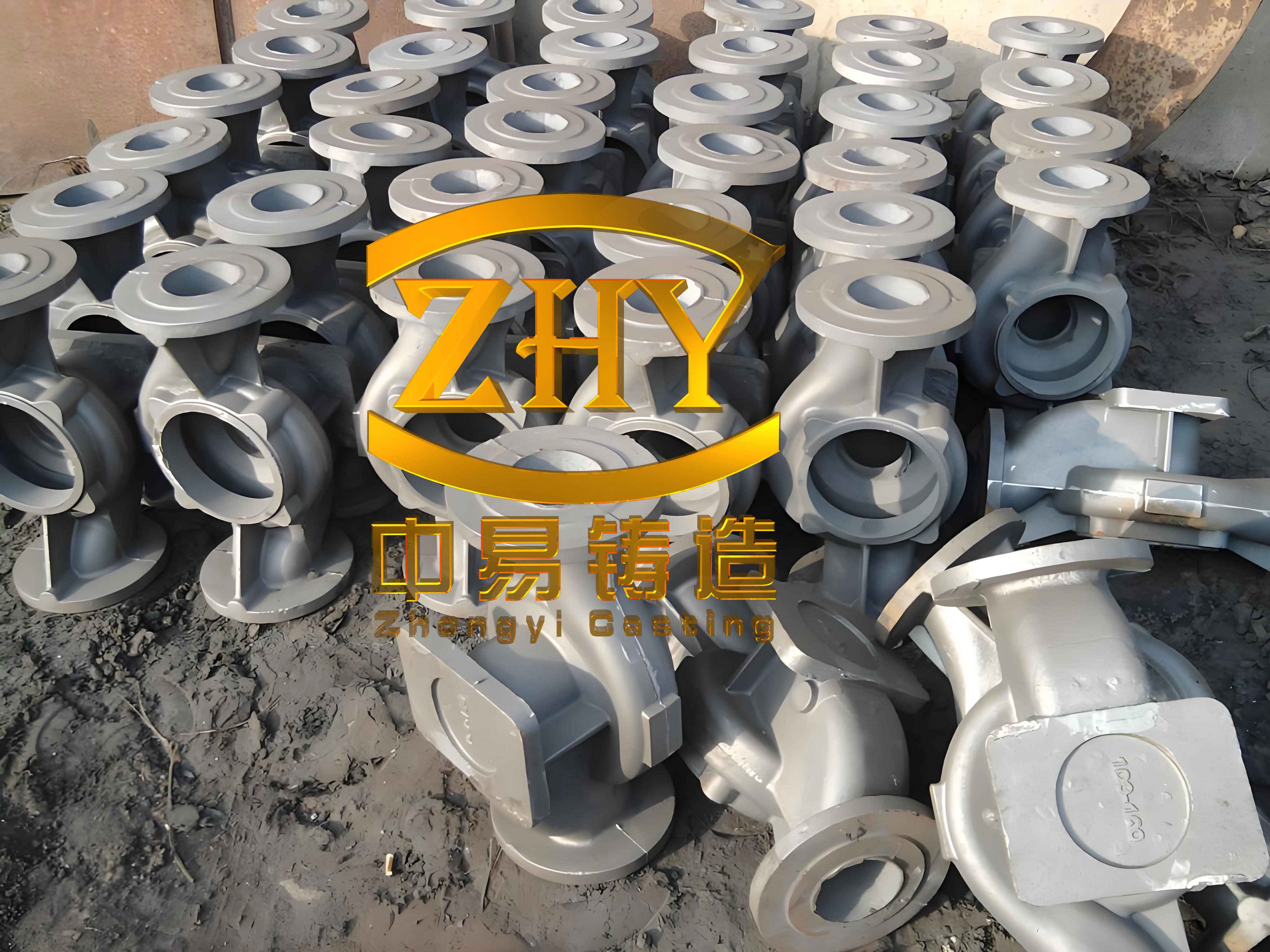
Process Analysis and Initial Design for Grey Iron Casting
The subject of this grey iron casting study is the upper section of a bearing housing. Its external envelope measures 1085 mm in length, 910 mm in width, and 380 mm in height. The component features a hollow internal structure with a large, flat base surface designed for bolting. The most critical aspect of its geometry is the pronounced variation in wall thickness, ranging from a minimum of 20 mm to a maximum of 145 mm. This severe disparity dictates the thermal behavior during casting and is the root cause of potential defects. The material specified is grey iron grade HT250, with a nominal composition leading to a predominantly pearlitic matrix with flake graphite. This class of material offers an excellent combination of strength, wear resistance, damping capacity, and crucially for casting, a favorable solidification characteristic. The volumetric expansion associated with the growth of graphite flakes during the eutectic reaction can compensate for a significant portion of the metal’s liquid and solidification shrinkage. This self-feeding tendency reduces, but does not eliminate, the demand for external feed metal from risers, especially in heavy sections.
Given the component’s size (weighing approximately 566 kg) and the requirement for small-batch production, sand casting with acid-catalyzed furan resin no-bake sand was selected. This binder system offers good thermal stability and is well-suited for jobbing foundry work. For the grey iron casting process design, three potential pouring orientations were initially considered. The selected orientation placed the critical, large mounting base face at the bottom of the mold. This choice ensures superior surface quality on this key functional area, facilitates core placement and stability, and positions the thickest sections of the casting in the upper regions, which is beneficial for later placement of feeding risers. Although this orientation may require more molding complexity, its benefits for quality outweigh the drawbacks. A simple two-part mold with a single parting plane along the bottom edge of the housing was chosen to maximize dimensional accuracy and simplify molding.
The gating system was designed as a pressurized, bottom-gating configuration. This design promotes a calm, upward fill of the mold cavity, minimizing turbulence, oxide formation, and sand erosion. The system consists of one downsprue, one horizontal runner, and multiple ingates. The cross-sectional area of the choke (the ingates) was first calculated using empirical relations like the Oseen formula, considering the poured metal weight and desired fill time. For a grey iron casting of this size, the pouring time can be estimated using an empirical formula:
$$ t = S_1 \cdot \sqrt[3]{\delta \cdot G_L} $$
where \( t \) is the pouring time in seconds, \( S_1 \) is an empirical coefficient (taken as 1.7 for fast pouring), \( \delta \) is the average wall thickness, and \( G_L \) is the total mass of metal in the mold. With a casting weight of 566 kg and a total poured weight of approximately 679 kg, the calculated fill time was approximately 46.4 seconds. Based on this and the selected area ratios for a pressurized system (\( \sum A_{sprue} : \sum A_{runner} : \sum A_{ingate} = 1.15 : 1.1 : 1 \)), the final dimensions for the gating system were determined and are summarized in the table below.
| Gating Element | Cross-Sectional Area (cm²) | Dimensions (mm) |
|---|---|---|
| Sprue (Choke) | 10.06 | Diameter: Ø 36 |
| Runner | 9.63 | Rectangular |
| Ingates | 8.75 | Multiple, Rectangular |
Numerical Simulation Methodology and Initial Results
The three-dimensional model of the bearing housing was created and meshed for finite element analysis. The simulation setup for this grey iron casting process included defining the following key boundary conditions: a pouring temperature of 1350°C, a mold and core initial temperature of 20°C, and the calculated fill time of 46.4 seconds. The thermo-physical properties of the HT250 iron and the furan resin sand were assigned from the software’s material database.
The filling simulation revealed a smooth and sequential mold fill. Metal entered the cavity from the bottom ingates at around 4.92 seconds and progressively rose to fill the entire cavity by approximately 47.71 seconds, closely matching the designed fill time. The temperature distribution during filling showed minimal cooling in the runner system early on, confirming the adequacy of the gating dimensions. The fill time contour plot displayed uniform bands of color, indicating a stable, non-turbulent fill front, which is ideal for reducing defects in grey iron casting. Post-filling, the solidification simulation was analyzed to map the thermal history. The natural solidification sequence, driven by geometry, clearly identified five major thermal hot spots where cooling was significantly slower than in the surrounding thin walls. These locations, typically at junctions and the thickest sections, are where shrinkage defects were predicted to nucleate in the absence of effective feeding.
A shrinkage porosity prediction analysis was performed on the initial design, which lacked any risers or chills. The results, as expected, confirmed significant defect formation precisely at the identified hot spots. The largest volume of predicted porosity was located in the central, thickest section of the casting. Other notable defect zones appeared in the rear thin-walled flange areas and other section transitions. This simulation provided a clear visual and quantitative map of the problem areas, forming the baseline against which optimization efforts could be measured.
Process Optimization Strategy for Defect Reduction
Guided by the principle of directional solidification—where the casting cools progressively from the extremities toward a designed feed source—the optimization strategy combined the use of insulating risers and chills. The goal is to modify the natural thermal gradients to ensure that the thermal hot spots remain liquid longest and are connected to a liquid feed metal source (the riser) until they themselves solidify.
Riser Design: For this grey iron casting, two top, open risers were designed using the modulus method, a common approach where the riser’s modulus (Volume/Surface Area) is made larger than that of the section it is intended to feed. The riser dimensions were calculated based on the thermal modulus of the hot spots they were assigned to. The key formulas derived from standard foundry manuals for open top risers are:
$$ D_R = K \cdot T $$
$$ H_R = (1.2 \text{ to } 2.5) \cdot D_R $$
where \( D_R \) is the riser diameter, \( K \) is a factor typically between 1.2 and 2.5, \( T \) is the thermal diameter (or thickness) of the hot spot, and \( H_R \) is the riser height. For the main central hot spot (T1 ≈ 66.5 mm), a riser (Riser 1) with a diameter of 100 mm was designed. For a secondary hot spot at the rear (T2 ≈ 50 mm), a smaller riser (Riser 2) with a 75 mm diameter was designed. Their neck dimensions were also calculated to ensure proper feeding and easy removal.
| Riser | Hot Spot Modulus | Designed Diameter (D_R) | Designed Height (H_R) | Neck Dimension |
|---|---|---|---|---|
| Riser 1 (Central) | ~66.5 mm | 100 mm | 150 mm | ~60 mm |
| Riser 2 (Rear) | ~50 mm | 75 mm | 112.5 mm | ~45 mm |
Chill Design: To accelerate cooling in specific areas and steer the solidification fronts, external chills were employed. Chills are masses of high thermal conductivity material (typically cast iron or steel) placed in the mold wall. They work by rapidly extracting heat, effectively increasing the local cooling rate and eliminating small thermal nodes. In this first optimization step, six chills of 10 mm thickness were strategically placed on the outer surfaces of thin-walled regions adjacent to the major hot spots. Their function was to create a “cold zone” that would solidify early, helping to directionally pull the solidification front toward the risers.
Simulation of Optimized Designs and Iterative Improvement
The first optimization scheme, incorporating the two risers and six chills, was simulated. The results showed a marked improvement. The size and severity of the predicted shrinkage defects were significantly reduced. More importantly, the defect location shifted; porosity was now primarily predicted within the riser bodies themselves, which is the intended function—the riser sacrifices itself to feed the casting. This confirmed that directional solidification was being achieved. However, the simulation also revealed that a non-trivial defect remained in the casting, specifically in the region just to the left of the central Riser 1. Analysis of the temperature field slice through this area showed a lingering, isolated liquid pool that was not being effectively fed by the riser before the feeding path solidified.
This prompted a second, targeted optimization. To address the residual hot spot near Riser 1, an additional, thicker chill (Chill 7) was introduced. The thickness of this chill was increased to 30 mm to provide a stronger cooling effect capable of breaking down this specific thermal node. The simulation of this final configuration yielded excellent results. The predicted shrinkage porosity within the actual bearing housing casting was reduced to minimal levels, with almost all defects now successfully moved into the risers. The sequence of solidification was effectively controlled, demonstrating a robust grey iron casting process.
The progression of the defect prediction clearly illustrates the impact of each optimization step. The following table summarizes the qualitative improvement observed through the simulation predictions for the main casting body:
| Design Stage | Number of Major Defect Zones in Casting | Defect Size/Severity | Primary Defect Location |
|---|---|---|---|
| Initial (No Riser/Chill) | 5 | Large | At all thermal hot spots in casting |
| First Optimization (2 Risers, 6 Chills) | 1-2 | Moderate | Mostly in risers, one residual zone in casting |
| Second Optimization (2 Risers, 7 Chills) | ~0 | Very Small/Negligible | Overwhelmingly confined to risers |
Conclusion
This systematic study successfully demonstrates the integration of numerical simulation into the design and optimization of a complex grey iron casting process. Beginning with a thorough analysis of the bearing housing’s geometry and the solidification characteristics of grey iron HT250, an initial sand casting process was designed, featuring a bottom-gated system. ProCAST simulation served as a virtual foundry, accurately predicting the formation of shrinkage defects at natural thermal hot spots. This diagnostic insight directly informed the optimization strategy. By applying fundamental principles of directional solidification through the calculated placement of two insulating risers and multiple chills, the natural solidification pattern was altered. An iterative simulation approach allowed for refinement, leading to a final design employing seven chills. The virtual prediction of the final process confirmed a dramatic reduction in internal casting defects, with shrinkage successfully redirected to the sacrificial risers. This methodology underscores the power of simulation to replace costly physical trials, reduce lead time, and enhance the quality and reliability of engineered grey iron casting components by providing a deep, physics-based understanding of the solidification event.