
In my experience working with small and medium-sized foundries, the production of complex grey iron castings like cylinder heads through the Evaporative Pattern Casting (EPC) process presents significant challenges. This grey iron casting method, while offering advantages such as reduced machining allowance and improved surface quality, requires meticulous control over materials and process parameters. Through extensive trials and batch production, I have explored the nuances of this grey iron casting technique, focusing on overcoming common defects like cold shuts, gas porosity, carbon accumulation, and coating residues. In this article, I will share insights from a first-person perspective, detailing the process debugging steps, supported by tables and formulas to summarize key findings. The goal is to provide a practical guide for implementing grey iron casting via EPC in resource-constrained settings.
The cylinder head, a critical component in engines, is structurally intricate, with internal passages and cavities. Traditional sand casting for such grey iron casting involves multiple cores, leading to complexity, poor surface finish, and high machining allowances. EPC, by using a foam pattern that vaporizes during metal pouring, eliminates cores and parting lines, enabling near-net-shape grey iron casting. However, the complexity of the cylinder head pattern—often assembled from multiple foam pieces—increases the risk of defects due to high gas evolution and inadequate sand compaction. My approach involved adjusting coatings, vibration parameters, and pouring systems to compensate for these issues, ensuring successful grey iron casting production.
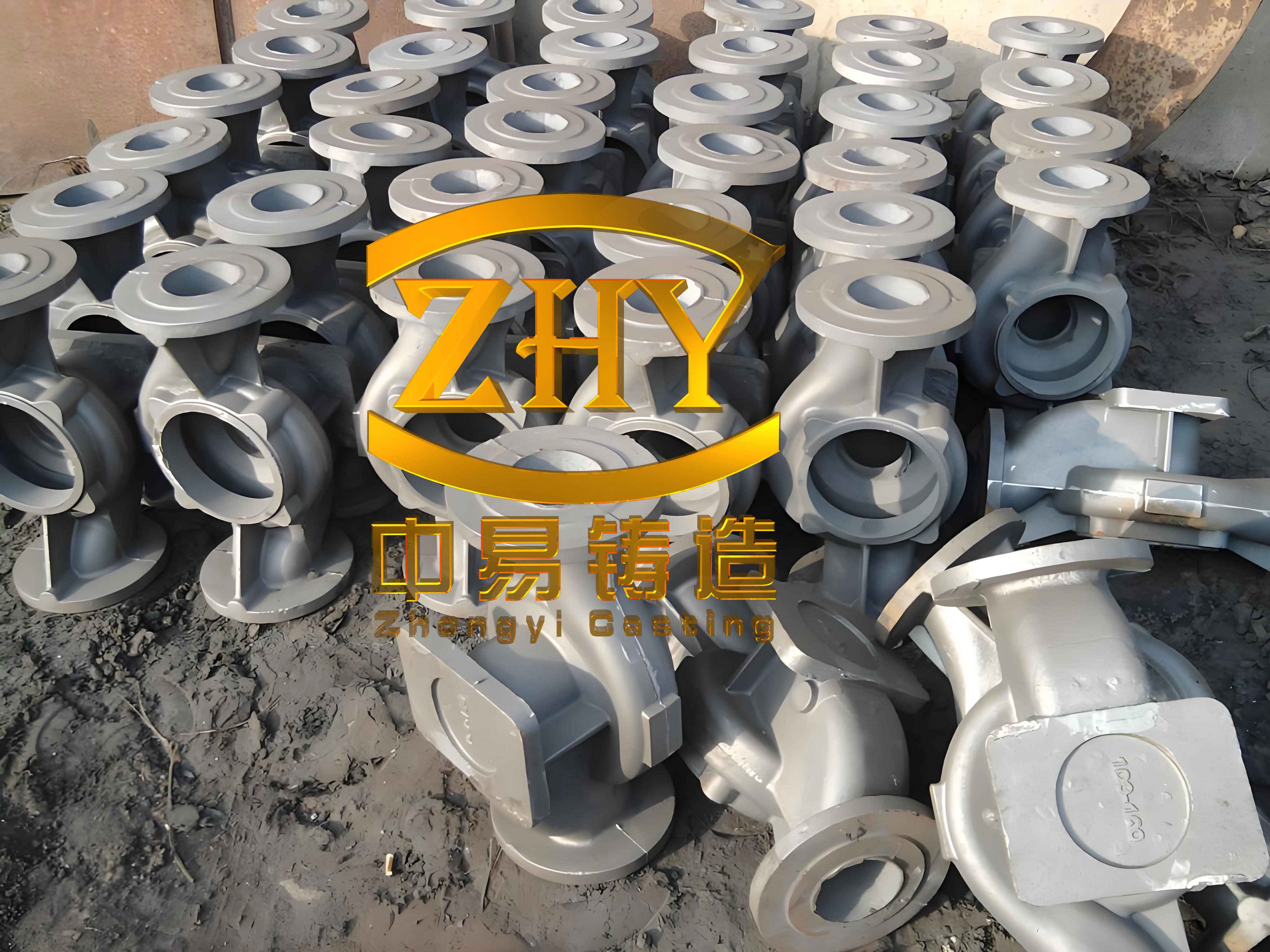
In grey iron casting via EPC, the foam pattern density plays a crucial role in gas generation during pouring. For the cylinder head, we used patterns with a density of 0.035 g/cm³, but assembly with adhesives increased overall gas evolution. To address this, I focused on enhancing coating properties and optimizing sand compaction. The coating must exhibit high strength at both low and high temperatures, along with good permeability to allow gas escape. The sand filling and vibration must ensure uniform compaction around complex internal features. I evaluated two pouring orientations: horizontal placement with side holes facing upward, and vertical placement with a small斜面 upward. Each orientation impacts metal flow and sand filling, critical for defect-free grey iron casting.
To quantify the process parameters, I developed a set of equations and tables. For instance, the gas evolution rate during grey iron casting can be approximated by the formula: $$G = \rho_p \cdot V \cdot k \cdot e^{-E_a/(RT)}$$ where \(G\) is the gas volume (cm³), \(\rho_p\) is the pattern density (g/cm³), \(V\) is the pattern volume (cm³), \(k\) is a rate constant, \(E_a\) is the activation energy (J/mol), \(R\) is the gas constant (8.314 J/mol·K), and \(T\) is the pouring temperature (K). This highlights the importance of controlling pattern density and temperature in grey iron casting. In our trials, pattern density ranged from 0.04 to 0.05 g/cm³, affecting defect formation.
| Parameter | Value Range | Impact on Grey Iron Casting |
|---|---|---|
| Pattern Density | 0.035–0.05 g/cm³ | Higher density increases gas evolution, risking cold shuts and porosity. |
| Pouring Temperature | 1360–1450 °C | Lower temperatures promote cold shuts; higher temperatures improve fluidity. |
| Negative Pressure | –0.04 to –0.05 MPa | Enhances metal filling and reduces defects in grey iron casting. |
| Coating Thickness | 0.5–1.0 mm | Thinner coatings may lead to sand penetration; thicker ones hinder gas escape. |
| Vibration Time | ≤2 minutes total | Over-vibration can damage coatings; under-vibration causes poor sand compaction. |
The gating system design is pivotal for successful grey iron casting. I employed a closed gating system with a hollow sprue to accelerate metal delivery and minimize heat loss. For horizontal pouring, the gating was attached to one side of the pattern, connected to a runner and vertical sprue. In vertical pouring, a stepped gating system was used to ensure progressive filling. The sprue cross-sectional area was sized larger than in conventional sand casting to allow sufficient time for pattern vaporization. This can be expressed using the continuity equation for fluid flow: $$A_1 v_1 = A_2 v_2$$ where \(A_1\) and \(v_1\) are the sprue area and velocity, and \(A_2\) and \(v_2\) are for the ingate. In grey iron casting, adjusting these areas helps control pouring speed and reduce cold shuts.
Coating formulation and application are critical in grey iron casting to prevent defects like slag inclusion and sand adhesion. The coating must have adequate bonding strength and permeability. I prepared coatings by thoroughly mixing refractory aggregates, binders, and additives, adjusting water content to achieve a suitable density. Dipping was the preferred application method, with slow rotation to ensure uniformity, especially in internal corners where pooling could occur. Drying was done in a烘干房 to remove moisture completely, as residual water exacerbates gas evolution. The coating drying rate can be modeled as: $$\frac{dM}{dt} = -k M$$ where \(M\) is the moisture content and \(k\) is a drying constant. Incomplete drying led to blowholes in our initial grey iron casting trials.
| Coating Aspect | Specification | Defect if Improper |
|---|---|---|
| Viscosity | Adjusted for dipping | Too high causes uneven coating; too low leads to runoff. |
| Drying Time | Until surface forms a skin | Insufficient drying causes coating cracks or脱落. |
| Layer Count | 2 layers | Single layer may not provide enough strength for grey iron casting. |
| Permeability | High to allow gas escape | Low permeability traps gases, causing porosity in grey iron casting. |
Sand filling and compaction are perhaps the most demanding aspects of grey iron casting for complex shapes like cylinder heads. The internal cavities, with through-holes and blind holes, require meticulous sand flow during vibration. I adopted a layered filling approach with intermittent vibration. For horizontal placement, sand was added in layers, with two-directional horizontal vibration at low amplitude and acceleration, assisted by manual packing in difficult areas. After full burial, vertical vibration was applied at higher intensity. The vibration parameters were optimized to avoid coating damage. The vibration energy can be described as: $$E = \frac{1}{2} m A^2 \omega^2$$ where \(m\) is the mass of sand, \(A\) is the amplitude, and \(\omega\) is the angular frequency. Excessive energy can crack coatings, leading to slag defects in grey iron casting.
In our first batch of grey iron casting trials, with horizontal pouring and pattern density of 0.04–0.05 g/cm³,浇注 temperature of 1360–1450°C, and negative pressure of –0.04 to –0.05 MPa, defects included cold shuts on upper surfaces and slag inclusions (coating fragments) after machining. Analysis revealed that coating layers had cracked during vibration, and metal flow swept fragments into the casting. This underscored the need for stronger coatings and better compaction. For the second batch, vertical pouring was used, resulting in severe sand adhesion in internal cavities due to inadequate sand filling, but no slag defects. These outcomes highlighted the trade-offs in grey iron casting orientation.
To address these issues, I implemented corrective measures. For coating-related defects in grey iron casting, I increased coating strength by adjusting binder content and ensured uniform thickness through controlled dipping. The coating strength can be related to its composition via: $$\sigma_c = k_b C_b + k_a C_a$$ where \(\sigma_c\) is the compressive strength, \(C_b\) and \(C_a\) are concentrations of binder and aggregate, and \(k_b\), \(k_a\) are constants. For sand adhesion, I refined vibration sequences: horizontal vibrations at lower levels during initial filling, followed by vertical vibrations with adjusted amplitude. The optimal vibration time was kept below 2 minutes to prevent pattern distortion. These adjustments proved effective, yielding sound grey iron castings with reduced machining allowance and improved surface quality.
| Defect Type | Causes | Solutions for Grey Iron Casting |
|---|---|---|
| Cold Shuts | Low pouring temperature, slow metal flow | Increase temperature to 1400–1450°C; use hollow sprue for faster filling. |
| Slag Inclusions | Coating cracks or脱落 during vibration | Enhance coating strength; optimize vibration parameters. |
| Sand Adhesion | Poor sand compaction in cavities | Use layered filling with directional vibration; manual aid in blind holes. | Gas Porosity | High pattern density, inadequate coating permeability | Reduce pattern density to 0.035 g/cm³; improve coating gas escape. |
The success of grey iron casting via EPC hinges on a holistic process control. From pattern making to pouring, each step must be calibrated for the specific geometry. For instance, the foam pattern assembly must ensure tight seams to prevent coating infiltration, which can cause internal slag. The adhesive usage should be minimized to reduce gas evolution, critical for grey iron casting integrity. During pouring, the negative pressure must be stable to support mold integrity and gas extraction. The relationship between negative pressure and metal velocity can be expressed as: $$v = \sqrt{\frac{2(P_a – P_v)}{\rho_m}}$$ where \(v\) is the metal velocity, \(P_a\) is atmospheric pressure, \(P_v\) is the negative pressure in the mold, and \(\rho_m\) is the metal density. In grey iron casting, maintaining –0.05 MPa helped mitigate defects.
Moreover, the metallurgical aspects of grey iron casting cannot be overlooked. Grey iron, with its graphite flakes, requires proper cooling rates to achieve desired microstructure and mechanical properties. In EPC, the dry sand mold offers lower cooling rates compared to green sand, which can influence graphite formation. The cooling rate can be estimated using Fourier’s law: $$q = -k \frac{dT}{dx}$$ where \(q\) is the heat flux, \(k\) is the thermal conductivity of sand, and \(\frac{dT}{dx}\) is the temperature gradient. For grey iron casting, ensuring uniform cooling prevents stresses and distortions in the cylinder head.
Through iterative trials, I found that vertical pouring combined with optimized coatings and vibration yielded the best results for grey iron casting. The cylinder heads produced showed a weight reduction of about 10 kg compared to sand-cast parts, with excellent surface finish and pressure-tightness. This demonstrates the viability of EPC for complex grey iron casting in small foundries. However, continuous monitoring is essential; for example, pattern density variations can be tracked using statistical process control charts to maintain consistency in grey iron casting production.
In conclusion, debugging the EPC process for grey iron cylinder heads involves a systematic approach to material and process parameters. Key lessons include the importance of coating integrity, sand compaction strategies, and gating design tailored to complex geometries. By leveraging formulas and tables for parameter optimization, foundries can overcome common defects and achieve high-quality grey iron casting. Future work could explore advanced coatings with nano-additives or simulation tools to predict metal flow and solidification. As grey iron casting evolves, EPC offers a cost-effective route for producing intricate components, provided that process nuances are mastered through hands-on experimentation and data-driven adjustments.
To further elaborate on the grey iron casting process, I have included additional tables summarizing optimal ranges and relationships. For instance, the interplay between pouring temperature and defect incidence can be modeled using regression analysis. In our data, the probability of cold shuts \(P_c\) decreased with temperature according to: $$P_c = a e^{-b T}$$ where \(a\) and \(b\) are constants derived from trial data. Such empirical models aid in fine-tuning grey iron casting operations.
| Process Stage | Optimal Range | Rationale for Grey Iron Casting |
|---|---|---|
| Pattern Making | Density: 0.035 g/cm³; minimal adhesive | Reduces gas evolution and improves dimensional accuracy. |
| Coating Application | Thickness: 0.8 mm; dried at 50–60°C | Balances strength and permeability for defect prevention. |
| Sand Compaction | Vibration: 1.5 min total; amplitude 0.5–1.0 mm | Ensures uniform density without coating damage. |
| Pouring Parameters | Temperature: 1420°C; negative pressure: –0.05 MPa | Promotes complete filling and gas extraction in grey iron casting. |
| Cooling Time | 24 hours in mold | Allows gradual solidification to avoid stresses in grey iron casting. |
In summary, the journey to perfect grey iron casting via EPC is iterative, but with careful attention to detail, small foundries can achieve remarkable results. The integration of theoretical principles with practical tweaks, as documented here, underscores the adaptability of grey iron casting processes. By sharing these insights, I hope to contribute to the broader adoption of EPC for complex grey iron casting components, driving efficiency and quality in the foundry industry.