
In the modern foundry industry, the demand for high-performance grey iron castings has surged, driven by applications in automotive engines, machinery, and heavy equipment. As a foundry engineer specializing in grey iron castings, I have dedicated years to optimizing the production processes for high-strength variants like HT300. This article delves into the comprehensive control strategies and melting technologies essential for manufacturing superior grey iron castings using induction furnaces. I will explore raw material selection, chemical composition management, melting practices, and advanced treatments such as inoculation and alloying, all aimed at enhancing the mechanical properties and consistency of grey iron castings.
The transition from cupola to induction furnace melting has revolutionized grey iron castings production, offering greater flexibility and control. However, it introduces unique challenges, including the absence of inherent refining reactions and the need for precise additive management. Through systematic process optimization, we can achieve stable, high-volume production of grey iron castings with tensile strengths exceeding 300 MPa. This discussion is based on practical experiences and validated techniques, emphasizing the critical role of each step in ensuring the quality of grey iron castings.
Raw Material Selection for Grey Iron Castings
The foundation of high-quality grey iron castings lies in the careful selection of raw materials. Induction furnaces, unlike cupolas, lack self-slagging systems, making the purity and condition of charges paramount. The primary charge materials include steel scrap, returns, and pig iron, but for high-strength grey iron castings, we often employ a high steel scrap ratio to mitigate the hereditary effects of coarse graphite from pig iron.
| Material | Percentage (%) | Purpose |
|---|---|---|
| Steel Scrap | 70–90 | Enhances strength, reduces graphite heredity |
| Returns (cleaned) | 10–30 | Recycles material, maintains consistency |
| Pig Iron | 0–10 | Optional; minimized to avoid coarse graphite |
Additives play a crucial role in compensating for elemental losses and modifying microstructure. Silicon carbide (SiC) is widely used as a pre-treatment agent and deoxidizer. Its dissolution in iron melt promotes graphite nucleation via the reaction: $$ \text{SiC} + \text{Fe} \rightarrow \text{FeSi} + \text{C (non-equilibrium graphite)} $$ This non-equilibrium carbon acts as a potent nucleation site, refining graphite flakes and reducing chilling tendencies in grey iron castings. Typically, 0.6–1.0% of charge weight is added in batches to the furnace crucible.
Carbon raisers are essential for adjusting carbon content, especially with high steel scrap charges. Graphitized carbon raisers are preferred due to their flake graphite structure, which enhances dissolution. The absorption efficiency depends on particle size and addition timing; early and分批 additions yield over 90% absorption. Similarly, sulfur addition is critical for grey iron castings, as sulfur improves machinability, inoculant effectiveness, and graphite morphology. We maintain sulfur levels at 0.04–0.10% using sulfurizers, which influence graphite shape and共晶团 count. The optimal sulfur range prevents undercooled graphite while promoting type A graphite in grey iron castings.
Chemical Composition Control in Grey Iron Castings
Precise chemical composition is vital for achieving the desired microstructure and mechanical properties in grey iron castings. The basic elements—carbon, silicon, manganese, phosphorus, and sulfur—must be balanced carefully, alongside monitoring trace elements that can detrimentally affect grey iron castings.
| Element | Range (wt%) | Role in Grey Iron Castings |
|---|---|---|
| Carbon (C) | 3.2–3.5 | Graphitizer; affects fluidity and strength |
| Silicon (Si) | 1.8–2.2 | Promotes graphite formation; adjusts Si/C ratio |
| Manganese (Mn) | 0.8–1.2 | Stabilizes pearlite; combines with sulfur |
| Phosphorus (P) | <0.03 | Minimized to avoid phosphide eutectics |
| Sulfur (S) | 0.06–0.10 | Enhances inoculation; refines graphite |
Carbon equivalent (CE) is a key parameter, typically maintained at 3.8–4.0% for high-strength grey iron castings to ensure good castability and reduced defects. The silicon-to-carbon ratio (Si/C) is kept between 0.6 and 0.7 to optimize hardness and tensile strength. Manganese and sulfur are interrelated; we follow the empirical formula to prevent sulfide-related issues: $$ \text{Mn\%} = 1.73\text{S\%} + 0.3\% $$ This balance ensures MnS formation, which aids graphite nucleation without causing slag blowholes in grey iron castings.
Trace elements like lead, arsenic, and aluminum must be controlled, as they can induce undesirable graphite forms or porosity. For instance, aluminum above 0.01% may lead to pinholes in grey iron castings. Nitrogen content is another concern, especially with high scrap and carbon raiser usage. Nitrogen levels around 70–100 ppm can improve graphite morphology, but exceeding 130 ppm in thin sections or 80 ppm in thick sections risks nitrogen porosity in grey iron castings. Regular monitoring through光谱 analysis is recommended.
Melting Process Control for Grey Iron Castings
Induction furnace melting requires meticulous control to ensure high-quality grey iron castings. The process involves power management, superheating, and temperature regulation, each impacting the final properties of grey iron castings.
During melting, we adhere to the principle of “full-charge, high-power rapid melting” to minimize oxidation and slag formation. Initial power is kept low to protect the lining, then increased as the melt pool forms. This reduces contact time between charge, atmosphere, and refractory, preserving melt quality for grey iron castings.
Superheating is a critical phase for refining grey iron castings. After melting, the iron is heated to 1500–1530°C and held for 10–15 minutes. This high-temperature holding dissolves coarse graphite seeds, eliminates gas and inclusion defects, and removes hereditary effects from charge materials. However, excessive temperature or time can destroy nucleation sites, increasing undercooling and degrading graphite structure in grey iron castings. The carbon solubility limit during this stage can be estimated using the formula: $$ C = 1.3 + 0.0257T – 0.31\%\text{Si} – 0.33\%\text{P} – 0.45\%\text{S} + 0.028\%\text{Mn} $$ where T is temperature in °C. This guides carbon adjustments for grey iron castings.
Tap temperature is controlled between 1430–1480°C, depending on casting size and section thickness. For grey iron castings with thin walls, higher tap temperatures ensure fluidity, while lower temperatures reduce shrinkage defects. During idle periods, the melt is held at 1380–1420°C to prevent nucleation site loss and chilling in grey iron castings.
| Parameter | Range | Effect on Grey Iron Castings |
|---|---|---|
| Superheat Temperature | 1500–1530°C | Refines structure, removes impurities |
| Holding Time | 10–15 min | Enhances homogeneity and nucleation |
| Tap Temperature | 1430–1480°C | Balances fluidity and defect minimization |
| Idle Holding Temperature | 1380–1420°C | Prevents inoculation衰退 and chilling |
Inoculation and Alloying Treatments for Grey Iron Castings
Inoculation is indispensable for achieving fine, type A graphite and high strength in grey iron castings. It involves adding inoculants to create nucleation sites, promoting石墨化 and reducing chill. We employ a dual approach: ladle inoculation during tapping and stream inoculation during pouring. Ladle inoculation uses ferrosilicon-based inoculants (e.g., FeSi, FeSi-Ba, FeSi-Sr) at 0.3–0.6% of melt weight, while stream inoculation applies finer grades like FeSi-Zr or FeSi-Sr at 0.06–0.15% to combat衰退. Inoculant particle size is optimized—too fine leads to oxidation, too coarse causes dissolution issues—typically 1–3 mm for effective treatment of grey iron castings.
Alloying enhances the matrix of grey iron castings, particularly for high-grade applications. Elements such as copper, chromium, tin, nickel, molybdenum, and vanadium are added to strengthen pearlite, refine grains, and improve hardenability. For example, copper promotes graphite化 and stabilizes pearlite, while chromium increases hardness and wear resistance. The combination of Cu-Cr-Mo-Sn is common in engine grey iron castings like cylinder heads. Alloying must be tailored to casting geometry; thin-section grey iron castings may require different additions than thick ones to ensure uniform properties.
The effectiveness of these treatments is evident in the microstructure of grey iron castings. Proper inoculation yields graphite sizes of 4–6 (ASTM) with over 98% pearlite, crucial for tensile strength above 280 MPa in grey iron castings.
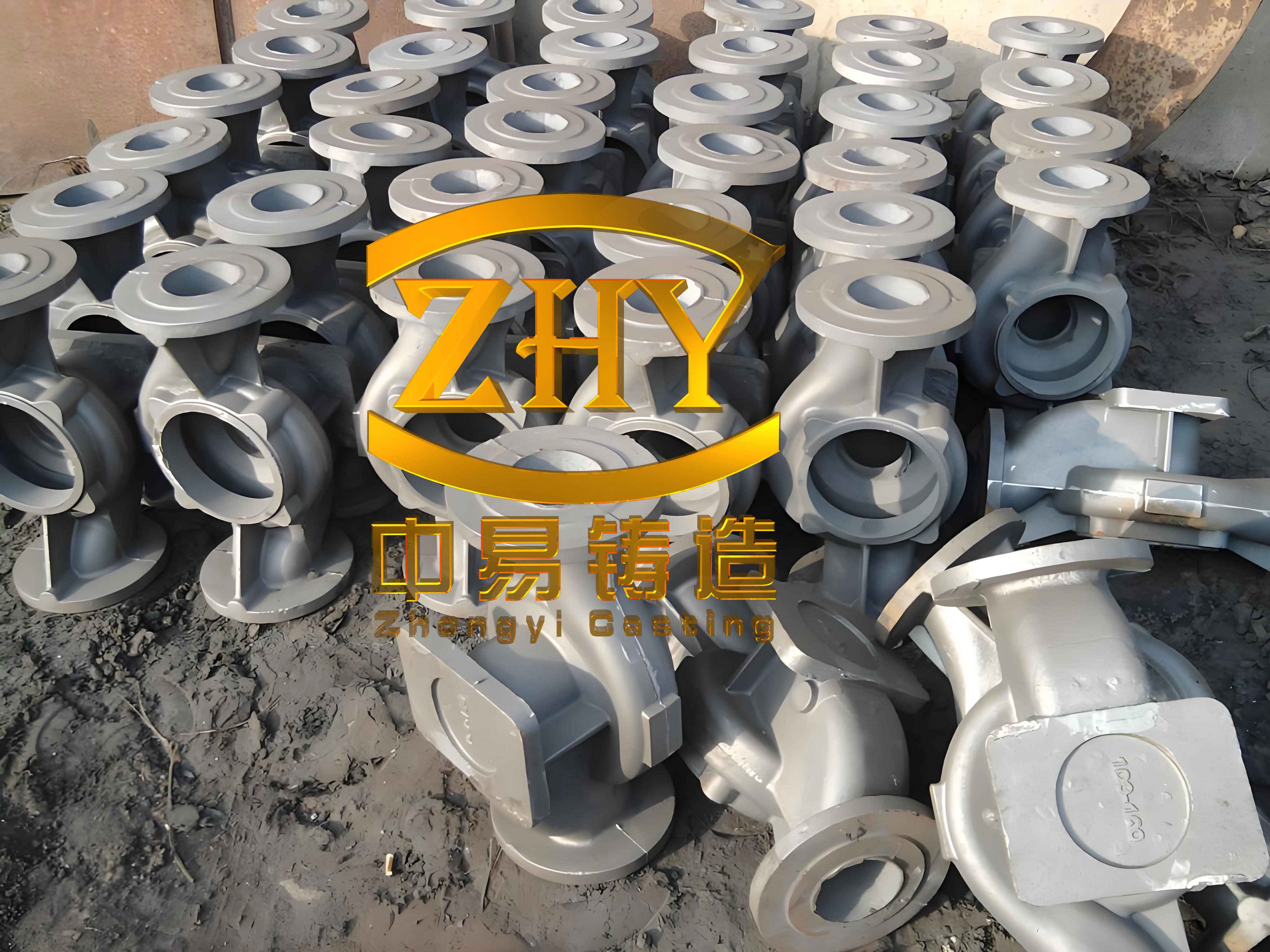
Practical Application in Grey Iron Castings Production
To illustrate these principles, consider the production of a cylinder head grey iron casting with HT300 specification. The casting has a complex shape with wall thicknesses around 5 mm, requiring precise control. We use an 85% steel scrap charge, balanced with returns, and tap at 1450–1480°C. The chemical composition is set at CE 3.95–4.05% with alloying additions of copper, chromium, molybdenum, and tin. Inoculation involves 0.4% FeSi-Sr in the ladle and 0.1% FeSi-Zr during pouring, resulting in浇注 temperatures of 1380–1410°C for grey iron castings.
This process yields grey iron castings with consistent tensile strength above 280 MPa, type A graphite, and minimal defects. Annual production volumes reach hundreds of thousands, with scrap rates below 3%, demonstrating the robustness of this approach for grey iron castings.
Conclusion
Producing high-strength grey iron castings via induction furnaces demands a holistic strategy encompassing raw material purity, chemical precision, controlled melting, and advanced treatments. Key takeaways include: the benefits of high steel scrap ratios in enhancing strength and reducing graphite heredity in grey iron castings; the importance of superheating at 1500–1530°C to refine microstructure; the necessity of dual inoculation to prevent衰退; and the role of alloying in tailoring properties for specific grey iron castings. By adhering to these practices, foundries can achieve reliable, high-performance grey iron castings suitable for demanding applications. Continuous innovation and monitoring will further advance the quality and efficiency of grey iron castings production.