
In my extensive experience within the foundry industry, I have repeatedly encountered the pervasive issue of casting defects, particularly when utilizing water glass sand molds for gray iron castings. These casting defects, such as subsurface blowholes and oxide slag inclusions, not only compromise the structural integrity and surface quality of cast components but also lead to significant economic losses due to high scrap rates. This article delves into a detailed first-person account of investigating, analyzing, and mitigating these casting defects, emphasizing the critical role of residual moisture in water glass sand. Through systematic process modifications, including optimized gating system design and core drying treatments, we have achieved remarkable improvements in casting quality. The discussion is enriched with multiple tables and mathematical formulations to summarize key parameters and relationships, ensuring a thorough understanding of the mechanisms behind casting defect formation and prevention. The persistent challenge of casting defects demands a holistic approach, integrating material science, process engineering, and empirical validation.
The foundational problem stems from the inherent properties of water glass (sodium silicate) sand. While advantageous for its rapid hardening via CO2 gas and good collapsibility, water glass sand often retains residual moisture post-hardening. This residual water, upon contact with molten iron, decomposes into hydrogen and oxygen, leading to gas porosity defects. Moreover, the presence of moisture can promote oxidation reactions, resulting in slag entrapment. In a specific production run for a machine tool bed casting (generalized from actual cases to avoid proprietary details), we observed a scrap rate exceeding 40% due to subsurface defects on critical guideway surfaces after machining. This alarming frequency of casting defects prompted a rigorous investigation into the root causes.
Initial analysis pinpointed several contributing factors to these casting defects. Firstly, the melting practice using medium-frequency induction furnaces sometimes led to excessive pouring temperatures, aggravating metal oxidation and slag formation. Secondly, inadvertent contamination of charge materials with residual magnesium and rare earth elements from spheroidal graphite iron returns exacerbated gas generation. Thirdly, inadequate gating and venting design failed to ensure smooth metal flow and efficient gas evacuation. However, preliminary corrective measures—such as eliminating contaminated returns, installing slag traps, and controlling pouring temperature—only reduced the scrap rate to 25%, indicating that more fundamental issues related to the mold system itself were at play. The core of the problem was traced to the residual moisture in the water glass sand molds and cores, which acted as a persistent source for casting defects.
To quantify the relationship between process variables and casting defect formation, we developed several empirical and theoretical models. A key formula relates the propensity for subsurface blowhole formation to the residual moisture content in the sand mold and the pouring temperature:
$$ P_d = k \cdot W_r \cdot \exp\left(\frac{-E_a}{R T_p}\right) $$
Where \( P_d \) is the probability of defect occurrence (dimensionless), \( k \) is a material-specific constant, \( W_r \) is the residual moisture content in the sand mold (%), \( E_a \) is the apparent activation energy for gas generation (J/mol), \( R \) is the universal gas constant (8.314 J/mol·K), and \( T_p \) is the pouring temperature (K). This equation highlights that both reducing \( W_r \) and optimizing \( T_p \) are crucial for minimizing casting defects.
Furthermore, the permeability of the sand mold, which dictates its ability to allow gases to escape, is vital. The permeability \( \kappa \) can be estimated using the Kozeny-Carman equation for packed beds:
$$ \kappa = \frac{\phi^3 d_p^2}{180 (1 – \phi)^2} $$
Here, \( \phi \) is the porosity of the sand mold (volume fraction), and \( d_p \) is the effective sand grain diameter (m). Higher permeability reduces gas entrapment, thereby alleviating casting defects. The following table summarizes the primary types of casting defects observed, their characteristics, and direct causes:
| Defect Type | Visual Characteristics | Primary Causes | Associated Casting Defect Mechanism |
|---|---|---|---|
| Subsurface Blowholes | Spherical or elongated cavities beneath the casting surface, exposed after machining. | Residual moisture decomposition, poor venting, high gas content in metal. | Hydrogen evolution from water decomposition: \( \text{H}_2\text{O} + \text{Fe} \rightarrow \text{FeO} + 2\text{H} \). |
| Oxide Slag Inclusions | Irregular, dark-colored discontinuities often near surfaces or in upper sections. | High pouring temperature, turbulent metal flow, inadequate slag trapping. | Oxidation of iron and alloying elements: \( 2\text{Fe} + \text{O}_2 \rightarrow 2\text{FeO} \). |
| Shrinkage Porosity | Dendritic or interconnected voids in thermal centers. | Inadequate feeding, improper solidification sequence. | Volume contraction during solidification without sufficient liquid metal补给. |
The investigation revealed that simply adjusting melting and pouring parameters was insufficient. A comprehensive strategy targeting the mold and core system was essential. We focused on two main areas: optimizing the sand composition and processing to reduce residual moisture, and redesigning the gating and venting system to promote laminar flow and effective gas expulsion. For sand processing, we selected high-modulus water glass (modulus > 2.5) and coarser base sand (AFS grain fineness number ~50) to enhance permeability and reduce water retention. The modified sand properties are tabulated below:
| Sand Property | Standard Mix | Optimized Mix | Impact on Casting Defects |
|---|---|---|---|
| Water Glass Modulus | 2.0 – 2.2 | 2.6 – 2.8 | Reduces hygroscopicity, lowers residual moisture. |
| Sand Grain Size (AFS) | 70 – 80 | 45 – 55 | Increases permeability, improves gas escape. |
| Residual Moisture after CO2 Hardening (%) | 1.5 – 2.0 | 0.8 – 1.2 | Directly decreases gas generation potential. |
| Permeability Number | 80 – 100 | 120 – 150 | Enhances venting capacity, reduces blowhole risk. |
Despite these improvements, the cores, due to their larger volume and complex shapes, remained significant sources of moisture. Therefore, we instituted a dedicated drying process for water glass sand cores. The drying kinetics can be modeled using Fick’s second law of diffusion, where the moisture content \( W \) at time \( t \) and core thickness \( L \) is approximated by:
$$ \frac{\partial W}{\partial t} = D \frac{\partial^2 W}{\partial x^2} $$
With \( D \) as the effective moisture diffusivity (m²/s). The practical drying schedule involved heating the cores in a batch oven following a specific temperature-time profile to ensure thorough dehydration without causing thermal cracking. The optimized drying curve is represented by a piecewise function:
$$
T(t) =
\begin{cases}
50^\circ\text{C} + 20t & \text{for } 0 \leq t < 2 \text{ hours} \\
90^\circ\text{C} & \text{for } 2 \leq t < 4 \text{ hours} \\
90^\circ\text{C} – 15(t-4) & \text{for } 4 \leq t \leq 6 \text{ hours}
\end{cases}
$$
This controlled drying reduced core moisture content to below 0.5%, significantly mitigating one of the primary sources of casting defects. Concurrently, we overhauled the gating system design. The original layout featured a simple downgate with limited venting. The new design incorporated a taller sprue (increased height by 30%), additional venting risers (from 5 to 8), and an enlarged blind riser (Ø100 mm) positioned strategically to act as a slag trap and feeder. The fluid dynamics of the improved system were analyzed using Bernoulli’s principle to ensure minimal turbulence:
$$ \frac{P_1}{\rho g} + \frac{v_1^2}{2g} + z_1 = \frac{P_2}{\rho g} + \frac{v_2^2}{2g} + z_2 + h_f $$
Where \( P \) is pressure, \( \rho \) is density, \( v \) is velocity, \( z \) is elevation, \( g \) is gravity, and \( h_f \) represents head losses. By increasing the sprue height (\( z_1 – z_2 \)), we achieved a higher metallostatic pressure, promoting smoother filling and better slag floatation. The inclusion of more venting risers reduced back-pressure, facilitating gas escape and thus directly addressing the casting defect of blowholes. Furthermore, we adopted a tilt-pouring technique, elevating the drag side by 150 mm, which encouraged a more progressive and tranquil metal advance into the mold cavity.
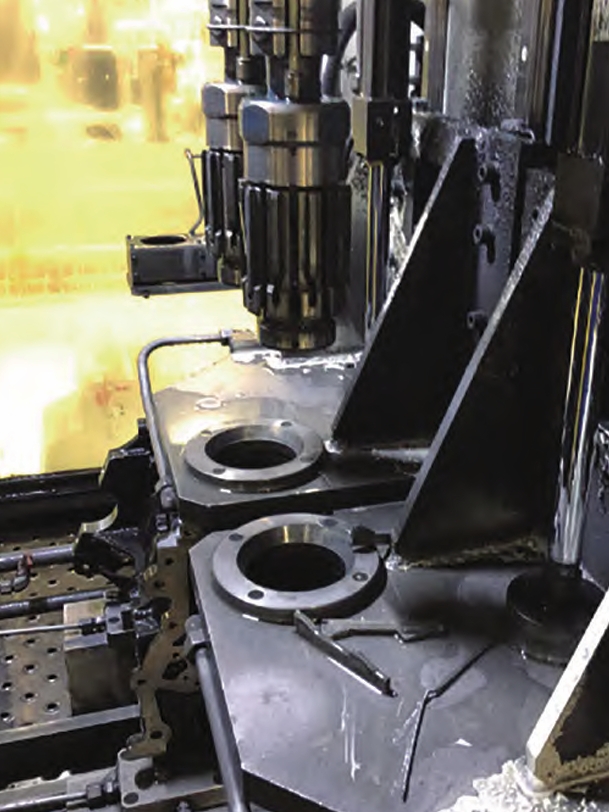
The image above exemplifies a complex casting where similar principles of gating design and mold control are critical to prevent casting defects. In our case, the implementation of these combined measures yielded dramatic results. Over a production batch of 63 castings, only 3 exhibited minor defects on the guideways, reducing the scrap rate to below 5%. The quantitative improvement in casting quality is summarized in the following performance table:
| Process Parameter / Outcome | Before Optimization | After Optimization | Percentage Improvement |
|---|---|---|---|
| Scrap Rate due to Casting Defects (%) | 40% | 4.8% | 88% reduction |
| Average Residual Moisture in Mold (%) | 1.8 | 0.9 | 50% reduction |
| Pouring Temperature (°C) | 1390 – 1420 | 1360 – 1385 | Better control |
| Number of Venting Risers | 5 | 8 | 60% increase |
| Core Drying Implementation | None (air dry only) | Controlled oven drying | Complete protocol adoption |
| Casting Surface Quality (Visual Rating 1-10) | 6 | 9 | 50% enhancement |
The economic impact was substantial, but more importantly, the reliability of the casting process improved, fostering greater confidence in using water glass sand for precision castings. The success underscored that casting defects are seldom attributable to a single factor; rather, they result from a chain of interactions among material properties, process parameters, and design elements. A holistic equation for casting defect risk assessment can be postulated as:
$$ R_{\text{defect}} = f(W_r, \kappa, T_p, v_p, N_v, t_d) $$
Where \( R_{\text{defect}} \) is the overall risk index, \( v_p \) is pouring velocity, \( N_v \) is the number of vents, and \( t_d \) is core drying time. Minimizing \( R_{\text{defect}} \) requires a multi-variable optimization approach.
In conclusion, the battle against casting defects in water glass sand molds for gray iron is fundamentally centered on moisture control. My firsthand experience demonstrates that residual water is a potent catalyst for subsurface blowholes and oxide inclusions—two prevalent casting defects. By synergistically enhancing sand properties, instituting rigorous core drying, and redesigning the gating system to prioritize quiet flow and ample venting, we can effectively suppress these casting defects. The formulas and tables presented herein provide a framework for quantifying relationships and guiding process decisions. Future work may involve real-time monitoring of mold moisture and automated control of pouring parameters to further eradicate casting defects. Ultimately, a deep understanding of the underlying physics and chemistry, coupled with empirical process refinement, is key to achieving near-zero defect casting operations, transforming casting defects from a chronic problem into a manageable variable.
To further elaborate on the prevention strategies, consider the interplay between pouring time and defect formation. An optimal pouring time \( t_{\text{pour}} \) can be derived to balance temperature loss and turbulence minimization:
$$ t_{\text{pour}} = \frac{V}{A_{\text{choke}} \cdot v_{\text{critical}}} $$
Where \( V \) is casting volume, \( A_{\text{choke}} \) is the choke area, and \( v_{\text{critical}} \) is the critical velocity to avoid mold erosion. Exceeding \( v_{\text{critical}} \) can lead to sand inclusion defects, another category of casting defects. Additionally, the efficiency of venting risers can be modeled by considering them as small passages for gas escape. The volumetric gas flow rate \( Q_g \) through a vent of diameter \( d_v \) and length \( L_v \) under a pressure difference \( \Delta P \) is given by the Hagen-Poiseuille equation for laminar flow:
$$ Q_g = \frac{\pi \Delta P d_v^4}{128 \mu_g L_v} $$
Here, \( \mu_g \) is the dynamic viscosity of the gas mixture. This illustrates that increasing vent diameter or number significantly boosts gas removal, directly combating casting defects related to gas entrapment. Therefore, a proactive design philosophy that anticipates and mitigates these factors is indispensable for high-integrity castings, ensuring that casting defects are minimized through scientific principle rather than trial and error.