
In the field of metal casting, the battle against casting defects is a constant and defining challenge. Success hinges not on avoiding complexity, but on meticulously analyzing it, understanding the interplay between material properties, component geometry, and process parameters. Through my extensive involvement in industrial casting projects, I have encountered a vast spectrum of these casting defects, from gross shrinkage cavities to subtle micro-porosity. This account consolidates key experiences and methodologies, focusing on two representative case studies: a large, thick-sectioned cast iron pump body and a thin-walled, complex aluminum alloy shell. The journey from high scrap rates to reliable production offers profound insights into the systematic mitigation of casting defects.
The foundational step in combating any casting defect is a rigorous analysis of the component’s geometry. Uneven wall thickness, isolated heavy sections (hot spots), and intricate internal passages are primary contributors to issues like shrinkage and gas entrapment. The thermal dynamics during solidification are paramount. A simple yet powerful concept for predicting hot spots is the Modulus, defined as volume divided by cooling surface area. Locations with a higher modulus solidify slower and are prone to shrinkage-related casting defects if not properly fed.
$$ M = \frac{V}{A} $$
where \( M \) is the modulus, \( V \) is the volume of the section, and \( A \) is its surface area through which heat is dissipated. Identifying these high-modulus regions is the first line of defense.
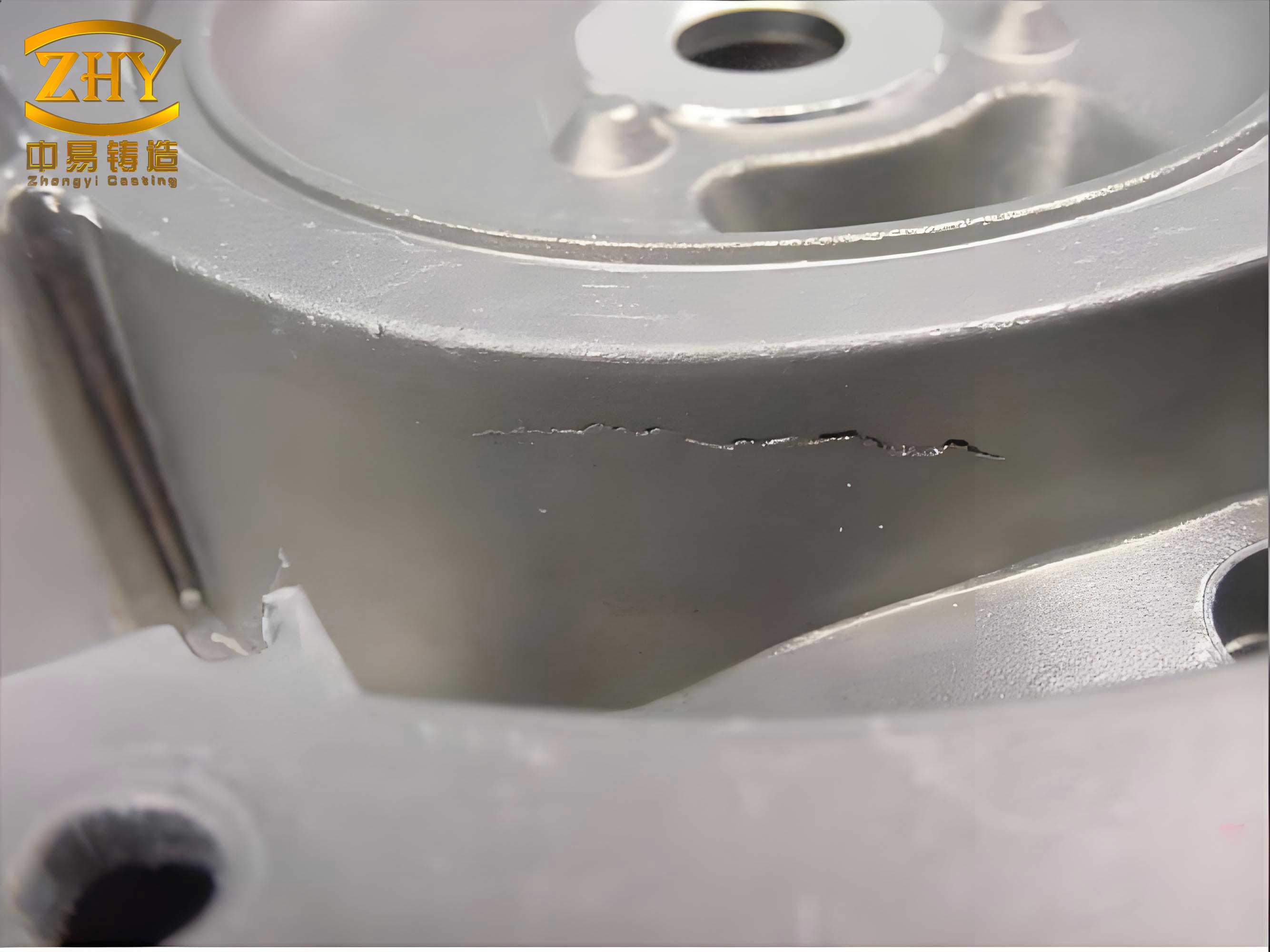
A critical visualization of common issues is essential. The image below categorizes typical casting defects encountered in sand casting processes, providing a reference for the problems discussed subsequently.
Case Study 1: Large Ductile Iron Pump Body
This component, weighing several tons, served a critical function in dredging equipment. Its sheer size and complex internal geometry presented a significant risk for major casting defects, including shrinkage cavities, gas holes, and sand inclusions.
Analysis and Strategic Approach
The pump body featured massive wall thicknesses and deep, recessed areas forming pronounced thermal hot spots. The primary casting defects anticipated were:
- Macro-shrinkage: Inadequate feeding of the heavy sections during the long solidification interval of ductile iron.
- Gas Porosity: Entrapped gases from molding sand cores and metal-mold reactions.
- Surface Finishing Issues: Burn-on and metal penetration in intricate details like internal text.
The strategy was built on three pillars: robust feeding to counter shrinkage, aggressive venting to eliminate gases, and precise molding to achieve surface definition.
Detailed Process Implementation and Rationale
The following table summarizes the core process measures implemented to target specific casting defects:
| Process Area | Implemented Measure | Targeted Casting Defect(s) | Technical Rationale |
|---|---|---|---|
| Molding & Cores | Use of zircon sand for intricate core sections (e.g., text). | Surface roughness, burn-on, metal penetration. | Zircon sand’s high refractoriness and low thermal expansion prevent metal/sand reaction and ensure sharp reproduction of details. |
| Venting System | Chambers formed by 6+ strands of straw rope tied to core irons, vented through Φ60mm holes at core prints. Multiple Φ60mm vents in the cope mold. | Gas porosity, blows, pinholes. | Provides high-permeability, high-volume escape paths for gases generated during pouring and solidification, preventing their entrapment in the metal. |
| Core Internal Structure | Placement of straw rope coils inside large cores. | Gas porosity, core-generated shrinkage stress (cracking). | Enhances internal venting and improves the collapsibility (deformation) of the core during metal contraction, reducing hot tearing risk. |
| Gating & Feeding | Riser necks made from high-purity quartz or specialty sands. Strategic placement of chills (external and internal). | Shrinkage porosity at hot spots near risers. | High-refractorory sand prevents erosion at the critical feeding channel. Chills accelerate local solidification to direct shrinkage toward the risers. |
| Metal Treatment | Ladle treatment with 0.6% Al + 0.2% CaSi before tapping. Slag carry-over tapping method. | Subsurface pinholes, hydrogen porosity. | Aluminum and Calcium-Silicon act as potent degassers, reducing dissolved hydrogen content in the iron melt, a primary cause of gas-related casting defects. |
| Pouring Practice | Pouring temperature: 1400–1430°C. Brief holding of ladle after tapping before pouring. | Shrinkage, mistruns, cold shuts. | Controlled superheat ensures fluidity for thin sections while minimizing total heat content to reduce shrinkage volume. Holding allows slag and gases to float out. |
The thermal parameters were carefully controlled. The relationship between pouring temperature (\(T_p\)), liquidus temperature (\(T_l\)), and the superheat (\(\Delta T_{sh}\)) is critical for defect formation:
$$ \Delta T_{sh} = T_p – T_l $$
An excessive \(\Delta T_{sh}\) increases the total latent heat to be removed, enlarging the size of the mushy zone and promoting dispersed shrinkage or porosity. Our target was to maintain sufficient superheat for fill while minimizing it to reduce feeding demand.
Results and Validation
The systematic implementation of these measures resulted in castings with excellent surface finish, sound internal integrity verified by non-destructive testing, and dimensional accuracy. The comprehensive approach successfully suppressed the anticipated casting defects, enabling reliable deployment in critical applications. The key learning was that for large, complex iron castings, preempting casting defects requires an integrated system covering mold engineering, metallurgy, and thermal management.
Case Study 2: Thin-Walled ZL115A Aluminum Alloy Shell
This component presented a different set of challenges. Its complex shape, significant variations in wall thickness, and the stringent radiographic inspection requirements made shrinkage porosity the dominant and most costly casting defect, initially leading to a scrap rate exceeding 70%.
Initial Problem Analysis
The original process used a differential pressure casting method with a vertical slot gate. Despite the application of local chills, severe shrinkage porosity persisted in a specific thickened region (Area A in the original diagram). Analysis revealed the root cause: Area A had an effective casting wall thickness of 21mm due to generous machining allowances, acting as a severe, isolated hot spot. It was too far from both the top of the casting and the slot gate to receive adequate sequential feeding during solidification. The local chill was insufficient to overcome this fundamental thermal and feeding imbalance. This classic feeding-related casting defect was captured by the modulus calculation, where Area A had a significantly higher modulus than the surrounding 5mm walls.
Systematic Process Improvement
The solution required a multi-faceted attack on the causes of this shrinkage casting defect.
1. Redesign for Thermal Uniformity: The most impactful change was a collaborative design modification to reduce the external machining allowance on Area A. This decreased its as-cast thickness from 21mm to 14mm, dramatically reducing its thermal modulus and bringing it closer to the modulus of the main walls. This simple change effectively eliminated the isolated hot spot, addressing the root cause of the shrinkage casting defect.
2. Optimized Gating for Better Feeding: The feeding capability of the differential pressure system was enhanced. The cross-sectional area of the connection between the gate and the central stalk was increased from a diameter of 55mm to 65mm. This improved the pressure transmission and metal feed to the casting. Furthermore, the width of the slot gate was strictly controlled to a narrow 15mm to minimize its thermal impact on the adjacent casting wall, preventing a new hot spot at the gate junction. The gating system was designed as an open, non-pressurized system to ensure quiescent filling:
$$ \Sigma A_{\text{stalk}} < \Sigma A_{\text{runner}} < \Sigma A_{\text{gates}} $$
This relationship promotes a non-turbulent flow front, reducing air entrainment—another potential source of casting defects.
3. Enhanced Metal Cleanliness and Degassing: To prevent confounding casting defects like gas porosity and inclusions, a double-refining practice was adopted. The melt was refined both in the furnace and again in the ladle just before pouring. A triple-filtration system was implemented: a fiberglass filter at the riser tube outlet, a ceramic foam filter in the runner, and a dual-layer filter at the entrance to the slot gates. This robust filtration virtually eliminated inclusion-based casting defects.
4. Precision-Controlled Solidification under Pressure: The parameters for the differential pressure casting process were fine-tuned. The pouring temperature was set to 720 ±10°C. The pressure increase rate was calibrated to 1.3 kPa/s to ensure a smooth, controlled filling of the mold cavity. The key to eliminating shrinkage casting defects in this process is the applied pressure during solidification. The pressure compensation helps feed shrinkage in the intricate, thin-walled sections. The required feeding pressure (\(P_{feed}\)) can be related to the surface tension (\(\gamma\)) and the size of the interdendritic channels (radius \(r\)) that must be fed:
$$ P_{feed} > \frac{2\gamma}{r} $$
The applied differential pressure in the chamber provides this \(P_{feed}\), forcing liquid metal into the shrinking interdendritic spaces to prevent pore formation.
Quantifiable Results and Comparative Summary
The table below contrasts the key parameters before and after the process improvements, highlighting their direct impact on mitigating the primary casting defects.
| Parameter / Aspect | Initial Process | Improved Process | Impact on Casting Defects |
|---|---|---|---|
| Hot Spot Thickness (Area A) | 21 mm | 14 mm | Fundamentally eliminated the isolated thermal center causing shrinkage porosity. |
| Gate Feed Stalk Diameter | 55 mm | 65 mm | Enhanced pressure-fed metal delivery to remote sections of the casting. |
| Metal Treatment | Single refining | Double refining + Triple filtration | Virtually eliminated gas porosity and inclusion defects. |
| Process Control | Standard parameters | Precise control of \(T_p\), \(dP/dt\), Hold time | Optimized solidification under pressure for effective micro-feeding. |
| Radiographic Pass Rate | ~30% | >70% | Direct result of the reduction in shrinkage and gas porosity defects. |
| Process Yield | Base | +21% | Reduced scrap from casting defects significantly improved material utilization. |
Synthesis of Principles for Casting Defect Mitigation
These case studies, though involving different alloys (iron vs. aluminum) and casting methods (sand vs. differential pressure), illustrate universal principles in the fight against casting defects. The following formula synthesizes the overarching approach:
Sound Casting = f( **Thermal Management**, **Feeding Effectiveness**, **Metal Cleanliness**, **Process Control** )
Where each factor is defined by specific actions:
- Thermal Management (M): Aim for uniform modulus. Use chills (\(C\)) to accelerate cooling in hot spots and design modifications (\(D\)) to reduce excessive thickness.
$$ M_{\text{uniform}} \approx D(M_{\text{hotspot}}) + C $$ - Feeding Effectiveness (F): Ensure directional solidification toward an adequate feed metal source (riser, gate). Enhance with applied pressure (\(P_a\)) in precision processes.
$$ F \propto \frac{A_{\text{feed}}}{d_{\text{path}}} \cdot P_a $$ - Metal Cleanliness (L): Implement degassing (\(G\)) and filtration (\(F_n\)).
$$ L = \text{Refine}(G) \cdot \text{Filter}(F_1, F_2, … F_n) $$ - Process Control (C): Strictly govern critical parameters like pouring temperature (\(T_p\)), pressure curves, and sand properties within defined windows (\(Tol\)).
$$ C = \{ T_p \pm Tol, \; dP/dt \pm Tol, \; … \} $$
A holistic view of casting defect causes and countermeasures can be summarized as follows:
| Defect Category | Primary Root Causes | Key Preventive Strategies | Relevant Case Study |
|---|---|---|---|
| Shrinkage Porosity/Cavities | Inadequate feeding, uneven modulus, low feeding pressure. | Modulus reduction via design, optimized risering/chilling, use of pressure-assisted casting. | Aluminum Shell (Thickness redesign, pressure casting). |
| Gas Porosity (Pinholes, Blows) | High dissolved gas in melt, gases from molds/cores, turbulent filling. | Melt degassing, aggressive mold/core venting, non-turbulent gating design. | Iron Pump Body (Al/CaSi treatment, straw rope vents). |
| Inclusions (Slag, Sand) | Slag entrainment, mold erosion, inadequate filtration. | Slag-free tapping practices, use of high-refractoriness sands, multi-stage filtration. | Both Cases (Specialty sands, ceramic filters). |
| Surface Defects (Burn-on, Penetration) | Metal-mold reaction, low sand refractoriness in details. | Use of zircon or chromite sand for critical surfaces/fine details. | Iron Pump Body (Zircon sand for text cores). |
In conclusion, the path to minimizing casting defects is not a search for a single perfect solution but the disciplined application of fundamental solidification and process engineering principles. It requires a diagnostic approach: accurately identifying the type and location of the casting defect, modeling the thermal and feeding conditions that caused it, and then deploying a tailored combination of design, material, and process controls to alter those conditions. Whether dealing with the massive thermal mass of a ductile iron pump or the delicate thermal gradients in a thin-walled aluminum shell, the core tenets remain consistent: manage heat distribution, ensure clean and feedable metal, and control every variable with precision. This systematic methodology transforms the production of complex castings from an art prone to unpredictable casting defects into a reliable engineering discipline.