
As a professional in the field of foundry engineering, I have extensive experience in the design and manufacturing of molds for sand casting processes. Sand casting remains one of the most widely used methods in modern manufacturing due to its versatility, cost-effectiveness, and ability to produce complex shapes. In this article, I will delve into the detailed process of designing and manufacturing metal molds for sand casting, specifically focusing on timing gear housings used in diesel engines. This example serves as a practical guide to illustrate key principles and considerations in sand casting mold design, incorporating tables and formulas to summarize critical data. Throughout this discussion, I will emphasize the importance of sand casting techniques and their applications in industrial settings.
The evolution of sand casting from manual methods to automated high-pressure molding lines has significantly enhanced production efficiency and casting quality. Sand casting offers numerous advantages, such as flexibility in part geometry, availability of raw materials, short production cycles, and compatibility with various casting alloys. My focus here is on the metal molds used in sand casting, which are essential for producing high-quality castings in bulk. The timing gear housing, a critical component in diesel engine传动 systems, exemplifies a thin-walled casting that requires precise mold design to ensure dimensional accuracy and structural integrity. Let me begin by analyzing the casting requirements and then proceed through the design and manufacturing steps.
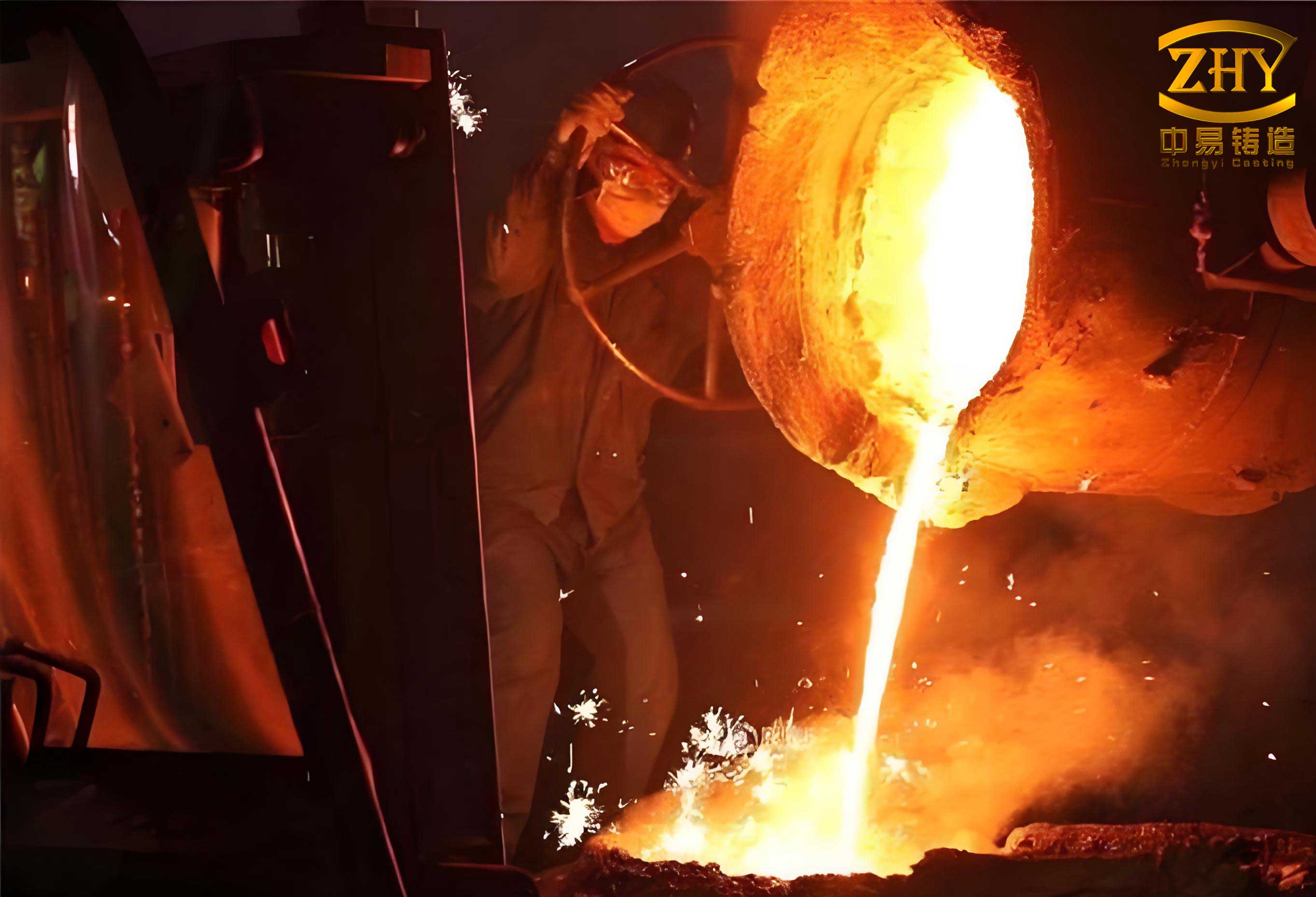
In sand casting, the initial step is to analyze the casting part. The timing gear housing is typically made of HT200 cast iron, with specifications for uniform wall thickness, smooth surface transitions, and absence of defects like porosity or inclusions. The technical requirements include a hardness range of 170–220 HB after aging treatment. To achieve this, I start by creating a three-dimensional rough model of the casting, accounting for factors such as shrinkage allowance, machining allowances, draft angles, and fillet radii. Using CAD software, I develop the model based on 2D drawings, ensuring that all sand casting parameters are integrated. For instance, the shrinkage rate for HT200 is set at 1%, as summarized in Table 1.
| Parameter | Value | Notes |
|---|---|---|
| Material | HT200 | Cast iron grade |
| Shrinkage Rate | 1% | Applied to all dimensions |
| Draft Angle | 1°–3° | For easy mold release |
| Fillet Radius (Unspecified) | 3–5 mm | To prevent stress concentration |
| Machining Allowance (Large Face) | 3 mm | For the gear cover mating surface |
| Machining Allowance (Small Features) | 2 mm | For holes and small加工 surfaces |
| Casting Weight | Approx. 15 kg | Estimated from model |
The design of the sand casting mold begins with the 3D rough model, which serves as the reference for creating the sand molds. In sand casting, the mold consists of two halves: the cope (upper) and drag (lower) sand molds. I use CAD software to generate these sand molds by defining a parting surface. Due to the geometry of the timing gear housing—particularly the mounting bosses—the parting surface must be stepped to facilitate mold opening. The process involves creating a workpiece block representing the sand mold and then splitting it into cope and drag sections. This step is critical in sand casting to ensure proper mold assembly and casting extraction.
Next, I design the metal molds that will produce these sand molds. In sand casting, metal molds are used to shape the sand into the desired cavity. The design includes features such as runners, gates, and venting systems. For the drag mold, I create a component assembly in CAD, where the drag sand mold is used to subtract material from a workpiece, forming the mold cavity. To compensate for potential misalignment, I add压拔缝 (flashing grooves) around the perimeter. The gate design is based on the casting weight and wall thickness, using formulas to determine the cross-sectional area. For sand casting, the gate area $A_g$ can be calculated using empirical formulas related to the casting weight $W$ and wall thickness $t$. A common approach is:
$$A_g = k \cdot \sqrt{W}$$
where $k$ is a coefficient dependent on the casting material and geometry. For cast iron with a wall thickness of 8 mm, $k$ is typically 0.6–0.8. Given the casting weight of 15 kg, the required gate area is approximately 2.5 cm². In this design, I use two gates, each with dimensions derived from this calculation. The runner system is designed as a trapezoidal channel to ensure smooth metal flow, a key aspect of sand casting efficiency. The dimensions are summarized in Table 2.
| Component | Dimensions | Cross-Sectional Area |
|---|---|---|
| Runner (Trapezoidal) | Top: 40 mm, Bottom: 30 mm, Height: 25 mm | 8.75 cm² |
| Each Gate | Length: 50 mm, Height: 5 mm | 2.5 cm² (total 5 cm² for two gates) |
| Pouring Cup | Diameter: 60 mm | 28.3 cm² |
The cope mold design follows similar principles but includes additional features like the runner and压拔缝. In sand casting, the cope mold often houses the pouring basin and sprue. The runner cross-sectional area $A_r$ is determined based on the casting weight and the desired filling time. Using the formula:
$$A_r = \frac{W}{\rho \cdot v \cdot t_f}$$
where $\rho$ is the metal density (7.2 g/cm³ for cast iron), $v$ is the flow velocity (assumed 0.5 m/s for sand casting), and $t_f$ is the filling time (set to 10 seconds for this casting). Plugging in the values:
$$A_r = \frac{15000 \text{ g}}{7.2 \text{ g/cm³} \cdot 50 \text{ cm/s} \cdot 10 \text{ s}} \approx 4.17 \text{ cm²}$$
This aligns with the designed runner area of 8.75 cm², providing a safety factor for efficient sand casting. The cope and drag molds are designed with locating pins for accurate alignment during mold assembly, a crucial step in sand casting to prevent casting defects.
Moving to manufacturing, the metal molds are fabricated from ductile iron (QT500-7) for durability. The process starts with pattern making: wooden patterns are created based on the 3D models, incorporating the shrinkage allowance. These patterns are used to produce sand castings of the mold blanks. The blanks are then machined on a CNC center to achieve the precise cavity shapes. The machining parameters are optimized for sand casting molds, considering factors like tool wear and surface finish. Key steps include rough milling, semi-finishing, and finishing, with cutting speeds and feeds adjusted based on the material. Table 3 summarizes the machining parameters.
| Operation | Cutting Speed (m/min) | Feed Rate (mm/rev) | Depth of Cut (mm) |
|---|---|---|---|
| Rough Milling | 120 | 0.3 | 2.5 |
| Semi-Finishing | 180 | 0.2 | 1.0 |
| Finishing | 250 | 0.1 | 0.5 |
During machining, I pay close attention to the clearance angles and fillet radii to ensure the sand molds can be easily released. After machining, the molds are assembled and tested for fit. In sand casting, trial runs are conducted to verify the mold performance, adjusting the gating system if necessary. The final molds are used in automated sand casting lines, where high-pressure molding produces consistent sand molds for casting.
Quality control is integral to sand casting. For the timing gear housing, I implement measures such as using chromite sand for core surfaces to prevent burning-on, and water glass sand for the mold to enhance strength. The coating application involves two layers of zircon-based paint to improve surface finish. During pouring, the temperature is controlled at 1350–1400°C, monitored with thermocouples. The solidification process is simulated using casting software to optimize riser design and eliminate shrinkage defects. The riser volume $V_r$ can be estimated using Chvorinov’s rule:
$$t = k \left( \frac{V}{A} \right)^2$$
where $t$ is solidification time, $V$ is volume, $A$ is surface area, and $k$ is a constant. For sand casting, risers are designed to solidify last, ensuring proper feeding. In this case, the riser dimensions are calculated to provide adequate metal supply, with a height increase of 10 mm to account for shrinkage.
The advantages of sand casting are further highlighted in the production of complex parts like timing gear housings. The ability to incorporate cores for internal features makes sand casting ideal for such components. I often use simulation software to analyze mold filling and solidification, reducing reliance on trial-and-error methods. For instance, the velocity of molten metal in the gate $v_g$ can be derived from Bernoulli’s equation:
$$v_g = \sqrt{2gh}$$
where $g$ is gravity and $h$ is the head height. In sand casting, this helps design gating systems for minimal turbulence. The Reynolds number $Re$ is also considered to ensure laminar flow:
$$Re = \frac{\rho v D}{\mu}$$
where $D$ is the hydraulic diameter and $\mu$ is the viscosity. For cast iron in sand casting, $Re$ should be below 2000 to avoid defects.
In summary, the design and manufacturing of metal molds for sand casting involve a systematic approach that balances geometric requirements with process constraints. From 3D modeling to CNC machining, each step is tailored to the nuances of sand casting. The timing gear housing example demonstrates how sand casting can achieve high-quality castings with efficient production. As sand casting technology advances, the demand for skilled mold designers continues to grow, underscoring the importance of mastering these techniques. Through this detailed exploration, I hope to provide valuable insights into sand casting mold design, encouraging further innovation in the field.
Looking ahead, sand casting will remain a cornerstone of manufacturing due to its adaptability and cost-effectiveness. Innovations in mold materials and simulation tools will enhance sand casting precision. By leveraging formulas and data-driven design, as shown in this article, engineers can optimize sand casting processes for diverse applications. I encourage practitioners to embrace these methods to push the boundaries of what sand casting can achieve, ensuring its relevance in modern industry.