
The production of high-integrity, thin-walled aluminum castings for demanding applications presents a significant challenge in foundry practice. Components such as rear cover frames, which are subject to high-intensity friction and thus require excellent surface finish, strength, and wear resistance, are prime examples. Sand casting remains a prevalent and cost-effective method for producing such components, especially in low-to-medium volume production runs. However, the inherent complexities of solidification in sections with varying wall thicknesses often lead to defects like shrinkage porosity and cavities, resulting in high scrap rates, extended production cycles, and increased costs. This article details a comprehensive methodology for the process design and optimization of a ZL101A (A356 equivalent) rear cover frame using sand casting, leveraging numerical simulation as a critical tool for virtual prototyping and defect prediction before physical trials.
Fundamentals of Sand Casting and Process Design
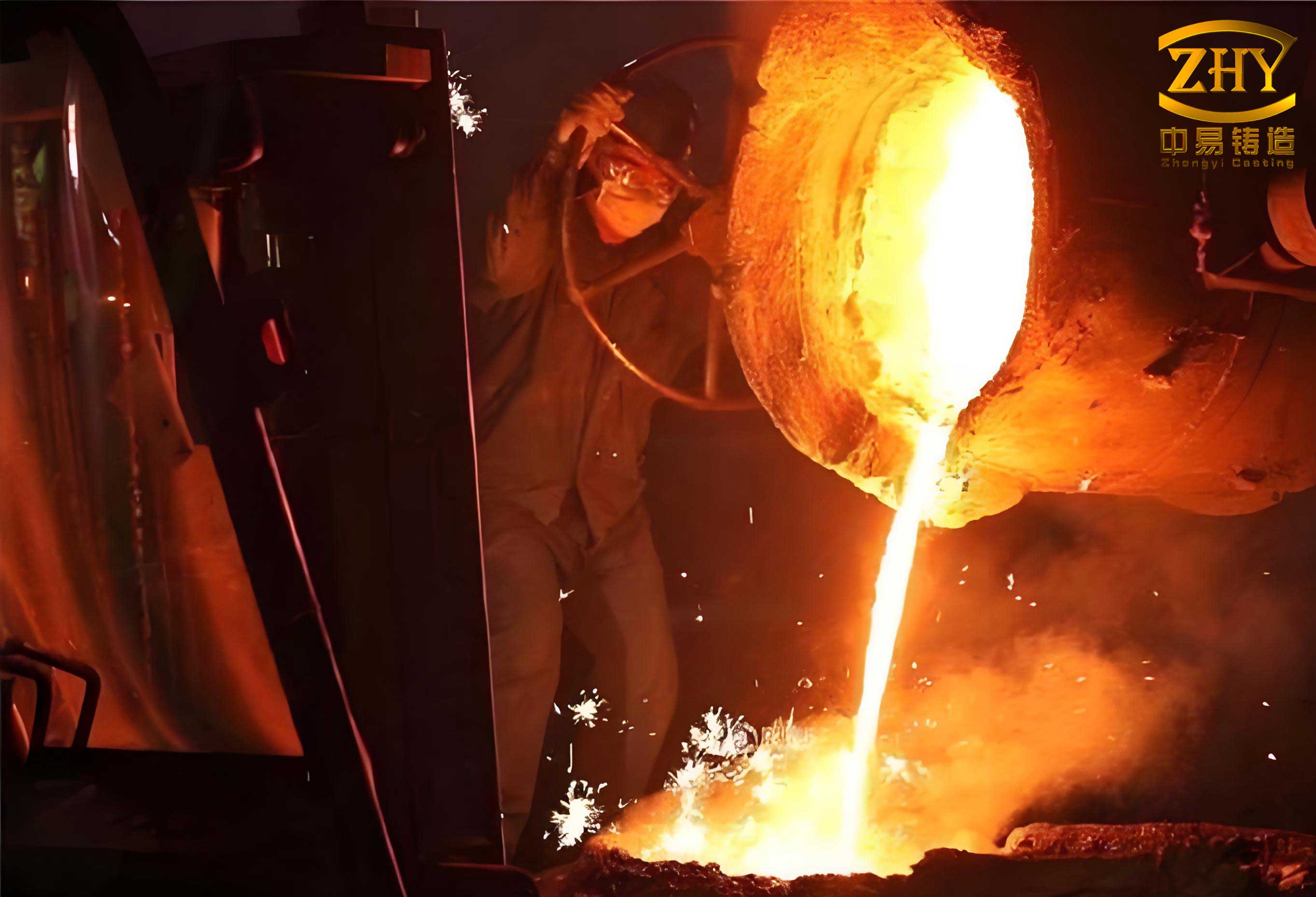
Sand casting is a versatile manufacturing process where molten metal is poured into a cavity formed within a sand mold. The mold is typically destroyed to remove the casting. The success of this process hinges on a well-designed casting process, which includes selecting the appropriate pouring position, parting line, gating system, and risering system to ensure sound castings.
For the subject rear cover frame, the material specified is ZL101A (Al-7Si-0.3Mg), chosen for its good castability, combination of strength, and wear resistance. The component’s geometry is relatively simple but features a thin-walled, shell-like structure with significant internal cavities. Key dimensions are approximately 400 mm x 195 mm x 125 mm, with wall thicknesses ranging from 3.5 mm to 6 mm. Small internal features like holes and grooves with diameters around 6 mm were deemed impractical to cast directly due to core-making complexity and potential for burn-in defects; these are therefore designed to be machined post-casting.
The primary objective of the initial process design is to achieve directional solidification, where the molten metal in the casting cavity solidifies from the areas farthest from the feed metal (risers) towards the risers themselves. This allows the risers, which remain liquid longest, to feed molten metal to compensate for the volumetric shrinkage that occurs during solidification. The first step involves determining the optimal pouring position and parting line. For this component, the largest flat surface (the base) was selected as the parting plane. This aligns the parting line with the chosen pouring position, simplifying mold construction and minimizing the need for complex cores or mold manipulations.
The design of the gating system is critical for controlling the melt flow during the filling stage. A bottom-gating system was employed. This design promotes a calm, non-turbulent fill by introducing metal at the bottom of the mold cavity, allowing it to rise steadily. This minimizes air entrapment, mold erosion, and oxide formation. The system consists of a downsprue (vertical channel), horizontal runners, and multiple ingates. The cross-sectional areas are calculated based on the principles of fluid mechanics and empirical ratios for aluminum sand casting. The choke area is typically at the bottom of the downsprue. The initial design used a gating ratio (Downsprue Area : Runner Area : Ingate Area) of 1 : 2 : 3.5, classifying it as a pressurized system which helps reduce air aspiration.
$$
\Sigma A_{choke} : \Sigma A_{runner} : \Sigma A_{ingate} = 1 : 2 : 3.5
$$
The total ingate area $\Sigma A_{ingate}$ can be estimated based on the desired fill time $t_f$, the effective metallostatic head $H$, and the casting weight $W$. An approximate formula is:
$$
\Sigma A_{ingate} \approx \frac{W}{\rho \cdot t_f \cdot C_d \cdot \sqrt{2gH}}
$$
Where:
$\rho$ is the liquid metal density (∼2400 kg/m³ for Al),
$C_d$ is the discharge coefficient (∼0.8 for ceramic/sand systems),
$g$ is the acceleration due to gravity (9.81 m/s²).
For a target fill time of ~7 seconds and a head height of ~0.2 m, the initial ingate area was calculated to be approximately 14 cm², distributed across 10 individual ingates.
Riser design follows the modulus method, where the riser’s solidification time must be greater than that of the casting region it is intended to feed. The modulus $M$ is defined as the volume $V$ to cooling surface area $A$ ratio ($M = V/A$). A riser should have a modulus about 1.2 times that of the hot spot it feeds. Initial risers (necked cylindrical) were placed at the two ends and the top center of the casting, targeting the thicker sections.
| Process Parameter | Initial Design Value |
|---|---|
| Pouring Temperature | 650 °C |
| Mold/Sand Initial Temperature | 25 °C |
| Gating Ratio (Sprue:Runner:Ingate) | 1 : 2 : 3.5 |
| Number of Ingates | 10 |
| Riser Type (Initial) | Conventional Top & Side Riser |
| Calculated Casting Weight | ~3.52 kg |
Numerical Simulation in Sand Casting: A Theoretical Foundation
Numerical simulation of the sand casting process involves solving the coupled equations governing fluid flow, heat transfer, and solidification. The core physics is described by the Navier-Stokes equations for incompressible, transient fluid flow with a free surface, coupled with the energy equation.
The momentum equation (Navier-Stokes) with the Boussinesq approximation for buoyancy is:
$$
\rho \left( \frac{\partial \vec{u}}{\partial t} + (\vec{u} \cdot \nabla) \vec{u} \right) = -\nabla p + \mu \nabla^2 \vec{u} + \rho \vec{g} \beta (T – T_{ref}) + \vec{S}
$$
The continuity equation for incompressible flow is:
$$
\nabla \cdot \vec{u} = 0
$$
The energy equation, encompassing latent heat release during solidification, is:
$$
\rho C_p \frac{\partial T}{\partial t} + \rho C_p \vec{u} \cdot \nabla T = \nabla \cdot (k \nabla T) – \rho L \frac{\partial f_s}{\partial t}
$$
Where:
$\vec{u}$ is the velocity vector,
$p$ is pressure,
$\rho$ is density,
$\mu$ is dynamic viscosity,
$\vec{g}$ is gravity vector,
$\beta$ is the thermal expansion coefficient,
$T$ is temperature, $T_{ref}$ is a reference temperature,
$\vec{S}$ is a momentum source term (e.g., for porous media in mushy zone),
$C_p$ is specific heat,
$k$ is thermal conductivity,
$L$ is latent heat of fusion,
$f_s$ is solid fraction.
The solidification morphology and defect prediction, particularly for shrinkage porosity, are often assessed using criteria functions. The Niyama criterion $N_y$, widely used for sand casting of aluminum alloys, is defined as:
$$
N_y = \frac{G}{\sqrt{\dot{T}}}
$$
Where $G$ is the temperature gradient at the solidus front and $\dot{T}$ is the cooling rate. Regions with a Niyama value below a critical threshold (empirically determined for the alloy and process) are predicted to be susceptible to microporosity. For macro shrinkage cavities, the thermal and fractional solid profiles are tracked to identify isolated liquid pools that cannot be fed.
In this study, the commercial software ViewCast was utilized. The process involves importing the 3D CAD model (converted to STL format), defining material properties (ZL101A for casting, silica sand for mold), setting boundary and initial conditions (pour temperature, mold preheat), and generating a computational mesh. A mesh of approximately 2 million elements was used to ensure a balance between accuracy and computational efficiency for this sand casting simulation.
Case Study: Initial Simulation, Defect Prediction, and Process Optimization
Using the initial sand casting process design described earlier, a numerical simulation was performed. The filling simulation showed a smooth, progressive fill from the bottom ingates, with the mold cavity filling completely in approximately 7 seconds without any predicted mistuns or excessive turbulence. This validated the basic design of the bottom-gating system for this thin-walled part.
The solidification simulation, however, revealed the limitations of the initial riser design. While a largely directional solidification pattern was observed—starting from the thin walls and progressing towards the thicker sections and finally the risers—the thermal analysis and shrinkage prediction algorithms flagged several problematic areas. Isolated hot spots were identified in the thicker wall sections adjacent to the internal cavities, particularly in the upper central region and the side walls. These regions solidified last but were not effectively fed by the conventional risers due to their limited feeding range and premature solidification. The simulation predicted a high probability of shrinkage porosity and potential micro-shrinkage cavities in these locations.
The feeding range $F_R$ of a riser in sand casting can be approximated for plate-like sections by:
$$
F_R \approx 4.5 \cdot \sqrt{T}
$$
Where $T$ is the plate thickness. For a 6mm section, $F_R$ is about 11 mm. The distances from the riser to the defective hot spots exceeded this effective range. Furthermore, the solidification modulus of the riser $M_r$ was insufficient relative to the modulus of the hot spot $M_h$ it needed to feed ($M_r < 1.2 \cdot M_h$).
To address these shortcomings, the process was optimized with two key modifications focused on enhancing feeding efficiency:
- Riser Enhancement: The central top riser was replaced with an insulating sleeve riser. An insulating riser liner reduces the heat loss rate from the riser, significantly extending its solidification time. This increases its effective feeding range and capacity. The diameter of this riser was also increased by 20% to further boost its volume and modulus.
- Riser Modulus Calculation: The modulus of the optimized riser was recalculated. For a cylindrical riser with diameter $D$ and height $H$, neglecting the top surface area if exothermic powder is used, the modulus is:
$$
M_r = \frac{V}{A} = \frac{\pi D^2 H / 4}{\pi D H + \pi D^2/4} = \frac{D H}{4H + D}
$$
By increasing $D$ and using an insulating sleeve (effectively reducing the heat extraction area $A$), the modulus $M_r$ was increased to meet the criterion $M_r \ge 1.2 \cdot M_h$.
| Design Aspect | Initial Design | Optimized Design | Rationale for Change |
|---|---|---|---|
| Central Top Riser | Conventional Sand Riser (Ø30×60 mm) | Insulated Sleeve Riser (Ø36×60 mm) | Increase feeding range & solidification time |
| Feeding Mechanism | Conductive Cooling | Reduced Heat Extraction | Promote directional solidification towards riser |
| Predicted Defects | Shrinkage in thick walls | Defects confined to risers | Improved thermal gradient control |
The optimized design was subjected to a new simulation cycle. The filling remained smooth. The solidification results showed a marked improvement. The thermal gradients now clearly directed solidification from the entire casting body towards the enhanced insulated riser. The Niyama criterion values throughout the casting were now above the critical defect-forming threshold. The shrinkage prediction model indicated that all potential shrinkage defects were successfully moved into the riser bodies, which are subsequently removed from the final part. The sand casting process was now virtually validated.
Extended Analysis: Sensitivity and Parametric Studies in Sand Casting
To further generalize the findings and provide deeper insight for sand casting practitioners, a sensitivity analysis of key process parameters can be conceptually explored based on the simulation methodology.
1. Effect of Pouring Temperature: Pouring temperature ($T_{pour}$) is a critical variable. A higher $T_{pour}$ increases the fluidity of the molten aluminum, which can benefit the filling of thin sections. However, it also increases the total heat content that must be removed, potentially coarsening the microstructure, increasing solidification shrinkage, and raising the risk of gas porosity. The thermal demand $Q_{total}$ on the mold can be expressed as:
$$
Q_{total} = \rho V [C_p (T_{pour} – T_{liquidus}) + L + C_{p,s} (T_{solidus} – T_{ambient})]
$$
Higher $Q_{total}$ can lead to slower solidification rates, affecting the Niyama criterion. An optimal $T_{pour}$ balances fillability with soundness.
2. Effect of Mold Preheat: While the initial condition used a cold mold (25°C), preheating the sand casting mold can be beneficial for very thin-walled parts to prevent mistuns. However, for this component with moderate thickness, mold preheat would uniformly slow down cooling, potentially negating the directional solidification goals and increasing the risk of shrinkage in unintended locations. The sensitivity of the defect location to mold temperature $T_{mold}$ can be significant.
3. Chilling Effects: An alternative or complementary strategy to risering is the use of chills. Metallic chills placed in the mold near thick sections can dramatically increase the local cooling rate, effectively creating a directional solidification front away from the chill and towards a riser. The effectiveness of a chill can be assessed by comparing the heat diffusivity $b = \sqrt{k \rho C_p}$ of the chill material (steel, copper) versus the sand mold. The interfacial heat transfer coefficient (IHTC) between the casting and the chill is also a crucial, often variable, parameter in simulation.
These parameters can be systematically varied in a simulation suite to create a process window for robust sand casting production. The results can be summarized in a parametric response table.
| Parameter Varied | Direction of Change | Primary Effect on Filling | Primary Effect on Solidification & Defects |
|---|---|---|---|
| Pouring Temperature | Increase | Improved Fluidity | Higher Shrinkage Risk, Coarser Grain |
| Mold Preheat Temperature | Increase | Reduced Mistun Risk | Slower Cooling, Poorer Directionality |
| Ingate Size/Number | Increase | Faster Fill, Higher Turbulence Risk | Minimal Direct Effect |
| Riser Insulation | Add/Improve | No Direct Effect | Greatly Improves Feeding Efficiency |
| Use of Chills | Add | No Direct Effect | Promotes Directional Solidification Locally |
Validation and Conclusion
Following the numerical optimization, the final sand casting process was implemented in a physical foundry. A batch of castings was produced using the optimized design featuring the insulated top riser. Non-destructive testing (X-ray radiography) of the production castings confirmed the simulation predictions: the internal shrinkage defects were eliminated, and the soundness of the casting was significantly improved. The mechanical properties of the cast components were tested and met all specified requirements for the application.
| Property | Test Result 1 | Test Result 2 | Test Result 3 | Specification Target |
|---|---|---|---|---|
| Tensile Strength (MPa) | 302 | 302 | 302 | >290 |
| Elongation (%) | 5.0 | 5.0 | 4.0 | >3.0 |
| Brinell Hardness (HBS) | 88.6 | 88.8 | 88.7 | >85 |
In conclusion, this work demonstrates a systematic, simulation-driven approach to optimizing the sand casting process for a complex aluminum alloy component. The traditional method of initial design was effectively augmented with numerical simulation, which accurately identified the root cause of potential defects—insufficient feeding range and capacity of conventional risers. The solution, involving the strategic use of an insulated riser to enhance feeding, was virtually tested and then physically validated, leading to a robust and economical sand casting process. This methodology significantly reduces the reliance on costly and time-consuming trial-and-error methods, shortens development cycles, minimizes scrap rates, and ensures higher quality in sand casting production. The principles of thermal gradient control, modulus-based riser design, and feeding range analysis, as validated by simulation, are universally applicable to a wide range of components manufactured via sand casting.