
In the field of industrial manufacturing, the production of high-quality casting parts is critical for equipment reliability and performance. Among these, pump covers for medium and large reciprocating pumps are essential components that operate under harsh conditions of high temperature and pressure. These casting parts must exhibit macroscopic integrity free from defects like shrinkage porosity and cavities, along with a dense internal microstructure to ensure leak-proof performance. However, due to their thick and uneven wall sections, such casting parts often face challenges during solidification, leading to defects that compromise their quality. In this article, I will explore the process design and optimization for these pump cover casting parts, leveraging simulation software to predict and mitigate defects, while focusing on improving yield and reducing material waste. The goal is to present a comprehensive analysis that enhances the production efficiency of casting parts, aligning with modern industrial demands for sustainability and cost-effectiveness.
The pump cover casting part discussed here is a large-scale component with a rotational symmetry design, resembling a circular disk. It features an outer diameter of 1,480 mm, a height of 559 mm, and a weight of approximately 3,200 kg. The wall thickness varies significantly, with maximum and minimum values of 228 mm and 6 mm, respectively. This non-uniformity, combined with the part’s substantial size, makes it prone to solidification-related defects. The casting part includes 14 ribs on the outer periphery and 36 small holes on the flange, which are not cast directly to simplify processing and ensure internal density. For such casting parts, the material selection plays a vital role in determining their performance. The alloy used is ZG15Cr12, a martensitic stainless steel, which offers good corrosion resistance but is susceptible to shrinkage during solidification due to its chemical composition. The table below summarizes the chemical composition of ZG15Cr12, highlighting elements that influence casting behavior.
| Element | Content (wt.%) |
|---|---|
| C | ≤ 0.15 |
| Mn | ≤ 0.8 |
| Si | ≤ 0.8 |
| Mo | ≤ 0.5 |
| Ni | ≤ 1.0 |
| P | ≤ 0.035 |
| S | ≤ 0.025 |
| Cr | 11.5–13.5 |
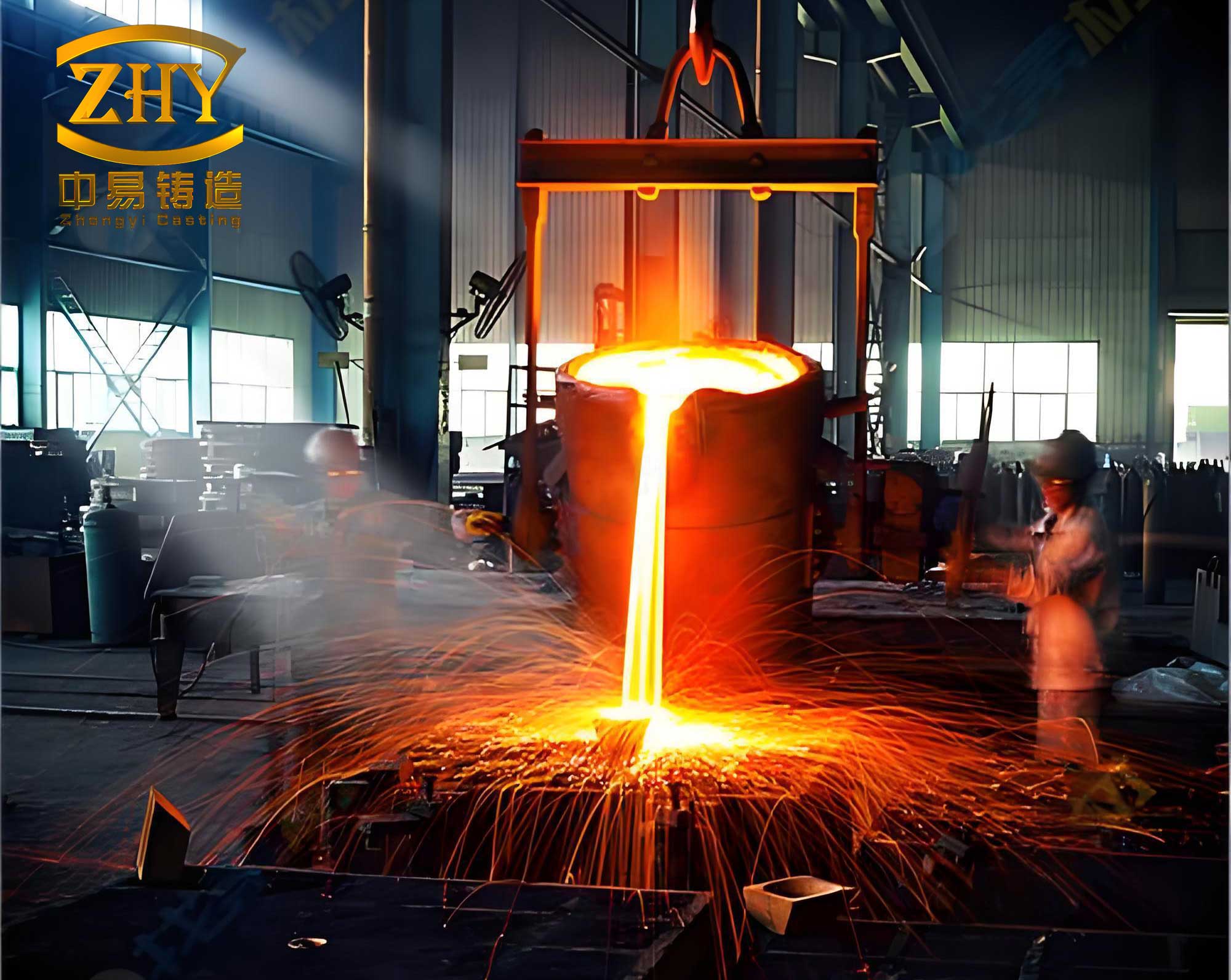
The presence of carbon and chromium in this alloy contributes to its solidification characteristics, often leading to volumetric shrinkage that must be managed through proper casting design. To visualize the complexity of such casting parts, consider the following image that illustrates a typical steel casting part with similar geometric features.
In the initial process design for these pump cover casting parts, a sand casting method was employed using wooden patterns and resin sand for molds and cores. The gating system was designed as a top-pouring type to facilitate directional solidification from bottom to top. This approach aimed to minimize defects by ensuring that thicker sections solidified last, allowing molten metal from risers to compensate for shrinkage. The original setup included a sprue with a diameter of 90 mm, a runner of 65 mm × 80 mm × 75 mm, and three ingates of 30 mm × 45 mm × 45 mm. Additionally, four rectangular open-top risers (referred to as 1# risers) were placed on the flange, each measuring 460 mm × 160 mm × 630 mm, and one cylindrical insulated open-top riser (2# riser) was positioned at the center of the flange, with dimensions of 170 mm × 210 mm × 410 mm and an insulation sleeve thickness of 25 mm. To enhance cooling at the bottom, 14 external chills were added, each with dimensions of R300 mm × 100 mm × 60 mm, corresponding to the rib locations. The mold and box sizes were 2,100 mm × 2,100 mm and 2,000 mm × 2,000 mm, respectively.
To analyze the effectiveness of this design, I used AnyCasting software to simulate the solidification process. The simulation revealed that while directional solidification was generally achieved, defects emerged in key areas. The solidification sequence showed that the bottom section and sprue top solidified first due to the chills and lower temperature. As solidification progressed, the gating system fully solidified, isolating the casting parts and risers into a closed system. However, thermal hotspots were identified at the central boss and flange areas, where the risers solidified before these regions, leading to insufficient feeding. This resulted in isolated liquid pools and predicted shrinkage defects. The probability defect parameter map based on residual melt modulus indicated high risks of shrinkage porosity in these hotspots, confirming the need for optimization.
The defects in the original process for these casting parts can be attributed to improper riser design and inadequate cooling. Specifically, the riser moduli were smaller than those of the casting parts’ hot spots, causing premature solidification. The modulus ratio is a critical factor in riser design, given by:
$$ M = \frac{V}{A} $$
where \( M \) is the modulus (cooling rate factor), \( V \) is the volume, and \( A \) is the surface area. For effective feeding, the riser modulus should exceed that of the casting part’s section it feeds. In this case, the original risers had moduli that were too low, calculated as:
$$ M_{\text{riser}} < M_{\text{casting}} $$
leading to inadequate compensation. To address this, I optimized the original process by increasing the size of the rectangular risers to 480 mm × 170 mm × 690 mm and replacing the cylindrical insulated riser with a exothermic insulated riser to enhance feeding efficiency. Additionally, a conformal chill was added at the central boss, with dimensions of R224 mm × 30 mm, to improve cooling and reduce thermal gradients. These changes aimed to ensure that risers solidified after the casting parts, providing sufficient molten metal for shrinkage compensation.
After optimization, the simulation showed a improved solidification pattern. The casting parts solidified directionally from bottom to top, with no isolated liquid regions. The risers remained liquid longer than the hot spots, effectively transferring metal to critical areas. The defect parameter map confirmed that shrinkage defects were eliminated from the casting parts and shifted to the risers, indicating a successful optimization. However, the process yield, defined as the ratio of casting weight to total poured weight, was calculated to be only 45%. This low yield is inefficient for casting parts production, as it increases material costs and waste, contradicting sustainable manufacturing goals. The yield can be expressed as:
$$ \text{Yield} = \frac{W_{\text{casting}}}{W_{\text{total}}} \times 100\% $$
where \( W_{\text{casting}} \) is the weight of the casting part and \( W_{\text{total}} \) includes the casting, risers, and gating system. For the optimized original process, this yielded 45%, prompting the need for a new design to improve efficiency.
To achieve higher yield while maintaining quality, I developed a new process design for these pump cover casting parts. This approach involved flipping the casting orientation, with the flange face downward, and using a bottom-pouring gating system to promote better temperature control. The gating system consisted of a sprue with an 80 mm diameter, a runner, and three ingates evenly distributed on the flange bottom. For feeding, one cylindrical open-top riser (1# riser) was placed at the central boss, sized at 300 mm × 400 mm × 550 mm, and six rectangular open-top risers (2# risers) were arranged on the top face, each measuring 195 mm × 130 mm × 430 mm, to address hot spots at the ribs. Six external chills were added on the flange, with dimensions of R400 mm × 210 mm × 150 mm, avoiding the ingate locations. This design aimed to enhance directional solidification and riser efficiency for these complex casting parts.
Simulation of the new process revealed a solidification sequence where the flange and gating system solidified first, followed by gradual cooling upward. However, hotspots persisted at the central boss and top face, leading to predicted shrinkage defects. The risers in this setup were found to provide insufficient feeding due to the large radial size of the casting parts and inadequate riser moduli. The defect parameter map highlighted risks in these areas, similar to the original process. To optimize this, I modified the design by converting the cylindrical riser into an insulated riser with a 30 mm thickness, calculated using the modulus criterion \( M_R = 1.2 M_C \), where \( M_R \) is the riser modulus and \( M_C \) is the casting modulus. Additionally, the number of rectangular risers was increased from six to seven, evenly distributed, to improve feeding coverage. These adjustments ensured that risers remained liquid longer, effectively compensating for shrinkage in the casting parts.
The optimized new process simulation demonstrated a robust solidification pattern, with the casting parts solidifying before the risers and no defects in critical areas. The defect parameter map showed that shrinkage was confined to the risers, confirming a high-quality outcome for the casting parts. The process yield for this optimized design was calculated as 62%, a significant improvement over the previous 45%. This increase not only reduces material usage but also enhances production efficiency for casting parts. The table below compares key parameters between the optimized original and new processes, emphasizing the benefits of the new design.
| Parameter | Optimized Original Process | Optimized New Process |
|---|---|---|
| Gating System Type | Top-pouring | Bottom-pouring |
| Number of Riser | 5 (4 rectangular + 1 cylindrical) | 8 (7 rectangular + 1 cylindrical) |
| Riser Modulus Ratio | Adjusted with exothermic riser | \( M_R = 1.2 M_C \) for insulated riser |
| Chill Configuration | 14 external + 1 conformal | 6 external on flange |
| Solidification Sequence | Directional from bottom to top | Directional from flange to top |
| Defect Prediction | Defects in risers only | Defects in risers only |
| Process Yield | 45% | 62% |
| Material Efficiency | Lower due to higher riser volume | Higher with reduced waste |
The improvement in yield can be quantified using the yield formula, where for the new process, the total weight is optimized through better riser design. The relationship between riser volume and casting volume is critical, often expressed as:
$$ V_{\text{riser}} = k \cdot V_{\text{casting}} \cdot \beta $$
where \( k \) is a safety factor, and \( \beta \) is the shrinkage factor. By minimizing \( V_{\text{riser}} \) while ensuring adequate feeding, the yield increases. In this case, the new process achieved a 17% boost in yield, demonstrating its advantage for producing casting parts efficiently.
To validate the optimized new process, it was implemented in an industrial setting. The produced pump cover casting parts underwent a hydrostatic pressure test at 15 MPa for 30 minutes, showing no leaks or cracks, confirming their integrity. This practical success underscores the effectiveness of simulation-driven optimization for complex casting parts. The ability to predict and eliminate defects while improving yield highlights the importance of advanced tools in modern foundry practices. For casting parts like these, such optimizations not only ensure quality but also contribute to cost savings and environmental sustainability by reducing material consumption.
In conclusion, the design and optimization of process for medium and large reciprocating pump cover casting parts require careful consideration of solidification dynamics and riser efficiency. Through simulation with AnyCasting, I identified defects in the original process and implemented optimizations that improved quality but yielded a low process yield of 45%. By redesigning the process with a bottom-pouring system and enhanced riser configuration, I achieved a higher yield of 62% while maintaining defect-free casting parts. This approach demonstrates how iterative simulation and modular analysis can transform the production of casting parts, leading to more sustainable and efficient manufacturing. The key lessons include the importance of modulus matching, strategic chill placement, and riser design for feeding, all of which are essential for high-quality casting parts in demanding applications.